
Le Hoang Da
Buddhist Scholar
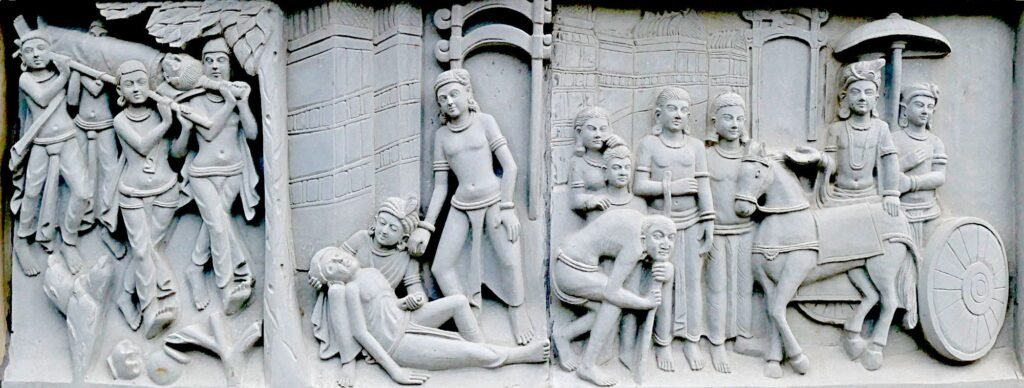
Figure 1: Relief depicting three of the Four Sights—old age, sickness, and death—at Mahabodhi Vihara, Hyderabad. Source: Wikimedia Commons. Photograph by Anandajoti Bhikkhu.
I. Introduction: The Four Sights and the Turning Point in the History of Awakening
In Buddhist tradition, the story of Prince Siddhartha’s four excursions beyond the city gates—commonly known as the “Four Sights”—is regarded as one of the decisive moments in the entire biography of the Buddha. According to this well-known narrative, when leaving the palace of Kapilavastu the prince successively encountered an old man, a sick person, a corpse, and finally a wandering ascetic. These images shattered the worldview carefully constructed within the sheltered life of the royal court, where every sign of suffering had been deliberately concealed. Confronted with the realities of aging, illness, and death, the prince came to recognize the fragility of existence and began to turn his mind toward the path of liberation symbolized by the figure of the ascetic.
This story is recounted in considerable detail in Buddhist biographical traditions that developed after the early canonical period. One important source is the Lalitavistara Sūtra, where the Bodhisattva’s encounters with the four sights are presented as revelatory moments that unsettle the worldview of a prince raised in luxury and security. Similarly, the Buddhist epic Buddhacarita portrays these four encounters as psychological turning points that lead the Bodhisattva to abandon royal life in search of liberation. Within the Theravāda tradition, the narrative is further systematized in the Nidānakathā, where the four sights appear as decisive signs that precipitate the Bodhisattva’s renunciation of worldly life.
It is noteworthy, however, that the Nikāya texts do not present this story as a fully developed narrative sequence in the same way as these later biographies. Instead, discourses such as the Ariyapariyesanā Sutta describe the Buddha’s decision to renounce the world in a more direct and existential manner. In these texts, the Bodhisattva reflects that he himself, like all beings, is subject to birth, aging, sickness, and death, and thus begins the search for what is unborn, unaging, and deathless. This difference suggests that the motif of the “Four Sights” may be understood as a narrativization of insights concerning suffering that were already present in early Buddhist thought.
The significance of this story is not confined to textual traditions. In ancient Buddhist art, moments associated with the four sights and the Bodhisattva’s renunciation were also depicted in narrative reliefs at major Buddhist centers such as the stūpas of Bharhut, Gandhāra, and Amarāvatī. The presence of these scenes within the sculptural programs of these monuments indicates that early Buddhist communities regarded them as visual symbols of a spiritual turning point, marking the transition from worldly life to the quest for liberation.
At the same time, within the Mahāyāna tradition, Nirvāṇa is sometimes described through the doctrine known as the “Four Virtues of Nirvāṇa”: permanence (常), bliss (樂), self (我), and purity (淨). This conceptual framework is articulated most clearly in the Mahāparinirvāṇa Sūtra. These qualities are not intended to affirm a personal self in the ordinary sense; rather, they function as a philosophical language used to describe the liberated reality that transcends all conditions of saṃsāra.
From this perspective, the story of the Four Sights can be reread in a different light. If Nirvāṇa in Mahāyāna thought is described through permanence, bliss, self, and purity, then the scenes witnessed by Prince Siddhartha—aging, sickness, death, and the figure of the spiritual seeker—appear to reveal the opposite qualities within the world of saṃsāra. In other words, the Four Sights may be understood as a negative mirror of Nirvāṇa: they expose the fragility, suffering, and instability of conditioned existence, thereby highlighting the horizon of liberation that Buddhist tradition calls Nirvāṇa.
This article examines the story of the Four Sights across Buddhist traditions while placing it in dialogue with the Mahāyāna doctrine of the Four Virtues of Nirvāṇa. Through a combined analysis of textual sources, philosophical interpretation, and early Buddhist art, the study proposes that the Four Sights can be understood as a symbolic structure of saṃsāra, while the Four Virtues of Nirvāṇa articulate the philosophical horizon of liberation that transcends that structure. In this way, the familiar story of Prince Siddhartha’s encounters with aging, sickness, death, and the ascetic can be read not merely as a biographical episode, but as a philosophical map of suffering and the possibility of liberation in Buddhist thought.
II. The Narrative of the Four Sights in Buddhist Tradition
The story of the Four Sights—old age, sickness, death, and the ascetic—has become one of the most well-known motifs in the biographies of the Buddha. In these narratives, Prince Siddhartha is portrayed as a royal heir who grew up within the carefully protected environment of the palace. According to tradition, King Śuddhodana sought to conceal from the prince every image of suffering, because prophecies had foretold that his son would either become a universal monarch (cakravartin) or renounce the world to become an awakened one. For this reason, the palace of Kapilavastu was constructed as a world of youth, health, and pleasure, where the harsh realities of human existence were kept hidden from the prince’s sight.
Nevertheless, according to Buddhist biographical accounts, during several excursions beyond the city gates Prince Siddhartha successively encountered four sights that he had never seen before. These encounters are described as profound cognitive shocks that unsettled the entire worldview of someone raised in luxury and security. The sequence of the sights is not accidental; rather, it forms a gradual process of realization concerning the nature of existence within the world of saṃsāra.
The first sight was that of an old man. Upon seeing a body trembling with age, hair turned white, and a frail figure walking with difficulty, Prince Siddhartha asked his charioteer about the condition of the man. When he was told that this was the natural consequence of aging and that all human beings are inevitably subject to it, the prince began to realize that the youth and beauty of palace life were only temporary. The appearance of old age shattered the illusion of a stable and enduring life, opening the prince’s first awareness of the impermanent nature of human existence.
The second sight was that of a sick person. Unlike the gradual decline associated with aging, illness appeared as an unexpected disruption of the body. When the prince saw a person tormented by pain, physically weakened and unable to control his own body, he realized that even a healthy body could be broken by forces beyond human control. This image confronted him directly with the reality of suffering inherent in finite existence.
The third sight was that of a corpse being carried in a funeral procession. If old age and sickness reveal the weakening of life, death exposes the ultimate limit of conditioned existence. When he learned that death is the common fate of all living beings, Prince Siddhartha realized that everything human beings accumulate—power, wealth, or youth—ultimately cannot prevent the dissolution of the body. In many biographies, this moment is portrayed as a profound shock, when the prince faced the reality that all finite lives inevitably move toward cessation.
After witnessing these three images, the prince began to reflect deeply on the nature of human existence. Yet during a subsequent excursion he encountered a wandering ascetic—someone who had renounced worldly life in search of truth. Unlike the previous sights, which evoked decay and suffering, the image of the ascetic conveyed an entirely different impression. In many narratives, the ascetic is described as serene, composed, and inwardly free. When the prince inquired about the path followed by such a person, he was told that it was the path of those who abandon worldly life in order to seek liberation from the cycle of birth and death.
At this point, the narrative structure reaches its completion. The first three sights—old age, sickness, and death—expose the fragile nature of existence within saṃsāra. The fourth sight—the ascetic—opens the possibility of transcending that condition. Thus the Four Sights are not merely a sequence of random events; they form a structured process of realization, moving from the discovery of suffering in life to the appearance of a path of liberation.
In many Buddhist traditions, this series of experiences ultimately leads to Prince Siddhartha’s famous decision to leave the palace of Kapilavastu and enter the life of renunciation. This event is commonly known as the Mahābhiniṣkramaṇa, often translated in modern scholarship as “the Great Renunciation.” It is not merely an act of abandoning royal privilege, but a decision with profound philosophical significance: the renunciation of a world defined by power and pleasure in order to begin the search for truth concerning suffering and liberation.
For this reason, the Four Sights may be understood as the initial stage of the process of awakening, where the recognition of suffering becomes the driving force behind the search for liberation. Taken together, they form a condensed picture of the existential condition of human beings: the decline of the body, the instability of life, and the inevitability of death. Accordingly, in Buddhist tradition this story is often interpreted as a symbol of the Bodhisattva’s first awakening to the nature of saṃsāra.
From this perspective, the Four Sights do not merely recount an episode in the life of the Buddha. They reveal the fundamental problem that Buddhist teaching seeks to address: the suffering inherent in conditioned existence. This realization becomes the foundation for the entire subsequent journey of the Bodhisattva. Confronted with the realities of aging, sickness, and death, Prince Siddhartha begins to search for a path that transcends these conditions—a path symbolized by the figure of the ascetic. From this starting point, the Bodhisattva’s quest for truth eventually leads to awakening beneath the Bodhi tree, where the problem of saṃsāra is resolved through liberating wisdom.
III. The Existential Structure of Saṃsāra
If read simply as a biographical episode, the Four Sights may be understood as a series of events that led Prince Siddhartha to his decision to renounce the world. Yet when examined more closely, this sequence of images appears to contain a condensed existential structure of saṃsāra. The first three sights—old age, sickness, and death—are not merely isolated occurrences within human life, but fundamental manifestations of conditioned existence itself. The fourth sight—the ascetic—suggests the possibility of transcending this structure. In this sense, the Four Sights may be interpreted as a philosophical map of the existential problem that Buddhist teaching seeks to address.
The sight of the old man first reveals the principle of impermanence (anitya) inherent in life. Youth and strength are often regarded as signs of stability, yet the image of a body weakened by time demonstrates that every form of existence unfolds within a process of transformation. In Buddhist thought, impermanence is not merely the superficial change of things; it is the fundamental characteristic of all conditioned phenomena. Whatever arises must eventually pass away. Thus the appearance of old age in the narrative is not simply a biological fact, but a disclosure of the universal law governing the entire phenomenal world.
The sight of a sick person exposes another dimension of existence: the instability and suffering (duḥkha) inherent in finite life. While old age represents a gradual decline over time, illness manifests as a sudden disruption of the body. A healthy body can be shattered by forces beyond human control. In many Buddhist texts, the body is described as a composite of conditions that are constantly changing and easily disturbed. The image of sickness therefore evokes not only personal pain but also the inherent vulnerability of conditioned existence.
The third sight—a corpse—brings this realization to its extreme point. If old age and illness reveal the weakening of life, death represents the termination of the entire process of individual existence. Within the context of the story, confronting death destroys the illusion that human life can be maintained indefinitely. Everything accumulated in life—power, wealth, or reputation—ultimately cannot overcome the limit imposed by death. The sight of the corpse thus reveals the fragility and uncertainty of individual existence within the cycle of saṃsāra.
Taken together, these first three sights form a coherent picture of the conditions of life within saṃsāra. Old age reveals the gradual decline of the body over time; illness demonstrates the instability of embodied existence; and death marks the final limit of personal life. These three elements reflect three fundamental dimensions of existential experience: constant change, the suffering inherent in finite existence, and the ultimate dissolution of all personal structures.
Within this context, the fourth sight—the ascetic—appears as a symbolic contrast. If the first three images expose the bondage of human beings within saṃsāra, the image of the renunciant suggests the possibility of liberation from that bondage. The ascetic represents those who abandon worldly life in order to seek a path beyond aging, sickness, and death. Thus within the structure of the narrative, this figure is not merely a biographical detail but a symbol of the possibility of transcending saṃsāra.
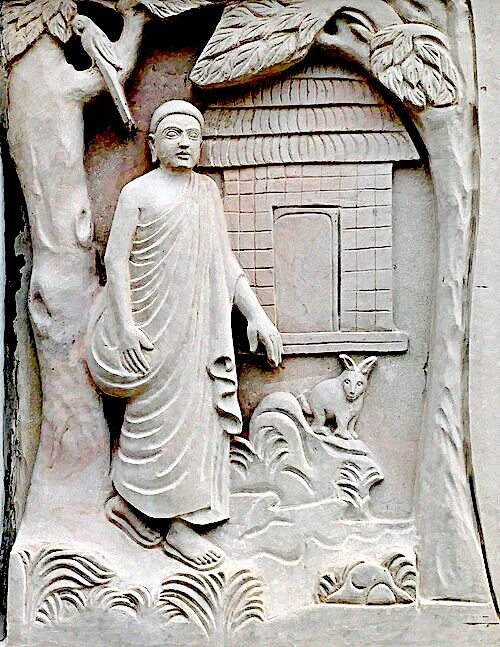
Figure 2: Relief depicting the Bodhisattva encountering the fourth sign—an ascetic who has renounced worldly life—at Mahabodhi Vihara, Hyderabad. Source: Wikimedia Commons. Photograph by Anandajoti Bhikkhu.
Seen in this way, the Four Sights are more than images that simply impressed a young prince. They form a philosophical sequence of realization: from the discovery of the fragility of life to the recognition that it may be transcended. The first three sights reveal the fundamental problem of existence within saṃsāra, while the final sight points toward the path of liberation.
For this reason, the Four Sights can be understood as a symbolic map of existential experience. They do not merely depict isolated events in human life but reveal the deeper structure of the condition that Buddhism calls saṃsāra. It is precisely from this recognition that the Bodhisattva Siddhartha’s quest for truth begins. Realizing that every form of existence within saṃsāra is governed by impermanence, suffering, and dissolution, the Bodhisattva begins to search for a reality that transcends these conditions—a reality that Buddhist tradition later calls Nirvāṇa.
IV. The Doctrine of the Four Virtues of Nirvāṇa in Mahāyāna Thought
If the first three sights—old age, sickness, and death—reveal the fundamental characteristics of existence within the world of saṃsāra, then within the Mahāyāna tradition Nirvāṇa is sometimes described through another conceptual framework, commonly known as the “Four Virtues of Nirvāṇa”: permanence (常), bliss (樂), self (我), and purity (淨). This doctrine is articulated most clearly in the Mahāparinirvāṇa Sūtra, where Nirvāṇa is portrayed not merely as the cessation of suffering but as a reality endowed with positive qualities that transcend all conditions of saṃsāra.
Within the philosophical context of this scripture, these four qualities should not be understood in their ordinary worldly sense. They are not intended to affirm the existence of an eternal entity within the phenomenal world, nor are they meant to negate the fundamental teachings of early Buddhism. Rather, they function as a paradoxical philosophical language used to express the liberated reality that lies beyond the familiar categories of saṃsāric experience.
The first quality is “permanence” (常). In the world of saṃsāra, all conditioned phenomena are governed by the processes of arising and dissolution. Every form of existence unfolds within the stream of impermanence. When Nirvāṇa is described as “permanent,” this does not mean that it is an enduring entity existing within time. Instead, permanence refers to a reality that is no longer subject to the processes of arising and ceasing that characterize conditioned phenomena. It signifies the dimension of the unconditioned (asaṃskṛta)—a state that transcends the operations of temporal change.
The second quality is “bliss” (樂). Within the experience of saṃsāra, human life is inseparable from suffering (duḥkha). Suffering appears not only in the form of physical pain or psychological distress; it also manifests in the fundamental dissatisfaction inherent in all finite conditions. Even the moments of pleasure in life are unstable and often lead to disappointment. When Nirvāṇa is described as “bliss,” it does not refer to worldly pleasure, but to a state of peace that transcends every form of suffering associated with saṃsāra—a tranquil condition in which all conflict and dissatisfaction have ceased.
The third quality—“self” (我)—is perhaps the most controversial element within this doctrine. In early Buddhism, the teaching of non-self (anātman) is regarded as one of its central principles: all phenomena of body and mind are conditioned processes, and no permanent self exists beneath them. For this reason, the use of the term “self” to describe Nirvāṇa in Mahāyāna texts might appear to reverse the doctrine of non-self. Yet within the context of the scripture, “self” does not refer to the personal ego of ordinary experience. Rather, it functions as a paradoxical expression intended to indicate the ultimate reality that transcends the structures of the empirical self. In other words, the “self” of Nirvāṇa is not the ego of worldly experience, but a symbolic way of pointing toward a reality that lies beyond all conceptual constructions of identity.
Finally, Nirvāṇa is described through the quality of “purity” (淨). Within saṃsāra, human life is shaped by numerous defilements and psychological impurities—greed, hatred, delusion, and other disturbances of the mind. These factors obscure the experience of existence with ignorance and attachment. When Nirvāṇa is called “pure,” it refers to a state of complete purity in which all defilements of the mind have been entirely extinguished. This is not purity in a merely moral sense, but the radical purity of a reality no longer conditioned by ignorance.
Taken together, the four qualities—permanence, bliss, self, and purity—form a synthetic description of Nirvāṇa as a reality that transcends all conditions of saṃsāra. They are not intended to construct a new metaphysical system opposed to the early Buddhist teachings of impermanence, suffering, and non-self. Rather, they represent a philosophical attempt to describe liberated reality in positive language, instead of portraying it solely as the cessation of suffering.
Within this context, the doctrine of the Four Virtues of Nirvāṇa becomes an important point of reference for rereading the story of the Four Sights. If the Four Sights reveal the fundamental characteristics of existence within saṃsāra, then the Four Virtues of Nirvāṇa describe the horizon of liberation that transcends those characteristics. In this way, the two systems of imagery—one belonging to the biography of the Buddha and the other to Mahāyāna philosophy—can be placed side by side as two different expressions of the same fundamental issue: the contrast between the condition of saṃsāra and the reality of liberation.
V. The Negative Mirror: Re-reading the Four Sights in Light of the Four Virtues of Nirvāṇa
If the Four Sights are understood as a symbolic map of the condition of existence within saṃsāra, then the Mahāyāna doctrine of the Four Virtues of Nirvāṇa describes the horizon of liberation that transcends that condition. In the Mahāparinirvāṇa Sūtra, Nirvāṇa is characterized through four qualities: permanence (常), bliss (樂), self (我), and purity (淨). These terms are not intended to affirm a personal self in the ordinary sense; rather, they function as a philosophical language designed to express a liberated reality that lies beyond all conditions of saṃsāra.
When these two systems of imagery are placed side by side, a striking symmetrical structure begins to emerge. The sights witnessed by Prince Siddhartha when leaving the city gates appear to reveal the negative counterpart of the qualities attributed to Nirvāṇa. If Nirvāṇa is described through permanence, bliss, self, and purity, then the scenes of aging, sickness, death, and the life of renunciation disclose the opposite characteristics of existence within the world of saṃsāra.
First, the sight of the old man reveals the impermanent nature of the body. Youth and strength are not stable states but only temporary phases within the process of bodily transformation. The image of a body weakened by time demonstrates that all conditioned phenomena exist within the flow of arising and passing away. By contrast, in Mahāyāna thought Nirvāṇa is described through the quality of permanence (常)—not as an immutable entity within the phenomenal world, but as a reality that transcends the processes of arising and ceasing characteristic of conditioned phenomena. Thus, if old age exposes the fragility of existence within time, the permanence of Nirvāṇa signifies a dimension that lies beyond the dominion of time.
The sight of the sick person further expands this realization by exposing the suffering inherent in finite existence. Illness demonstrates that the body not only declines over time but can also be disrupted by conditions beyond human control. The body becomes a site where pain and instability may arise at any moment. In contrast, Nirvāṇa in Buddhist scriptures is often described as bliss (樂)—a state of peace no longer governed by the suffering of saṃsāra. This contrast shows that if illness reveals the suffering inherent in conditioned life, the bliss of Nirvāṇa represents the cessation of all forms of suffering bound to finite existence.
The third sight—death—brings the awareness of existential fragility to its extreme point. Death reveals that all personal structures ultimately move toward dissolution. When the body ceases, the forms of individual life also come to an end. From the perspective of early Buddhist philosophy, this dissolution demonstrates that no permanent self exists beneath the processes of body and mind. Yet in Mahāyāna thought Nirvāṇa is sometimes described using the term “self” (我)—a paradoxical expression intended to indicate the ultimate reality that transcends the constructed identity of the empirical self. Thus, if death exposes the dissolution of personal structures within saṃsāra, the “self” of Nirvāṇa points to a dimension of reality no longer subject to the arising and dissolution of those structures.
Finally, the image of the ascetic appears as a sign of redirection. While the first three sights reveal the human condition bound within saṃsāra, the image of one who renounces worldly life suggests the possibility of purification and liberation from those conditions. In Buddhist biographies, the ascetic is often portrayed as serene and composed, embodying a life directed toward the eradication of defilements. In the doctrine of the Four Virtues of Nirvāṇa, the final quality—purity (淨)—likewise signifies the complete purity of liberated reality, where all defilements of greed, hatred, and delusion have been fully extinguished.
From this perspective, the Four Sights may be understood as the negative mirror of Nirvāṇa. They reveal the characteristics of existence within saṃsāra—impermanence, suffering, the dissolution of personal structures, and the impurity of conditioned life. By contrast, the doctrine of the Four Virtues of Nirvāṇa describes liberated reality as permanence, bliss, self, and purity, qualities that signify a dimension beyond the conditions of saṃsāra.
It is important to emphasize, however, that this interpretation does not contradict the fundamental Buddhist teaching of the Three Marks of Existence—suffering (duḥkha), impermanence (anitya), and non-self (anātman). Rather, it can be understood as a symbolic expression of that very teaching. The first three sights witnessed by Prince Siddhartha—old age, sickness, and death—successively reveal the basic characteristics of existence within saṃsāra: the constant transformation of the body, the suffering inherent in finite life, and the ultimate dissolution of all personal structures. In this sense, the story of the Four Sights may be read as a narrativization of the Three Marks of Existence. What appears in the scriptures as philosophical principles is here expressed through concrete images drawn from human experience.
Seen in this light, the Four Sights are not merely a biographical episode in the life of the Buddha, but a visual symbol of the fundamental truths affirmed by Buddhist teaching about the nature of existence. When placed alongside the doctrine of the Four Virtues of Nirvāṇa, they form a clear structure of contrast: one reveals the conditions of saṃsāra, the other describes the horizon of liberation. Thus the story of Prince Siddhartha’s encounters may be read not only as a biographical anecdote, but also as a philosophical diagram of saṃsāra and liberation within Buddhist thought.
VI. The Four Sights in Early Buddhist Art
Up to this point, the analysis of the Four Sights has relied primarily on textual sources and philosophical interpretation. Yet the importance of this motif within the Buddhist tradition is not confined to biographical narratives or canonical texts. Archaeological discoveries indicate that the story of the Four Sights and Prince Siddhartha’s renunciation also occupied a prominent place in ancient Buddhist art. Narrative reliefs at major Buddhist centers demonstrate that these moments were early transformed into visual symbols, carved onto stūpas and stone railings as part of religious artistic programs.
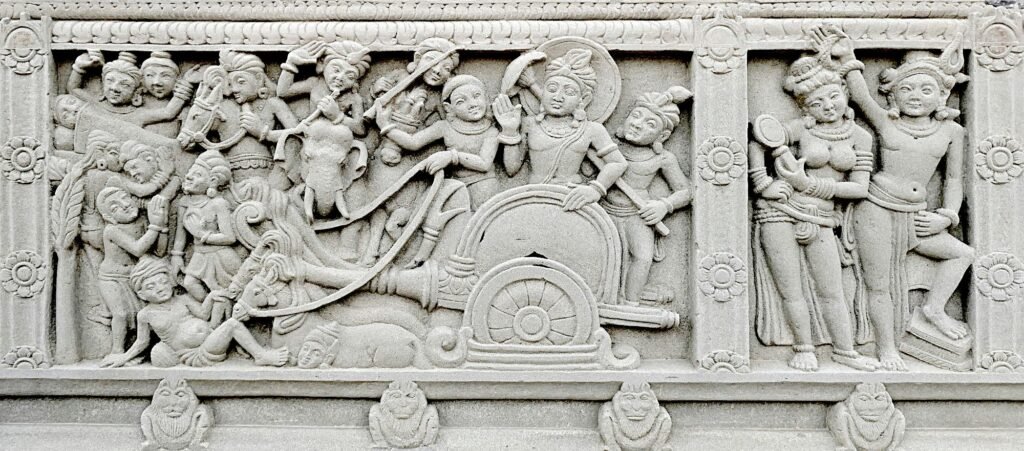
Figure 3: Relief depicting the Bodhisattva encountering the signs of aging, sickness, and death at Mahabodhi Vihara, Hyderabad. Soucre: Wikimedia Commons. Photograph by Anandajoti Bhikkhu.
One of the most significant sites from this period is the Bharhut Stupa, a monument dating to approximately the second century BCE. At Bharhut, reliefs on the stūpa railings frequently depict stories related to the life of the Buddha and his previous births. A distinctive feature of the art of this period is its symbolic or aniconic character: the Buddha is often not represented in human form but suggested through symbols such as an empty throne, footprints, or the Bodhi tree. Within this context, scenes related to Prince Siddhartha’s Great Departure (Mahābhiniṣkramaṇa) are represented through symbolic images such as the horse Kanthaka, the royal parasol, or the retinue leaving the city of Kapilavastu. Although these reliefs do not always portray the Four Sights individually, they demonstrate that the narrative of the prince’s renunciation had already become an important theme in Buddhist art at an early stage.
In later centuries, particularly in the region of Gandhāra, this motif was depicted with greater narrative detail. Gandhāran art, influenced by Greco-Roman artistic traditions, developed a style of storytelling through continuous narrative friezes. In many sculptures from this region, episodes from the Buddha’s life are arranged in sequential panels, including scenes depicting Prince Siddhartha encountering the old man, the sick person, the corpse, and the wandering ascetic. Unlike earlier symbolic representations, figures in Gandhāran art are rendered with clear human forms and a heightened sense of realism. This development allows viewers to identify characters and situations more easily, transforming the story of the Four Sights into a coherent visual sequence representing the Bodhisattva’s awakening to the reality of saṃsāra.
Another major artistic center was the Amarāvatī Stupa in South India. The reliefs at Amarāvatī, dating from approximately the second century BCE to the third century CE, are renowned for their intricate carving and dynamic compositions. Here, narratives from the Buddha’s life are often depicted in elaborate panels in which multiple events are arranged within a single scene. Within these sculptural programs, scenes related to Prince Siddhartha’s renunciation—including events leading to the Great Departure—are represented as decisive moments in the history of awakening.
The presence of these scenes in early Buddhist art indicates that the story of the Four Sights was not merely an element of religious literature but also a central symbol within the religious imagination of ancient Buddhist communities. When carved onto stūpas—sacred monuments around which devotees practiced circumambulation (pradakṣiṇā)—these images became part of a direct religious experience. Pilgrims did not only read or hear the story of the Buddha’s life; they also saw it narrated visually, thereby participating in a contemplative reflection on the nature of saṃsāra and the path toward liberation.
From this perspective, early Buddhist art may be understood as a visual interpretation of doctrine. The reliefs at Bharhut, Gandhāra, and Amarāvatī do not merely recount events from the Buddha’s life; they also convey the symbolic meanings of those events. When represented visually, the story of the Four Sights becomes a vivid reminder of the realities of aging, sickness, and death—the fundamental conditions of existence within saṃsāra—while simultaneously pointing toward the path of liberation symbolized by the figure of the ascetic.
For this reason, the widespread appearance of this motif in early Buddhist art suggests that ancient Buddhist communities understood the Four Sights not simply as a biographical detail in the life of the Buddha, but as a powerful symbol of the fundamental problem of human existence. In this sense, the Four Sights became one of the most significant images within the entire Buddhist tradition—an image that both recounts the beginning of the Buddha’s journey toward awakening and evokes the profound philosophical question concerning the nature of saṃsāra and the possibility of transcending it.
VII. Philosophical Significance: The Four Sights as a Symbolic Structure of Doctrine
When considered as a whole, the story of the Four Sights should not be understood merely as a biographical episode in the life of the Buddha. As the previous sections have shown—drawing on textual sources, philosophical interpretation, and artistic evidence—this motif appears to reflect a deeper symbolic dimension within Buddhist thought. At the same time, this interpretive perspective does not deny the traditional narrative preserved in Buddhist biographies; rather, it proposes an additional philosophical reading of the motif within the broader doctrinal framework of Buddhism. In this sense, the story not only recounts the initial moment of the Bodhisattva’s journey toward awakening, but also reveals how the Buddhist tradition has articulated fundamental truths about existence and liberation.
First, the Four Sights may be understood as a kind of phenomenological representation of saṃsāra. The first three sights—old age, sickness, and death—are not merely isolated events in human life, but universal experiences of finite existence. They reveal the fundamental characteristics of life within the world of saṃsāra: the constant transformation of the body, the inherent dissatisfaction of conditioned existence, and the ultimate dissolution of personal structures. From this perspective, the story of the Four Sights can be seen as a narrative illustration of what Buddhist scriptures express in the form of philosophical principles.
In this sense, the Four Sights can also be read as a narrativization of the Three Marks of Existence. What appears in Buddhist texts as philosophical propositions—impermanence, suffering, and non-self—is here expressed through concrete images drawn from human experience. The old man represents the gradual decline of the body over time; the sick person reveals the vulnerability and instability of finite life; and the corpse demonstrates the final dissolution of all personal structures. Taken together, these three images form a vivid portrayal of the nature of existence within saṃsāra.
Within this structure, the figure of the ascetic occupies a distinctive role. While the first three sights expose the conditions of saṃsāra, the image of the renunciant suggests the possibility of transcending those conditions. The ascetic does not merely represent a particular historical individual but also symbolizes the possibility of a reorientation in human life—from being bound within the cycle of existence to seeking a path toward liberation. Thus, the fourth sight does not simply conclude the sequence of realizations concerning saṃsāra; it opens the horizon of a new direction.
From this perspective, the Four Sights form a twofold philosophical structure. On the one hand, they reveal the nature of existence within saṃsāra through the images of aging, sickness, and death. On the other hand, they point toward the possibility of transcending that condition through the image of the renunciant life. This structure reflects a fundamental principle of Buddhist thought: recognizing the nature of saṃsāra is itself the beginning of the path to liberation.
When this structure is placed alongside the doctrine of the Four Virtues of Nirvāṇa, the contrast becomes even clearer. If the Four Sights reveal the characteristics of conditioned existence—impermanence, suffering, and the dissolution of personal structures—then the Four Virtues of Nirvāṇa describe liberated reality through the qualities of permanence, bliss, self, and purity. These two systems of imagery need not be understood as opposing doctrines. Rather, they may be viewed as two different ways of expressing the same philosophical problem: one describes the condition of saṃsāra, while the other articulates the horizon of liberation.
It is also noteworthy that this symbolic structure appears not only in textual traditions. As discussed in the previous section, reliefs at major centers of early Buddhist art transformed the story of the Four Sights into visual sequences embedded within sacred architectural spaces. This suggests that ancient Buddhist communities did not receive the story merely as a historical narrative, but also understood it as a symbolic form capable of conveying deeper philosophical meanings.
From this perspective, the Four Sights may be regarded as an important symbolic structure within Buddhist thought. They connect several layers of the tradition: the biographical narrative of the Buddha’s life, philosophical principles concerning the nature of existence, and visual representations within religious art. It is precisely this interconnection that has made the motif of the Four Sights one of the most evocative images in the entire Buddhist tradition.
For this reason, rereading the Four Sights in light of the Three Marks of Existence and the Four Virtues of Nirvāṇa should not be understood as replacing the traditional narrative preserved in Buddhist sources. Rather, it highlights how Buddhist thought has long used stories and symbolic images to convey profound philosophical insights. In this sense, the encounters of Prince Siddhartha may be understood not only as moments in a sacred biography but also as a symbolic map of saṃsāra and liberation, in which the existential experience of human life is placed within the broader horizon of the path to awakening.
VIII. Conclusion: The Enduring Motif of the Four Sights
A striking feature becomes apparent when one surveys the entire Buddhist tradition: although different schools—from early Buddhism to Mahāyāna and Vajrayāna—have developed highly diverse doctrinal and philosophical systems, the image of the Four Sights has remained remarkably consistent in the biographies of the Buddha and in the religious imagination of Buddhist communities. From the earliest textual sources to later traditions of art and literature, this motif continues to appear as one of the decisive moments in the narrative of the Bodhisattva Siddhartha’s awakening.
The persistence of this image is unlikely to be accidental. The scenes of aging, sickness, and death touch upon some of the most universal experiences of human life—experiences that no philosophical or religious tradition can easily ignore. For this reason, even as Buddhist philosophical systems evolved in many different directions throughout history, the story of the Four Sights has continued to function as a fundamental reminder of the condition of existence within saṃsāra.
From this perspective, the enduring presence of the motif across multiple Buddhist traditions may be understood as a sign of the continuity of foundational doctrine. Although philosophical interpretations have developed in different ways, they must ultimately confront the fundamental truths that Buddhist teaching affirms about the nature of existence. Within the Buddhist tradition, these truths are often summarized in the doctrine of the Three Marks of Existence—impermanence, suffering, and non-self—which are regarded as the defining characteristics of all conditioned phenomena.
Seen in this light, the Four Sights may be understood not merely as an episode within the sacred biography of the Buddha, but also as a symbolic condensation of these foundational insights. Through the concrete images of aging, sickness, and death, the philosophical principles expressed in the Three Marks of Existence are rendered visible within the sphere of human experience. The narrative thus transforms abstract doctrine into an existential recognition of the conditions that define life in saṃsāra.
For this reason, the enduring preservation of this motif throughout Buddhist history reflects not only the narrative power of a religious story, but also the role of the Three Marks as a foundational orientation within Buddhist thought. Regardless of how diverse later interpretations of the Dharma may become, they continue to revolve around these basic insights concerning the nature of conditioned existence.
Thus the story of the Four Sights does not merely mark the beginning of the Buddha’s journey toward awakening. It also continues to function as a symbolic reminder of the shared foundation of the entire Buddhist tradition. However varied its philosophical expressions may be, any path that calls itself the Buddha’s teaching must ultimately confront the fundamental truths of impermanence, suffering, and non-self—the marks of existence that the Buddha himself recognized at the very moment that set his search for liberation in motion.
Bibliography
Aśvaghoṣa. Buddhacarita: The Acts of the Buddha. Translated by E. H. Johnston. 2 vols. Delhi: Motilal Banarsidass, 1995.
Beal, Samuel, trans. The Romantic Legend of Śākya Buddha: A Translation of the Chinese Version of the Abhiniṣkramaṇa Sūtra. London: Trübner & Co., 1875.
Coomaraswamy, Ananda K. History of Indian and Indonesian Art. New York: Dover Publications, 1965.
Foucher, Alfred. The Life of the Buddha According to the Ancient Texts and Monuments of India. Translated by Simone Brangier Boas. Middletown, CT: Wesleyan University Press, 2003.
Gethin, Rupert. The Foundations of Buddhism. Oxford: Oxford University Press, 1998.
Lamotte, Étienne. History of Indian Buddhism: From the Origins to the Śaka Era. Translated by Sara Webb-Boin. Louvain-la-Neuve: Université Catholique de Louvain, 1988.
Rhys Davids, T. W., and C. A. F. Rhys Davids, trans. Dialogues of the Buddha. 3 vols. London: Pali Text Society, 1899–1921.
Strong, John S. The Buddha: A Short Biography. Oxford: Oneworld Publications, 2001.
Williams, Paul. Mahāyāna Buddhism: The Doctrinal Foundations. 2nd ed. London: Routledge, 2009.
Zimmer, Heinrich. The Art of Indian Asia: Its Mythology and Transformations. Princeton: Princeton University Press, 1955.