
Le Hoang Da
Buddhist Scholar
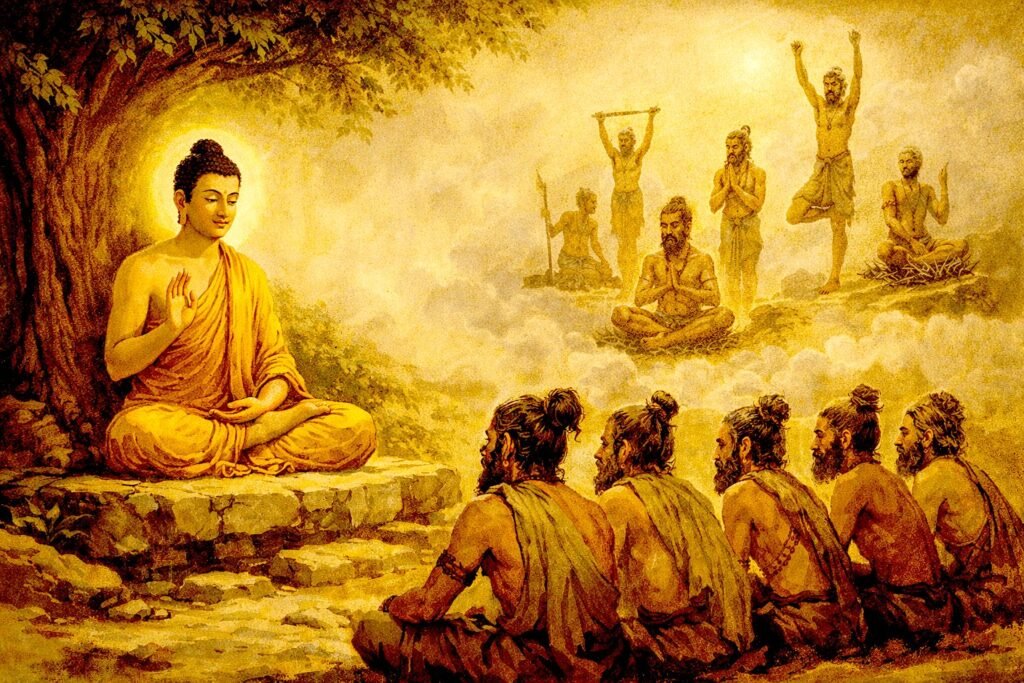
The Buddha teaching the Nigaṇṭha ascetics at Devadaha, illustrating the critique of extreme asceticism found in the Devadaha Sutta (Majjhima Nikāya 101).
I. Introduction: Asceticism and the Problem of Karma in the Intellectual Context of Ancient India
Among the many debates that shaped the intellectual life of ancient India, few were as influential as the debate concerning the meaning of suffering and the role of asceticism in the attainment of liberation. Various religious movements of the time offered different explanations for the origin of suffering as well as different methods for overcoming it. Within this broader context, asceticism—often expressed through severe forms of bodily mortification—was regarded as a powerful spiritual discipline capable of purifying past actions and leading to ultimate freedom. The idea that suffering could function as a means of spiritual purification became particularly prominent among ascetic wanderers who believed that the deliberate mortification of the body was the path to eliminating the karmic residue accumulated in previous lives.
It is within this wider intellectual and religious landscape that the Devadaha Sutta of the Majjhima Nikāya must be situated in order to be properly understood. The discourse records a dialogue between the Buddha and a group of ascetics known as the Nigaṇṭhas, whose teachings are historically associated with the religious tradition later known as Jainism. According to their doctrine, the suffering experienced in the present is the inevitable result of actions performed in the past. From this premise, the Nigaṇṭhas maintain that rigorous ascetic practice provides an effective means of eliminating past karma. By voluntarily subjecting the body to painful and austere conditions, they believe that the residual effects of past actions can gradually be destroyed; once the accumulated karmic force has been completely purified, the bondage of karma comes to an end, thereby leading to liberation.
The Buddha’s response to this doctrine constitutes one of the most significant philosophical critiques of asceticism preserved in the early Buddhist texts. Rather than simply rejecting ascetic practices outright, the Buddha approaches the issue by carefully examining the assumptions underlying the Nigaṇṭhas’ theory of karmic purification. Through a series of questions and logical reflections, the discourse exposes the conceptual difficulties embedded in the idea that suffering itself possesses the power to eliminate past karma. In doing so, the focus of the discussion shifts away from the mere endurance of pain toward a deeper inquiry into how actions, intentions, and mental states shape the moral structure of human experience.
At the same time, the discourse reveals a broader dimension of early Buddhist thought. The critique of asceticism in the Devadaha Sutta is not merely a rejection of extreme practices of self-mortification; it also reflects a fundamental redefinition of the relationship between karma, suffering, and liberation. Instead of viewing suffering as a necessary instrument for eliminating past karma, the Buddhist perspective emphasizes the role of present intention, ethical conduct, and meditative cultivation. Within this framework, liberation is not achieved through the passive endurance of pain but through the transformation of the mind and the development of insight into the nature of experience.
This article offers a philosophical reading of the Devadaha Sutta in order to clarify the structure of the Buddha’s critique of asceticism as well as the implications of that critique for the understanding of karma and spiritual practice in early Buddhism. By situating this dialogue within its historical and doctrinal context, the study argues that the discourse does more than challenge a particular religious practice; it articulates a broader vision of the path to liberation—one that rejects both the determinism of past karma and the belief in the redemptive value of self-mortification. In this sense, the Devadaha Sutta provides a profound insight into the emergence of the Middle Way in Buddhist thought, a path that seeks to transcend the two extremes of sensual indulgence and severe asceticism while redefining the foundations of spiritual transformation.
II. The Doctrine of Asceticism and the Purification of Karma in the Nigaṇṭha Tradition
In order to fully understand the significance of the critique presented in the Devadaha Sutta, it is first necessary to examine the doctrine of the Nigaṇṭhas, with whom the Buddha engages in dialogue in the discourse. Within the religious landscape of ancient India, the Nigaṇṭhas were known as ascetic wanderers distinguished by their rigorous lifestyle and by their belief that liberation could only be attained through the complete purification of karma accumulated in the past. Historically, this tradition is often associated with the religious movement later known as Jainism, which is closely linked with the figure of Mahāvīra, one of the most influential religious leaders of India during the sixth and fifth centuries BCE.
At the center of the Nigaṇṭha doctrine lies the belief that all suffering experienced in the present life originates from actions performed in the past. According to this understanding, karma is not merely an abstract moral principle but is conceived almost as a quasi-material force that adheres to the individual and determines the conditions that one must undergo. Consequently, suffering is not understood simply as a psychological state or an unfortunate circumstance of life; rather, it is regarded as the inevitable manifestation of karmic forces accumulated in the past.
From this premise, the Nigaṇṭhas developed a distinctive conception of the path to liberation. If present suffering is the result of past karma, then the cessation of suffering must involve the complete elimination of that accumulated karmic force. The method proposed for achieving this goal is the practice of rigorous asceticism. By voluntarily subjecting the body to painful and austere conditions—such as prolonged fasting, exposure to intense heat or cold, and various other forms of bodily mortification—they believe that the karmic residues of past actions can gradually be burned away and destroyed.
Within this framework, suffering is no longer something to be avoided but becomes a form of redemptive instrument. The more suffering the ascetic endures, the more rapidly he is thought to purify his karma. Ascetic practice is thus understood as a process of “burning off” karmic force: when past karma is destroyed through suffering and when the ascetic simultaneously refrains from generating new actions, the chain of karmic causation will gradually come to an end. According to this logic, final liberation is achieved once no remaining karma exists to sustain the cycle of rebirth.
However, this doctrine also carries an important implication for the understanding of moral life. If every experience of suffering is the result of actions performed in the past, then what occurs in the present largely appears as the unfolding of karma already predetermined. Within such a perspective, the role of present action becomes ambiguous. The endurance of suffering is treated as the primary means of karmic purification, while present mental states and ethical intentions seem to play only a secondary role.
It is precisely at this point that the dialogue in the Devadaha Sutta becomes particularly significant. The Buddha is not merely confronting a specific ascetic practice but an entire framework for understanding karma, suffering, and liberation. By analyzing the assumptions underlying the Nigaṇṭha doctrine of asceticism, the discourse opens a profound discussion about whether suffering itself can function as a means of purifying karma and whether the path to liberation truly lies in the mortification of the body. From this starting point, the Buddha’s critique unfolds gradually in the subsequent sections of the discourse.
III. The Buddha’s First Critique: The Problem of Epistemic Uncertainty
After presenting the Nigaṇṭha doctrine of karmic purification through asceticism, Gautama Buddha begins his response by raising a series of questions intended to clarify the epistemic assumptions underlying that position. Rather than directly rejecting asceticism as a religious practice, the Buddha first approaches the issue at the level of epistemology: do those who advocate this doctrine truly know the things they claim?
In the Devadaha Sutta, the Buddha poses a set of simple yet decisive questions to the Nigaṇṭhas. He asks whether they have clear knowledge of the karmic actions they performed in their past lives. Do they know what deeds they committed, under what circumstances they were carried out, and to what extent they were performed? He further asks whether they know precisely how much karma has been accumulated in the past and how much suffering must be endured in order to eliminate it completely.
The response given by the Nigaṇṭhas in the discourse is negative. They acknowledge that they possess no direct knowledge of the actions performed in their past lives, nor do they know whether the karmic force they have accumulated is great or small. They are also unable to determine how much karma is actually being eliminated through their present ascetic practices, or how much remains yet to be purified. This admission leads to a fundamental difficulty: if there is no clear knowledge of past karma, then the entire claim that ascetic suffering can eliminate it lacks a reliable epistemic foundation.
The Buddha’s argument here is not merely a logical rebuttal; it also establishes an important standard for religious knowledge. A doctrine concerning liberation cannot rest solely upon unverified assumptions; it must instead be grounded in a form of insight that can be confirmed through the experience of spiritual practice. When the Nigaṇṭhas are unable to answer the most basic questions about their own past karma, their theory of “burning off” karma through ascetic suffering loses its necessary epistemic grounding.
What is particularly noteworthy in this argument is that the Buddha is not simply rejecting a specific religious belief; he is also criticizing a pattern of thought that was widespread among many ascetic traditions of ancient India—the belief that suffering itself possesses a purifying spiritual power. By demonstrating that those who advocate this view possess no clear knowledge of the very object they claim to purify—namely past karma—the Buddha shows that the entire ascetic project rests upon an unstable epistemic foundation.
At a deeper level, this part of the dialogue reflects an important feature of early Buddhist thought: the emphasis on direct knowledge (direct knowledge) as the foundation of the path to liberation. Rather than relying on metaphysical assumptions about events that cannot be known, the Buddha redirects the attention of the practitioner toward present experience, where intentions, actions, and mental states can be observed and transformed. This shift of focus becomes the basis for the next stage of the discourse, in which the Buddha proceeds to analyze the logical difficulties involved in the belief that suffering can function as a means of purifying karma.
IV. The Buddha’s Second Critique: The Logical Problem of the Idea that “Suffering Eliminates Karma”
After pointing out the epistemic difficulties in the doctrine of the Nigaṇṭhas, Gautama Buddha continues his critique along another line of reasoning, this time focusing on the logical structure of the claim that suffering can eliminate past karma. If the previous part of the dialogue questioned whether individuals truly know their past karma, the present discussion raises a deeper issue: whether suffering itself genuinely possesses the power to purify karma.
In the Devadaha Sutta, the Buddha examines the Nigaṇṭha argument by tracing its logical implications. According to their doctrine, the suffering experienced in the present is the result of actions performed in the past, and by enduring suffering through rigorous ascetic practices, a practitioner can gradually eliminate those karmic residues. However, once this premise is accepted, several unavoidable questions arise.
First, if suffering truly has the capacity to eliminate past karma, then suffering itself must be regarded as a positive factor on the path to liberation. In that case, the more suffering one experiences, the closer one would come to the purification of karma. Yet this conclusion leads to a troubling implication: if suffering has purifying value, then pleasant or happy experiences must be seen as obstacles to liberation. In other words, if painful feeling (dukkha-vedanā) can eliminate karma, then pleasurable feeling (sukha-vedanā) would appear to be spiritually disadvantageous.
However, the moral experience of human life does not seem to confirm such a conclusion. In actual life, the presence of suffering does not necessarily correspond to moral purification, just as the presence of happiness does not necessarily lead to spiritual decline. A person may endure great suffering without undergoing any inner transformation, while another may live under favorable conditions and still cultivate profound moral integrity and wisdom. This suggests that the relationship between suffering and spiritual purification is far more complex than the ascetic doctrine assumes.
By emphasizing this point, the Buddha reveals a logical difficulty within the belief that suffering itself can eliminate karma. If suffering is merely a feeling—an experience that arises within life—then its occurrence alone cannot guarantee that a moral or spiritual process is taking place. Suffering may arise from many different causes, and the mere endurance of suffering does not necessarily bring about a transformation of the mind.
This line of reasoning moves the discussion to a crucial new stage. Instead of treating suffering as a tool for karmic purification, the Buddha shifts the focus to the role of intention and action in the present moment. In the Buddhist perspective, it is intention (cetanā) that determines the moral quality of an action, and it is the transformation of intention that has the power to alter the flow of karma. Liberation, therefore, cannot be achieved simply by increasing the amount of suffering endured by the body; it requires a profound transformation of the mind in which ignorance, craving, and aversion are recognized and overcome.
In this way, the Buddha’s critique does more than reject a particular form of religious practice. It also challenges a fundamental assumption about the relationship between experience and moral transformation. By showing that suffering itself has no intrinsic power to purify karma, the discourse opens the way for a different understanding of the path to liberation—one that does not rely on bodily mortification but on the cultivation of the mind and the development of wisdom. From this point, the discourse proceeds to illustrate the limitations of the ascetic view through a series of instructive examples.
V. The Arrow Analogy: The Limits of Asceticism and the Pedagogical Method of the Buddha
After examining the epistemic and logical difficulties inherent in the Nigaṇṭha doctrine of asceticism, Gautama Buddha further develops his argument by introducing a vivid pedagogical illustration. This example, presented in the Devadaha Sutta, not only clarifies the limitations of the belief that suffering can eliminate karma, but also reveals a characteristic feature of the Buddha’s teaching method: rather than relying solely on abstract reasoning, he frequently employs images drawn from everyday experience to illuminate complex philosophical issues.
In this illustration, the Buddha asks the Nigaṇṭhas to consider a simple situation. Suppose a man has been struck by an arrow and is suffering from the resulting pain. In such circumstances, would it be reasonable for him to deliberately shoot another arrow into his own body in the hope that this act might heal the wound? The answer is obviously no. Inflicting additional pain upon oneself cannot be regarded as a sensible form of treatment; on the contrary, it would only worsen the person’s condition.
The meaning of this analogy becomes clear when it is placed within the context of the debate over asceticism. If the suffering experienced in the present is already the result of past actions, then deliberately creating further suffering through severe practices of bodily mortification can be compared to the act of shooting a second arrow into oneself. Rather than addressing the cause of suffering, the deliberate intensification of pain merely deepens the experience of suffering. From this perspective, extreme asceticism does not function as a means of liberation but instead represents a prolongation and multiplication of suffering.
This example reveals an important dimension of the Buddha’s approach to the problem of suffering. Instead of attempting to overcome suffering by generating more suffering, the Buddha directs attention toward understanding its causes. In the Buddhist perspective, suffering is not an entity that must be “burned away” through bodily mortification; rather, it is a phenomenon that must be recognized and carefully analyzed. Only when the underlying causes of suffering—such as ignorance, craving, and attachment—are identified and overcome can suffering truly come to an end.
At the same time, the arrow analogy clearly highlights the difference between the Buddha’s method and many other ascetic traditions within the religious landscape of ancient India. While certain religious movements regarded the endurance of suffering as a means of spiritual purification, the Buddha emphasizes that suffering itself is not the goal of spiritual practice. What truly matters is understanding the nature of suffering and cultivating forms of practice capable of bringing it to an end.
Through this simple yet powerful illustration, the discourse demonstrates that the path to liberation does not lie in increasing the degree of pain endured by the body. Rather, it lies in a correct understanding of the structure of experience and in the transformation of the mind. From this point onward, the discussion in the discourse moves toward a new direction: presenting the path that the Buddha identifies as transcending the two extremes of sensual indulgence and severe asceticism—namely, the Middle Way.
VI. From Asceticism to the Middle Way: A Redefinition of the Path of Practice
After exposing the epistemic difficulties and logical limitations of the ascetic doctrine, Gautama Buddha does not stop at merely criticizing a particular form of religious practice. Instead, the dialogue in the Devadaha Sutta gradually turns toward a more constructive direction: presenting an alternative understanding of the path that leads to liberation. At this point, the discourse reveals a fundamental difference between the Buddhist position and many ascetic traditions that existed within the religious landscape of ancient India.
In many contemporary ascetic movements, the body was often regarded as an obstacle to spiritual life. According to this view, the pleasures of the body were considered a primary cause of bondage within the cycle of rebirth. Consequently, the deliberate imposition of suffering upon the body was seen as a necessary means for achieving spiritual purification. It was from this perspective that severe forms of bodily mortification became a prominent feature of religious practice among wandering ascetics.
By contrast, the approach presented by the Buddha in this discourse does not regard bodily suffering as a path to liberation. As discussed in the previous sections, suffering in itself has no capacity to eliminate past karma, nor can it guarantee moral transformation. For this reason, increasing the degree of pain endured by the body cannot be considered a reliable path to liberation. Instead, the Buddha directs the practitioner’s attention toward a different method: the transformation of the mind through ethical living and meditative cultivation.
Within this context, the idea of the Middle Way becomes particularly significant. The path presented by the Buddha does not lie at either extreme of spiritual life: on the one hand, indulgence in sensual pleasure, and on the other, severe self-mortification. According to the perspective of early Buddhism, neither of these extremes leads to the cessation of suffering. Rather, the path of practice is described as a process of balance and transformation in which both body and mind are placed in a harmonious condition conducive to the development of wisdom.
Within this framework, meditation occupies a central role. Instead of seeking purification through suffering, the practitioner is guided to cultivate stable and lucid states of mind. These meditative states—often described in the early Buddhist texts as the jhānas—are not mystical experiences detached from ethical life, but the result of a disciplined process grounded in moral conduct, mindfulness, and mental training. It is within such states of calm and clarity that wisdom can arise, enabling the practitioner to understand the nature of suffering and the path leading to its cessation.
Thus, this part of the discourse does more than simply present a method of meditation; it reflects a profound redefinition of the spiritual path. While many ascetic traditions regarded the endurance of suffering as a sign of spiritual progress, early Buddhism emphasizes that genuine progress is measured by the transformation of the mind and the development of wisdom. Suffering is not something to be deliberately sought; what truly matters is understanding its causes and cultivating the conditions that allow those causes to be removed.
Seen from this perspective, the dialogue in the Devadaha Sutta can be understood as an important moment in the formation of the Buddhist ideal of the Middle Way. By rejecting both extremes of sensual indulgence and severe asceticism, the discourse presents a path of practice grounded in balance, mindfulness, and wisdom. It is this path, according to the perspective of early Buddhism, that truly leads to liberation from the cycle of rebirth and suffering.
VII. Conclusion: Karma, Suffering, and the Redefinition of the Path to Liberation
The analyses presented in the previous sections show that the Devadaha Sutta is not merely a religious debate between Gautama Buddha and the Nigaṇṭhas. When read in its full structure, the discourse can be understood as one of the clearest philosophical efforts within the early Buddhist texts to redefine the relationship between karma, suffering, and the path to liberation. Through a sequence of arguments developed step by step, the discourse not only questions the value of asceticism as a method of spiritual practice but also challenges deeper assumptions about how human beings understand and interpret the experience of suffering.
First, the dialogue highlights an important epistemological issue. When the Nigaṇṭhas assert that present suffering is the result of actions performed in the past and that ascetic practices can eliminate those karmic residues, the Buddha asks whether they truly possess knowledge of the claims they are making. When they acknowledge that they have no direct knowledge of their past karma, the epistemic foundation of the ascetic doctrine becomes unstable. In this way, the discourse emphasizes a key principle of early Buddhist thought: teachings about liberation cannot rest upon unverified assumptions but must instead be grounded in insight and experiential understanding.
Alongside this epistemological critique, the discourse also presents a logical challenge to the belief that suffering itself can eliminate karma. If suffering had the power to purify past karma, then suffering would have to be regarded as a positive factor on the path to liberation. Yet, as the discourse demonstrates, human moral experience does not confirm such a simple relationship between suffering and spiritual purification. Suffering may arise without leading to any inner transformation, while favorable conditions in life do not necessarily hinder the development of ethical integrity and wisdom. By highlighting this point, the discourse undermines the assumption that the endurance of suffering can, by itself, serve as a means of liberation.
The example of the person struck by an arrow who then chooses to shoot another arrow into himself further clarifies the limitations of the ascetic view. This image illustrates that increasing suffering cannot reasonably be regarded as a method for bringing suffering to an end. Rather than addressing the underlying cause of suffering, such an action only deepens the condition of pain. Through this simple yet powerful analogy, the discourse redirects attention from the mere endurance of suffering toward an understanding of its causes.
At this point, the deeper significance of the discourse becomes evident. The critique of asceticism in the Devadaha Sutta does not merely reject a specific form of religious practice; it reflects a fundamental shift in the understanding of the path to liberation. While many ascetic traditions in the religious environment of ancient India viewed the endurance of suffering as a means of spiritual purification—a view closely associated with the Jain tradition—early Buddhism emphasizes that liberation is not achieved through the mortification of the body but through the transformation of the mind.
From the Buddhist perspective, the decisive factor of karma is not suffering or pleasure in themselves, but the intentions and actions of individuals in the present moment. It is the transformation of intention and the development of wisdom that possess the power to alter the course of karma and bring about the cessation of suffering. Consequently, the path to liberation described in the Buddhist scriptures is not a process of “burning away” karma through suffering, but a path of cultivation in which ethical conduct, meditation, and wisdom work together to transform the structure of experience.
Seen from this perspective, the Devadaha Sutta provides an important insight into the emergence of the Middle Way within Buddhist thought. By rejecting both extremes of sensual indulgence and severe asceticism, the discourse presents a path of practice grounded in a correct understanding of the nature of suffering and the conditions that lead to its cessation. It is within this redefinition—where the transformation of the mind occupies the central place—that the path of liberation in early Buddhism is established as a distinctive philosophical and spiritual alternative within the diverse intellectual landscape of ancient India.
Related Studies:
- Beyond the Two Extremes: Dependent Origination and the Middle Way in the Kaccāyanagotta and Aggivacchagotta Suttas
- Spiritual Authority in Early Buddhism: A Comparative Study of Three Nikāya Discourse
Bibliography
Anālayo. A Comparative Study of the Majjhima-nikāya. 2 vols. Taipei: Dharma Drum Publishing, 2011.
Bronkhorst, Johannes. Greater Magadha: Studies in the Culture of Early India. Leiden: Brill, 2007.
Gethin, Rupert. The Foundations of Buddhism. Oxford: Oxford University Press, 1998.
Harvey, Peter. An Introduction to Buddhism: Teachings, History and Practices. 2nd ed. Cambridge: Cambridge University Press, 2013.
Ñāṇamoli, Bhikkhu, and Bhikkhu Bodhi, trans. The Middle Length Discourses of the Buddha: A Translation of the Majjhima Nikāya. Boston: Wisdom Publications, 1995.
Rhys Davids, T. W., and C. A. F. Rhys Davids, trans. Dialogues of the Buddha. 3 vols. London: Oxford University Press, 1899–1921.
Strong, John S. The Experience of Buddhism: Sources and Interpretations. 2nd ed. Belmont, CA: Wadsworth, 2002.
Warder, A. K. Indian Buddhism. 3rd ed. Delhi: Motilal Banarsidass, 2000.
Williams, Paul. Buddhist Thought: A Complete Introduction to the Indian Tradition. London: Routledge, 2000.