
Le Hoang Da
Buddhist Scholar
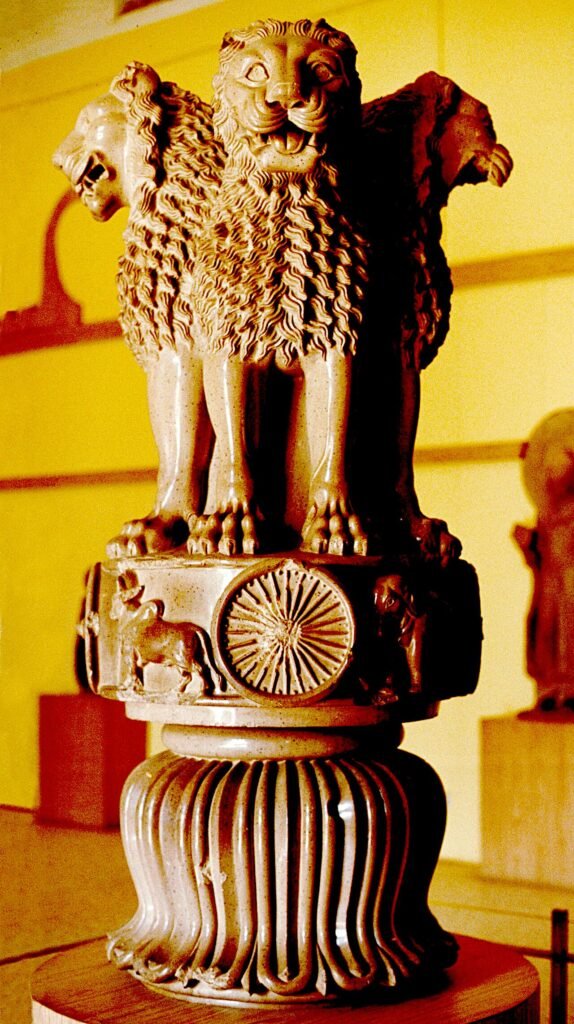
Figure 1: The Lion Capital of Aśoka from Sarnath (Mauryan period, c. 250 BCE), originally crowning one of the emperor’s pillars and symbolizing the proclamation of Dhamma. Source: Wikimedia Commons – Sarnath capital.
I. Introduction: The Problem of Aśoka’s Mission to Sri Lanka
In the history of Buddhism, few figures have had as profound an influence on the spread of the Dharma as Aśoka, the Mauryan emperor who ruled over much of the Indian subcontinent in the third century BCE. After the devastating Kalinga war, Aśoka is portrayed in Buddhist tradition as a ruler who underwent a deep moral and spiritual transformation, abandoning the path of military conquest and turning instead toward the promotion of Dhamma. In the historical memory of many Buddhist communities, his reign is often regarded as a turning point, when Buddhism began to expand beyond a regional monastic tradition into a wider religious presence across different regions.
Within this broader context, the story of Aśoka’s mission to Sri Lanka occupies a particularly important place. According to the Sri Lankan Buddhist chronicles—most notably the Mahāvaṃsa and the Dīpavaṃsa—Buddhism was introduced to the island through the elder Mahinda, who is described as Aśoka’s son. Tradition relates that Mahinda, accompanied by a group of monks, arrived in Sri Lanka during the reign of King Devanampiya Tissa. Their encounter is said to have led to the king’s conversion and to the establishment of Buddhism as a major religious tradition in the kingdom of Anurādhapura. In the religious memory of Sri Lanka, this event is often regarded as the foundational moment of Buddhism on the island.
When examined from the perspective of modern historical research, however, this narrative raises several important questions. The Sri Lankan chronicles were composed centuries after the time of Aśoka and clearly reflect the influence of religious tradition as well as literary purposes. As a result, historians must carefully consider the degree to which these sources can be relied upon when reconstructing historical events. At the same time, other sources—especially the rock and pillar inscriptions issued by Aśoka himself—provide a different type of evidence that is independent of the chronicle tradition. These inscriptions, commonly known as the Aśokan edicts, allow us to approach more directly the political and ideological context of the Mauryan court.
The coexistence of these two types of sources—on the one hand the traditional Buddhist chronicles, and on the other contemporary epigraphic evidence—creates a particularly intriguing problem in the study of Buddhist history. Do Aśoka’s edicts confirm the account of the mission to Sri Lanka as recorded in the chronicles? Does the term Tambapaṇṇi, which appears in Aśoka’s inscriptions, truly refer to Sri Lanka? And when these different sources are placed side by side, can they help us reconstruct a historically credible picture of the spread of Buddhism in the third century BCE?
This article approaches the problem by placing the Sri Lankan chronicles alongside the epigraphic evidence from the time of Aśoka. Rather than simply accepting or rejecting the traditional narrative, the aim is to examine how different types of sources—chronicles and inscriptions—may complement one another in reconstructing the historical context of this missionary episode. By comparing the traditional texts with the Aśokan edicts, the study seeks to clarify the extent to which the story of the mission to Sri Lanka may be understood as a historical memory preserved and developed across generations.
II. The Ceylonese Chronicles and the Narrative of the Mission
In the Sri Lankan Buddhist tradition, the story of the introduction of Buddhism to the island is preserved primarily in two important Pāli chronicles: the Dīpavaṃsa and the Mahāvaṃsa. Composed within the monastic environment of Sri Lanka several centuries after the time of Aśoka, these works function not only as historical records but also as texts that shaped the religious memory of the Theravāda Buddhist community. It is within these chronicles that the narrative of the missionary enterprise from the Mauryan court to Sri Lanka is presented in a relatively coherent form, closely associated with the event traditionally known as the Third Buddhist Council at Pāṭaliputra.
According to the account of the Mahāvaṃsa, after becoming a patron of Buddhism, Aśoka convened a great council in order to purify the Saṅgha of heterodox views and to reaffirm the unity of the doctrine. In the traditional narrative, this council is closely associated with the leadership of the elder Moggaliputta Tissa, who is portrayed as a central figure in restoring doctrinal orthodoxy. Following the conclusion of the council, the chronicles report that a number of missionary delegations were dispatched to different regions, with the aim of extending the presence of Buddhism beyond the core territories of the Mauryan Empire.
Among these missions, the one sent to Sri Lanka occupies a particularly prominent place. The leader of this mission was the elder Mahinda, whom the Mahāvaṃsa describes as the son of Aśoka. According to the traditional narrative, Mahinda and a group of monks arrived in Sri Lanka during the reign of King Devanampiya Tissa of the kingdom of Anurādhapura. Their encounter, which tradition situates at Mihintale, is portrayed as a symbolic dialogue in which Mahinda tests the intellectual capacity of the king through a series of questions designed to demonstrate his ability to comprehend the teachings of the Buddha. Following this meeting, Devanampiya Tissa is said to have embraced Buddhism and subsequently became a patron of the establishment of the monastic community on the island.
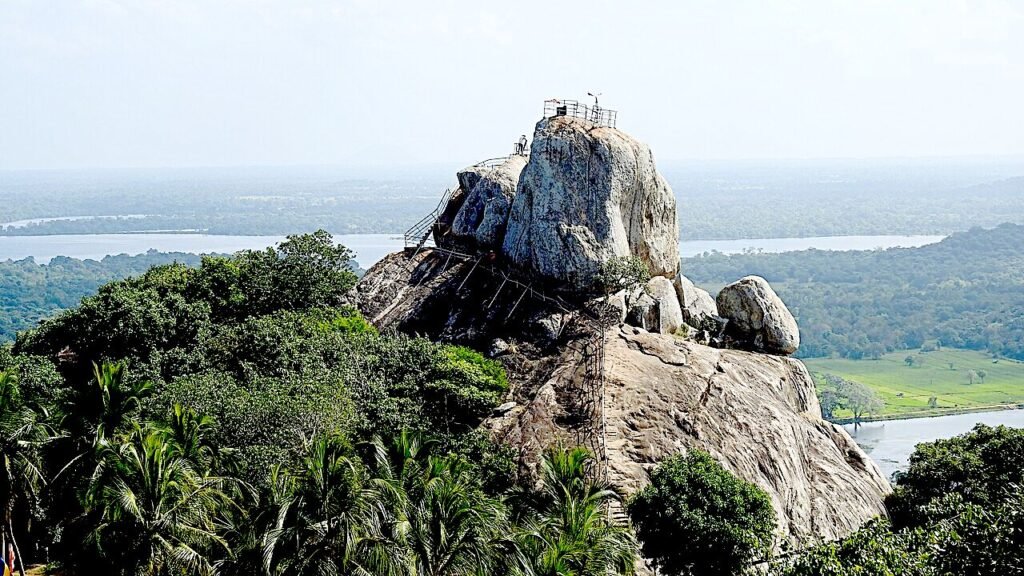
Figure 2: The rocky summit of Mihintale in Sri Lanka, traditionally associated with the meeting between the elder Mahinda and King Devanampiya Tissa, an event regarded in the Sri Lankan chronicles as marking the introduction of Buddhism to the island. Source: Dennis Sylvester Hurd, Mihintale Rock, Wikimedia Commons (CC0 Public Domain).
The chronicles further recount that numerous monasteries were founded at Anurādhapura after this event, among which the Mahāvihāra became the most prominent center of learning and monastic practice within the Theravāda tradition. In addition, the tradition narrates that Princess Saṅghamittā—Aśoka’s daughter—brought a branch of the Bodhi tree from Bodhgayā to Sri Lanka, an act that became one of the most enduring religious symbols in the island’s Buddhist history. These elements demonstrate that the story of the missionary mission is not presented merely as a historical event but is also intertwined with sacred symbols that affirm the continuity between Sri Lanka and the Buddhist heartland in India.
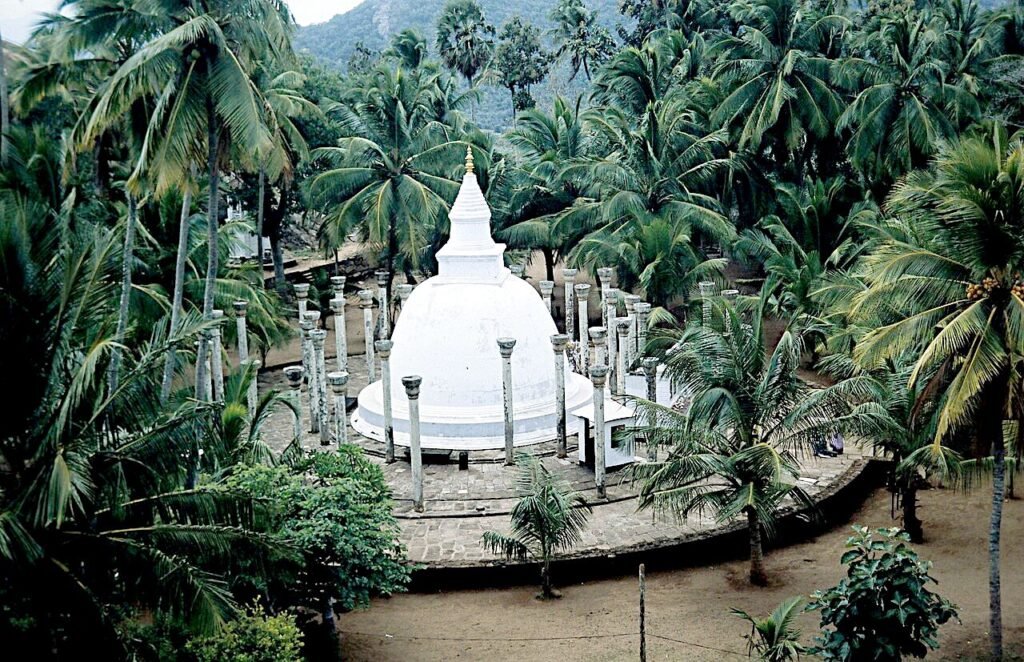
Figure 3: Ambasthala Dagoba at Mihintale, Sri Lanka. According to Sri Lankan tradition, this stupa marks the place where the monk Mahinda met King Devanampiya Tissa, an event associated with the introduction of Buddhism to the island in the third century BCE. Source: Wikimedia Commons — Ambasthala Dagoba in Mihintale.
From the perspective of modern historical scholarship, however, these chronicles also raise several methodological concerns. The Dīpavaṃsa and the Mahāvaṃsa were composed many centuries after the time of Aśoka, and their purpose was not limited to the recording of historical events. They also served to affirm the legitimacy and orthodoxy of the Theravāda tradition in Sri Lanka. For this reason, the narrative of Mahinda’s mission may have been presented in a manner that emphasizes the central role of Sri Lanka in the broader history of Buddhism. Hagiographical elements—such as miraculous details or literary motifs common in religious literature—also suggest that these chronicles cannot be read as historical records in the modern sense.
Nevertheless, this does not necessarily mean that the entire narrative preserved in the chronicles should be dismissed as purely legendary. A number of scholars have argued that these texts may preserve historical memories transmitted across generations within monastic communities. When examined alongside other sources, particularly the inscriptions issued by Aśoka, certain elements of the Sri Lankan tradition may reflect historical events that occurred during the spread of Buddhism in the third century BCE. For this reason, rather than rejecting the chronicles entirely as legendary narratives, many recent studies approach them as sources that must be read with caution and evaluated in relation to other types of evidence.
From this perspective, the story of Mahinda’s mission can be understood not merely as a religious tradition but also as an important starting point for investigating the historical spread of Buddhism. In order to assess the extent to which this tradition may reflect historical events, it must be examined in relation to contemporary sources—particularly the rock and pillar inscriptions issued by Aśoka. It is precisely through the comparison between the Sri Lankan chronicles and the epigraphic evidence from the Mauryan period that it becomes possible to reconstruct a more balanced historical picture of the missionary enterprise that is believed to have introduced Buddhism to the island.
III. Aśokan Inscriptions and the Evidence of Epigraphy
Alongside the Sri Lankan chronicles, another important source for the study of the spread of Buddhism in the third century BCE is the body of rock and pillar inscriptions issued by Aśoka. These texts, commonly referred to as the Aśokan edicts, were engraved at numerous locations across the Indian subcontinent and represent some of the rare contemporary sources that survive from the Mauryan period. Unlike the Buddhist chronicles that were composed centuries later, these inscriptions directly reflect the policies and ideological concerns of Aśoka’s court, and therefore possess particular value for reconstructing the historical context of the period.
The edicts of Aśoka are usually classified into several groups, including the Major Rock Edicts, the Minor Rock Edicts, and the Pillar Edicts. Their contents primarily revolve around the propagation of Dhamma—a concept that Aśoka employed to denote ethical and social principles such as compassion, religious tolerance, and the protection of living beings. Rather than presenting Buddhist doctrine in a strictly sectarian or doctrinal form, the edicts articulate Dhamma as a universal moral ideal that the king sought to promote throughout society. In this sense, the inscriptions possess both religious and political dimensions, reflecting Aśoka’s effort to establish a moral order within his empire.
Among these inscriptions, two texts are particularly relevant to the question of the spread of Buddhism beyond the Mauryan realm: Rock Edict II and Rock Edict XIII. Rock Edict II refers to the king’s concern for the welfare of both humans and animals not only within his own empire but also in neighboring regions. The inscription mentions several areas beyond the Mauryan territories, including Tambapaṇṇi. Although the primary focus of the edict concerns the establishment of medical facilities and the encouragement of ethical conduct, the mention of Tambapaṇṇi in this context suggests that this region was already within the geographical and political awareness of the Mauryan court.
Rock Edict XIII is even more significant for the study of Aśoka’s relations with the wider world. In this inscription, Aśoka expresses his profound remorse following the Kalinga war and declares that victory through Dhamma—that is, the spread of moral values—is superior to victory through military conquest. The edict also refers to several regions beyond the direct control of the Mauryan Empire, including Greek kingdoms in the west as well as certain territories to the south. The appearance of Tambapaṇṇi in this list has attracted considerable scholarly attention, as it suggests that this region may have been known within the diplomatic or cultural networks associated with Aśoka’s court.
It should be noted, however, that Aśoka’s inscriptions do not provide a detailed narrative of the spread of Buddhism in the sense of organized missionary activity. The concept of Dhamma in the edicts is generally expressed in broad terms, encompassing ethical and social values that Aśoka sought to promote throughout the world known to him. Consequently, while the inscriptions indicate that the Mauryan court was aware of regions beyond its imperial borders and sought to extend its moral influence toward them, they do not directly confirm specific Buddhist missions such as those described in the Sri Lankan chronicles.
Nevertheless, the significance of the edicts lies in the independent historical context that they provide for the traditions preserved in Buddhist texts. While the chronicles recount that Buddhism was introduced to Sri Lanka under Aśoka’s patronage, the inscriptions demonstrate that during the same period the Mauryan court was indeed directing its attention beyond the borders of the empire and attempting to disseminate the principles of Dhamma to neighboring regions. This correspondence does not necessarily prove the historicity of Mahinda’s mission, but it does offer a historical framework that renders the tradition more plausible within the broader context of the third century BCE.
IV. Tambapaṇṇi and the Question of Sri Lanka
One of the most important issues in examining the evidence related to Aśoka’s missionary enterprise is the identification of the place-name Tambapaṇṇi that appears in Aśoka’s inscriptions. In the Rock Edicts—particularly Rock Edict II and Rock Edict XIII—Aśoka refers to several regions lying beyond the direct borders of the Mauryan Empire, among which Tambapaṇṇi is included. For many scholars, the central question is whether this place-name indeed refers to Sri Lanka, and if so, what this reference might reveal about the relationship between the Mauryan court and the island during the third century BCE.
In the Sri Lankan tradition, Tambapaṇṇi is regarded as an ancient name for the island. According to the Pāli chronicles, when Prince Vijaya and his followers first arrived in Sri Lanka, they named the land Tambapaṇṇi, a term traditionally explained as referring to the reddish color of the soil or sand at the place where they landed. The name subsequently became a familiar designation for Sri Lanka in early Pāli literature. For this reason, when scholars discovered that the term Tambapaṇṇi appears in Aśoka’s edicts, many quickly associated it with the island described in the Sri Lankan chronicles.
Nevertheless, the identification of Tambapaṇṇi with Sri Lanka has not always been accepted without question. Some researchers have suggested that the term might instead refer to a coastal region in South India rather than to the island of Sri Lanka. This interpretation is based on the assumption that during the Mauryan period commercial and cultural relations between northern India and the southern regions of the subcontinent were already well developed, and that Aśoka’s edicts may have referred to areas that formed part of these trading networks. From this perspective, Tambapaṇṇi could represent a local toponym in South India rather than necessarily indicating Sri Lanka.
Despite these alternative interpretations, several linguistic and historical considerations have led the majority of scholars to favor the identification of Tambapaṇṇi with Sri Lanka. First, in Aśoka’s edicts the term is often listed together with territories that lay beyond the direct political control of the Mauryan Empire, including the Greek kingdoms in the west. This suggests that the name most likely refers to an independent region outside Mauryan authority. Second, Sri Lankan traditions from an early period consistently used Tambapaṇṇi as a designation for the island, and this correspondence makes the identification historically plausible.
Additional evidence concerning diplomatic and cultural relations between Sri Lanka and the Mauryan court also strengthens this possibility. The Sri Lankan chronicles recount that King Devanampiya Tissa maintained friendly relations with Aśoka and even received gifts from the Mauryan court. Although the details of these accounts may reflect later traditional elaboration, they nonetheless suggest the possibility of political or commercial connections between the two regions. Within such a context, the appearance of Tambapaṇṇi in Aśoka’s inscriptions may be interpreted as an indication that Sri Lanka had already entered the geopolitical awareness of the Mauryan state.
It is important to emphasize, however, that even if Tambapaṇṇi does indeed refer to Sri Lanka, the edicts of Aśoka do not provide a detailed narrative of the introduction of Buddhism to the island. The inscriptions primarily refer to the dissemination of Dhamma in a broad sense—encompassing ethical values such as compassion, restraint, and the protection of living beings—rather than to the establishment of Buddhist missions in a strictly religious sense. This circumstance makes the direct linkage between the edicts and the account of Mahinda’s mission in the Sri Lankan chronicles more complex.
The question of Tambapaṇṇi, therefore, is not merely a matter of historical geography but also represents a point of intersection between literary tradition and historical evidence. If Tambapaṇṇi in the edicts does indeed refer to Sri Lanka, it indicates that the island was already known within the political and cultural horizon of the Mauryan court. Yet in order to understand more fully how these connections might relate to the narrative of the missionary mission, it is necessary to consider the chronology of the edicts and the historical circumstances in which they were issued. In particular, the dating of the inscriptions—especially Rock Edict XIII—provides an important key for evaluating the historical plausibility of the mission described in the Sri Lankan chronicles.
V. Chronology of the Missions
One of the most important issues in the study of Aśoka’s missionary activities concerns the chronology of the events involved. The Sri Lankan chronicles—particularly the Mahāvaṃsa and the Dīpavaṃsa—present the mission of Mahinda as closely associated with the Third Buddhist Council at Pāṭaliputra. According to this tradition, after the conclusion of the council, missionary delegations were dispatched to various regions, including Sri Lanka. However, since these chronicles were composed several centuries after the reign of Aśoka, the chronology of the events they describe must be examined carefully in light of independent sources of evidence.
Among the contemporary sources available, the rock inscriptions of Aśoka provide an important foundation for establishing the chronological framework of the dissemination of Dhamma. Particularly significant in this regard is Rock Edict XIII, one of the most well-known of Aśoka’s inscriptions, in which he refers to the spread of Dhamma to a number of regions beyond the direct control of the Mauryan Empire. The edict mentions not only western kingdoms ruled by Greek monarchs but also other territories outside the Mauryan sphere, including Tambapaṇṇi. The appearance of this place-name has led many scholars to associate Rock Edict XIII with the tradition that Buddhism was transmitted to Sri Lanka during Aśoka’s reign.
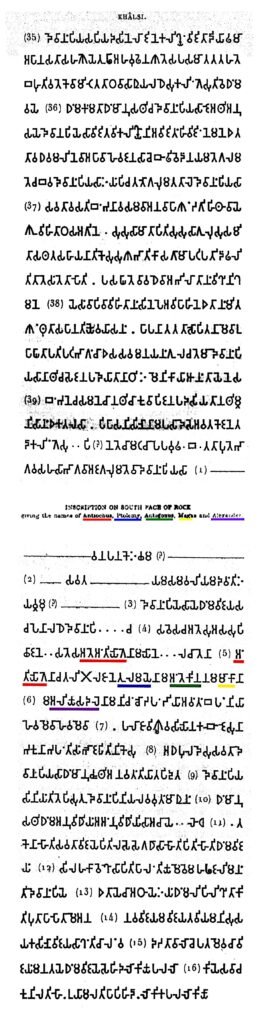
Figure 4: Major Rock Edict XIII of Aśoka at Khalsi, inscribed in Brāhmī script (3rd century BCE). This famous inscription mentions several Hellenistic rulers—Antiochus, Ptolemy, Antigonus, Magas, and Alexander—providing an important chronological reference for the reign of Aśoka and the dissemination of Dhamma beyond the Mauryan Empire. Source: Wikimedia Commons — Ashoka Edict 13 at Khalsi vertical
An important factor in determining the date of Rock Edict XIII is the reference within the inscription to several contemporary Greek rulers. Scholars have utilized data from Hellenistic history to identify the periods during which these kings reigned, thereby establishing an approximate date for the edict. Such analyses generally lead to the conclusion that Rock Edict XIII was issued around the middle of the third century BCE, approximately around 260 BCE. If this dating is accepted, the inscription may correspond to roughly the sixteenth to eighteenth year of Aśoka’s reign, depending on the method used to calculate the date of his accession.
Interestingly, this result corresponds relatively closely with the chronology preserved in the Sri Lankan tradition. According to the Mahāvaṃsa, the Third Buddhist Council and the subsequent missionary missions are placed around the seventeenth year of Aśoka’s reign. Although the chronicles do not provide a chronological system that conforms fully to modern historiographical standards, the approximate convergence between the date inferred from the inscriptions and that preserved in the Pāli texts has led a number of scholars to suggest that the Sri Lankan tradition may preserve a historically reliable memory of the timing of these events.
It should be emphasized, however, that Aśoka’s edicts do not provide a direct narrative of missionary activities in the sense described in the chronicles. The inscriptions primarily refer to the propagation of Dhamma in a broad sense, encompassing the ethical and political principles that Aśoka sought to promote both within and beyond his empire. Consequently, the direct identification of Rock Edict XIII with the mission of Mahinda must be approached with caution. What the edicts provide is not a detailed historical narrative but rather a historical context indicating that during Aśoka’s reign the Mauryan court was clearly aware of regions beyond its borders and sought to establish moral and political connections with them.
Furthermore, the question of chronology raises another issue: whether all of Aśoka’s edicts were issued at the same time. Epigraphic studies have suggested that the inscriptions may have been promulgated at different stages of Aśoka’s reign, reflecting the gradual development of his policy of Dhamma. If this is the case, Rock Edict XIII may represent a phase in which Aśoka’s policy expanded beyond the internal administration of the empire toward the dissemination of moral ideals to neighboring regions.
From this perspective, the date of Rock Edict XIII and the regions mentioned within it may be understood as an important indicator of the historical context in which the missionary missions described in the Sri Lankan chronicles are situated. Although the edicts do not directly confirm the narrative of Mahinda’s mission, they provide a chronological framework and political background that are broadly consistent with that tradition. When considered together, the epigraphic evidence and the Buddhist chronicles suggest that around the middle of the third century BCE—during the mature phase of Aśoka’s reign—religious and cultural connections between India and Sri Lanka may have developed in ways that facilitated the establishment of Buddhism on the island.
VI. Conclusion: Tradition and Historical Reconstruction
The examination of Aśoka’s missionary mission to Sri Lanka reveals a familiar issue in the study of Buddhist history: the complex interaction between literary tradition and historical evidence. The Sri Lankan chronicles, particularly the Dīpavaṃsa and the Mahāvaṃsa, provide a relatively detailed account of the introduction of Buddhism to the island through the mission of the elder Mahinda during the reign of Aśoka. In these texts, the story of Mahinda and his encounter with King Devanampiya Tissa is presented as a decisive moment in the religious history of Sri Lanka, marking the establishment of Buddhism on the island and the emergence of a long-lasting Theravāda tradition.
However, as demonstrated in the preceding sections, these chronicles cannot be read simply as historical records in the modern sense. They were composed several centuries after the events they describe and clearly reflect the monastic environment in which they were produced as well as the intention to affirm the legitimacy of the Sri Lankan Buddhist tradition. Hagiographical elements, together with the literary structures typical of religious chronicles, indicate that these texts function both as historical narratives and as forms of religious memory shaped across generations.
For this reason, any attempt to reconstruct the history of the missionary enterprise cannot rely solely on the chronicles but must place them in relation to other forms of evidence. Among these, the rock and pillar inscriptions of Aśoka are of particular importance. The Aśokan edicts do not provide a direct narrative of the introduction of Buddhism to Sri Lanka, yet they demonstrate that during the third century BCE the Mauryan court actively sought to disseminate the concept of Dhamma beyond the direct boundaries of the empire. The appearance of the place-name Tambapaṇṇi in these inscriptions, together with references to other territories beyond Mauryan control, suggests that Sri Lanka may already have been situated within the political and cultural horizon recognized by Aśoka’s court.
Moreover, the chronological analysis of Rock Edict XIII indicates that the references to regions beyond Maurya can be dated to approximately the middle of the third century BCE, around the sixteenth to eighteenth year of Aśoka’s reign. Notably, this time frame corresponds relatively closely to the chronology preserved in the Sri Lankan chronicles, which place the Third Buddhist Council and the subsequent missionary missions around the seventeenth year of Aśoka’s rule. Although this correspondence cannot be taken as direct proof, it suggests that the Sri Lankan tradition may preserve a historical memory of religious and cultural connections between India and Sri Lanka during the Mauryan period.
From this perspective, the story of Mahinda’s mission may be understood as a religious tradition built upon a genuine historical foundation. The specific details of the narrative—such as the symbolic dialogues or other legendary motifs—may reflect the processes through which historical memories were interpreted and transmitted within monastic communities. Yet beneath these layers of interpretation there may still lie a fundamental historical event: the formation of religious connections between the Mauryan court and Sri Lanka that ultimately contributed to the establishment of Buddhism on the island during the third century BCE.
Thus, rather than placing tradition and history in opposition, the study of Aśoka’s missionary mission suggests that the two often complement one another. The chronicles preserve stories and memories maintained within Buddhist communities, while the inscriptions and other forms of epigraphic evidence help situate these memories within a broader historical context. When read together, these sources allow us to approach a more balanced reconstruction of the spread of Buddhism in the third century BCE—a process in which religious tradition and political history intertwined to shape one of the most significant turning points in the history of Buddhism in Asia.
Bibliography
Aśoka. The Edicts of King Aśoka. Translated by N. A. Nikam and Richard McKeon. Chicago: University of Chicago Press, 1959.
Geiger, Wilhelm, trans. The Mahāvaṃsa or The Great Chronicle of Ceylon. London: Pali Text Society, 1912.
Oldenberg, Hermann, ed. The Dīpavaṃsa: An Ancient Buddhist Historical Record. London: Williams and Norgate, 1879.
Rhys Davids, T. W. Buddhist India. London: T. Fisher Unwin, 1903.
Smith, Vincent A. Aśoka: The Buddhist Emperor of India. Oxford: Clarendon Press, 1901.
Thapar, Romila. Aśoka and the Decline of the Mauryas. Oxford: Oxford University Press, 1961.
Strong, John S. The Legend of King Aśoka: A Study and Translation of the Aśokāvadāna. Princeton: Princeton University Press, 1983.