
Le Hoang Da
Independent Philosopher & Buddhist Scholar
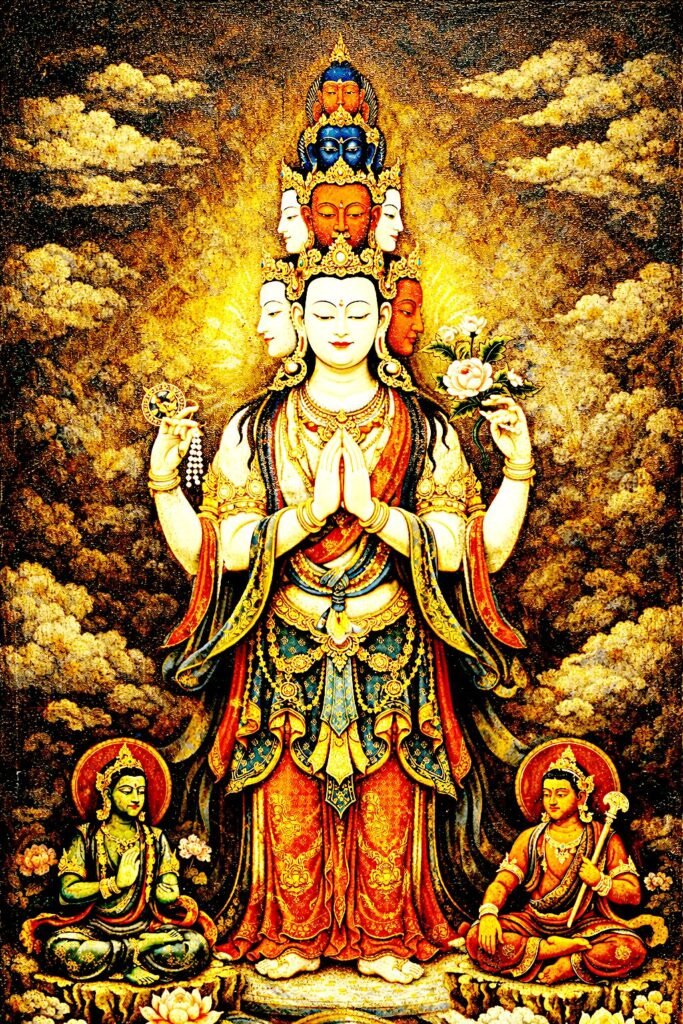
Ekādaśamukha Avalokiteśvara — From Sonic Devotion to Iconic Form.
I. Rethinking the Formation of Tantra through the Evidence of Gilgit
The emergence of Buddhist Tantra is often presented as a rupture in the history of Indian Buddhism. In many conventional narratives, Tantra is said to have appeared rather abruptly around the seventh to eighth centuries CE, frequently associated with the consolidation of esoteric systems in North India and their subsequent institutional development in Tibet. Within this framework, Tantra is regarded as a relatively late layer, largely distinct from the earlier textual traditions of Mahāyāna Buddhism.
Such a model of “sudden transformation,” however, risks oversimplifying what was in fact a gradual and far more complex historical process. The manuscripts discovered at Gilgit—an important Buddhist center within the cultural sphere of ancient Kashmir—provide substantial evidence that ritual and mantra structures, typically associated with later Tantric developments, had already begun to take shape within Mahāyāna communities by the sixth century. Written in Gupta script and dated palaeographically to this period, the Gilgit manuscripts preserve several texts related to Avalokiteśvara, including the Ekādaśamukha-dhāraṇī and a corresponding Hṛdaya-vidyā.
These texts reveal a multi-layered structure in which narrative passages, hymnic praise, protective formulas, and condensed sound sequences coexist within a unified ritual framework. The presence of repeated mantra elements—including forceful syllabic formulas such as phaṭ—alongside invocations and supplications addressed to Ārya Avalokiteśvara suggests that the ritualization of Mahāyāna devotion was already well underway. Elements that would later be systematized in Tantric scriptures—such as complex visualization practices and mandalic cosmology—appear here in embryonic yet structurally recognizable forms.
This article argues that the Avalokiteśvara texts preserved in the Gilgit Manuscripts constitute significant evidence for a pre-Tantric phase within Indian Mahāyāna Buddhism. Rather than representing a radical break from earlier traditions, Tantric ritual may be understood as the systematization and amplification of developments already present in textual practice by the sixth century. Through an analysis of the structure of the Ekādaśamukha-dhāraṇī and its related Hṛdaya-vidyā, this study seeks to illuminate the internal continuity between classical Mahāyāna devotion and the ritual imagination of later Tantra.
II. Gilgit and Sixth-Century Kashmir: Historical and Textual Context
The manuscripts discovered at Gilgit constitute one of the most significant archaeological finds in twentieth-century Buddhist studies. Situated in the mountainous region of the northern Indian subcontinent, Gilgit lay within the cultural sphere deeply influenced by ancient Kashmir—an important intellectual and religious center of Indian Buddhism from the early centuries of the Common Era. Its geographical position along major trade routes connecting India with Central Asia and beyond rendered the region a crossroads of diverse intellectual traditions and ritual practices.
From the fourth century onward in particular, Kashmir was renowned as a major center of the Sarvāstivāda tradition and Abhidharma scholarship. The analytical treatises composed and preserved there attest to a highly systematic and philosophically rigorous scholarly environment. For this reason, the appearance of ritual and mantra-oriented texts within the Gilgit manuscripts cannot be dismissed as the product of a peripheral or “superstitious” milieu. Rather, they must be understood within the context of a Buddhist center characterized by considerable doctrinal sophistication.
From a textual and material perspective, the Gilgit manuscripts were written on birch bark—a writing material commonly used in the northwestern regions of the Indian subcontinent and ancient Kashmir. On palaeographic grounds, they are dated to approximately the sixth century CE. The script employed in these manuscripts is a late form of Gupta Brāhmī, a development of the earlier Brāhmī script widely used during the Gupta period.
At this point, it is important to distinguish clearly between language and script. The texts preserved in the Gilgit manuscripts are composed in Buddhist Sanskrit; however, Sanskrit refers to a language, not a script. It could be written in various scripts depending on time and region. In this case, the Sanskrit texts were transcribed in a Gupta script, not in Devanagari—the much later script commonly used for printing Sanskrit today. This distinction is crucial, as the identification of script provides the primary basis for dating the manuscripts and situating them within their proper historical context.
It is within this geographical and intellectual environment that the Avalokiteśvara texts—such as the Ekādaśamukha-dhāraṇī and the related Hṛdaya-vidyā—appear. Significantly, these texts do not survive as isolated fragments; they are preserved within the same manuscript collection, suggesting the presence of a structured ritual tradition. The coexistence of classical doctrinal analysis and dhāraṇī practice within the same cultural setting indicates an internal process of development rather than replacement or rupture.
Thus, before turning to a detailed analysis of the textual structure of the Avalokiteśvara materials, it is necessary to emphasize that sixth-century Gilgit should not be regarded as a historical anomaly. Rather, it represents a rare window through which we can observe Indian Buddhism in a state of transformation—where philosophical reasoning, devotional expression, and ritual practice coexisted within a unified intellectual ecosystem.
III. The Ekādaśamukha-dhāraṇī: A Two-Layered Structure between Scripture and Ritual
Among the Avalokiteśvara texts preserved at Gilgit, the Ekādaśamukha-dhāraṇī occupies a central position. The title “Ekādaśamukha” (“Eleven-Faced”) confirms the presence of a form of Avalokiteśvara with a clearly developed iconographic identity, even though at this stage the visual imagery had not yet been elaborated to the degree found in later Vajrayāna traditions. Yet the most significant feature lies not in the number of faces, but in the structure of the text itself.
1. A Classical Scriptural Framework
The text opens according to a familiar Mahāyāna sūtra pattern: hymnic praise, invocation of the Tathāgata, and the establishment of a preaching context. Formulas such as namo tathāgatāya or namo ārya-avalokiteśvarāya situate the dhāraṇī within the authority of the Buddha and the Bodhisattva, rather than presenting it as an external or marginal practice.
This indicates a clear strategy of legitimation: ritual is not detached from scripture but embedded within a scriptural framework.
As visible in the manuscript folio reproduced below (Figure 1), the dhāraṇī begins within a syntactically structured discourse before transitioning toward more condensed formulaic elements.
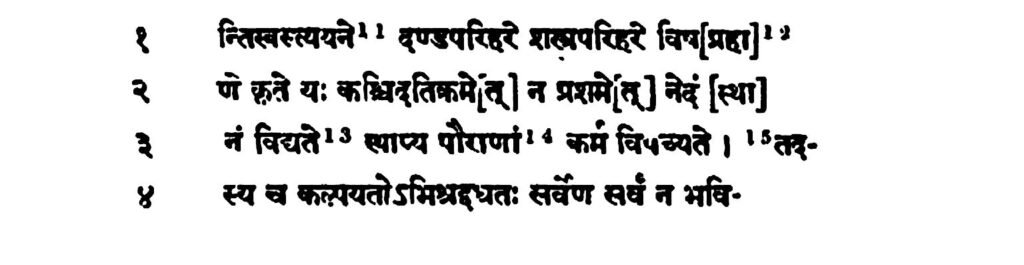
Figure 1. Early portion of the Ekādaśamukha-dhāraṇī in Gupta script, showing syntactically structured discourse prior to the concentration into mantra sequences.
Source: Nalinaksha Dutt, “The Buddhist Manuscripts at Gilgit,” The Indian Historical Quarterly 12 (1936): 109–120.
2. The Semantic Layer: Universal Salvation
The initial portion of the Ekādaśamukha-dhāraṇī conveys a broad salvific scope. Expressions referring to “all beings” (sarvasattva), “the removal of suffering” (duḥkha-nivāraṇa), and the “ocean of saṃsāra” reflect a distinctly Mahāyāna horizon. Avalokiteśvara appears as the embodiment of great compassion (mahā-kāruṇika), functioning as a universal savior rather than merely a personal protector.
At this level, the text remains firmly situated within classical Mahāyāna theology: compassion, universal liberation, and the authority of the Tathāgata remain central.
3. The Ritual Layer: Protection and Practical Efficacy
Alongside this universal salvific dimension, the text proceeds to enumerate specific benefits: protection from poison, weapons, illness, and various obstacles. These passages reveal a distinctly pragmatic dimension—the dhāraṇī is recited not only for ultimate enlightenment but also for the safeguarding of bodily life and present existence.
The coexistence of these two layers is crucial. The text does not separate the “transcendent” from the “pragmatic”; rather, it integrates them within a unified ritual structure. This suggests that sixth-century Mahāyāna had developed a form of devotion that was simultaneously cosmological and concretely protective.
4. The Internal Movement of the Text
Even more striking is the gradual shift from syntactically complete semantic sentences to short, repetitive, rhythmically charged syllabic sequences. Sound formulas such as huṃ, phaṭ, and svāhā appear with increasing frequency, marking a transition from narrative language to performative sound.
At this point, one is no longer simply reading a doctrinal passage but witnessing a process of the “sonicization” of the Dharma. The dhāraṇī is not merely content to be understood; it is practice to be voiced, repeated, and believed to possess efficacy.
It is precisely this internal movement—from the semantic layer of salvation to the sonic layer of ritual—that allows us to identify a pre-Tantric stage. There is no elaborate maṇḍala, no fully systematized deity-yoga, yet the foundational structure of mantra-based ritual is already present.
5. Pre-Tantra as Process, Not Leap
When read within the sixth-century Gilgit context, the Ekādaśamukha-dhāraṇī reveals a model of continuous development: Mahāyāna scripture → protective dhāraṇī → condensed mantra formula. Tantra, in its later systematized form, may thus be understood as the amplification and formalization of this trajectory.
Rather than representing a radical rupture, the Ekādaśamukha-dhāraṇī displays a structurally identifiable intermediate phase in which Mahāyāna devotion had begun to transform into a systematized ritual of sacred sound.
IV. The Hṛdaya-vidyā and the “Sonicization” of the Dharma
If the Ekādaśamukha-dhāraṇī reveals a ritual structure in formation, the Hṛdaya-vidyā preserved in the Gilgit Manuscripts marks a further stage in that development. From its very title, “Hṛdaya-vidyā” (“Heart-Essence Spell” or “Essential Knowledge-Mantra”), the text implies condensation: this is no longer an extended narrative discourse, but a distilled, core formulation oriented toward intensive practice.
1. From Dhāraṇī to Vidyā: A Shift in Emphasis
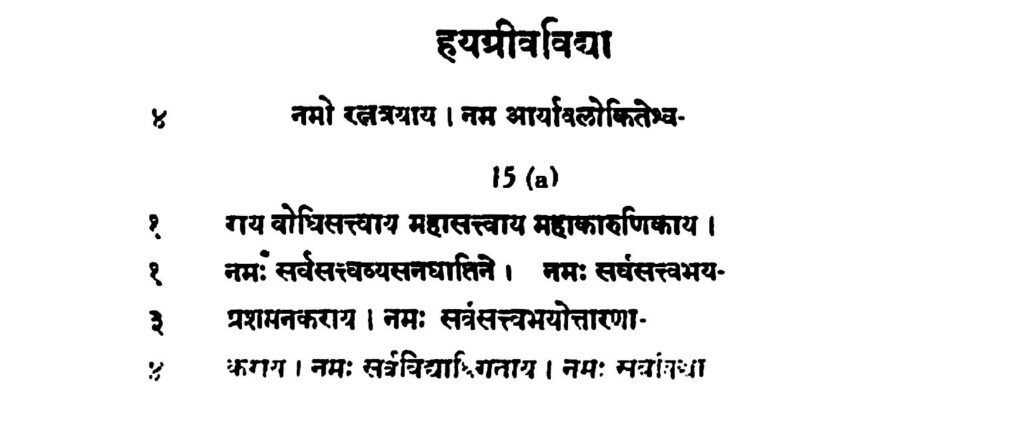
Figure 2. Title and opening invocation of the Hṛdaya-vidyā in Gupta script, demonstrating the continuity of scriptural framing within emerging mantra structures.
Source: Nalinaksha Dutt, “The Buddhist Manuscripts at Gilgit,” The Indian Historical Quarterly 12 (1936): 109–120.
Unlike the opening sections of the Ekādaśamukha-dhāraṇī, the Hṛdaya-vidyā significantly reduces narrative elements. Hymnic praise and scriptural framing are abbreviated, giving way to increasingly dense sequences of mantra formulas. Here, syllables no longer function as illustrative or supplementary components; they become the very center of practice.
Repetitive sequences such as phaṭ phaṭ phaṭ, together with syllables like huṃ and svāhā, appear not as marginal additions but as the core substance of the text. Syntactic meaning gradually yields to rhythm and sonic force. One observes a shift from “reading to understand” toward “chanting to enact.”
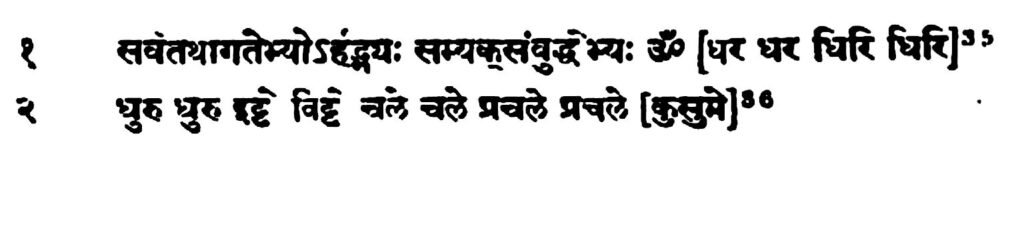
Figure 3. Repetitive mantra sequences in Gupta script from the Hṛdaya-vidyā, including rhythmic syllabic formulas such as ghara ghara, ciri ciri, huṃ, and phaṭ.
Source: Nalinaksha Dutt, “The Buddhist Manuscripts at Gilgit,” The Indian Historical Quarterly 12 (1936): 109–120.
2. Sound as Performative Power
In many Indian traditions, sacred sound (śabda) is not merely a vehicle of meaning but is understood to possess intrinsic potency. In the Hṛdaya-vidyā, this principle becomes explicit: the sonic formulas do not explain doctrine, yet they are presented as capable of dispelling obstacles, protecting life, and eliminating karmic obstructions.
The dense repetition of syllables associated with “cutting” or “severing,” such as phaṭ, suggests a ritual act—not simply supplication, but performative execution. Sound here does not merely express the compassion of Avalokiteśvara; it is believed to actualize that compassionate power.
At this juncture, a significant transformation becomes visible: the Dharma no longer exists solely as content to be taught and interpreted, but as sound to be uttered and ritually reenacted within sacred space.
3. A Pre-Tantric Structure
Although the Hṛdaya-vidyā does not yet present the fully systematized elements of later Tantric traditions—such as complex maṇḍala structures, elaborate deity-yoga, or formalized systems of esoteric transmission—the foundational components are already present:
- A central mantra accompanied by auxiliary formulas
- Obstacle-destroying expressions
- Emphasis on ritual efficacy
- The condensation of doctrine into a “heart-essence”
These features indicate that we are confronting a pre-Tantric phase: a ritual structure clearly formed but not yet codified into a complete Tantric system.
4. From Text to Ritual Imagination
When the Hṛdaya-vidyā is compared with later Tibetan Tantric scriptures, differences in complexity are evident—but not differences in structural principle. What would later be elaborated into multi-layered visualization systems and richly developed symbolic iconography appears here in germinal form: sacred sound as a direct vehicle of salvation.
This perspective allows us to understand Tantra not as a sudden leap, but as a coherent extension of a process of ritualization already underway within sixth-century Mahāyāna. The Hṛdaya-vidyā, therefore, functions as a bridge between sūtra and tantra—between language as semantic discourse and sound as operative power.
V. Internal Continuity and the Problem of “Rupture” in the History of Tantra
Most interpretive models concerning the emergence of Buddhist Tantra operate according to a logic of rupture. According to this view, following the classical Mahāyāna scriptural phase, a new layer of practice—characterized by mantra, esoteric ritual, and deity visualization—appeared as a revolutionary turning point. Although such a framework is convenient for periodization, it tends to detach Tantra from its earlier Mahāyāna foundations.
When the Avalokiteśvara texts preserved in the Gilgit Manuscripts are placed at the center of analysis, however, the historical picture becomes considerably more nuanced.
1. Not Replacement, but Expansion
In the Ekādaśamukha-dhāraṇī and the Hṛdaya-vidyā, there is no rejection or abandonment of classical Mahāyāna structures. On the contrary, the fundamental elements—universal compassion, the authority of the Tathāgata, and the liberation of all beings—remain intact and are explicitly emphasized. What changes is not the salvific goal, but the mode of practice.
Dhāraṇī and vidyā do not replace scripture; they expand the ways in which the Dharma is actualized. Sacred sound becomes the operative vehicle through which the compassion already central to Mahāyāna is enacted.
2. The Transformation of the Function of the Dharma
One of the most striking features of the Gilgit texts is the transformation in the function of language itself. In classical sūtra literature, the Buddha’s words primarily serve a didactic and revelatory role. In dhāraṇī and vidyā literature, language gradually acquires an additional performative dimension: it is believed to protect, to remove obstacles, and to generate concrete effects.
This shift need not be interpreted as intellectual decline or the “superstitious” degeneration of a tradition, as some earlier views have suggested. Rather, it reflects a process in which the Dharma was reconfigured to address increasingly diverse practical needs within Buddhist communities. In this context, sound becomes soteriological—a means of salvation—rather than merely a vehicle of semantic meaning.
3. Gilgit as Evidence of an Intermediate Phase
The particular value of the Gilgit Manuscripts lies in their preservation of a rare intermediate stage. Here we do not yet encounter fully developed Tantric scriptures with elaborate maṇḍala systems and formalized esoteric transmission. Yet the foundational structure of mantra-based ritual is clearly in place.
It is precisely this “not-yet-fully-systematized” state that allows us to discern the developmental process. If one looks only at later Tantric texts, Tantra may appear as a fully formed and self-contained system. But when viewed from sixth-century Gilgit, its core elements are visible in embryonic form, gradually crystallizing.
4. Avalokiteśvara and the Formation of Ritual Imagination
That these pre-Tantric texts revolve around Avalokiteśvara is not incidental. As the embodiment of great compassion, Avalokiteśvara provides the theological foundation for the transformation of devotion into sonic ritual. When compassion is re-enacted through mantra and vidyā, one witnesses the formation of a “ritual imagination”—a unified structure in which sound, visualization, and efficacy are interwoven.
Seen in this light, Tantra may be understood as the high systematization of a process already underway within Indian Mahāyāna. Gilgit thus offers not only textual evidence but also a corrective to historical narration: shifting the emphasis from rupture to internal continuity.
VI. Avalokiteśvara and the Formation of Ritual Structure
That the texts preserved in the Gilgit Manuscripts revolve around Avalokiteśvara is not an incidental detail; it reflects a significant theological axis in the development of Mahāyāna Buddhism. Within the Mahāyāna tradition, Avalokiteśvara is identified as the embodiment of great compassion (mahā-kāruṇā), inseparably linked to the vow to liberate all sentient beings. This very characteristic creates the conditions for the transformation of devotion into ritual structure.
1. Great Compassion as the Theological Foundation of Ritual
In classical Mahāyāna scripture, the compassion of Avalokiteśvara is presented as a universal salvific power. In the dhāraṇī texts preserved at Gilgit, however, that power is not merely described; it is enacted through mantra formulas. Sacred sound becomes the concrete means through which great compassion is re-presented and activated within ritual context.
This marks a significant transformation: from theological description to operative mechanism. Compassion is no longer only a transcendent attribute of the Bodhisattva; it is structured into sonic sequences that can be recited, repeated, and believed to possess efficacy.
2. From Invocation to Performative Sound
In the Ekādaśamukha-dhāraṇī, formulas such as namo ārya-avalokiteśvarāya mahā-kāruṇikāya place Avalokiteśvara at the center of ritual orientation. Yet in the Hṛdaya-vidyā, explicit invocations are abbreviated, yielding space to syllables that function more directly as acts. This shift reflects a movement from directing one’s intention toward the Bodhisattva to employing sound itself as a direct vehicle of salvation.
In other words, the role of Avalokiteśvara is not diminished; it is internalized within the mantra structure. Sound does not detach from theology but becomes its ritual manifestation.
3. Ritual Structure and the Formation of Religious Imagination
The development of dhāraṇī and vidyā in the context of Avalokiteśvara creates the conditions for the emergence of an increasingly defined “ritual structure.” At this stage, one does not yet encounter elaborate visualization systems or fully articulated maṇḍala symbolism. Nevertheless, foundational elements are already in place:
- The centralization of a specific Bodhisattva figure
- The linking of salvific power with sacred sound
- The emphasis on ritual efficacy within present life
These elements would later provide the basis for the development of Tantric ritual imagination, in which sound, visualization, and symbolic form are integrated into a comprehensive system.
4. Gilgit as a Pre-Iconographic Phase
A noteworthy feature of the Gilgit materials is that ritual structure appears to have developed prior to the standardization of complex visual symbolism. This suggests that the historical process may have unfolded from text and sound toward visualization and symbolic elaboration, rather than the reverse.
The eleven-faced Avalokiteśvara of later Tibetan traditions represents a highly developed stage of iconographic elaboration. Yet the textual and mantra foundations of this form may have been established much earlier in dhāraṇī texts such as those preserved at Gilgit. Visual symbolism thus does not emerge as an entirely new creation, but as an expansion of an already existing ritual structure.
VII. Pre-Tantric Structure and the Reassessment of the “Rupture” Model
After examining the textual structures of the Ekādaśamukha-dhāraṇī and the Hṛdaya-vidyā, and situating them within the theological framework of Avalokiteśvara, an important question arises: what do these findings imply for our understanding of the formation of Buddhist Tantra?
1. The Problem of the “Rupture” Model
In many scholarly accounts, the emergence of Tantra is described as a radical turning point: a new system characterized by mantra, esoteric ritual, deity visualization, and complex maṇḍala structures, significantly distinct from earlier Mahāyāna scriptural frameworks. This model often rests on the marked contrast between classical Mahāyāna sūtra literature and fully developed Tantric texts.
Yet rigid periodization risks obscuring intermediate phases. If one compares second–third century Mahāyāna sūtras directly with fully systematized eighth–ninth century Tantric scriptures, the distance between these two poles may create the impression of sudden transformation. Sixth-century Gilgit, however, provides evidence of a process already underway—one in which mantra and ritual elements had been integrated into Mahāyāna structures prior to their formal codification as Tantra.
2. Identifying the Pre-Tantric Structure
From the foregoing analysis, several characteristics of a pre-Tantric stage can be identified:
- The emergence of dhāraṇī as a central practice
- The shift from narrative language to performative sonic sequences
- The emphasis on protection and the removal of obstacles in present life
- The condensation of doctrine into a “heart-essence” (vidyā)
These elements do not yet constitute a fully developed Tantric system, but they establish the structural foundation for later developments. Crucially, these features arise from within the Mahāyāna tradition itself, rather than appearing as an externally imposed layer.
3. Internal Continuity Rather than Replacement
The Gilgit manuscripts demonstrate a pattern of internal continuity: Avalokiteśvara’s great compassion remains the theological axis; universal salvation continues as the ultimate aim; yet the mode of practice expands. Mantra and vidyā do not supplant scripture but reconfigure the manner in which the Dharma operates within ritual space.
This perspective allows Tantra to be understood as a process of accumulation and systematization rather than radical substitution. What later becomes complex visualization and elaborated maṇḍala structures may be seen as further developments of sonic and ritual mechanisms already in formation.
4. Repositioning Gilgit in the History of Buddhism
In this context, Gilgit is not merely an archaeological discovery of documentary value but a theoretical fulcrum. It compels a reconsideration of how the history of Indian Buddhism is periodized. Instead of viewing Buddhist history as a sequence of sharply separated strata—Hīnayāna, Mahāyāna, and Vajrayāna—it becomes possible to envision a transformative process in which new elements emerge from within pre-existing structures.
Sixth-century Gilgit demonstrates that, before Tantra was systematized as an independent tradition, ritual and mantra mechanisms had already been integrated into Mahāyāna practice. The formation of Tantra may therefore be understood as the maturation of a dynamic already present, rather than the sudden appearance of an entirely new structure.
VIII. Gilgit and Continuity in the History of Indian Buddhism
The examination of the Avalokiteśvara texts preserved in the Gilgit Manuscripts allows us to approach a crucial phase of transformation in the history of Indian Buddhism. Through the analysis of the Ekādaśamukha-dhāraṇī and the Hṛdaya-vidyā, this study has demonstrated that elements commonly regarded as characteristic of Tantra—central mantra structures, performative syllables, mechanisms of protection and obstacle removal—were already present within sixth-century Mahāyāna tradition.
These texts are not fully developed Tantric scriptures in the later sense; they lack the elaborate visualization systems, mature maṇḍala structures, and formalized esoteric transmission mechanisms characteristic of subsequent Tantra. Nevertheless, they reveal a clearly formed ritual structure in which sacred sound becomes the operative vehicle of great compassion. It is this structure that may be identified as a pre-Tantric phase.
Gilgit thus functions as an intermediate witness. It neither confirms a strict “rupture” model in which Tantra emerges as an entirely new system, nor denies the real differences between classical Mahāyāna and later esoteric Buddhism. Rather, it reveals a process of internal accumulation and reconfiguration: from narrative scripture to ritual dhāraṇī, from dhāraṇī to condensed vidyā, and from there to the systematization of Tantric scripture.
Within this process, Avalokiteśvara plays a pivotal role. Great compassion—the theological foundation of Mahāyāna—is not supplanted by ritual mechanisms; it is internalized within mantra structure. Sound does not detach from the Dharma; it becomes a mode through which the Dharma operates within lived practice.
Viewed from the birch-bark folios inscribed in Gupta script at Gilgit, the history of Indian Buddhism appears not as a sequence of abrupt ruptures, but as a continuous process of transformation. Repositioning Gilgit within this history not only clarifies the formation of Tantra but also refines our broader understanding of the developmental dynamics of the Mahāyāna tradition itself.
Bibliography
Davidson, Ronald M. Indian Esoteric Buddhism: A Social History of the Tantric Movement. New York: Columbia University Press, 2002.
Dutt, Nalinaksha. “The Buddhist Manuscripts at Gilgit.” The Indian Historical Quarterly 12 (1936): 109–120.
Gonda, Jan. The Indian Mantra. Oriens Supplementa 7. Leiden: Brill, 1963.
Ray, Nihar Ranjan. Bodhisattva Avalokiteśvara. Calcutta: Indian Studies Past and Present, 1965.
Salomon, Richard. Indian Epigraphy. New York: Oxford University Press, 1998.