
Le Hoang Da
Buddhist Scholar
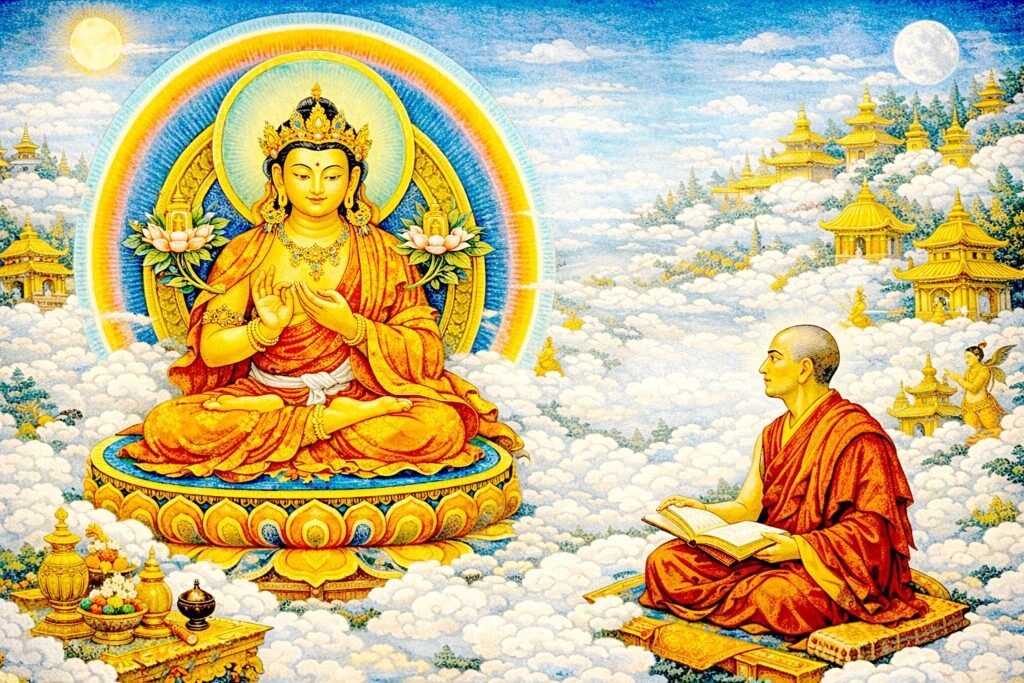
Figure 1: One of the most common motifs is the attribution of the text to bodhisattvas such as Asaṅga, who is traditionally said to have received the teaching directly from the Tuṣita heaven through the bodhisattva Maitreya.
I. Introduction: The Problem of Tantra
In the history of Buddhist studies, few terms have generated as much controversy and misunderstanding as “Tantra.” For many early twentieth-century Western scholars, as well as for a segment of modern readers, Tantra has often been perceived as a deviant phenomenon: either an obscure form of mysticism or a ritual system imbued with magical elements, sometimes even regarded as morally degenerate due to the presence of “transgressive” features within its texts. While such interpretations are not entirely without basis, they are frequently grounded in a literal reading of Tantric materials, detached from their distinctive philosophical and linguistic contexts.
At the same time, an opposing tendency has emerged: the attempt to defend Tantra by elevating it as the supreme mystical culmination of Buddhism, transcending all earlier forms of practice. Yet this approach risks falling into uncritical idealization, overlooking the historical, philological, and internal logical issues embedded within Tantric scriptures themselves. Between these two extremes—moral critique on the one hand and unconditional glorification on the other—a fundamental question remains insufficiently addressed:
What is Tantra within the context of Buddhist thought?
This question becomes particularly urgent when examining one of the central texts of the esoteric tradition: the Guhyasamāja Tantra. With its complex history and multilayered content, this text is regarded both as a foundational tantra within Vajrayāna and as a work that retains traces of earlier Mahāyāna modes of thought. It embodies elements that appear contradictory: on the one hand, a deeply symbolic language concerning wisdom and awakening; on the other, descriptions of practices that can easily be misunderstood when removed from their symbolic and philosophical frameworks.
Thus, the issue is not limited to determining the date or origin of the Guhyasamāja Tantra, but extends to understanding its nature as a form of thought. Is Tantra a rupture from earlier Buddhist traditions? Or is it an internal development in which preexisting Mahāyāna elements are reconfigured and expressed through a different language?
This study approaches the problem from a different perspective. Rather than asking where Tantra “comes from” in a purely historical sense, it asks what Tantra “is” at the level of cognitive structure, language, and practice. In other words, the focus is not on geography or transmission, but on the internal logic of Tantra as a system of thought.
The central thesis of this article is as follows:
Tantra is not a deviation or degeneration of Buddhism, but a profound reconfiguration of the tradition, in which concepts such as compassion, wisdom, and awakening are transformed from ethical and conceptual forms into symbolic structures and direct experience.
From this perspective, elements often regarded as “transgressive” in Tantra—such as twilight language (sandhyābhāṣā), the apparent violation of normative ethical conventions, or highly symbolic practices—are no longer signs of decline. Rather, they function as means for overcoming the limitations of dualistic thinking. Tantra, therefore, is not merely a ritual system or a textual genre, but a way of restructuring the entirety of cognitive experience.
To clarify this thesis, the article will examine in turn: the textual origins and traditions of the Guhyasamāja Tantra; the relationship between sūtra and tantra; the transformation of the Bodhisattva ideal; the role of “transgressive” elements within the framework of emptiness (śūnyatā); the distinctive features of symbolic language in Tantra; and finally, the concept of parāvṛtti as a model for the radical transformation of cognition.
Through this analysis, the article seeks to propose an alternative understanding of Tantra: not as an exotic or esoteric anomaly, but as one of the most radical efforts within Buddhism to articulate and enact a truth that transcends conceptual thought.
II. Text and Tradition: The Problem of Origins
One of the greatest difficulties in the study of the Guhyasamāja Tantra lies in what initially appears to be a simple question: when did this text emerge, and to which tradition does it belong? Yet as soon as this question is posed, we enter a complex intersection of history, myth, and strategies of authority construction within Buddhism.
In Tibetan traditions and certain Indian lineages, the Guhyasamāja Tantra is often associated with transcendent origins. One common motif attributes the text to bodhisattvas such as Asaṅga, who is said to have received the teaching directly from the Tuṣita heaven through the bodhisattva Maitreya. Such narratives are not merely religious stories; they function as mechanisms of legitimization. By linking Tantra to central figures of Mahāyāna, these traditions assert that esoteric teachings are not late innovations, but rather part of a continuous stream of awakening.
However, when we turn to philological analysis, a markedly different picture emerges. Available evidence suggests that the Guhyasamāja Tantra cannot plausibly be attributed to a specific historical author such as Asaṅga. The text does not appear in traditional catalogues of his works, nor is it clearly identified in Chinese or Tibetan sources as belonging to the Yogācāra corpus. Moreover, significant differences in linguistic style and conceptual structure between the Guhyasamāja Tantra and Asaṅga’s authenticated writings indicate that such attribution is more symbolic than historical.
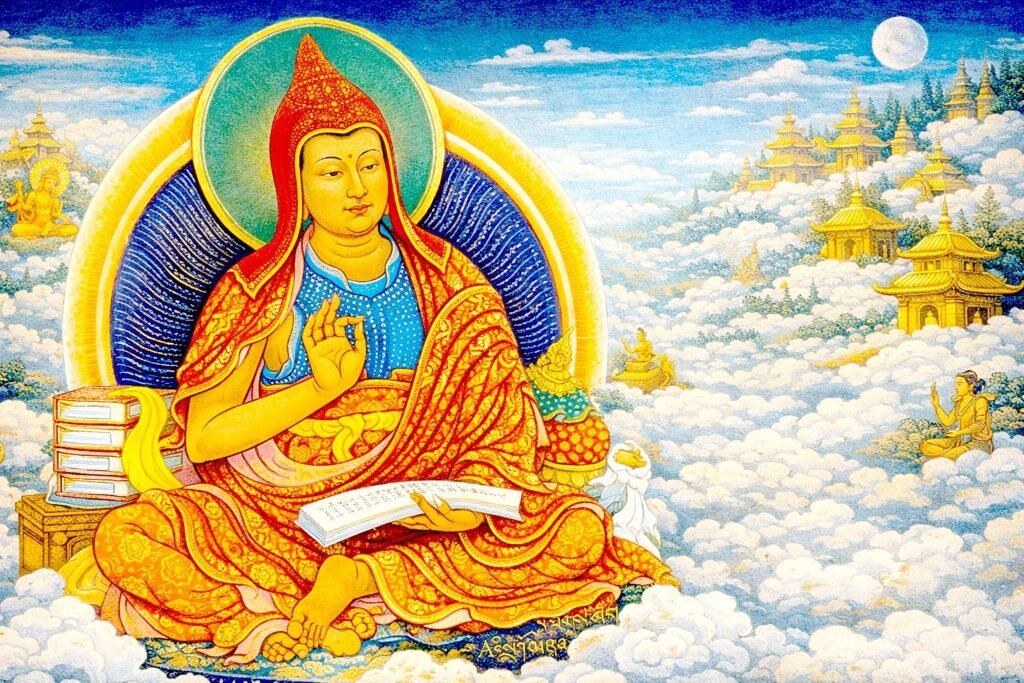
Figure 2: Asaṅga as a central figure of the Yogācāra tradition; despite later attributions linking him to the Guhyasamāja Tantra, textual and philological evidence indicates that such associations are better understood as symbolic constructions than historical fact.
This leads to an important observation: within the Buddhist context, “authorship” is not always understood in the modern sense of a historically identifiable individual. Rather, attributing a text to an authoritative figure often reflects an attempt to situate that text within a legitimate lineage. In other words, the crucial question is not “who wrote this text,” but “to which intellectual tradition does it belong, and how is it legitimized?”
With regard to dating, modern scholarship tends to converge on the view that the Guhyasamāja Tantra was composed or redacted into its current form between the eighth and tenth centuries. Chinese and Tibetan translations, which begin to appear from around the seventh century onward, provide important chronological markers, indicating that the text does not belong to the earliest phase of Buddhism. Nevertheless, establishing a precise point of origin remains difficult, as the text itself bears evidence of multiple layers of composition and transmission.
At this point, a simplistic conclusion must be avoided: the relatively late emergence of the Guhyasamāja Tantra as a text does not imply that its conceptual elements are entirely new. On the contrary, many of the components that constitute Tantra—ritual practices, mantra, symbolic forms, and psycho-physical methods—may have existed in dispersed forms within earlier Buddhist and broader Indian traditions, without yet being systematized into a unified structure. In this sense, Tantra should not be understood as a sudden innovation, but as a process of crystallization of elements accumulated over centuries.
Another crucial dimension of the problem of origins concerns the relationship between the Guhyasamāja Tantra and earlier Mahāyāna texts. In some sources, this text is described as a form of Vaipulya Mahāyāna Sūtra—that is, an “expanded discourse” within the Mahāyāna tradition. At the same time, it is referred to as Tathāgata-guhyaka, “the secret of the Tathāgata,” a designation that suggests an attempt to position Tantra as the inner, esoteric dimension of the Buddha’s own teaching.
This dual characterization indicates that the boundary between “sūtra” and “tantra” is not a sharply defined line, but a fluid zone of transition. Rather than existing as entirely separate genres, they may be understood as different modes of expressing a shared endeavor: the communication of a truth that transcends conceptual language. If sūtra tends toward discursive explanation and reasoning, tantra moves toward a form of expression grounded in symbol, ritual, and direct experience.
From this, an important conclusion can be drawn for the article as a whole:
The Guhyasamāja Tantra should not be understood merely as a “late” or “deviant” text, but as a point of convergence in which diverse streams of Buddhist thought, ritual, and symbolism are reconfigured into a new system.
This insight opens the way for the following sections. Rather than placing Tantra outside or in opposition to Mahāyāna, we must examine how it reshapes the central concepts of that tradition—from the Bodhisattva ideal, to emptiness (śūnyatā), and ultimately to the very structure of cognitive experience.
III. Between Sūtra and Tantra: A Fluid Boundary
If the question of the origins of the Guhyasamāja Tantra raises issues of “when” and “from where,” a deeper question must be addressed: to what category does this text truly belong within the Buddhist tradition? Is it a “tantra” in the strict sense, or does it still fall within the scope of Mahāyāna sūtra literature?
At first glance, the distinction between sūtra and tantra appears relatively clear. Sūtras are typically structured as dialogues, presenting doctrinal teachings through direct discourse, aiming to communicate truth by means of reasoning and metaphor. By contrast, tantra is characterized by ritual structure, symbolic language, and the presence of mantra, mudrā, maṇḍala, and esoteric forms of practice. From this perspective, tantra seems to represent a fundamentally different stage of development, even one that stands apart from earlier scriptural traditions.
However, when we examine the case of the Guhyasamāja Tantra more closely, this boundary begins to blur. In some sources, the text is described as a form of Vaipulya Mahāyāna Sūtra—that is, an “expanded discourse” within the Mahāyāna tradition. At the same time, it is also known as Tathāgata-guhyaka, meaning “the secret of the Tathāgata,” a designation that suggests an attempt to position its content as the innermost dimension of the Buddha’s teaching.
This dual characterization is not an accidental contradiction, but reflects a more fundamental reality: the division between sūtra and tantra is not an absolute boundary, but a continuous zone of transition. Within this transitional space, elements of the sūtra tradition—such as the doctrine of emptiness (śūnyatā), the Bodhisattva ideal, and dialogical structure—are gradually reconfigured and expressed through different means: ritual, symbolism, and embodied practice.
An important intermediary role in this process is played by dhāraṇī literature. Emerging in the later phases of Mahāyāna, these texts introduce elements such as mantra, repetitive formulae, and ritual forms of protection. Although not yet systematized to the extent seen in tantra, dhāraṇī texts reveal a clear trajectory: from the transmission of doctrine through discursive language toward the use of sound, rhythm, and symbol as transformative media.
In this context, tantra should not be understood as a sudden rupture, but as a stage in which preexisting tendencies reach a point of crystallization. This helps explain why the Guhyasamāja Tantra simultaneously retains familiar features of Mahāyāna while manifesting a radically different mode of expression. It does not abandon the scriptural tradition, but reconfigures how that tradition is articulated and practiced.
One important implication of this perspective is that tantra need not be viewed as a distinct textual genre. Rather, it can be understood as a mode of Buddhism. In this mode, doctrine is no longer primarily presented through conceptual discourse and reasoning, but through symbolic structures and direct experience. Elements such as maṇḍala, mantra, and ritual are not external additions to the teaching, but alternative forms of expressing the same truth—at a different level of cognition.
From this, a central conclusion can be drawn for the article as a whole:
Tantra is not a textual category separate from sūtra, but a reconfiguration of earlier scriptural forms—from language to symbol, from reasoning to practice, and from interpretation to direct experience.
This insight prepares the ground for the next section, where we will examine one of the most profound transformations within this process: the shift of the Bodhisattva ideal from an outward-oriented ethical model to an internal structure of cognition within the Tantric tradition.
IV. From Ethics to Esotericism: The Transformation of the Bodhisattva Ideal
In the Mahāyāna tradition, the Bodhisattva ideal is typically presented as a distinctly outward-oriented ethical model. Texts such as Śāntideva’s Śikṣāsamuccaya emphasize qualities such as unconditional compassion, self-sacrifice, and active engagement in the world for the liberation of sentient beings. Here, ethical action is not merely a means, but a direct expression of awakened wisdom. A Bodhisattva is recognized through concrete acts: giving, protecting, healing, and willingly bearing the suffering of others.
However, when we turn to the Guhyasamāja Tantra, this image no longer appears with the same clarity. Detailed descriptions of ethical conduct, which occupy a central role in earlier Mahāyāna texts, become attenuated or even absent. Instead, the text foregrounds elements such as maṇḍala, mantra, ritual, and esoteric modes of practice. This shift can easily give rise to a hasty conclusion: that Tantra has weakened or even abandoned the Bodhisattva ideal.
Yet such a reading overlooks a more subtle transformation occurring within the structure of thought itself. The issue is not the disappearance of ethics, but the transformation of its form. If in earlier Mahāyāna texts compassion is expressed through outward-directed action, in Tantra it is internalized and integrated into the very structure of the practitioner’s cognition.
In other words, rather than asking “What does a Bodhisattva do?”, Tantra asks, “How does a Bodhisattva see the world?” This shift marks a movement from ethical action to epistemology. Within this framework, the liberation of beings is no longer understood primarily as a sequence of discrete actions, but as the natural outcome of a mode of perception that transcends duality.
This transformation can be illustrated through the structure of the maṇḍala in the Guhyasamāja Tantra. Within the maṇḍala, the practitioner no longer stands as a separate subject who “helps” external objects, but instead identifies with an integrated totality in which Buddhas, Bodhisattvas, and sentient beings are no longer divided in conventional terms. Here, compassion is no longer an action directed from “self” to “other,” but an intrinsic quality of non-dual cognition itself.
This shift may also be understood as an extension of Mahāyāna logic. If, in Madhyamaka philosophy, all phenomena are devoid of intrinsic nature (svabhāva), then the distinction between “one who saves” and “one who is saved” cannot possess any fixed foundation. Tantra does not reject the ideal of liberation; rather, it radicalizes it. When subject and object are no longer fixed, the act of saving ceases to be a volitional deed and becomes the spontaneous expression of a cognition that has transcended all distinctions.
From this perspective, the apparent “silence” of the Guhyasamāja Tantra regarding conventional ethical conduct is not a sign of decline, but of a shift in semantic register. Ethics does not disappear; it is translated into a different language—the language of symbol, ritual, and direct experience.
Thus, instead of opposing Mahāyāna and Tantra as two contradictory stages, we may understand their relationship as a continuous process: from outward-directed ethics → to internal cognitive structure, from concrete action → to the transformation of how the world is experienced.
This conclusion carries significant implications for the article as a whole. It demonstrates that Tantra does not abandon the Bodhisattva ideal, but represents one of the most radical attempts to reinterpret it at a deeper level—where compassion is no longer a moral obligation, but an intrinsic and inevitable quality of transformed cognition.
V. Transgression and Emptiness: Rethinking “Transgression” in Tantra
Among the elements that render Tantra controversial, none are more striking than passages that appear to contradict conventional moral norms. Texts such as the Guhyasamāja Tantra contain instructions involving substances considered impure, references to extreme forms of conduct, and even statements that seem to permit the violation of fundamental precepts. For modern readers—and even for early twentieth-century scholars—such features have often led to the conclusion that Tantra represents a degeneration of Buddhist ethics.
However, this interpretation largely rests on an implicit assumption: that the statements in these texts are to be read literally, as prescriptions for behavior. Once this assumption is called into question, the entire structure of meaning surrounding these so-called “transgressive” elements begins to shift.
The starting point for this reinterpretation lies in a central principle of Mahāyāna thought: emptiness (śūnyatā). In the Madhyamaka tradition, all phenomena lack intrinsic existence; distinctions such as pure and impure, good and evil, subject and object exist only at the level of convention. If this is accepted as a philosophical principle, an unavoidable question follows: what happens when this principle is applied not only in thought, but within the very structure of lived experience?
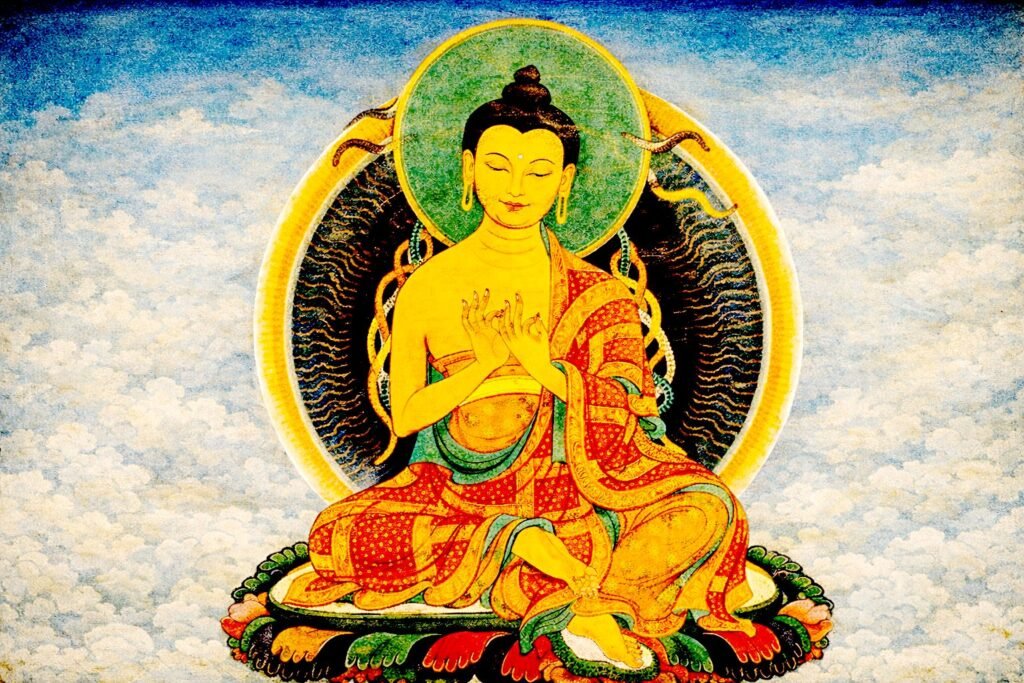
Figure 3: Nāgārjuna, the foundational philosopher of the Madhyamaka tradition, whose doctrine of emptiness (śūnyatā) provides the philosophical basis for later Tantric reinterpretations of duality and transgression.
It is precisely at this point that Tantra emerges as a radical extension of the logic of emptiness. The “transgressive” elements found in the Guhyasamāja Tantra are not intended to encourage unethical behavior, but to disrupt attachment to dualistic distinctions that are ordinarily taken for granted. When practitioners are instructed to confront what is considered “impure” or “taboo,” the aim is not literal enactment, but the recognition that the distinction between “pure” and “impure” lacks any fixed foundation.
In this context, “transgression” is not the collapse of ethics, but a cognitive instrument. It compels the practitioner to confront the limits of the conceptual categories through which the world is ordinarily defined. If in Mahāyāna emptiness is primarily articulated through philosophical reasoning, in Tantra it is brought into experience through symbolic and ritual structures.
At the same time, a crucial distinction must be maintained: interpreting “transgressive” elements in epistemological terms does not entail their justification at the level of behavior. Within the Buddhist tradition, Tantric practices are always situated within strict conditions—ethical discipline, guidance by a qualified teacher, and the appropriate level of spiritual maturity. When removed from these conditions, symbolic elements can be misunderstood, giving rise to interpretations that deviate from, or even contradict, the fundamental spirit of Buddhism.
Thus, “transgression” in Tantra cannot be understood as an invitation to violate ethical norms, but as a context-dependent cognitive strategy, meaningful only within a specific framework of practice. Once extracted from that context, it ceases to function as a means of deconstructing duality and instead becomes a source of misunderstanding.
From this perspective, Tantra does not abolish ethics, but repositions it. If in earlier stages ethics functions to guide behavior and purify the mind, in Tantra it is integrated into a broader structure in which the goal is no longer the formal adherence to rules, but the transformation of the very cognitive foundations from which such rules arise.
This leads to an important conclusion:
“Transgression” in Tantra is not the negation of ethics, but a means of exposing the conventional nature of ethical categories—thereby opening the possibility of cognition beyond duality.
VI. Sandhyābhāṣā: Language at the Limits of Meaning
One of the greatest difficulties in approaching Tantric texts lies not in their content, but in the way that content is expressed. Extreme statements, shocking imagery, and instructions that appear to contradict conventional morality are not merely issues of “meaning,” but of language itself. If the Guhyasamāja Tantra is read as a text of direct description, misunderstanding is almost inevitable.
For this reason, the Tantric tradition developed a key concept to describe its distinctive mode of expression: sandhyābhāṣā, often translated as “twilight language” or “intentional language.” This term does not simply denote ambiguity; rather, it reflects a structure of expression in which each statement operates simultaneously on multiple levels of meaning.
At the surface level, sandhyābhāṣā may appear irrational, paradoxical, or even offensive. Yet at a deeper level, it functions as a symbolic system in which terms and images are not intended to describe reality in the ordinary sense, but to induce a shift in the practitioner’s cognition. In other words, this is not a language for transmitting information, but a language for transforming perception.
This helps explain why many elements in Tantra cannot be understood when isolated from their practical context. Terms related to the body, sexuality, or “impure” substances often do not carry literal meaning, but instead serve as symbols for internal processes or philosophical principles, such as the union of wisdom (prajñā) and skillful means (upāya). When read literally, they become misleading; when situated within a symbolic framework, they open entirely different layers of meaning.
From this perspective, sandhyābhāṣā is not an arbitrary choice, but a necessity. What Tantra seeks to articulate—especially non-dual experience—cannot be fully captured by ordinary conceptual language. Conventional language operates through distinctions: subject and object, right and wrong, pure and impure. Tantra, however, aims at a level of cognition in which these distinctions are transcended. To rely on ordinary language would therefore be to contradict its own aim.
In this sense, sandhyābhāṣā is not a language of concealment, but a language of threshold. It does not aim to hide meaning from the reader, but to protect meaning from being reduced to conceptual categories. For this reason, a single Tantric statement may carry entirely different meanings depending on the level of understanding of the reader. For the unprepared, it may appear as a sequence of obscure images; for the practitioner, it becomes a map of experience.
Yet this very feature also gives rise to a paradox. If Tantric language is highly symbolic and multi-layered, the risk of misinterpretation becomes unavoidable. Scholars have long raised the question of whether such a mode of expression is inherently problematic, given its susceptibility to radically divergent interpretations. This concern is not unfounded, as history demonstrates that the removal of symbolic elements from their practical context can lead to distorted understandings of Tantra.
Nevertheless, this paradox reflects a deeper reality: the closer language approaches the limits of experience, the more unstable it becomes. Tantra is not unique in this regard; many philosophical and religious traditions have resorted to paradox, metaphor, and symbolism to express what cannot be said directly. Within this broader context, sandhyābhāṣā may be understood as one of the most systematic attempts to confront the limits of language.
From this, an important conclusion can be drawn for the article as a whole:
The language of Tantra is not a superficial layer covering its content, but an integral part of that content itself—a means not only of expression, but of cognitive transformation.
This insight allows us to revisit the controversial elements discussed in earlier sections from a different perspective. What initially appears irrational or transgressive is no longer a problem to be resolved at the level of ethics, but a symbolic structure to be interpreted in relation to the cognitive aims of Tantra.
VII. Parāvṛtti: The Radical Transformation of Cognition
Having examined the issues of textuality, ethics, and language in the Guhyasamāja Tantra, a final question becomes unavoidable: what do all these elements—from “transgression” to twilight language—ultimately aim at? If they are not intended to undermine ethics, nor merely to function as esoteric symbolism, what role do they play within the overall structure of Tantra?
A useful approach to this question lies in the concept of parāvṛtti, often translated as a “turning about” or “reversal” of cognition. In certain Mahāyāna traditions, particularly Yogācāra, parāvṛtti refers to a radical transformation of consciousness (vijñāna), in which the dualistic foundation of cognition is overturned, giving rise to an entirely different mode of experiencing reality.
When this concept is brought into the context of Tantra, it becomes clear that the entire structure of the Guhyasamāja Tantra—including ritual, maṇḍala, mantra, and even “transgressive” elements—should not be seen as disparate components, but as coordinated means designed to activate a process of parāvṛtti. In other words, Tantra does not merely convey a system of thought; it seeks to reconfigure the very way in which the practitioner experiences the world.
In ordinary cognition, human experience is structured through binary oppositions: subject and object, pure and impure, right and wrong. These distinctions are not only tools of understanding, but also serve as the foundation for ethics, behavior, and the overall organization of lived reality. Yet from a Buddhist perspective—especially within Madhyamaka—such distinctions lack intrinsic existence; they operate only at the level of convention.
Parāvṛtti, in this sense, does not involve replacing one set of concepts with another, but rather reversing the very mechanism that generates conceptualization. When the division between subject and object is recognized as lacking any independent ground, the entire structure of experience is transformed. The world is no longer encountered as a collection of discrete objects, but as a network of interrelations, in which all distinctions are provisional.
It is within this framework that the elements of Tantra become intelligible. The maṇḍala is not merely a ritual diagram, but a symbolic structure representing a world reorganized according to non-dual cognition. Mantra is not simply sacred sound, but a means of interrupting conceptual thought, opening a more immediate mode of engagement with experience. Even “transgressive” elements can be understood as cognitive shocks, forcing the practitioner to confront the limits of habitual distinctions.
From this perspective, Tantra is not an addition to Buddhism, but an attempt to accelerate and deepen a process of cognitive transformation already grounded in Mahāyāna. While traditional sūtra literature guides practitioners step by step toward the realization of emptiness through analysis and meditation, Tantra seeks to place the practitioner directly within a structure of experience in which dualistic distinctions are already deconstructed.
This also explains why Tantra is often described as a “swift path.” The “swiftness” here does not refer to a reduction in time, but to a shift in method: rather than gradually dismantling layers of cognition, Tantra employs powerful means to reconfigure the entire cognitive system in a single, integrated movement.
At the same time, precisely because of its radical nature, parāvṛtti in Tantra cannot be understood as a simple technique to be applied arbitrarily. It requires a firm foundation in ethics, insight, and proper guidance. Without these conditions, the very means designed to deconstruct cognition may instead give rise to confusion rather than liberation.
Thus, it may be said that the entire structure of the Guhyasamāja Tantra is oriented toward a single aim: not the modification of isolated behaviors, but the radical transformation of how reality is experienced.
In this sense, Tantra is neither merely a ritual system nor a collection of esoteric symbols, but a form of cognitive technology—a set of means designed to bring about a fundamental reversal of cognition.
This conclusion allows us to revisit the entire article from a unified perspective. What initially appeared as disparate elements—complex history, obscure language, and controversial imagery—can now be understood as components of a coherent structure, all oriented toward a single objective: parāvṛtti.
VIII. Conclusion: Tantra as a Reconfiguration of Buddhist Thought
The analyses presented in the preceding sections demonstrate that the Guhyasamāja Tantra cannot be adequately understood if it is confined within the familiar classificatory frameworks of Buddhist studies—as a “late” text, a ritual system, or an anomalous form of mysticism. When read in its full structural context, Tantra does not appear as a deviation, but as a profound reconfiguration of the Buddhist tradition itself.
One of the primary sources of misunderstanding lies in the tendency to read Tantra according to standards derived from earlier scriptural forms. When approached as a system that describes doctrine in conventional terms, elements such as “transgression,” symbolic language, and ritual structures are easily interpreted as signs of degeneration or distortion. However, as this article has shown, these elements are not deviations, but the result of a deeper transformation: a shift from conceptual language to cognitive structure.
Within this framework, the boundary between sūtra and tantra is no longer absolute. Rather than representing two opposing genres, they may be understood as distinct modes of expression of a shared endeavor: the articulation and enactment of a truth that transcends duality. If sūtra operates primarily through explanation and analysis, tantra moves toward an experiential mode of expression, in which symbolic and ritual structures assume a central role.
This difference becomes especially evident in the way Tantra engages with ethics and language. “Transgressive” elements, when situated within the framework of emptiness, are no longer the negation of ethics, but means of revealing the conventional nature of ethical categories. Likewise, twilight language (sandhyābhāṣā) is not a strategy of concealment, but an effort to move beyond the limits of conceptual language, enabling the articulation of what cannot be directly stated.
All these elements converge in the concept of parāvṛtti—the radical transformation of cognition. It is here that Tantra reveals its deepest nature: not as a collection of discrete practices, but as a system aimed at reconfiguring the entire way in which reality is experienced. When the division between subject and object is deconstructed, categories such as right and wrong, pure and impure, no longer retain absolute status. What remains is not chaos, but a new mode of seeing, in which distinctions are recognized as provisional constructs of cognition.
From this perspective, Tantra cannot be reduced to a historical phenomenon or a ritual tradition. It represents one of the most radical efforts within Buddhism to confront a fundamental problem: how to transcend the very cognitive structures that generate a dualistic world. If earlier phases of Buddhism focus on analyzing and dismantling these structures layer by layer, Tantra seeks to enact a total shift—a reversal in the very way the world is experienced.
This perspective also allows Tantra to be situated within a broader intellectual context beyond Buddhist studies. In an era when fields such as cognitive science, philosophy of mind, and consciousness studies are grappling with the nature of subjective experience, Tantra may be read as a distinctive system of reflection on the transformation of cognition. Although articulated in symbolic and religious language, it engages questions that modern philosophy and science continue to explore.
At the same time, such a reading requires careful restraint. As emphasized throughout this article, interpreting Tantric elements does not entail legitimizing them at the level of behavior. The distinction between analysis and justification must be maintained with clarity; otherwise, the very tools designed to deconstruct cognition may be misunderstood and misapplied.
Accordingly, the aim of this article has not been to evaluate Tantra according to modern ethical standards, nor to defend or critique it, but to clarify its internal logic as a distinctive form of Buddhist thought. Within this framework, the Guhyasamāja Tantra no longer appears as an obscure or controversial text, but as one of the most coherent and radical attempts to articulate and enact a truth that lies beyond conceptual thought.

Figure 4: The north face of Mount Everest in the Himalayas — used here as a visual analogy for the limits of conceptual frameworks, rather than as an emblem of spiritual transcendence. Source: Wikimedia Commons
Related Studies:
Bibliography
Davidson, Ronald M. Indian Esoteric Buddhism: A Social History of the Tantric Movement. New York: Columbia University Press, 2002.
Flood, Gavin. The Tantric Body: The Secret Tradition of Hindu Religion. London: I.B. Tauris, 2006.
Garfield, Jay L. The Fundamental Wisdom of the Middle Way: Mūlamadhyamakakārikā. New York: Oxford University Press, 1995.
Gray, David B. The Cakrasaṃvara Tantra: The Discourse of Śrī Heruka. New York: American Institute of Buddhist Studies, 2007.
Guhyasamāja Tantra. In The Guhyasamāja Tantra: Sanskrit Text and Tibetan Translation, edited and translated by Yukei Matsunaga. Osaka: Toho Shuppan, 1978.
Nāgārjuna. Mahāprajñāpāramitāśāstra (Da zhidu lun 大智度論). Taishō Tripiṭaka, no. 1509.
Samuel, Geoffrey. The Origins of Yoga and Tantra: Indic Religions to the Thirteenth Century. Cambridge: Cambridge University Press, 2008.
Śāntideva. Śikṣāsamuccaya: A Compendium of Buddhist Doctrine. Translated by Cecil Bendall and W. H. D. Rouse. Delhi: Motilal Banarsidass, 1971.
Wayman, Alex. Yoga of the Guhyasamājatantra: The Arcane Lore of Forty Verses. Delhi: Motilal Banarsidass, 1977.