
Le Hoang Da
Independent Philosopher & Buddhist Scholar
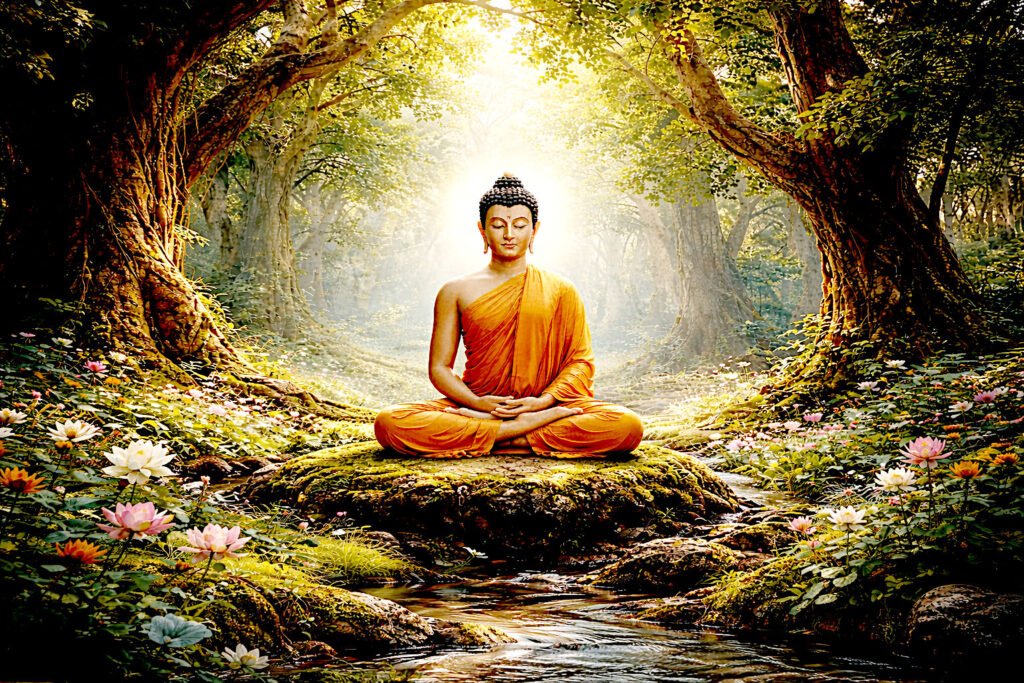
Jhāna as a meditative stillness between mind and world
I. The Problem of Interpreting Jhāna in Early Buddhist Studies
In the history of Buddhist scholarship, meditation (jhāna) has often been understood as a technique of mental concentration—a method for regulating the stream of thought in order to attain tranquility and unification of mind. This interpretation, particularly prevalent in the twentieth century, tends to situate jhāna within the framework of empirical psychology: it is seen as a process of reducing distraction, suspending the operation of vitakka–vicāra, and culminating in an increasingly refined structure of consciousness. Within this reading, jhāna is regarded as a stage in the path of practice, preparing the ground for the arising of wisdom (paññā), and carrying no transcendent function beyond serving as a foundation for seeing things as they truly are.
However, when the Nikāyas are examined more comprehensively, the picture appears far less straightforward. Jhāna occurs with striking frequency in the discourses, not only in contexts of internal cultivation but also in connection with forms of knowledge referred to as “higher knowledges” (abhiññā): recollection of past lives, the divine eye, the divine ear, and the knowledge of the destruction of the taints. The texts also describe interactions between accomplished meditators and celestial beings (deva), as well as the capacity to “see” the arising and passing of beings according to their kamma. These textual data raise an important question: if jhāna were merely a psychological technique of self-regulation, why would it function as the foundation for experiences with such a pronounced cosmological dimension?
The issue becomes even more complex when we consider the linguistic structure of the jhāna formulas in Pāli. In many instances, the texts do not emphasize a “meditator” as an ontologically established subject, but rather describe a process: “secluded from sensual pleasures, secluded from unwholesome states, he enters and abides…” The shift in focus from the “person” to the “state” suggests that jhāna is not the perfection of a self, but a reconfiguration of the structure of experience itself. If this is so, we must reconsider the question: how does jhāna operate in relation to mind and world? Is it a withdrawal into interiority, or an expansion of the scope of being?
This article does not seek to restore a metaphysical conception of a soul or enduring substance. Nor does it accept the reduction of jhāna to a purely psychological technique. Rather, its aim is to examine the function of jhāna in the Nikāyas as an intermediate structure—a mode of experience situated “between Mind and World.” Through textual analysis, we will explore how jhāna is presented as the foundation for higher knowledges, as the condition for inter-worldly interactions, and as a process that attenuates the structure of the “person” without collapsing into nihilism.
The central question of this study may therefore be formulated as follows: within the context of early Buddhism, is jhāna merely a method of mental training, or does it constitute a form of experiential restructuring that enables an expansion of human cognition without presupposing an immutable self? Addressing this question not only clarifies the role of meditation in the Nikāyas, but also contributes to the broader discussion concerning the structure of subjectivity and the continuity of experience in early Buddhist thought.
II. Jhāna in the Textual Structure of the Nikāyas
To understand the function of jhāna in early Buddhism, one must first examine how it appears within the textual structure of the Nikāyas. A general survey reveals that jhāna is not a peripheral or secondary element, but a central component in numerous discourses of the Dīgha Nikāya, Majjhima Nikāya, Saṃyutta Nikāya, and Aṅguttara Nikāya. The formula of the four jhānas is repeated with remarkable consistency, often appearing as part of a normative progression of practice leading to deeper stages of cognition.
The standard formulation begins with the phrase: “So vivicceva kāmehi vivicca akusalehi dhammehi…”—“Secluded from sensual pleasures, secluded from unwholesome states…” It then describes the entering and abiding in the first jhāna, characterized by vitakka and vicāra, together with pīti and sukha born of seclusion. The subsequent stages successively abandon vitakka–vicāra, then pīti, and finally both sukha and dukkha, leaving only upekkhā-sati-parisuddhi in the fourth jhāna.
What is noteworthy here is that the structure of presentation emphasizes process rather than subject. The texts do not describe a “person” undergoing an ontological transformation, but rather a sequence of conditions that are relinquished or refined. Vitakka and vicāra are not suppressed by a stronger ego; they simply subside. Pīti is not rejected as an enemy but transcended as a state that has fulfilled its function. This structure suggests an internal dynamics of experience rather than a process of self-perfection.
Moreover, in many discourses jhāna is not presented as an end in itself. It often appears as a stage within a broader progression: virtue (sīla), concentration (samādhi), and wisdom (paññā). Yet concentration here is not an abstract notion; it is concretized through the four jhānas. This indicates that within the structure of early practice, jhāna functions as the normative realization of samādhi.
Another significant feature is the stability of the jhāna formula across diverse contexts. Whether a discourse concerns ethics, epistemology, or cosmology, the fourfold formula remains largely unchanged. Such consistency suggests that jhāna is not an arbitrary addition, but part of a core tradition preserved with considerable care.
More importantly, the placement of jhāna within the narrative flow of major discourses is revealing. In some cases, the description of the four jhānas is immediately followed by the higher knowledges (abhiññā) or by the knowledge of the destruction of the taints. Elsewhere, jhāna appears as a prerequisite condition enabling a monk to “abide” firmly in the path. This suggests that jhāna is not merely a temporary psychological state, but a foundational structure for deeper forms of cognition.
From a grammatical and narrative perspective, it is also significant that jhāna is described with the verb upasampajja viharati—“enters and abides.” These two elements carry important implications: not only attaining a state, but sustaining it in stability. Jhāna is thus not a fleeting moment of ecstatic absorption, but a mode of being maintained over time.
Taken as a whole, the textual structure of the Nikāyas portrays jhāna as a systematic process articulated in the language of conditions and transformation, without privileging a metaphysical self. At the same time, its stability and centrality across diverse contexts demonstrate that it cannot be reduced to a merely auxiliary technique. It is precisely this tension—between processual dynamics and foundational significance—that prepares the ground for a broader examination of jhāna’s function in the sections that follow.
III. Jhāna and the Higher Knowledges (Abhiññā)
If the Nikāyas are examined only at the level of describing the four absorptions, one might easily conclude that jhāna is merely a technique of psychological refinement. However, when jhāna is situated within the broader context of passages concerning the abhiññā (higher knowledges), a different perspective gradually emerges. In many discourses of the Dīgha Nikāya and the Majjhima Nikāya, the four jhānas are presented not as ends in themselves, but as the foundation for the arising of forms of knowledge that exceed ordinary experience.
The typical structure described in these texts unfolds as follows: after firmly abiding in the fourth jhāna, the monk “directs his mind” (cittaṃ abhininnāmeti) toward a particular object. From this deeply concentrated state, the capacities known as the chaḷabhiññā (six higher knowledges) are developed. These include psychic powers (iddhividha), the divine ear (dibbasota), knowledge of others’ minds (cetopariyañāṇa), recollection of past lives (pubbenivāsānussatiñāṇa), the divine eye (dibbacakkhu), and finally the knowledge of the destruction of the taints (āsavakkhayañāṇa).
It is noteworthy that among these higher knowledges, only āsavakkhayañāṇa—the knowledge of the destruction of the taints—is directly related to ultimate liberation. The others represent an expansion of cognition: they concern memory of past existences, the rebirth of beings, and forms of perception that surpass the limits of ordinary sensory experience. If jhāna were merely a self-enclosed psychological technique, it would be difficult to explain why the texts consistently present it as a prerequisite condition for such modes of knowing.
Another point of importance lies in the dynamic structure of this process. The texts do not describe the higher knowledges as supernatural “gifts” bestowed from outside, but as outcomes of directing the mind within a state of concentration that has been stabilized and purified. This indicates an intrinsic relationship between jhāna and the expansion of cognition: it is precisely the restructuring of experience in meditative absorption that enables other forms of knowledge to arise.
Alongside the system of the chaḷabhiññā, the Nikāya tradition also records another triadic framework known as the tevijjā (three knowledges): recollection of past lives, the divine eye, and the knowledge of the destruction of the taints. In many discourses—especially those recounting the Buddha’s night of awakening—these three knowledges are described as stages of insight arising after abiding in the fourth jhāna. This structure further reinforces the view that jhāna is not a point of arrival, but the foundation for a transformative cognitive process.
The question then arises: how should these higher knowledges be understood? A reductive approach might interpret them as mythological symbols or as products of religious imagination. Yet such a reading risks flattening the internal structure of the texts. The Nikāyas present these forms of knowledge as conditionally arising from a meditative process described in detail and repeated with remarkable consistency. This systematic presentation suggests that, within the understanding of the early community, jhāna carried a function extending beyond that of a mere technique of tranquility.
More importantly, the connection between the higher knowledges and liberating insight must be emphasized. The knowledge of the destruction of the taints—the culmination of the chaḷabhiññā—does not stand apart from the preceding process, but arises within the same dynamic continuum. This indicates that jhāna expands cognition not only horizontally (through capacities such as the divine eye or recollection of past lives), but also vertically—toward the complete cessation of defilements. It is precisely this conjunction of cognitive expansion and liberative culmination that grants jhāna its distinctive place within the structure of early Buddhist practice.
From a functional perspective, jhāna may thus be understood as a distinctive cognitive ground: a state in which the structure of experience becomes sufficiently clarified and stabilized for forms of knowing beyond the ordinary to emerge. This interpretation does not require positing a metaphysical self, yet neither does it permit reducing jhāna to a technique of psychological relaxation. Rather, it reveals jhāna as a condition for the expansion of the scope of cognition—a mediating step between interior experience and a wider horizon of reality.
Analyzing the relationship between jhāna and abhiññā therefore opens a new avenue of interpretation. Instead of viewing meditation as a process of withdrawal into interiority, we may understand it as a restructuring of experience that renders other dimensions of existence knowable. On this basis, the question of the relationship between jhāna and the world—particularly the world of other realms of existence—can now be examined in greater depth in the following section.
IV. Jhāna and the World of Existential Realms
Within the Nikāyas, the relationship between jhāna and realms of existence beyond ordinary sensory experience is not marginal, but appears with notable frequency. Numerous discourses describe monks who, after firmly abiding in meditative absorption, are able to “see” the arising and passing of beings according to their kamma, or to communicate with celestial beings (deva). Such passages raise an important question: how should the function of jhāna be understood when it is presented as the condition for inter-realm interaction?
First, it must be acknowledged that in many discourses, celestial beings are portrayed as real entities within the cosmological structure assumed by the Nikāyas. They are not described as psychological symbols, but as agents capable of hearing, speaking, encouraging, and engaging in dialogue. In the Saṃyutta Nikāya, entire chapters record visits of devas who approach the Buddha to pay homage or pose questions. Elsewhere, monks are said—through the development of deep concentration—to “approach” celestial realms or to discern the destinies of beings reborn in various spheres of existence.
Significantly, these interactions are frequently placed after the formula of the four jhānas. Following the description of abiding in the fourth jhāna, the text continues by stating that “with the mind concentrated, purified, and unblemished…” the practitioner directs attention toward knowledge of other realms. This connection is not incidental. It suggests that, within the understanding of the early community, jhāna functions as a condition enabling perception beyond the ordinary limits of the senses.
Yet a crucial distinction must be maintained between “access” and “union.” The Nikāyas do not portray jhāna as absorption into a cosmic substance or supreme ātman. There is no language suggesting that the meditator becomes part of a deity or dissolves into a metaphysical absolute. Rather, jhāna is presented as a state in which the structure of experience becomes sufficiently stable and clarified for other dimensions of existence to become objects of knowledge.
Another important element concerns the description of the “divine eye” (dibbacakkhu). After abiding in meditative absorption, the practitioner is said to “see beings passing away and being reborn, inferior and superior, beautiful and ugly…” This knowledge is not framed as a supernatural revelation granted from outside, but as a capacity arising from the development of concentrated mind. This suggests that jhāna not only calms the mind, but restructures cognitive capacity in an expansive direction.
If these passages are read purely as mythology, one risks overlooking the internal structure of the texts. Conversely, if they are interpreted entirely as psychological metaphor, the cosmological dimension clearly presupposed in the Nikāyas is flattened. A more cautious approach is to understand jhāna as a mode of access—a form of experience in which other layers of existence become knowable without presupposing an immutable self at the center.
Of particular significance here is the relationship between jhāna and the form realms (rūpa-loka). In certain discourses, the stages of absorption are correlated with corresponding realms of rebirth: one who abides in the first jhāna may be reborn in the Brahmā worlds, and so forth. This indicates that jhāna is not merely a transient psychological state, but is correlated with the broader cosmological framework of early Buddhism. Yet such correlation does not entail the reintroduction of a “soul” migrating from realm to realm; rather, it reflects a conception of continuity grounded in kamma and the structured conditions of experience.
When jhāna is thus situated in relation to the world of existential realms, an intermediate model emerges. Jhāna is neither an inward withdrawal into sealed interiority nor a metaphysical fusion with an ultimate reality. It operates as a cognitive ground enabling interaction between subjective experience and the cosmological structure assumed in the Nikāyas. It is precisely within this tension—between interiority and world, between psychological process and cosmology—that the distinctive function of jhāna becomes increasingly apparent.
This analysis leads to an important conclusion: within the early context, jhāna cannot be fully understood if isolated from the cosmological vision articulated in the Nikāyas. It is not a self-contained interior technique, but a mode of experience that situates the practitioner in a position capable of recognizing multiple layers of existence. Yet this expansion does not rely on a permanent essence, but on the restructuring of the conditions of cognition.
From this point, the question of the “disappearance of the person” within the structure of meditative absorption becomes unavoidable: if jhāna enables an expansion of existential scope without restoring a soul, how, then, is the role of the subject to be understood within this process?
V. The “Disappearance of the Person” in the Structure of Meditative Absorption
One of the most striking features of the Nikāya descriptions of jhāna is the absence of a subject affirmed in ontological terms. The meditative formula does not speak of a “soul” or “self” being purified and perfected; rather, it describes a sequence of conditions that are relinquished, calmed, and transcended. Vitakka and vicāra subside; pīti is surpassed; sukha gives way to upekkhā-sati-parisuddhi. This structure suggests a conditional process rather than the refinement of a central entity.
When compared with ancient Indian Yoga traditions, the contrast becomes clearer. In many yogic systems, meditation aims at the realization of ātman or puruṣa as a reality distinct from body and mind. Liberation consists in recognizing one’s true essence. By contrast, in the Nikāyas there is no language affirming an enduring reality discovered within jhāna. Instead, meditation is portrayed as a process of restructuring psychological and cognitive elements.
This absence, however, should not be understood as a simple negation of the “person” in an existential sense. The Nikāyas do not deny subjective experience; they merely refrain from positing a metaphysical subject standing outside the process. When the text states that “he enters and abides,” the emphasis falls not on an immutable self, but on a state sustained through conditions. The subject is not erased, but understood as a functional structure operating within experiential processes.
This has significant implications for how we interpret the function of jhāna. If there is no central soul being purified, meditation cannot be construed as the perfection of a self. Rather, it is a reorganization of the conditions that constitute subjective experience. When vitakka–vicāra subside, when pīti and sukha are transcended, what changes is not the being of the practitioner, but the structure of experience within which consciousness operates.
It is precisely within this restructuring that the relationship between subject and world is also recalibrated. In ordinary states, experience is shaped by emotional reactivity and attachment; in jhāna, this structure becomes clarified and stabilized. Yet this does not imply that the subject dissolves into nothingness. On the contrary, one might say that the subject undergoes a reduction of ontological density: it is no longer conceived as a permanent substance, yet it continues to function as a reference point within experience.
In this sense, the “disappearance of the person” should be understood as a shift of emphasis. Rather than grounding liberation in the discovery of a true self, the Nikāyas ground it in insight into the conditionality of experience. Jhāna contributes to this process by attenuating the structure of self-identification that sustains the illusion of an independent “I.” Yet this attenuation does not annihilate subjectivity; it repositions it within a network of conditions.
Thus, within the structure of early meditative practice, the “person” is not abolished in an existential sense, but no longer occupies a central ontological role. What is emphasized is not a saved entity, but a clarified process. It is precisely this transformation that allows jhāna to function as an intermediate mode: it affirms no soul, yet avoids nihilism. Instead, it opens a different understanding of subjectivity—as a dynamic configuration within the flow of conditioned experience.
From this point, we may take a further step: if jhāna both attenuates the structure of the “person” and expands the scope of cognition, then it is not merely an inward technique, but a mode that situates the subject in a new position between mind and world. This mediating role will be examined more fully in the following section.
VI. Jhāna as an Intermediate Structure Between Mind and World
From the foregoing analyses, it becomes evident that jhāna in the Nikāyas cannot be adequately understood if confined to the domain of interior psychology, nor can it be equated with a metaphysical experience of union with a cosmic essence. Jhāna operates within an intermediate zone: it restructures subjective experience while simultaneously opening the possibility of cognizing broader dimensions of existence.
First, on the inward level, jhāna is a process of refining conditions. Vitakka–vicāra subside, pīti is transcended, and sukha gives way to upekkhā-sati-parisuddhi. This progression indicates that jhāna does not aim to reinforce a self, but gradually attenuates the elements that sustain attachment and self-identification. The subject is not denied, but repositioned within the conditional structure of experience. In this respect, jhāna differs fundamentally from traditions that seek to uncover an enduring entity hidden behind body and mind.
Yet jhāna does not stop at calming the mind. In numerous Nikāya contexts, it is presented as the foundation for higher knowledges and for the recognition of other planes of existence. This suggests that jhāna does not merely narrow experience into interiority, but simultaneously expands the scope of cognition. Such expansion is not a dissolution into an ultimate reality, but a capacity of access to dimensions that remain unknowable in ordinary states.
It is precisely the conjunction of these two dimensions—internal purification and cognitive expansion—that establishes the intermediate character of jhāna. If only the first dimension were present, jhāna would be a closed inward technique. If only the second, it might easily be interpreted as a form of mysticism. Within the Nikāya structure, however, the two are inseparable: the purification of internal conditions enables the widening of perceptual scope, and this widening ultimately converges upon liberating insight.
From this perspective, jhāna situates the subject in a new position between mind and world. The subject is no longer conceived as an independent substance standing over against the world, yet neither is it dissolved into nothingness. Rather, it is constituted as a dynamic process in which the structure of experience can be reorganized at different levels. Jhāna represents one such level—a reconfiguration that alters the relation between interiority and exteriority.
Seen in this light, reducing jhāna to a modern technique of psychological regulation risks obscuring its inherent intermediate dimension. At the same time, re-metaphysicalizing jhāna as a path toward an immutable soul is equally inconsistent with the textual structure of the Nikāyas. Jhāna affirms no enduring substance, yet it cannot be confined within the boundaries of individual psychology. It operates as a mode of experience in which the structure of consciousness and the structure of the world are placed into a new relation.
Thus, rather than asking whether jhāna is psychological or metaphysical, it may be more fruitful to ask: what does jhāna do to experience? The answer suggested by the Nikāyas indicates that jhāna both attenuates the structure of self-identification and expands cognitive capacity beyond ordinary limits. It is at this intersection—between inward refinement and worldly expansion—that the distinctive function of jhāna in early Buddhism is established.
VII. Jhāna as an Intermediate Mode of Experience
An examination of jhāna in the Nikāyas demonstrates that reducing meditation to a technique of psychological regulation is an incomplete interpretation. The textual structure indicates that jhāna is not merely the calming of vitakka–vicāra or the refinement of emotional states, but a systematic restructuring of experience. It occupies a central place within the path of practice, serving as the foundation for the higher knowledges and for liberating insight.
At the same time, jhāna cannot be identified with a path leading to the discovery of an enduring essence. The Nikāyas do not affirm the revelation of an immutable soul within meditative absorption. Rather, the structure of meditation reveals a gradual attenuation of the elements that sustain self-identification, through which the subject is understood as a conditioned process rather than an independent entity.
It is precisely within this tension—between inward refinement and cognitive expansion, between the attenuation of ego-structure and the capacity to recognize multiple layers of existence—that jhāna emerges as an intermediate structure. It is neither sealed within interiority nor metaphysically inflated into a union with ultimate reality. Instead of reinforcing a “person” who is saved, jhāna repositions the subject within a dynamic relation between mind and world.
Reading jhāna as a mode of experience situated “between Mind and World” thus enables us to move beyond two common extremes in modern interpretation: on the one hand, pure psychologization; on the other, the metaphysical reification of a soul. In the early Buddhist context, jhāna appears as a reconfiguration of experience that opens the possibility of cognition beyond ordinary states without presupposing an immutable self.
Such an understanding not only clarifies the function of meditation in the Nikāyas, but also contributes to a broader discussion concerning the structure of subjectivity and the continuity of experience in early Buddhist thought. Considered within the full textual architecture of the Nikāyas, jhāna is neither a closed technique nor a metaphysical mysticism, but an intermediate mode in which experience is restructured so that the subject may stand in a different position—neither entirely within nor entirely outside—between Mind and World.
Related Studies:
Bibliography
Bodhi, Bhikkhu. The Noble Eightfold Path: Way to the End of Suffering. Kandy: Buddhist Publication Society, 1984.
———, trans. The Connected Discourses of the Buddha: A Translation of the Saṃyutta Nikāya. Boston: Wisdom Publications, 2000.
———, trans. The Numerical Discourses of the Buddha: A Translation of the Aṅguttara Nikāya. Boston: Wisdom Publications, 2012.
Gethin, Rupert. The Foundations of Buddhism. Oxford: Oxford University Press, 1998.
Harvey, Peter. An Introduction to Buddhism: Teachings, History and Practices. 2nd ed. Cambridge: Cambridge University Press, 2013.
Ñāṇamoli, Bhikkhu, and Bhikkhu Bodhi, trans. The Middle Length Discourses of the Buddha: A Translation of the Majjhima Nikāya. Boston: Wisdom Publications, 1995.
Rhys Davids, T. W., and C. A. F. Rhys Davids, trans. Dialogues of the Buddha. 3 vols. London: Pali Text Society, 1899–1921.
Walshe, Maurice, trans. The Long Discourses of the Buddha: A Translation of the Dīgha Nikāya. Boston: Wisdom Publications, 1987.
Wynne, Alexander. The Origin of Buddhist Meditation. London: Routledge, 2007.