
Le Hoang Da
Buddhist Scholar
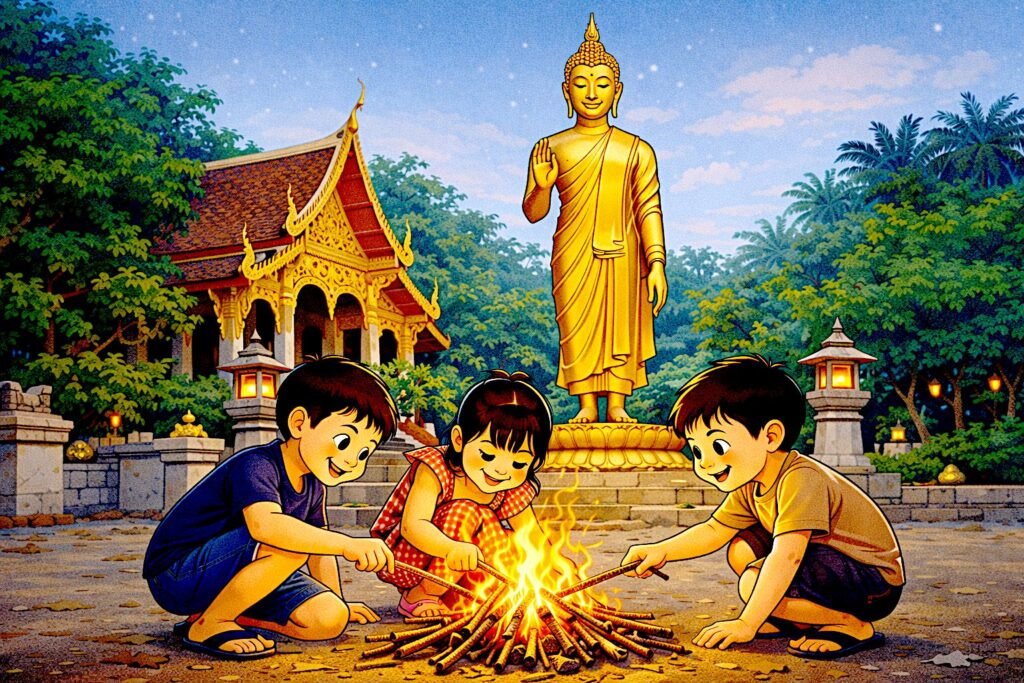
Children tending a small fire before a Buddha statue — evoking the fire metaphor of the Aggivacchagotta Sutta, where a flame ceases when its fuel is exhausted.
I. Metaphysical Questions and the Emergence of the Middle Way
In the history of ancient Indian thought, one of the most frequently debated metaphysical questions concerned the nature of reality and the destiny of human beings after death. Different philosophical traditions proposed different answers to these issues: whether the world exists eternally or not, whether the soul continues to exist after the dissolution of the body or is completely annihilated, and whether an awakened being continues to exist in some form after attaining liberation. Such questions were not merely abstract philosophical concerns; they also reflected a profound human attempt to understand the ultimate meaning of life and death.
Within this intellectual context, the teachings preserved in the early Buddhist scriptures present a distinctive approach to these metaphysical problems. Rather than offering definitive assertions about the existence or non-existence of reality, the Buddha frequently redirected the discussion toward an analysis of the conditions under which phenomena arise and cease. This approach does not avoid philosophical inquiry; instead, it reveals that many metaphysical questions are formulated on conceptual assumptions that are not appropriate to the nature of phenomena themselves.
Two discourses in the Nikāyas illustrate this approach particularly clearly: the Aggivacchagotta Sutta and the Kaccāyanagotta Sutta. In the Aggivacchagotta Sutta, the wanderer Vacchagotta raises a series of well-known questions concerning the fate of the Tathāgata after death: Does the Tathāgata exist after death? Does he not exist? Does he both exist and not exist? Or does he neither exist nor not exist? Rather than accepting any of these alternatives, the Buddha refuses to answer and explains that such views belong to forms of speculative opinion that lead to dispute and entanglement rather than to liberation. To clarify his position, he introduces the metaphor of a fire that has gone out when its fuel is exhausted, illustrating that the conceptual categories employed in Vacchagotta’s questions are no longer applicable to a process whose sustaining conditions have ceased.
The Kaccāyanagotta Sutta approaches the issue from a more principled perspective. When asked about right view, the Buddha observes that the world is generally inclined toward two extremes: one asserting that everything exists, and the other asserting that nothing exists. According to the discourse, both positions arise from a distorted way of perceiving reality. Instead of endorsing either standpoint, the Buddha presents the Middle Way, in which phenomena are understood through their arising and cessation in dependence upon conditions. When phenomena are recognized as conditionally arisen processes, absolute assertions about existence or non-existence become inappropriate.
Although these two discourses arise in different contexts and employ different illustrative images, they share a common aim: to clarify the limits of metaphysical speculation and to point toward an alternative approach to reality. The Aggivacchagotta Sutta illustrates the issue through a concrete dialogue and a vivid metaphor, whereas the Kaccāyanagotta Sutta articulates the philosophical principle underlying the Middle Way through the teaching of dependent origination. Read together, these texts suggest that the Middle Way in early Buddhism is not simply a position between two opposing views, but rather a different mode of understanding reality—one that emphasizes the conditional and processual nature of phenomena.
This article examines these two discourses in relation to one another in order to illuminate how early Buddhism moves beyond the dualistic framework of metaphysical thought. Through an analysis of Vacchagotta’s sequence of questions, the metaphor of the extinguished fire, the explanation of the Tathāgata beyond the five aggregates, and the definition of right view in the Kaccāyanagotta Sutta, the article argues that the Middle Way in the Nikāya texts is not a compromise between philosophical extremes but the result of an entirely different way of seeing reality—one that places emphasis on the structure of dependent origination rather than on absolute ontological assertions.
II. Vacchagotta’s Series of Questions and the Context of the Undeclared Issues
In the Aggivacchagotta Sutta, the dialogue between the Buddha and the wanderer Vacchagotta does not begin with a single isolated question, but with an extended sequence of metaphysical problems. The very structure of this sequence suggests that Vacchagotta is not merely seeking a personal clarification; rather, he represents a broader pattern of inquiry characteristic of ancient Indian philosophical thought.
Vacchagotta first asks the Buddha about the nature of the world. He presents a series of opposing possibilities: whether the world is eternal or not eternal, whether it is finite or infinite. To each of these questions, the Buddha gives the same response: he does not accept such views.
This series of questions reflects a familiar form of metaphysical speculation within the philosophical traditions of ancient India, where thinkers attempted to determine the ultimate nature of the universe through absolute affirmations or negations. By framing his questions in this manner, Vacchagotta appears to be attempting to situate the Buddha within the same framework of metaphysical debate that was widespread at the time.
After raising questions about the nature of the world, Vacchagotta turns to another issue: the relation between life and the body. He asks whether life and the body are identical or whether they are two different entities. This question represents a version of the broader problem of the nature of the self, a central concern in many Indian philosophical systems. Yet once again, the Buddha refuses to endorse either of the alternatives.
Finally, Vacchagotta poses the well-known series of questions concerning the fate of the Tathāgata after death. These questions are formulated in four possible alternatives:
- The Tathāgata exists after death.
- The Tathāgata does not exist after death.
- The Tathāgata both exists and does not exist after death.
- The Tathāgata neither exists nor does not exist after death.
These four alternatives correspond to a logical structure known in Indian philosophy as the tetralemma (catuṣkoṭi), which attempts to exhaust all logical possibilities of a proposition. By employing this structure, Vacchagotta seeks to ensure that no possible answer lies outside the conceptual framework of the question. Yet in response to each of these propositions, the Buddha gives the same reply: he does not accept such views.
When considered as a whole, Vacchagotta’s sequence of questions corresponds to a group of metaphysical issues that are described in the Nikāyas as the undeclared questions (avyākata). These include speculations concerning the nature of the world, the nature of the individual, and the fate of the Tathāgata after death. What unites all of these questions is their attempt to describe reality through absolute ontological assertions.
What is particularly striking is that the Buddha does not refute each proposition by proposing an opposing one. He does not claim, for example, that the world is non-eternal rather than eternal, nor that the Tathāgata exists rather than does not exist. Instead, he rejects the entire framework within which these questions are formulated. When Vacchagotta asks why the Buddha does not accept any of these views, the Buddha explains that such views belong to wrong perspectives. They are described as a “thicket of views,” a “wilderness of views,” a “contortion of views,” and a “fetter of views,” because they lead to dispute and entanglement rather than to liberation.
This response reveals that the problem lies not in choosing between competing metaphysical propositions, but in the way the questions themselves are framed. Vacchagotta’s questions assume that reality can be adequately described through familiar ontological categories, whereas the Buddha’s teaching directs attention to a different dimension altogether: the arising and cessation of phenomena according to specific conditions.
For this reason, Vacchagotta’s sequence of questions serves as the starting point for the entire argument of the discourse. It exposes the way metaphysical thinking attempts to encompass reality through fixed logical categories, while simultaneously preparing for a crucial shift in the dialogue. Having revealed the limitations of these speculative views, the Buddha proceeds to offer an entirely different explanation of the issue—one illustrated through the metaphor of fire and fuel, which clarifies why categories such as “existence” and “non-existence” are no longer applicable once the conditions sustaining a phenomenon have ceased.
III. Why Metaphysical Speculations Become a “Thicket of Views”
After Vacchagotta presents a long series of metaphysical questions, the Buddha does not choose any of the alternatives proposed. Yet the significance of the discourse lies not merely in this refusal, but in the reason behind it. When Vacchagotta asks why the Buddha does not accept such views, the Buddha’s reply clarifies the underlying nature of the problem.
In the Aggivacchagotta Sutta, the Buddha explains that views such as “the world is eternal,” “the world is not eternal,” “the world is finite,” “the world is infinite,” or speculations about the continued existence of the Tathāgata after death all belong to wrong views. These views are described through a series of striking expressions: they are a “thicket of views,” a “wilderness of views,” a “contortion of views,” a “dispute of views,” and a “fetter of views.”
These expressions are not merely critical labels; they evoke vivid images that reveal the nature of the metaphysical reasoning represented by Vacchagotta. When described as a “thicket of views,” such doctrines resemble a dense forest in which one can easily lose one’s way among countless arguments and counterarguments. From a single proposition, numerous variations can be developed, forming an increasingly complex network of competing positions that never leads to the end of debate.
Similarly, the image of a “wilderness of views” suggests a barren terrain where metaphysical speculation may be intellectually elaborate yet practically fruitless. Such speculation does not help the practitioner move closer to the cessation of suffering; instead, it leads the mind into endless chains of abstract reasoning without resolution. When these views are described as a “contortion of views,” they resemble philosophical disputations that function almost as a game of argument, where defending a position becomes an end in itself rather than a means to genuine understanding.
The Buddha also characterizes them as “disputes of views,” since metaphysical systems frequently generate prolonged debates between competing philosophical schools. When each system attempts to assert its position as the ultimate truth, philosophical controversy becomes an activity with no possible conclusion. From the perspective of the Nikāya texts, such disputes are not only unproductive but also reinforce attachment to views.
Finally, these metaphysical doctrines are described as “fetters of views,” meaning that they bind the mind. In early Buddhist thought, clinging to a view is not merely an intellectual error; it is also a form of attachment (upādāna). When an individual identifies with a particular system of ideas, the defense of that view becomes part of one’s sense of self, thereby strengthening the very bonds that sustain the cycle of suffering.
For this reason, the Buddha’s refusal to engage with metaphysical speculation does not stem from the view that such speculation lacks logical coherence or cannot be proven. The deeper issue is that such views are unrelated to the goal of the path of liberation. The Nikāya texts repeatedly emphasize that these doctrines do not lead to dispassion, fading away, cessation, peace, direct knowledge, awakening, or Nibbāna. It is this practical criterion that shapes the Buddha’s approach to philosophical questions.
Seen from this perspective, the Buddha’s refusal to answer Vacchagotta’s questions is not an evasion of a difficult philosophical issue. Rather, it represents a deliberate redirection. Instead of participating in metaphysical debates about the nature of the world or the fate of an awakened being, the Buddha redirects the discussion toward another domain altogether—the domain of experience and of the processes that constitute experience.
This shift becomes evident within the dialogue itself. When Vacchagotta asks whether the Buddha holds any view, the Buddha replies that wrong views have been abandoned by the Tathāgata. Rather than presenting a new metaphysical doctrine about the world, he describes what the Tathāgata has directly understood:
“This is form; this is the origin of form; this is the cessation of form. This is feeling… this is perception… this is formations… this is consciousness; this is the origin of consciousness; this is the cessation of consciousness.”
Here the focus of understanding no longer lies in determining the ultimate nature of the world, but in seeing clearly the arising and cessation of the elements that constitute experience. This movement from metaphysical speculation to the analysis of processes prepares the way for the next stage of the discourse, where the Buddha illustrates his position through the well-known metaphor of fire and fuel.
IV. The Metaphor of Fire and the Meaning of Extinction
After showing that metaphysical speculations about the nature of the world and the fate of the Tathāgata belong to a “thicket of views” and do not lead to liberation, the dialogue in the Aggivacchagotta Sutta turns to a completely different mode of explanation. Instead of continuing the discussion at the level of abstract concepts, the Buddha introduces a simple yet profound example: the example of fire and fuel.
The Buddha asks Vacchagotta whether, if there were a fire burning in front of him, he would know that the fire was burning. Vacchagotta replies that he would know. The Buddha then asks on what condition the fire burns, and Vacchagotta answers that it burns dependent on fuel—grass and wood.
This response establishes an important principle: fire does not exist independently but depends upon specific conditions. It appears only when suitable fuel is present. When grass and wood provide the energy necessary for combustion, the fire continues to burn; when these conditions are no longer present, the fire cannot continue.
The Buddha then asks another question: if the fire were to go out because its fuel had been exhausted, in which direction would the fire have gone—east, west, north, or south? Vacchagotta replies that such a question would not apply. The fire does not “go” anywhere; it simply ceases to burn because the conditions sustaining it have come to an end.
Vacchagotta’s answer shows that he has grasped the essential point of the example. When a phenomenon exists dependent upon certain conditions, asking where it “goes” after those conditions have ceased is a misguided question. The question assumes that the fire is an entity capable of continuing independently of the conditions that produced it, whereas in reality the fire is merely a process dependent on fuel.
At this point the Buddha applies the metaphor of fire to the issue Vacchagotta had raised earlier. According to the discourse, the Tathāgata cannot be identified as an independently existing entity but can only be recognized through the elements that constitute experience. Yet for one who has completely abandoned all clinging, those elements have been cut off at the root. The discourse states that the factors through which the Tathāgata could be identified—form, feeling, perception, formations, and consciousness—have been eliminated, “cut off at the root, made like a palm stump, incapable of arising again.”
Thus, when one asks whether the Tathāgata exists after death or not, the question encounters the same problem as asking where an extinguished fire has gone. The categories of “existence” and “non-existence” have meaning only when applied to phenomena that can be identified within ordinary experience. In the case of a liberated being, however, the conditions through which such identification could occur are no longer present.
For this reason, the discourse describes the Tathāgata as “deep, immeasurable, hard to fathom like the ocean.” Statements such as “exists,” “does not exist,” “both exists and does not exist,” or “neither exists nor does not exist” all become inapplicable. These categories belong to a conceptual system designed to describe phenomena that still operate within the network of conditions characterizing ordinary experience. When those conditions have ceased, applying such categories becomes inappropriate.
The metaphor of fire, therefore, is not merely a simple illustrative example. It clarifies an important principle in early Buddhist thought: phenomena are not independently existing entities but processes dependent upon conditions. When the conditions that sustain a process have come to an end, attempts to describe it using conceptual categories designed for phenomena still operating under those conditions will inevitably lead to unanswerable questions.
In this way, the example of fire shows why Vacchagotta’s metaphysical questions cannot be resolved by selecting one of the alternatives he proposed. Rather than answering the questions directly, the Buddha demonstrates that the very form of the questions rests upon a mistaken assumption about the nature of phenomena. Once that assumption is recognized, the original metaphysical questions lose their foundation, and the issue must be understood in an entirely different way.
V. The Tathāgata and the Five Aggregates: The Limits of Identification
The metaphor of fire in the Aggivacchagotta Sutta does not stand as an isolated argument; it is closely connected with another important analysis presented in the discourse—the analysis of the five aggregates (pañcakkhandha). Through this framework, the Buddha clarifies why questions concerning the continued existence of the Tathāgata after death become inappropriate.
In the Nikāya texts, the individual is not described as an independent entity or an immutable soul, but rather as a collection of five elements that constitute experience: form (rūpa), feeling (vedanā), perception (saññā), formations (saṅkhāra), and consciousness (viññāṇa). These elements are not static substances but processes that continually arise and change in dependence upon conditions.
It is through these five aggregates that an individual can be identified. When we refer to a particular person, that identification is in fact based upon the presence of these psycho-physical processes. Thus, when the Buddha describes what the Tathāgata has understood—“This is form; this is the origin of form; this is the cessation of form. This is feeling… this is perception… this is formations… this is consciousness; this is the origin of consciousness; this is the cessation of consciousness”—he is indicating that the crucial point is not to affirm the existence of a self, but to see clearly the arising and cessation of the processes that constitute experience.
In the case of a liberated being, the discourse emphasizes that clinging to the five aggregates has been completely abandoned. Form, feeling, perception, formations, and consciousness no longer serve as the basis for identification in terms of “I” or “mine.” When attachment to the five aggregates has been cut off at the root, the process of rebirth no longer has the conditions necessary to continue.
At this point the metaphor of fire and fuel becomes especially illuminating. Fire burns dependent upon fuel; when the fuel is exhausted, the fire cannot continue. In the same way, the process of continued existence within saṃsāra depends upon clinging (upādāna) to the elements that constitute experience. When that clinging has been completely abandoned, the process no longer has the conditions required for its continuation.
Thus, when Vacchagotta asks whether the Tathāgata exists after death, the question assumes that the Tathāgata is an entity capable of continuing independently of the conditions that constitute experience. According to the analysis presented in the discourse, however, this assumption is precisely the problem. The factors through which a person could be identified—the five aggregates—are no longer the basis of clinging for a liberated being.
For this reason, the discourse states that the Tathāgata has cut off these elements at the root, “like a palm stump, incapable of growing again.” The image of a palm tree cut at its base suggests the complete termination of a process rather than the transition of an entity from one state to another.
This explains why statements such as “the Tathāgata exists after death” or “the Tathāgata does not exist after death” are both inappropriate. Each statement assumes the presence of an identifiable entity to which such predicates could apply. Yet in the analysis offered by the discourse, the conditions that would make such identification possible are no longer present. Consequently, the categories of “existence” and “non-existence” can no longer be meaningfully applied.
In this way, the analysis of the five aggregates provides a clearer theoretical framework that complements the metaphor of fire. It shows that the issue is not to determine the fate of an entity after death, but to understand the conditions through which an individual can be identified within experience. When those conditions have been completely eliminated, attempts to describe the state of the Tathāgata using familiar metaphysical categories become inappropriate.
VI. Right View in the Kaccāyanagotta Sutta: Beyond the Two Extremes
If the Aggivacchagotta Sutta demonstrates why metaphysical questions concerning the continued existence of the Tathāgata cannot be answered within conventional conceptual categories, the Kaccāyanagotta Sutta provides an important key for understanding the Buddha’s position more fully. This discourse does not focus on the fate of the Tathāgata after death, but on a more fundamental issue: how human beings come to form views concerning existence and non-existence.
When the venerable Kaccāyana asks the Buddha about right view (sammā-diṭṭhi), the Buddha replies with an analysis that is brief yet remarkably profound. According to the discourse, the world is generally bound by two extremes: “everything exists” and “nothing exists.” These two extremes reflect philosophical tendencies that were widely present in the intellectual environment of ancient India. One tendency affirms the existence of an enduring reality or permanent essence, while the other denies any basis of existence altogether.
According to the Buddha, one who possesses right view does not fall into either of these extremes. Rather than affirming existence or denying it, such a person understands the world in terms of conditional arising. When a phenomenon arises dependent upon specific conditions, it is inaccurate to claim that it exists absolutely; yet when those conditions cease, it is equally inappropriate to claim that nothing exists at all.
For this reason, the Buddha declares that one who sees dependent origination (paṭiccasamuppāda) clearly will not fall into these two extremes. When phenomena are understood as arising through conditions and ceasing when those conditions dissolve, there is no longer any need to posit a permanent entity underlying phenomena, nor to deny the reality of phenomena altogether. Reality is understood instead as a process of conditional formation rather than as a collection of fixed entities.
This perspective illuminates an important point in the earlier dialogue with Vacchagotta. When Vacchagotta asks whether the Tathāgata exists after death, his question assumes that the issue can be resolved by choosing between propositions concerning existence or non-existence. Yet according to the analysis presented in the Kaccāyanagotta Sutta, the very framing of the question already falls within the two extremes that the Buddha seeks to transcend.
If phenomena are understood as conditionally arisen processes, then the categories of “existence” and “non-existence” cannot be applied in an absolute sense. A phenomenon does not exist independently in such a way that it could be affirmed as an eternal entity; yet neither can it be said to be entirely nonexistent, since it arises whenever the appropriate conditions come together. It is precisely within the space beyond these two extremes that the Middle Way emerges.
Thus, the Kaccāyanagotta Sutta provides the philosophical foundation for what is illustrated through the metaphor of fire in the Aggivacchagotta Sutta. If a fire burns when fuel is present and goes out when the fuel is exhausted, then asking where the fire “exists” after it has been extinguished is a misguided question. In the same way, when the conditions that sustain a process have ceased, attempting to determine its status in terms of existence or non-existence becomes inappropriate.
In this way, the two discourses complement one another. The Aggivacchagotta Sutta demonstrates the inadequacy of metaphysical questions when applied to a liberated being, while the Kaccāyanagotta Sutta clarifies the philosophical principle underlying this position: correct understanding does not lie in affirming or denying existence, but in seeing clearly the arising and cessation of phenomena in dependence upon conditions. It is this mode of understanding that opens the path of the Middle Way, beyond the extremes of eternalism and nihilism.
VII. Dependent Origination as a Method of Understanding, Not a Metaphysical Doctrine
If the Kaccāyanagotta Sutta shows that right view transcends the two extremes of “existence” and “non-existence,” the next question naturally arises: how does such transcendence become possible in cognition? The answer offered by the discourse is not a new ontological theory, but rather a method for seeing reality. That method is dependent origination.
In the Kaccāyanagotta Sutta, the Buddha explains that when a person sees the arising of the world as it truly is, they no longer fall into the view of “non-existence”; and when they see the cessation of the world as it truly is, they no longer fall into the view of “existence.” In this way, transcending the two extremes does not occur by adopting a middle position between two propositions, but by transforming the very way in which reality is perceived.
From this perspective, the world is not a collection of independently existing entities but a network of phenomena that arise through conditions and cease when those conditions dissolve. What the Buddha refers to as the “world” in this context is the process of experience itself: that which appears, changes, and disappears within the dynamic interaction of conditions. For this reason, to say that the world “exists” as a fixed entity is an excessive simplification, while to claim that it “does not exist” fails to account for the processes that continue to arise.
In this context, dependent origination is not presented as a metaphysical system explaining the ultimate origin of the universe. Instead, it functions as a method of understanding—a way of observing phenomena that reveals that nothing exists independently and nothing is entirely separate from the network of conditions that sustains it. When a phenomenon is seen in relation to the conditions that give rise to it, the need to attribute to it an absolute mode of existence naturally disappears.
For this reason, in the Nikāya texts dependent origination is frequently expressed in the form of a conditional sequence: “When this is, that is; with the arising of this, that arises; when this ceases, that ceases.” This formula does not aim to describe a foundational substance of the world, but to demonstrate the conditional nature of all phenomena.
When this principle is applied to the issue raised by Vacchagotta in the Aggivacchagotta Sutta, the Buddha’s position becomes easier to understand. If phenomena can only be identified through the conditions that constitute them, then once those conditions have ceased, asking about the “existence” of that phenomenon becomes inappropriate. The question concerning the fate of the Tathāgata after death thus falls into the same error as asking where an extinguished fire has gone.
Dependent origination therefore does more than explain why phenomena arise and cease; it also reveals the limits of the conceptual categories through which we usually attempt to describe reality. When categories such as “existence” and “non-existence” are applied to conditionally arisen processes, they easily become metaphysical extremes. But when reality is understood as a network of conditioned processes, the need to choose between those extremes disappears.
In this way, dependent origination serves as the epistemological foundation of the Middle Way. It allows the practitioner to see that the world is neither a permanent entity requiring affirmation nor an absolute nothingness requiring denial. Rather, it is a continuous process of arising and passing away among phenomena dependent upon conditions. It is precisely this mode of understanding that enables the Buddha to move beyond metaphysical disputes while still offering a coherent account of reality.
VIII. The Middle Way as a Log Drifting Down the River: An Image of the Process of Liberation
Up to this point, placing the Aggivacchagotta Sutta alongside the Kaccāyanagotta Sutta has shown that the Buddha’s Middle Way is not a compromise between two opposing metaphysical propositions. Rather, it represents a different way of understanding reality, in which phenomena are seen as processes that arise and cease in dependence upon conditions. Yet the Nikāya texts do not express these principles solely through philosophical analysis. They frequently employ vivid images to illustrate how the Middle Way functions within the practical path of liberation.
One such image appears in the Dārukkhandha Sutta of the Saṃyutta Nikāya. In this discourse, the Buddha stands on the bank of the Ganges and observes a large log drifting along with the current. From this simple observation he develops a metaphor for the path of liberation. If the log does not drift to the near shore, does not drift to the far shore, does not sink in the middle of the river, does not become stranded on a sandbank, is not taken by humans or non-human beings, is not caught in a whirlpool, and does not rot from within, then it will naturally reach the ocean.
What is particularly noteworthy is the way the Buddha explains each element of this metaphor. The “near shore” represents the six internal sense bases, while the “far shore” represents the six external sense objects. The remaining obstacles symbolize various forms of attachment within spiritual life: craving for sensual pleasure, conceit, involvement in worldly life, aspiration for rebirth in higher realms, or deception within the practice itself. Whenever such factors arise, the process of liberation resembles a log that becomes trapped along the course of the river and is unable to continue its movement toward the great ocean.
This metaphor clarifies an important dimension of the Middle Way. In philosophical discussions, the Middle Way is often described as transcending the extremes of “existence” and “non-existence.” Yet in the imagery of the Dārukkhandha Sutta, the Middle Way is not portrayed as a theoretical position but as a continuous movement within the path of practice. The log does not need to find its own route to the ocean; it only needs to avoid becoming caught in obstacles along the way. If it remains unobstructed, the current of the river will naturally carry it toward the sea.
At this point the image of the drifting log connects deeply with the issues raised in the two earlier discourses. The metaphysical speculations posed by Vacchagotta in the Aggivacchagotta Sutta can be understood as the “banks” of philosophical thought. When the mind clings to any of these views—whether affirming existence, denying existence, or combining both—it resembles a log that has drifted toward one of the banks and is no longer carried along by the current of right understanding.
Meanwhile, the Kaccāyanagotta Sutta explains why such banks arise in the first place: the world is generally inclined toward the two extremes that “everything exists” and “nothing exists.” The Middle Way indicated by the Buddha does not lie between these banks; it resembles instead the flowing current of dependent origination. When phenomena are understood as conditionally arisen processes, the mind no longer needs to cling to metaphysical propositions in order to define reality.
From this perspective, the image of the drifting log carries a profound philosophical meaning. It suggests that liberation does not arise from discovering the correct metaphysical answer, but from no longer becoming trapped within the structures of attachment that shape experience. When these obstacles fall away, the process of liberation unfolds naturally—just as the Ganges eventually flows into the great ocean.
In this way, the metaphor of the log does more than illustrate the path of practice; it also clarifies the nature of the Middle Way itself. The Middle Way is not a point positioned between two extremes of thought. Rather, it is the flowing movement of understanding and practice that remains free from fixation on any extreme. Within that movement, the path of liberation gradually opens.
IX. The Middle Way as the Transcendence of Metaphysical Categories
Placing the Aggivacchagotta Sutta alongside the Kaccāyanagotta Sutta reveals a coherent structure of thought within the Nikāyas: the Buddha’s Middle Way is not a reconciliation between two opposing philosophical extremes, but a transcendence of the very conceptual categories that give rise to those extremes.
In the Kaccāyanagotta Sutta, the issue is presented at an epistemological level. The world is generally inclined toward two opposing views: “everything exists” and “nothing exists.” The Buddha explains that both positions arise from a distorted perception of reality. When phenomena are understood as processes that arise dependent upon conditions, they cannot be adequately described through the metaphysical categories of existence or non-existence. By seeing the dependent origination of phenomena, the practitioner is freed from the need to affirm or deny a fixed essence underlying the world.
In the Aggivacchagotta Sutta, the same principle is developed on another level. Vacchagotta raises a series of questions concerning the nature of the world and the fate of the Tathāgata after death: whether the world is eternal or not eternal, finite or infinite, and whether the Tathāgata exists or does not exist after death. Faced with these questions, the Buddha accepts none of the alternatives. Yet this refusal does not represent an evasion of philosophical inquiry; rather, it expresses the insight that the categories used in those questions are no longer appropriate for describing the condition of one who has attained liberation.
The metaphor of fire in the discourse clarifies this point. When a fire goes out because its fuel has been exhausted, the question “in which direction has the fire gone?” loses its meaning. The fire has not gone east, west, north, or south; it simply ceases because the conditions that once sustained it are no longer present. In the same way, when the five aggregates are no longer sustained by craving and clinging, asking whether the Tathāgata “exists” or “does not exist” after death becomes a question framed within the wrong conceptual categories.
Taken together, these two discourses show that the Buddha’s Middle Way is not merely an ethical principle or a practical method, but also a profound philosophical strategy. Rather than attempting to resolve metaphysical disputes by choosing one position over another, the Buddha reveals that the structure of such questions rests upon mistaken assumptions about the nature of reality.
The Middle Way, therefore, is not a midpoint between two extremes of thought, but a radical shift in perspective. When reality is understood as a process of dependent origination, the metaphysical categories that once governed philosophical speculation lose their applicability. It is precisely through this shift that the path to liberation becomes possible.
In this sense, the Middle Way is not a doctrine intended to answer every metaphysical question. On the contrary, it shows that many of those questions no longer need to be answered. Once the conditions that give rise to suffering are understood and abandoned, the central concern of spiritual life is no longer the determination of the ultimate nature of the world, but the cessation of suffering within present experience. At this point, philosophy and practice converge within the teaching of the Buddha.
Related Studies:
Bibliography
Bodhi, Bhikkhu, trans. 2000. The Connected Discourses of the Buddha: A Translation of the Saṃyutta Nikāya. Boston: Wisdom Publications.
Gethin, Rupert. 1998. The Foundations of Buddhism. Oxford: Oxford University Press.
Kalupahana, David J. 1976. Buddhist Philosophy: A Historical Analysis. Honolulu: University of Hawai‘i Press.
Kalupahana, David J. 1992. A History of Buddhist Philosophy: Continuities and Discontinuities. Honolulu: University of Hawai‘i Press.
Nāṇamoli, Bhikkhu, and Bhikkhu Bodhi, trans. 2005. The Middle Length Discourses of the Buddha. 2nd ed. Boston: Wisdom Publications.
Thanissaro Bhikkhu. 2012. The Shape of Suffering: A Study of Dependent Co-arising. Valley Center, CA: Metta Forest Monastery.
Waldron, William S. 2003. The Buddhist Unconscious: The Ālaya-vijñāna in the Context of Indian Buddhist Thought. London: RoutledgeCurzon.
Wynne, Alexander. 2007. The Origin of Buddhist Meditation. London: Routledge.
Yao, Zhihua. 2012. The Buddhist Theory of Self-Cognition. London: Routledge.