
Le Hoang Da
Independent Philosopher & Buddhist Scholar

Figure 1. The Amluk Dara stupa in the Swat Valley (ancient Gandhāra, present-day Pakistan), a Buddhist monastic and devotional complex dating from the Indo-Greek to Kushan periods, illustrating the material and institutional presence of Buddhism within the Indo-Greek cultural and political landscape.
Source: Wikimedia Commons.
I. Religion, Power, and the Historical Presence of Buddhism
In contemporary imagination, Buddhism is often portrayed as a purely inward tradition—associated primarily with meditation, personal ethics, and a mode of life seemingly removed from worldly affairs. From this perspective, the Dharma is understood chiefly as a path of individual cultivation and liberation rather than as a force actively engaged in the broader movements of history. As a result, placing Buddhism alongside notions such as political power can appear strained, as though the two belong to fundamentally separate realms.
Yet this separation reflects a modern ideal more than historical reality. Across the development of many ancient civilizations, religion rarely existed as an exclusively spiritual pursuit. It functioned simultaneously as a social institution—organizing communities, shaping collective moral norms, and intertwining with concrete structures of authority. Beyond nurturing inner life, religion helped stabilize political and cultural orders.
Buddhism was no exception. From its earliest formation, the Dharma evolved in close relation to the social conditions and political frameworks of its time: from royal patronage in Magadha, where the Sangha first established a durable institutional base, to the urban and mercantile networks that carried the teaching beyond the Ganges basin and along trade routes connecting distant cultural regions. Rather than standing at the margins of history, Buddhism moved within the very currents of economic exchange, political organization, and interregional contact that shaped the ancient world.
Within this broader context, the presence of Buddhism in the Indo-Greek kingdoms of northwestern India—where Hellenistic civilization encountered Indian traditions—was not an accidental anomaly, but a natural outcome of sustained interactions between religion and power. It was precisely in this frontier zone that the relationship became especially visible, offering a distinctive case through which to examine how the Dharma was received, reinterpreted, and woven into the political structures of the eastern Hellenistic realms.
II. Buddhism Enters the Indo-Greek Sphere of Power
The presence of Buddhism in the Indo-Greek world cannot be understood apart from the political and cultural conditions that emerged in the aftermath of Alexander the Great’s campaigns in the late fourth century BCE. Although Alexander’s empire quickly fragmented after his death, the processes of Hellenization that followed continued to shape northern India and Central Asia for centuries. Out of this historical transformation arose the eastern Greek kingdoms, forming a distinctive sphere of power in which Greek and Indian elements coexisted and interacted in complex ways.
Contrary to the image of a purely military domination, the Indo-Greek polities operated through cultural accommodation and flexible governance. Their authority was sustained not only by armed force but also by their capacity to adapt to local traditions, especially in the religious domain. In highly urbanized environments linked by transregional trade networks, religion played a crucial role in establishing legitimacy and maintaining social cohesion. It was precisely within such a context that Buddhism emerged as a particularly compatible tradition.
Compared with many other systems of belief, Buddhism did not rest upon an absolute theocracy or a closed ritual structure. Instead, the Dharma was articulated as a rational path, emphasizing ethical conduct, insight, and liberation from suffering through right understanding. This orientation created a notable affinity with Greek philosophical traditions, which likewise valued dialogue, argumentation, and critical inquiry into the nature of human life. Within the Indo-Greek milieu, Buddhism therefore did not appear as an alien cult but could be approached as a coherent intellectual system capable of engaging the dominant patterns of contemporary thought.
At the same time, the social composition of the Indo-Greek kingdoms—with their strong mercantile presence, urban centers, and multiethnic communities—provided favorable conditions for the spread of Buddhism. The Sangha, organized through a flexible institutional structure and supported by networks of lay followers, could readily integrate into commercial hubs and densely populated settlements. Royal patronage in this environment did not necessarily take the form of religious imposition; rather, it often manifested as the provision of space and resources that allowed diverse religious communities to coexist and flourish.
For these reasons, the reception of Buddhism in the Indo-Greek world should not be interpreted as the outcome of a linear missionary strategy or merely the product of short-term political calculation. It was, instead, the result of a historical environment already prepared for encounter—one in which secular power required ethical and intellectual foundations to reinforce its legitimacy, and in which Buddhism, with its non-dogmatic character and high degree of adaptability, could enter the sphere of authority without surrendering its essential identity.
III. The Anthropomorphic Buddha Image and the Hellenistic Imprint
During the first centuries following the Buddha’s parinirvāṇa, Buddhist tradition largely refrained from depicting him in human form. Instead, the Buddha’s presence was expressed through symbolic markers such as the wheel of Dharma, footprints, the Bodhi tree, or an empty throne. This aniconic mode of representation reflected a cautious attitude toward the personalization of the awakened one, while directing attention to the teaching itself rather than to physical likeness.
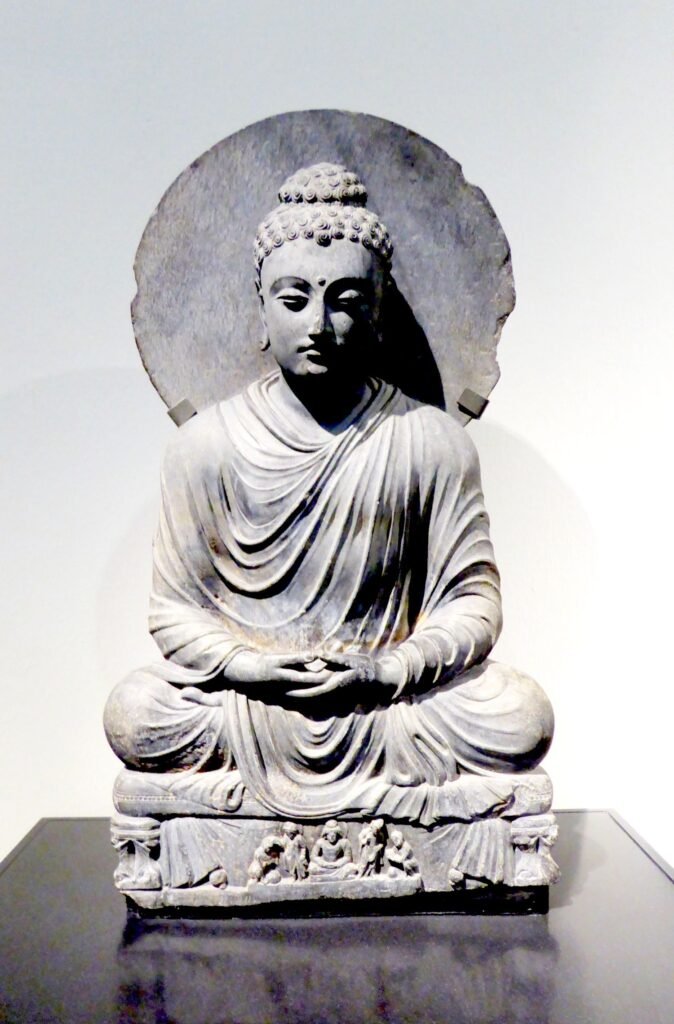
Figure 2. Seated Buddha in Gandhāran style (schist), displaying naturalistic proportions and deeply carved drapery characteristic of Hellenistic sculptural conventions. Such anthropomorphic representations mark a decisive transformation in early Buddhist visual culture in the Indo-Greek cultural sphere.
Source: Wikimedia Commons.
A decisive shift emerged in the early centuries of the Common Era in Gandhāra, in northwestern India, where images of the Buddha in anthropomorphic form began to appear with increasing scale and frequency. This development signaled not merely a stylistic innovation but a fundamental transformation in the way Buddhism presented its object of veneration to both devotees and the broader public.
Gandhāran sculptures display unmistakable features associated with Hellenistic art: naturalistic bodily proportions, balanced facial features, wavy hair, and, most notably, heavy drapery carved in deep folds resembling the cloaks of Greek statuary. In some works, architectural settings incorporate Corinthian columns and Mediterranean decorative motifs. Such elements indicate not simple imitation but the active participation of an external visual tradition that was received and reconfigured within a local context.
The emergence of large-scale Buddha imagery in Gandhāra cannot be separated from the political and social environment of the Indo-Greek kingdoms. Monumental sculpture required substantial material resources, organized workshops, and stable systems of patronage. The move toward anthropomorphic representation was therefore not solely an artistic decision; it was closely linked to royal support and to affluent urban elites—actors who had a vested interest in reinforcing moral order and political legitimacy through recognizable religious imagery.
Importantly, this creative opening did not remain confined to Gandhāra. Almost concurrently, Mathura in northern India developed its own robust tradition of anthropomorphic Buddha images, though in a markedly different style: fuller bodies, simplified contours, and garments that clung lightly to the form rather than falling in the heavy, deeply carved folds characteristic of Hellenistic sculpture. If Gandhāra reveals the adoption of a Greek visual vocabulary, Mathura demonstrates processes of localization and reinterpretation according to Indian aesthetic sensibilities.
The parallel development of Gandhāra and Mathura thus suggests that the anthropomorphic Buddha image was not the product of a single linear influence, but the outcome of a broader network of interregional artistic exchange. In this space, Buddhism entered the Indo-Greek sphere of power, appropriating expressive tools from the Hellenistic world while simultaneously embedding them within indigenous traditions. The resulting transformation rendered the relationship between religion and politics visible not only in texts, but in stone itself—in form, volume, and in the Buddha’s appearance as a human figure for the first time.
IV. Greek Kings as Lay Buddhists
While the artistic traditions of Gandhāra and Mathura provide material evidence of Indo-Greek patronage of Buddhism, Buddhist texts reveal another, more inward dimension: the intellectual and religious participation of the rulers themselves. The most prominent example is Menander I, known in Buddhist tradition as Milinda, the king who appears as the central figure in the Milindapañha.

Figure 3. Portrait of Menander I (Milinda) on an Indo-Greek silver coin. Numismatic evidence of Hellenistic political authority in northwestern India during the second century BCE.
Source: Wikimedia Commons.
Unlike many texts of a purely legendary or propagandistic character, the Milindapañha is structured as a sustained series of philosophical dialogues between King Milinda and the monk Nāgasena. The king does not appear as a passive believer receiving instruction, but as a sharp and probing interlocutor who questions the core doctrines of the teaching: non-self, karma, rebirth, and the nature of liberation. His inquiries unfold through argument, counterargument, and careful reasoning—a style of exchange that recalls the Greek philosophical tradition, in which truth is pursued through rational dialogue rather than revelation.
Significantly, Milinda is not portrayed as a convert who renounces the world. He neither abdicates his throne nor is idealized as a ruler who abandons political life for monastic withdrawal. Instead, he is presented as an exemplary lay Buddhist: one who understands the Dharma, respects the Sangha, and applies Buddhist principles within the framework of governance. This portrayal suggests that Buddhism was not necessarily opposed to secular authority, but could offer an ethical foundation for the exercise of that authority itself.
Another important implication emerges from the text: the capacity of the Theravāda tradition to enter naturally into lay life. The dialogues between Milinda and Nāgasena demonstrate how fundamental teachings—non-self, dependent origination, karma, and liberation—are articulated in ways that can be understood, examined, and realized within the conditions of ordinary worldly existence, without requiring a rupture from social roles. This suggests that Theravāda did not function as a closed system reserved exclusively for monastics, but opened a flexible path of practice for laypeople, including those who held political power. The Dharma could thus touch everyday life directly, becoming a practicable ethical framework even within the sphere of politics.
From the perspective of religious history, the figure of Milinda carries particular significance. It challenges the assumption that Indo-Greek patronage of Buddhism was motivated solely by political calculation. Instead, the Milindapañha points to another possibility: a genuine intellectual and moral affinity between ruling elites and the Dharma. In the culturally and religiously plural societies of the Indo-Greek world, a system of thought that emphasized reason, ethical self-restraint, and non-coercion could serve as a supple foundation of legitimacy for kingship. Here, Buddhism was not merely supported from the outside; it entered the very space of power’s own thinking—where doctrine was debated, tested, and appropriated as a living intellectual tradition.
V. Inheriting and Developing the Model of Buddhist Patronage from Aśoka
To understand the role of the Indo-Greek rulers in Buddhist history, they must be situated within a longer trajectory of interaction between the Dharma and political authority. The most significant precedent for this relationship emerged in the third century BCE under the reign of Aśoka, the emperor who established a model of religious patronage whose influence would prove both profound and enduring. Under Aśoka, Buddhism was supported on an imperial scale for the first time—not as an instrument of enforced belief, but as an ethical foundation for governance.
The core of Aśoka’s model did not lie in transforming Buddhism into an exclusive state religion. Rather, it consisted in integrating Buddhist moral principles—nonviolence, tolerance, and social responsibility—into the practice of state administration. His edicts reveal a form of self-restrained kingship, in which the ruler sought to regulate both his own conduct and that of his subjects through moral exhortation rather than coercion. Parallel to these policies were concrete acts of patronage: the construction of stupas, the expansion of monasteries, the support of centers of learning, and the dispatch of missions to spread the Dharma to distant regions. Buddhism, therefore, was anchored not only at the level of ideas but also through a durable religious infrastructure embedded in social life.
Viewed in light of this precedent, the role of the Indo-Greek rulers becomes more intelligible. When the eastern Greek kingdoms emerged in northern India and Central Asia, they inherited a political environment already accustomed to royal support for Buddhism. Although they did not command the scale or imperial ambition of the Mauryan state, Indo-Greek rulers nonetheless adopted and adapted this model of patronage to their own circumstances: supporting the Sangha, encouraging religious life, and creating spaces for intellectual exchange between Buddhism and other traditions of thought.
Beyond patronage of the monastic community, traces of this support are also evident in architecture. Archaeological evidence indicates that within the Indo-Greek sphere numerous monasteries, memorial stupas, and large Buddhist complexes were constructed along major urban centers and trade routes. These sites served not merely devotional purposes but functioned as cultural and social nodes where monks, lay followers, and merchants intersected. Investment in such religious infrastructure suggests that royal patronage extended far beyond symbolic gestures, materializing instead as a durable network of institutions that anchored Buddhism within the public life of the region.
An important difference, however, lay in the multicultural context of the Indo-Greek world. Whereas Aśoka governed an empire largely shaped by Indian civilization, Indo-Greek rulers administered societies that were multilingual and religiously diverse. In such circumstances, patronage could not rely on cultural homogeneity, but required an ethical foundation capable of crossing boundaries of identity. Buddhism, with its non-theocratic, non-exclusive, and rationally oriented character, proved particularly suited to this role.
From a historical perspective, then, the Indo-Greek rulers did not invent an entirely new form of religious support. Rather, they inherited and reconfigured a tradition of patronage first articulated under Aśoka. They embraced its spirit—support without imposition, moral guidance without coercion—while translating it into concrete institutions and material forms. Through this selective inheritance, Buddhism was able to continue developing flexibly within the Indo-Greek world, functioning as a resilient moral force alongside secular power.
VI. Buddhism as a Form of Ancient “Soft Power”
Taken together, the evidence surveyed thus far—from the Buddha images of Gandhāra and Mathura, the philosophical dialogues of the Milindapañha, to the patterns of royal patronage and networks of religious architecture—suggests that Buddhism in the Indo-Greek world operated far beyond the boundaries of a purely devotional tradition. In this context, Buddhism functioned as a distinctive form of power: non-coercive and non-impositional, yet capable of shaping behavior, moral norms, and the legitimacy of kingship. In modern terminology, it may be described as a form of “soft power” before the concept itself was ever named.
Unlike military or administrative authority, Buddhist influence did not rely on command or force. It operated through moral persuasion, cultural symbolism, and intellectual prestige. Anthropomorphic Buddha images—supported and disseminated in public spaces—offered a visible representation of an ideal moral order. Monasteries and stupas, established along trade routes and urban centers, served not only as sites of worship but also as hubs of social, educational, and cultural exchange. Meanwhile, texts such as the Milindapañha provided a philosophical vocabulary through which rulers could reflect on questions of power, responsibility, and ethical conduct without resorting to the sacralization of royal authority.
It was precisely this combination of symbols, institutions, and ideas that enabled Buddhism to become a supple source of legitimacy for the Indo-Greek kingdoms. In pluralistic societies marked by cultural and religious diversity—where authority could not easily rest upon a single exclusive creed—Buddhism offered an ethical framework that was broadly intelligible yet non-coercive. It allowed rulers to project an image of tolerance, rationality, and restraint, while avoiding the sectarian conflicts often associated with theocratic models of rule.
As a natural consequence of this process, once an ethical system was embraced by political institutions and gradually adopted as a guide for governance, secular power itself began to be redefined. Legitimacy increasingly depended not solely on coercion or violence, but on the capacity to embody justice, self-restraint, and conformity with the Dharma. In such a setting, Buddhist teachings did not merely coexist with political authority; they quietly shaped the standards by which good governance was measured. Through the internalization of these moral values, Buddhism came to function as a long-term normative reference point for political conduct, far exceeding the role of a ritual or ceremonial religion.
From this perspective, the relationship between Buddhism and the Indo-Greek rulers should not be interpreted as a cynical “instrumentalization” of religion for political ends, nor as a corruption of the Dharma. Rather, it represents a form of historical symbiosis: power found in Buddhism a source of moral legitimacy, while Buddhism found in secular authority the material and social conditions necessary for its dissemination. It was precisely this symbiotic relationship that enabled Buddhism not merely to survive, but to flourish within one of the most culturally diverse regions of the ancient world.
VII. Conclusion: Buddhism between Ethics and Power
A review of the trajectory examined in this study makes clear that the presence of Buddhism in the Indo-Greek world was neither anomalous nor accidental. From the transformations in visual culture at Gandhāra and Mathura, through the philosophical dialogues of the Milindapañha, to the inherited model of patronage from Aśoka and the sustained investment in monastic infrastructure, all strands point toward a shared reality: Buddhism participated deeply in the political and social life of the region. It did not stand at the margins of power, but moved alongside it—shaping, and being shaped by, specific historical conditions.
This participation, however, did not take the form of coercion or theocratic domination. On the contrary, what distinguished Buddhism in the Indo-Greek context was its capacity to exert influence without compulsion. Through artistic symbols, communal institutions, and philosophical discourse, the Dharma gradually permeated the moral norms of society and of the ruling elites themselves. Secular authority, in adopting values such as self-restraint, tolerance, and ethical responsibility, was in turn redefined according to new standards. Religion did not replace politics, but supplied it with a moral dimension that violence alone could never produce.
From this perspective, the Indo-Greek kings should not be seen either as rulers who “instrumentalized” Buddhism to secure their position or as purely religious devotees detached from the realities of governance. Rather, they emerge as historical actors operating within a shared space of interaction, where religion, philosophy, and politics were continuously interwoven. Their patronage—whether expressed through art, texts, or architecture—reflects a process of mutual negotiation between power and ethics, rather than the unilateral dominance of one over the other.
More importantly, the Indo-Greek case compels a reconsideration of a modern assumption: that religion and politics belong to fundamentally separate spheres. Historical evidence suggests that this separation is a relatively recent ideal. In many ancient civilizations, religion functioned as a moral foundation and symbolic framework for social order, while political authority provided the material conditions necessary for religious traditions to endure and expand. Buddhism in the Indo-Greek world stands as a vivid illustration of this reciprocal relationship.
Within this process, royal patronage may be understood as one of the key factors that enabled Buddhism to sustain and extend its presence across successive historical periods. Beyond providing material resources—such as monasteries, stupas, and communal infrastructure—patronage also created social spaces in which the Dharma could be practiced, interpreted, and transmitted continuously. It was the convergence of the teaching’s inward ethical depth with favorable historical conditions that allowed Buddhism to operate with remarkable resilience within the broader currents of human civilization, surviving political upheavals and cultural transformations alike.
The study of the interaction between Buddhism and political power, therefore, does not aim to “secularize” the Dharma, but to clarify how it functioned within concrete historical realities. Viewed in this light, Buddhism appears not only as a path of individual liberation, but also as a cultural and ethical force capable of shaping collective life. It is precisely this dual movement—between inward cultivation and social engagement—that enabled Buddhism to transcend geographical and civilizational boundaries, remaining a living tradition across diverse historical worlds.
Bibliography
Tarn, W. W. The Greeks in Bactria and India. Cambridge: Cambridge University Press, 1922.
Boardman, John. The Diffusion of Classical Art in Antiquity. Princeton: Princeton University Press, 1994.
Rhys Davids, T. W., trans. The Questions of King Milinda (Milindapañha). Oxford: Clarendon Press, 1890–1894.
Thapar, Romila. Aśoka and the Decline of the Mauryas. Oxford: Oxford University Press, 1997.
Gombrich, Richard F.Theravāda Buddhism: A Social History from Ancient Benares to Modern Colombo. London: Routledge, 2006