
Le Hoang Da
Independent Philosopher & Buddhist Scholar
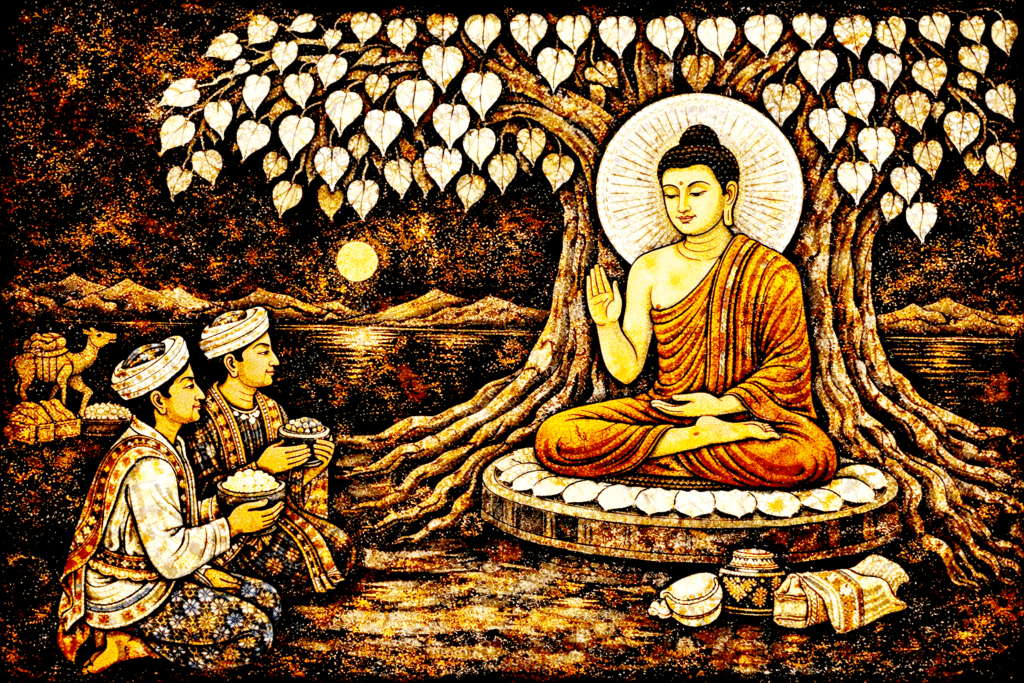
Tapussa and Bhallika offering food to the Buddha, marking the earliest recorded lay encounter in the Buddhist tradition
I. Engagement at the Origins of Buddhism
In recent decades, the term “Engaged Buddhism” has frequently been employed to designate socially oriented and activist forms of Buddhism, particularly in contexts marked by war, injustice, and the crises of the modern world. While this label is useful at the level of conceptual history, it easily creates the impression that “engagement” is merely a late development—or even a situational response of Buddhism to contemporary problems.
A broader historical survey, however, suggests that such an interpretation does not fully capture the formative character of the tradition. From the very moment of awakening beneath the Bodhi tree, the Buddha’s teaching was not shaped as a path of withdrawal isolated from social life. On the contrary, the Dharma operated from the outset within the concrete interactions of the world: between monastics and laypeople, among villages, householders, and merchants, and within the emerging economic and cultural networks that were taking shape across northern ancient India.
Throughout nearly five decades of teaching, the Buddha not only established a monastic Saṅgha but also maintained continuous dialogue with lay followers from diverse social strata. Many of his teachings directly addressed the practical concerns of everyday life, including family ethics, right livelihood, the management of wealth, communal relations, and social responsibility. This demonstrates that the Dharma, from its very inception, was oriented toward serving as an ethical and spiritual framework for life within society, rather than solely for secluded monastic cultivation.
As regional trade routes expanded, Buddhism continued to travel alongside merchant caravans and local populations along the economic and cultural corridors stretching from India into Central Asia. In this process, the teaching was transmitted not merely as a system of thought but also embraced as a source of spiritual support and as a means of navigating the uncertainties of a mobile and often precarious existence. Buddhism thus emerged as an integral component of social structure itself, intimately intertwined with the rhythms of daily activity, exchange, and survival within communities.
This engaged orientation did not cease in the early period but later became articulated even more explicitly within Mahāyāna traditions, where the ideal of universal salvation and active participation in worldly life was systematically formulated into clear doctrinal commitments. Viewed across this entire historical trajectory, engagement appears not as a late-emerging characteristic of Buddhism, nor as a modern innovation, but rather as a foundational structure present from the very beginning of the tradition’s formation.
For this reason, instead of treating “Engaged Buddhism” as a novel phenomenon of modernity, it may be more appropriate to understand it as a contemporary reinterpretation of an impulse that has always been embedded within Buddhist history and doctrine. In other words, Buddhism did not become engaged in the modern world; it has been engaged from the moment of its inception.
II. The First Lay Encounter – Merchants at the Dawn of the Dharma
If one traces the history of Buddhism back to its earliest point of origin, it becomes apparent that the relationship between the Dharma and worldly life was not a secondary development that emerged only later, but was present from the very first moment of the tradition itself. Pāli canonical sources record that immediately after attaining awakening beneath the Bodhi tree, the Buddha did not remain in secluded withdrawal. Instead, he quickly entered into interaction with the people and the social environment around him.
Significantly, the first individuals to approach him were not ascetics or renunciants who had abandoned household life, but two merchants traveling in the course of their trade: Tapussa and Bhallika. Early texts note that they came from Suvaṇṇabhūmi, an ancient locality frequently mentioned in the Pāli tradition as a coastal commercial region embedded within the extensive trade networks of the Indian Ocean world. This detail, seemingly modest within the biographical narrative of the Buddha, acquires considerable significance when viewed through a historical–social lens.
The two merchants offered food in alms and requested refuge, thereby becoming the first lay disciples of the Buddhist community. Thus, the initial bond between the Dharma and the lay world was established not through an enclosed monastic circle, but through an ordinary encounter between a spiritual teacher and individuals engaged in economic and commercial life. From the very beginning, Buddhism entered the world through the channels of social exchange: offering, dialogue, refuge, and communal interaction.
Moreover, the merchant class in ancient India was itself characterized by mobility and interregional networks. Merchants traversed geographical distances, connected centers of population, and created routes through which goods, information, and cultural influences circulated. That two merchants became the first lay followers may therefore be read as an early indication that the Dharma would not remain confined to a local setting, but would travel along these very pathways of exchange. Caravans, stopping points, and marketplaces were not merely sites of material trade; they also became spaces through which beliefs and ideas were transmitted.
From this perspective, the meeting between the Buddha and Tapussa–Bhallika is not simply a symbolic anecdote, but can be understood as a microcosmic pattern of the entire subsequent history of Buddhism: the teaching arises within social life, is sustained by lay supporters, and spreads through the mobile networks of commerce and cultural communication. Buddhism thus did not emerge as a tradition that rejected the world, but as a spiritual practice that accompanied the very rhythms of worldly existence.
Accordingly, if one seeks to identify the earliest moment at which the “engaged” character of Buddhism becomes visible, this episode already provides a foundational piece of evidence: from the dawn of its existence, the Dharma unfolded within the midst of commercial and social life, rather than outside it.
III. Lay-Oriented Teachings in the Nikāyas – The Ethics of Everyday Life
If the encounter between the Buddha and the two merchants Tapussa and Bhallika demonstrates the early presence of Buddhism within the secular sphere at a historical–social level, the doctrinal content preserved in the Nikāyas provides a corresponding form of evidence at the level of teaching itself. Here, “engagement” is not merely the byproduct of circumstance, but becomes a conscious orientation embedded within the very structure of the Dharma.
A common assumption tends to equate early Buddhism with monastic life and the ideal of withdrawal, treating the Saṅgha as the almost exclusive center of religious practice. Yet a careful reading of the discourses reveals that the Buddha did not teach solely for monks. A substantial portion of his instruction was addressed to lay followers. The concerns of these teachings were not abstract metaphysical problems, but the concrete questions of everyday life: how to organize the family, pursue a right livelihood, manage wealth, sustain social relationships, and cultivate a harmonious community.
The Sigālovāda Sutta, often regarded as a paradigmatic “lay ethics,” offers a clear illustration. Rather than discussing meditation or states of liberation, the discourse outlines a system of mutual responsibilities between parents and children, teachers and students, husbands and wives, friends, employers and workers, as well as between laypeople and renunciants. Family and social life are not treated as obstacles to be abandoned, but as arenas in which responsibility is enacted and moral character is cultivated.
Similarly, the Dīghajānu Sutta addresses directly the prosperity and economic stability of householders. The Buddha advises lay practitioners to be diligent in work, prudent in managing resources, to associate with good friends, and to maintain an ethical life. These recommendations are strikingly practical, reflecting concern for material and social sustainability rather than an exclusive focus on purely spiritual ends. Mental well-being here is understood as inseparable from an orderly and responsible economic life.
Even more general discourses such as the Maṅgala Sutta, frequently recited as a blessing, convey the same orientation. “Supreme blessings” are not defined through mystical rites, but through ordinary and recognizable virtues: associating with the wise, honoring one’s parents, practicing an honest profession, acting rightly, pursuing learning, and cultivating self-discipline. Happiness, in this vision, does not lie outside the world, but is constructed through the way one organizes one’s social existence.
Taken together, these teachings reveal a consistent pattern. The Dharma in the Nikāyas does not aim solely to establish a self-enclosed monastic community; it simultaneously provides an ethical and practical framework for the entirety of civic life. Occupation, finance, family relations, communal responsibility, and social conduct all fall within its scope of concern. The Dharma therefore does not function as a metaphysical system detached from reality, but as a mode of living capable of permeating every dimension of ordinary activity.
From this perspective, the engaged character of Buddhism is manifested not only in the historical interactions between the Saṅgha and lay communities, but is inscribed directly within the content of the teachings themselves. Already in the earliest textual strata, the Dharma appears as a framework for shaping social life rather than merely a path of private contemplation. In other words, for lay followers, Buddhism is first and foremost an art of living in the world, and only thereafter a theory of liberation.
IV. Trade Routes, Risk, and Ritual Protection – Buddhism along the Silk Road
If the Nikāya sources demonstrate that the Dharma was doctrinally oriented toward lay life, the historical diffusion of Buddhism across Central Asia provides another form of evidence at the geo-cultural level. Here, “engagement” is expressed not only through the content of the teachings, but also through the very routes along which the tradition moved. Buddhism did not spread through conquest or political imposition; rather, it traveled primarily in the footsteps of merchants, travelers, and mobile communities along interregional trade networks.
Over many centuries, commercial routes linking India with Central and East Asia formed vast corridors of exchange, later collectively referred to as the Silk Road. Along these pathways, goods, languages, customs, and beliefs circulated continuously. Monastics and merchants often journeyed together: monasteries arose near oases, rest stations, and trading centers, functioning not only as religious spaces but also as places of lodging, supply, and cultural interaction. In this manner, Buddhism became woven into the rhythms of commerce, emerging as a natural component of socio-economic life rather than a separate or isolated institution.
Yet these journeys were inherently precarious. Arid deserts, sandstorms, snow-covered mountains, wild animals, banditry, and political instability constantly threatened the safety of travelers. Movement meant persistent exposure to existential risk. In such conditions, religious needs were no longer merely metaphysical reflections; they became profoundly practical concerns—the search for protection, reassurance, and meaning amid forces beyond one’s control.
It was precisely in this context that certain protective and salvific forms of Buddhist practice proved especially suited to the lives of itinerant merchants. Scriptures and devotional traditions emphasizing compassion, guardianship, and the rescuing power of Buddhas and bodhisattvas were received as sources of psychological support in dangerous circumstances. The figure of Avalokiteśvara—the bodhisattva who “hears the cries of the world”—exemplifies this tendency. Narratives of deliverance from shipwrecks, robbery, disaster, or disorientation were not merely symbolic motifs; they reflected the concrete anxieties of communities whose existence depended upon constant movement.
From the perspective of the sociology of religion, Buddhism in this environment may be said to have functioned as a form of “spiritual infrastructure” for commercial life. It provided a shared ethical language, an interregional network of community, and ritual practices that enabled individuals to confront uncertainty. Buddhism thus accompanied trade not simply as an auxiliary cultural element, but as a factor that helped render commercial activity psychologically and socially sustainable.
Viewed more broadly, the presence of Buddhism along these trade routes reveals a consistent characteristic of the tradition: the Dharma was not fixed within an enclosed monastic space, but adapted flexibly to dynamic and unstable environments. It followed human movement, entering frontier regions, oases, and crossroads of civilizations. In this sense, Buddhism did not merely accompany the mobility of the ancient world; it became part of that world’s very structure of survival.
Accordingly, if in the early period Buddhist engagement was visible primarily through its relationship with local lay communities, along the Silk Road this engagement expanded into an interregional phenomenon. The Dharma was not confined to village life but became intimately connected with mobility, commerce, and cross-cultural exchange. Buddhism, in this context, appears not as a belief system standing outside history, but as an active agent within history’s own unfolding.
V. Mahāyāna and the Doctrinal Articulation of Engagement
If the Nikāya strata demonstrate that early Buddhism was closely intertwined with lay life at the level of ethical practice and social conduct, the emergence of Mahāyāna traditions marks another significant turning point: a tendency toward engagement that had long existed in historical practice now came to be expressed and conceptualized more explicitly within thought itself. Here, “engagement” was no longer merely the byproduct of social circumstances, but gradually became established as a doctrinal ideal.
One of the most prominent expressions of this transformation is the appearance of the bodhisattva as the central figure of religious cultivation. Unlike the ideal of individual liberation, which emphasizes the cessation of one’s own suffering, the bodhisattva is defined by the vow to defer personal liberation in order to remain within the world and work for the deliverance of all beings. The alleviation of suffering is not an incidental consequence of practice, but the very core purpose of the spiritual path. Engagement in social life is thus elevated from the level of personal morality to that of a metaphysical principle and comprehensive vision of existence.
This spirit is vividly reflected in numerous Mahāyāna scriptures, where the boundary between “withdrawal from the world” and “participation in the world” is fundamentally reconsidered. The Vimalakīrti Sūtra, for instance, places a lay practitioner at the center of urban life and portrays him as possessing wisdom equal to—if not surpassing—that of many monastics. Such imagery challenges the assumption that only the monastic setting provides an appropriate environment for awakening. On the contrary, even amidst markets, households, and social interaction, wisdom may fully manifest itself. The world is no longer viewed as an obstacle to liberation, but as the very site where liberation is realized.
Similarly, Pure Land traditions demonstrate a significant broadening of the scope of salvation. Rather than emphasizing the self-power of a small number of highly disciplined practitioners, these teachings point toward universal accessibility, where faith and vow open the path of liberation to the wider populace. Salvation thus takes on a communal and popular character, reflecting a clear concern for the spiritual destiny of the many rather than the achievements of a specialized religious elite.
It is important to note that these developments should not be understood as wholly novel “inventions” of the Mahāyāna. As the preceding sections have shown, Buddhism from its earliest period was already embedded in lay life, commercial networks, and concrete ethical–social concerns. What the Mahāyāna accomplished was perhaps not the creation of engagement ex nihilo, but the systematization and reinterpretation of a tendency that had long existed in the historical practice of the tradition. In other words, the Mahāyāna provided this tendency with a clearer philosophical language and a more explicit religious ideal.
From this perspective, the formation of the Mahāyāna may be seen as a moment of self-consciousness within Buddhism regarding its own social character. If in earlier centuries the connection with worldly life functioned primarily as a lived reality, it was now elevated into a principle of thought: the liberation of beings, active participation in the world, and the cultivation of collective well-being became central criteria of the path. The spirit of engagement thus ceased to be merely a historical feature and emerged instead as an explicitly articulated doctrinal orientation.
Accordingly, when viewed across the entire trajectory from early Buddhism to the Mahāyāna, what appears is not rupture but continuity. From the first lay followers, to discourses on everyday ethics, from monasteries along trade routes to the bodhisattva ideal of compassionate deliverance, Buddhism consistently displays an orientation toward concrete human life. In this sense, the Mahāyāna represents not a turn away from the world, but a more forceful affirmation of a tendency that had been present from the very beginning.
VI. From Tradition to Modernity – A False Break
In contemporary discussions, “Engaged Buddhism” is often presented as a distinctly modern phenomenon, associated with the political and social crises of the twentieth and twenty-first centuries. Movements advocating peace, social justice, and human rights—together with prominent spiritual leaders such as Thích Nhất Hạnh—are frequently regarded as markers of a new turning point, one in which Buddhism supposedly departed from the monastic sphere for the first time in order to intervene directly in secular life. While this portrayal may be convenient at the level of journalism and media narratives, it easily creates the impression that engagement is a late innovation in Buddhist history.
Yet when this assumption is placed alongside the historical and textual evidence surveyed above, the notion of a sharp rupture between “tradition” and “modernity” becomes difficult to sustain. From its earliest beginnings, Buddhism established close relationships with lay communities and merchants; in the Nikāyas, family and economic life were already direct objects of instruction; along the trade routes, the Dharma functioned as a source of spiritual support for mobile populations; and within the Mahāyāna, the commitment to the liberation of all beings was elevated into an explicit philosophical ideal. Taken together, these elements suggest that involvement with the world was not a late development, but a structural feature running throughout the history of the tradition.
For this reason, what is called “Engaged Buddhism” in the modern era may be more carefully understood not as a fundamental reorientation, but as a renewed expression of an already existing tendency. What is new lies in context and modes of action, not in underlying orientation. Modernity may alter the language and instruments of engagement, but it does not necessarily generate the spirit of engagement itself.
From this perspective, the opposition between “traditional Buddhism” and “modern engaged Buddhism” may prove to be little more than a convenient conceptual distinction rather than a historical reality. The more pertinent question, therefore, is not when Buddhism began to engage with the world, but through what forms this enduring impulse has manifested itself in different historical periods.
VII. Conclusion – Engagement as Structural, Not Accidental
From the historical, doctrinal, and cultural evidence surveyed above, a more conceptual conclusion may be drawn regarding the nature of Buddhism itself. The spirit of “engagement” does not appear as an auxiliary feature or a temporary adjustment to social circumstances; rather, it seems to belong to the foundational structure of the tradition from its very inception. It is not an outer layer added to Buddhism at a later stage, nor a specifically modern political reaction, but a continuous tendency that has shaped the way the Dharma exists within human life.
From the earliest moment, the teaching was received by lay followers and merchants moving along commercial networks; in the Nikāyas, it provided an ethical framework for family, economic, and communal life; along the Silk Road, it functioned as a source of spiritual support for mobile societies; and in the Mahāyāna, the ideal of liberating all beings was elevated into an explicit philosophical principle. These layers of development do not form a sequence of ruptures, but are linked together as varied expressions of the same fundamental orientation.
Seen in this light, “Engaged Buddhism” in the modern period should be understood not as a new beginning, but as another name for a long-standing impulse. What changes are historical contexts and forms of action, not the underlying character of the Dharma itself. Buddhism does not shift from “withdrawal” to “engagement”; rather, it has always operated in continuous relationship with the world, and it is precisely within this relationship that its practical significance is established.
One might therefore say that the history of Buddhism, viewed from beginning to end, is not a story of retreat from life, but of the many ways in which the teaching adapts to, permeates, and accompanies life. From the first two merchants at the dawn of the Dharma to the global networks of communities today, a continuous current can be discerned: the Dharma consistently finds its mode of existence within the concrete conditions of human society.
For this reason, instead of treating engagement as a contingent or period-specific characteristic, it may be more appropriate to understand it as a structural attribute of the Dharma itself. Buddhism, ultimately, does not stand outside the world to observe it; it is always formed, enacted, and realized from within the world.
Bibliography
Horner, I. B., translated by. The Book of the Discipline (Vinaya Piṭaka), Vol. IV: Mahāvagga. London: Luzac & Company, 1962.
“Sigālovāda Sutta” (Dīgha Nikāya 31). In The Long Discourses of the Buddha, translated by Maurice Walshe. Boston: Wisdom Publications, 1995.
“Vyagghapajja (Dīghajānu) Sutta” (Aṅguttara Nikāya 8.54). In The Numerical Discourses of the Buddha: A Complete Translation of the Aṅguttara Nikāya, translated by Bhikkhu Bodhi. Boston: Wisdom Publications, 2012.
“Maṅgala Sutta” (Sutta Nipāta 2.4). In The Group of Discourses (Sutta-Nipāta), translated by K. R. Norman. Oxford: Pali Text Society, 2001.
Thurman, Robert A. F., translated by. The Holy Teaching of Vimalakīrti: A Mahāyāna Scripture. University Park: Pennsylvania State University Press, 1976.
Gomez, Luis O., translated by. The Land of Bliss: The Paradise of the Buddha of Measureless Light. Honolulu: University of Hawai‘i Press, 1996.
Thích Nhất Hạnh. Interbeing: Fourteen Guidelines for Engaged Buddhism. Berkeley: Parallax Press, 1987.