
Le Hoang Da
Independent Philosopher & Buddhist Scholar
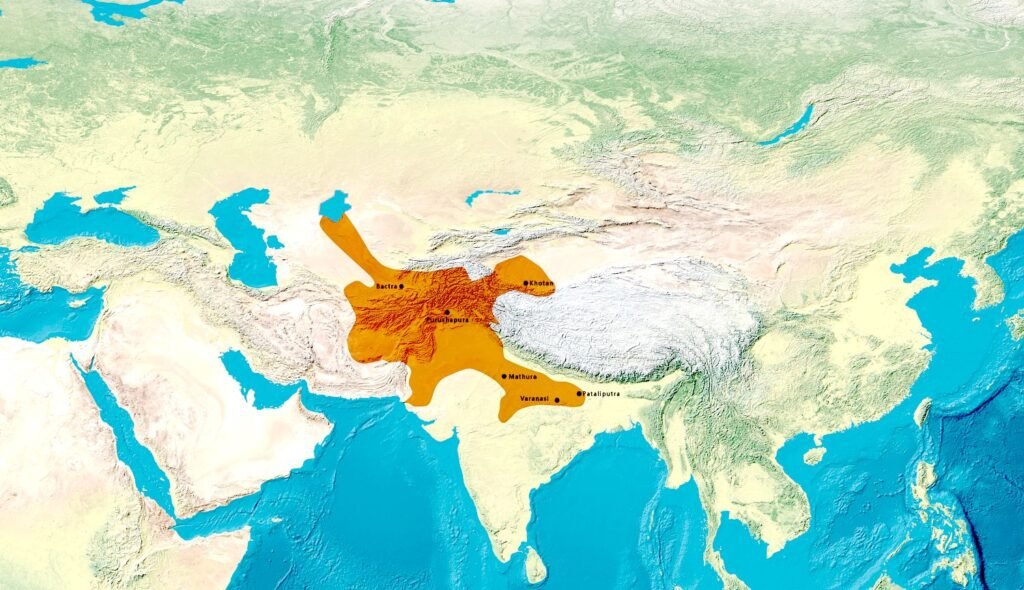
Figure 1. Map of the Kushan Empire at its greatest territorial extent.
Source: Wikimedia Commons (public domain).
I. Why Does the Chronology of Kaniṣka Still Matter?
In the history of Buddhism in Northern India and Central Asia, few figures occupy such a pivotal position as Kaniṣka I of the Kushan Empire. His name is commonly associated with the territorial expansion of the Kushans, the flourishing of Gandhāran art, the tradition of a “Fourth Buddhist Council” in Kashmir, and the consolidation of the Sarvāstivāda school. For this reason, determining the date of Kaniṣka’s reign is not merely a chronological exercise; it is a temporal axis capable of restructuring the entire historical landscape of Buddhism in the early centuries of the Common Era.
At present, many scholars place Kaniṣka I’s accession around 127 CE (± a few years), based on a synthesis of numismatic evidence, stratified archaeological data, and inscriptions. This date is often regarded as the most plausible working hypothesis in contemporary Kushan studies. Yet the chronology of Kaniṣka has not achieved absolute consensus. Specialized discussions—including academic conferences devoted to Kushan chronology in Europe—demonstrate that differing interpretations persist regarding the era associated with Kaniṣka and the reading of certain inscriptions. The relative stability of the 127 CE date should therefore not be understood as a closed conclusion, but rather as a provisional equilibrium within an ongoing scholarly debate.
It is precisely the history of these debates that renders the question of Kaniṣka’s chronology worthy of continued investigation. The issue is not only “In what year did Kaniṣka live?” but also “How did scholarship move from a proliferation of competing hypotheses to a relatively stabilized chronological framework?” The case of Kaniṣka thus provides a paradigmatic illustration of methodological transformation in Buddhist studies: from heavy reliance on textual traditions and retrospective chronological calculations to an increasing emphasis on archaeology, numismatics, and materially verifiable evidence—while still leaving room for new interpretations.
The importance of this issue becomes even clearer when one considers its broader implications. If Kaniṣka were placed in 58 BCE, the entire developmental timeline of Sarvāstivāda, the Mahāvibhāṣā tradition in Kashmir, and early Mahāyāna formations would need to be significantly shifted backward. Conversely, if he belongs to the early second century CE, the consolidation of Sarvāstivāda and the Sanskritization of North Indian Buddhism must be situated within a Kushan Empire at the height of its political power. Chronology in this case is not a technical detail; it is a structural framework that reorganizes the entire trajectory of doctrinal development.
Moreover, Buddhist tradition associates Kaniṣka with the image of a Dharmarāja—a king who patronized the Dharma, convened councils, and strengthened the systematization of scholastic literature. This image, though shaped by tradition, has contributed significantly to the collective memory of the Sarvāstivāda school and of North Indian Buddhism more broadly. Determining Kaniṣka’s chronology cannot therefore be separated from the larger question of the relationship between imperial power and the systematization of doctrine.
This study does not aim to reaffirm a single chronological date as a final conclusion. Rather, it approaches the chronology of Kaniṣka as a case study in the evolution of Kushan Buddhist historiography. By examining competing hypotheses in the early phase of scholarship, analyzing the archaeological turning point and the emergence of the now widely accepted model, and reconsidering the role of Sarvāstivāda in linking Kaniṣka to the council tradition, this article argues that chronology is not a neutral datum. It is a historical construct, shaped through debate, methodological choice, and shifts in scholarly authority.
In this sense, the story of Kaniṣka’s chronology transcends a mere number. It reflects how time is organized in Buddhist historiography, how imperial memory intertwines with doctrinal history, and how scholarly consensus forms—relatively stable, yet always open to reinterpretation.
II. Chronological Crisis and Competing Hypotheses in Early Scholarship
Before reaching its present state of relative stabilization, the question of Kaniṣka’s chronology underwent a prolonged and complex period of debate. Throughout the nineteenth century and the first half of the twentieth century, scholars proposed widely divergent dates, at times differing by more than two centuries. This dispersion reflected not only the lack of reliable archaeological data, but also the limitations of historiographical method at a time when textual sources functioned as the primary—indeed nearly exclusive—authority.
1. Competing Hypotheses
One of the most influential hypotheses placed Kaniṣka in 58 BCE, often associated with the Vikrama era. This approach relied on attempts to synchronize traditional Indian chronological systems with the list of Kushan rulers. In the absence of securely stratified inscriptions and clearly established coin sequences, anchoring the dynasty to a familiar chronological era was an understandable and pragmatic strategy.
Another proposal linked Kaniṣka with 78 CE—the beginning of the Śaka era. This model reflected the desire to associate the Kushan dynasty with a calendrical era widely used in the Indian subcontinent. However, the difficulty of demonstrating a direct connection between the Śaka era and Kaniṣka’s accession prevented this hypothesis from gaining broad acceptance.
Some scholars adopted a more cautious position, placing Kaniṣka somewhere in the second century CE without committing to a specific year. This approach acknowledged the uncertainty of the available evidence and avoided excessive dependence on a single calculated date.
In an effort to reconcile conflicting sources, the “two Kaniṣkas” hypothesis also emerged. According to this view, an earlier and a later Kaniṣka were distinguished in order to explain discrepancies between council traditions and political data. Although this solution did not achieve lasting acceptance, it illustrates both the complexity of the problem and the difficulty of harmonizing heterogeneous textual traditions.
2. Kimura and Text-Based Reconstruction
The work of R. Kimura provides a representative example of historical reconstruction under conditions lacking systematic archaeological evidence. Drawing upon the accounts of Xuanzang and the Sarvāstivāda tradition concerning the Abhidharma-Mahāvibhāṣā, Kimura argued that Kaniṣka should be placed around 58 BCE. He calculated retrospectively from the date of the Buddha’s parinirvāṇa, using various chronological traditions, and constructed a Kushan succession sequence consistent with this hypothesis.
It is important to note that Kimura’s method was not arbitrary speculation, but a systematic attempt to establish coherence among textual sources. Nevertheless, given the internal inconsistencies among parinirvāṇa traditions and the layered transmission of Chinese pilgrimage accounts, reliance upon these materials as fixed chronological anchors inevitably produced highly conjectural chronological structures.
The “two Kaniṣkas” hypothesis within Kimura’s framework may thus be understood less as a conclusion grounded in independent material evidence than as an internal adjustment strategy designed to preserve the coherence of a text-centered model.
3. The Limits of the Textual Model
In retrospect, the period of chronological crisis reflects a stage in which the historiography of ancient India operated under conditions of limited stratified archaeological data. Texts—despite their late composition and legendary elements—remained the primary source of authority. When the Sarvāstivāda council tradition associated Kaniṣka with the systematization of the Mahāvibhāṣā in Kashmir, the king was naturally positioned at the center of doctrinal history. Yet sectarian memory and political history do not necessarily coincide.
Hypotheses such as 58 BCE or the “two Kaniṣkas” model should therefore be understood within the epistemic context in which they were proposed. They were not merely errors to be discarded, but historically situated attempts to manage the indeterminacy of available sources. Precisely because of these limitations, the need for a methodology grounded in independent material evidence became increasingly urgent.
The transition from a text-centered model to an archaeology-based framework did not simply alter the proposed date; it transformed the structure of authority within Kushan historiography. At this juncture, the question of Kaniṣka’s chronology entered a new phase.
III. The Archaeological Turn and the Relative Stabilization of the Early Second-Century CE Model
If the earlier phase of research on Kaniṣka’s chronology was characterized by heavy reliance on textual sources, the second half of the twentieth century witnessed a decisive turning point: the emergence of archaeology, numismatics, and inscriptions as independent sources of authority. This methodological shift significantly altered the balance of the debate and contributed to the formation of the model placing Kaniṣka I in the early second century CE.
1. Numismatics and the Kushan Dynastic Sequence
One of the major foundations of the archaeological turn was the systematic analysis of Kushan coinage. Although Kushan coins had long been known, they had not been securely arranged into a relatively stable dynastic sequence. As numismatics developed into a specialized field, scholars began to establish a succession order: Kujula Kadphises → Vima Taktu → Vima Kadphises → Kaniṣka I → Huvishka → Vāsudeva I.
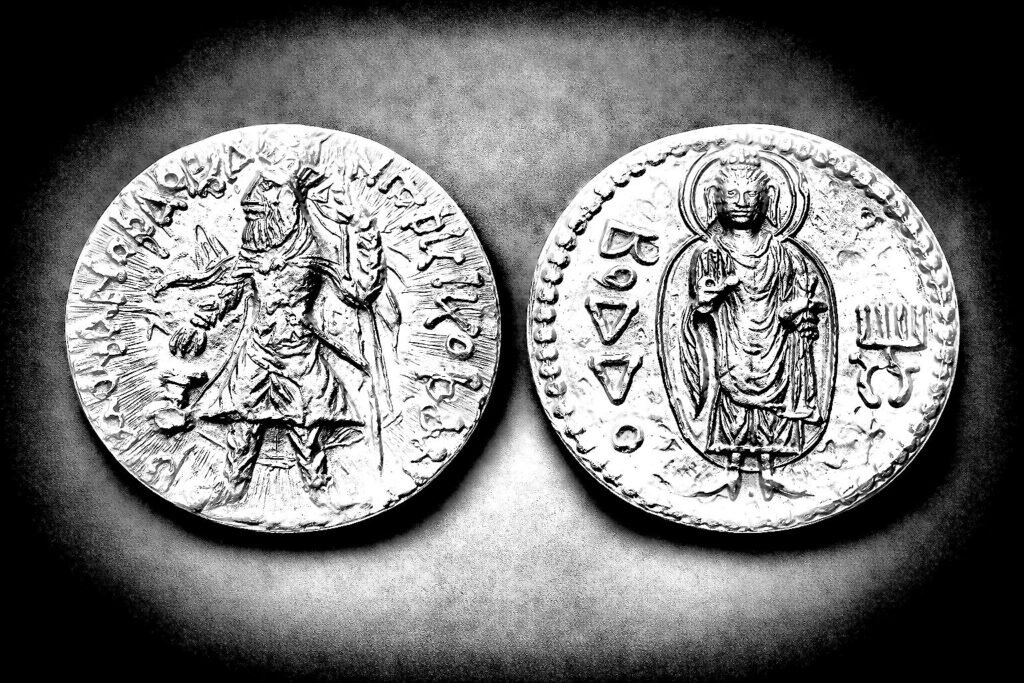
Figure 2 Kushan coin attributed to Kaniṣka I (obverse and reverse), providing numismatic evidence for dynastic sequencing and titulature.
Source: Wikimedia Commons (public domain).
By comparing iconography, royal titulature, and the evolution of minting styles, researchers were able to construct a coherent dynastic sequence. More importantly, this sequence proved difficult to reconcile with the hypothesis placing Kaniṣka in 58 BCE. If the 58 BCE model were adopted, the chronological intervals between Kushan rulers would generate significant gaps and inconsistencies in both numismatic and archaeological data.
Numismatics thus provided a relatively stable framework for reassessing earlier hypotheses. While it could not by itself determine the precise year of accession, it contributed to the elimination of chronologies that placed Kaniṣka too early.
2. Epigraphic Evidence and the Reconstruction of the Dynasty
An even more decisive turning point came from Kushan inscriptions, particularly discoveries in Afghanistan and neighboring regions. Among these, the Rabatak Inscription occupies a central place. This inscription provides information on royal titles and the dynastic order of the Kushan rulers, confirming Kaniṣka’s position in the succession following Vima Kadphises.
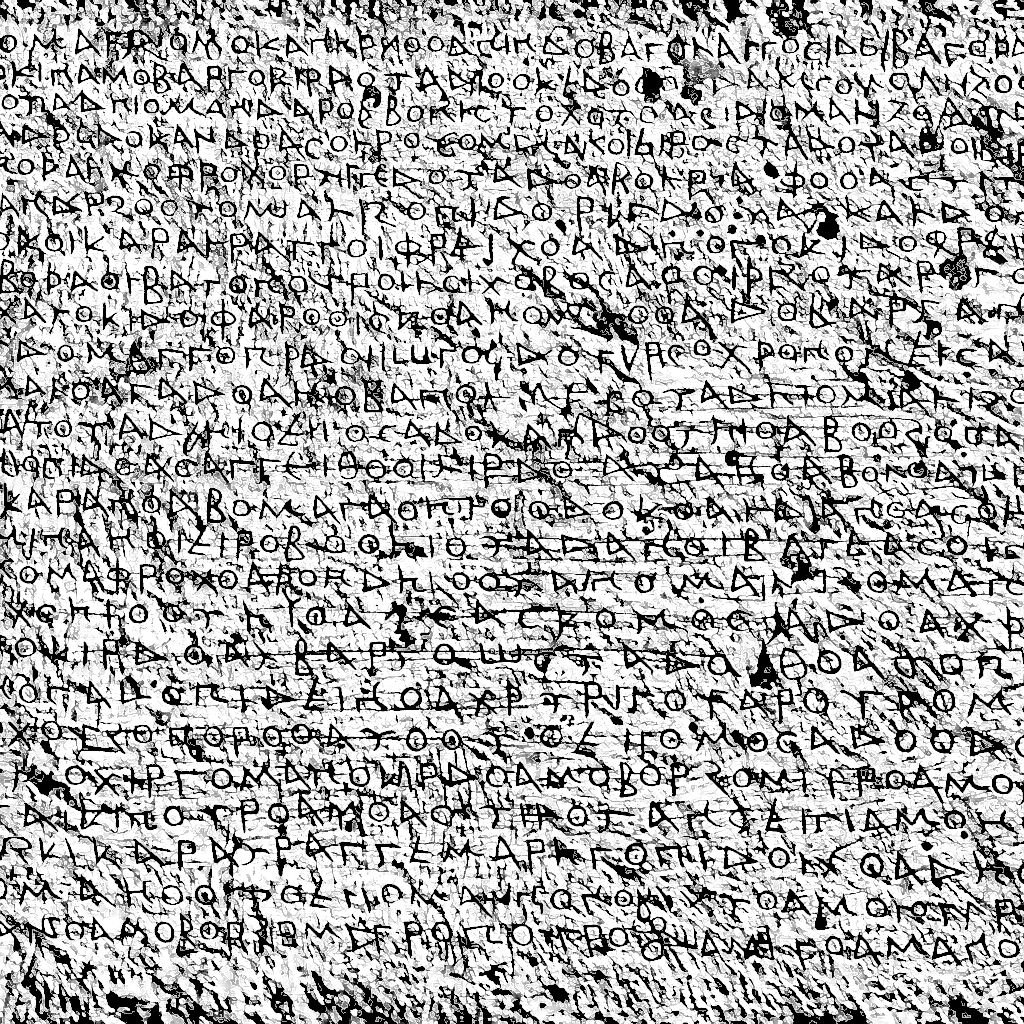
Figure 3. Rabatak Inscription in the Bactrian language (written in Greek script), a key epigraphic source for reconstructing Kushan dynastic succession.
Source: Wikimedia Commons (public domain).
Although the Rabatak Inscription does not provide a Gregorian calendar date in modern terms, it reinforces the dynastic structure of the Kushan line and helps exclude hypotheses overly dependent on late textual traditions. When considered alongside numismatic evidence and stratified archaeological data, the model situating Kaniṣka in the early second century CE gradually gained plausibility among many scholars.
It should be emphasized, however, that inscriptions do not automatically resolve all chronological problems. The interpretation of the so-called Kaniṣka era, the conversion of regnal years across different calendrical systems, and the relationship between epigraphic evidence and textual tradition remain subjects of specialized discussion. The archaeological turn therefore did not eliminate debate altogether; rather, it redefined its scope and method.
3. The Formation of the Early Second-Century CE Model
Through the combined weight of numismatics, inscriptions, and stratified archaeological findings, many scholars gradually came to place Kaniṣka I’s accession around 127 CE, or more broadly within the early second century CE. This date did not emerge as an isolated numerical claim, but as the result of cross-examining multiple categories of evidence.
Compared to the 58 BCE model, the early second-century CE framework holds several advantages. It aligns more coherently with the established sequence of Kushan coinage, with archaeological data from Gandhāra, and with the development of Buddhist art in the region. At the same time, it is more compatible with the formation and systematization of the Sarvāstivāda tradition, which many scholars situate in the context of the second century CE.
Yet the fact that a model is widely regarded as plausible does not mean that debate has ended. Scholarly conferences devoted to Kushan chronology—including meetings held in London to examine the era associated with Kaniṣka—demonstrate that differing interpretations persist concerning the relationship between inscriptions, coinage, and chronological systems. The disagreements no longer involve discrepancies of several centuries, but they continue to revolve around the interpretation of evidence and the methodological conversion of regnal years.
What is particularly noteworthy in this phase is the shift in historiographical authority. Whereas textual traditions—especially council narratives and Chinese pilgrimage accounts—once held a central position, archaeological material and inscriptions have become the primary criteria of evaluation. Kaniṣka’s chronology is thus no longer determined chiefly through calculations based on the Buddha’s parinirvāṇa or through sectarian memory, but through the alignment of dynastic sequences and material evidence.
This methodological shift carries implications beyond the question of a single date. It reflects a profound transformation in the study of Buddhism and ancient Indian history: from near-exclusive reliance on textual authority to the establishment of a multi-source evidentiary framework. In this sense, the archaeological turn not only altered the proposed date of Kaniṣka, but also redefined how history itself is written.
It is precisely within this emerging predominance of the early second-century CE model that the relationship between Kaniṣka, Sarvāstivāda, and the council tradition becomes particularly significant. If Kaniṣka indeed belongs to the early second century CE, then the systematization of the Mahāvibhāṣā in Kashmir and the role of Sarvāstivāda must be understood within the context of a Kushan Empire that had reached a high level of political organization. Chronology, at this point, ceases to be merely a chronological problem and becomes instead a point of intersection between imperial power and the consolidation of ontology.
IV. Sarvāstivāda and the Consolidation of Ontology in the Kushan Context
If the archaeological turn reshaped the way we position Kaniṣka within political chronology, the next question must be asked: what does that chronology mean for the intellectual history of North Indian Buddhism? In particular, the association of Kaniṣka with the council tradition in Kashmir and with the formation of the Abhidharma-Mahāvibhāṣā is not merely a traditional detail. It reflects a large-scale process of doctrinal systematization, within which the Sarvāstivāda school occupies a central place.
1. “Sarva-asti” and the Structure of Time
The name Sarvāstivāda is commonly interpreted through the proposition sarva asti—“everything exists.” This formulation refers to the doctrine that dharmas exist in the three times: past, present, and future. The issue is not simply the affirmation of existence, but the construction of an ontological framework capable of addressing problems related to karma, causality, and the continuity of experience.
In this model, time is no longer conceived as a purely present flow; it is analyzed and conceptualized as a structured and differentiated system. Past dharmas do not entirely vanish, nor are future dharmas entirely nonexistent; rather, they exist in distinct modes. This approach generates a rigorous explanatory system for the operation of karma and the continuity of the mental stream.
From the perspective of intellectual history, the development of such a refined classificatory and definitional system by the Sarvāstivāda reflects a mature phase of Abhidharma thought. These are no longer isolated analytical reflections, but a sustained effort to construct an internally coherent ontology.
2. The Mahāvibhāṣā and the Kashmir Center
North Indian Buddhist tradition—especially sources associated with Sarvāstivāda—frequently links the systematization of the Mahāvibhāṣā to a council held under the patronage of Kaniṣka in Kashmir. While the historicity of this event remains debated, the role of the Mahāvibhāṣā in consolidating Sarvāstivāda thought is difficult to deny.
The Mahāvibhāṣā is not merely a commentary on Abhidharma; it is a large-scale synthetic enterprise, reflecting an attempt to standardize and situate the school within a broader doctrinal landscape. The placement of this work within a framework of royal patronage suggests a connection between political authority and scholastic consolidation.
If Kaniṣka indeed belongs to the early second century CE, then the systematization of the Mahāvibhāṣā occurred within a Kushan Empire that had reached a high degree of political organization, with trade networks extending from Central Asia to North India. In Sarvāstivāda tradition, Kashmir emerges as an intellectual center—a site where positions were gathered, debated, and codified.
3. Ontology and Imperial Structure
At this point, a question arises that must be approached with caution: can the development of a stable and highly structured ontological system such as that of the Sarvāstivāda be correlated with the imperial structure of the Kushan state?
One cannot simply claim that the empire “produced” the doctrine. Yet a structural resonance may be observed. The Kushan Empire, vast and culturally diverse, required a high degree of organization and systematization in governance. In parallel, the Sarvāstivāda developed a tightly organized classification of dharmas, in which every constituent of reality was defined and positioned within a coherent schema.
This similarity does not necessarily imply direct causation. However, it suggests that an imperial environment may have provided favorable conditions for large-scale systematizing efforts. When a school attains a high level of ontological sophistication, royal patronage—whether historically factual or later constructed in collective memory—can function as a reinforcing element of orthodoxy.
4. Sectarian Memory and Power
The Sarvāstivāda tradition’s association of the Mahāvibhāṣā and the council with Kaniṣka may therefore be understood as a form of memory construction. An imperial king becomes the symbol of doctrinal legitimation. The image of the Dharmarāja is not merely an ethical motif; it serves as a historical anchor for the consolidation of the school.
In this case, Kaniṣka’s chronology is no longer a simple numerical datum. If he belongs to the early second century CE, the systematization of Sarvāstivāda is situated within an empire characterized by expansion and intense cultural exchange. If he were placed significantly earlier, this structural configuration would need to be reorganized.
Thus, positioning Kaniṣka within the chronological framework affects not only the political history of the Kushans, but also reshapes our understanding of the maturation of Sarvāstivāda Abhidharma. Chronology becomes a decisive factor in framing the entire narrative of ontological consolidation in North Indian Buddhism.
V. Kaniṣka, Empire, and the Construction of Buddhist Memory
If Section IV demonstrated the consolidation of Sarvāstivāda ontology within the Kushan context, the next question follows naturally: how did the image of Kaniṣka come to occupy the center of sectarian memory and North Indian Buddhist tradition? The issue here is not merely a historical event, but the process by which religious memory is constructed in interaction with imperial power.
1. The Image of the Dharmarāja and Legitimation
In many Buddhist traditions, Kaniṣka is portrayed as a Dharmarāja—a king who patronized the Dharma, convened councils, and defended orthodoxy. This model was not unprecedented in Indian history. Earlier, Aśoka had already become the paradigmatic example of a ruler who linked political authority with the protection and promotion of Buddhism.
Positioning Kaniṣka within a similar framework suggests an effort to reproduce the “king–Dharma” paradigm in a new historical context. The Kushan Empire, with its vast territory and intermediary position between India and Central Asia, created a favorable environment for the expansion of Buddhism. Within this setting, associating the systematization of Sarvāstivāda with an imperial ruler carried not only religious meaning but also reinforced the school’s legitimacy within a diverse and competitive intellectual landscape.
2. Council Memory and Doctrinal Stabilization
The tradition of a council held in Kashmir under Kaniṣka’s patronage—regardless of the degree to which its historicity can be verified—functions as a mnemonic anchor. It provides Sarvāstivāda with a symbolically charged moment of origin, in which doctrine was gathered, analyzed, and established as authoritative.
In this sense, memory of Kaniṣka does not merely record an event; it stabilizes a doctrinal order. When a school reaches a high level of complexity in systematizing Abhidharma, placing that process under royal patronage enhances both its legitimacy and its durability.
Collective memory thus operates not simply as recollection, but as a positioning structure. It organizes the past in a way that highlights continuity and orthodoxy.
3. Empire as a Space of Transmission and Standardization
The Kushan Empire was not only a political formation but also an extensive network of trade and cultural exchange. Routes linking India with Central Asia and beyond facilitated the transmission of texts, symbols, and ideas. Within such a context, a school possessing a tightly organized doctrinal system—such as Sarvāstivāda—could more readily function as a highly standardizable form of Buddhism.
The association of Sarvāstivāda with Kaniṣka in traditional memory may therefore be understood as reflecting a broader historical dynamic: the interaction between empire and doctrinal formation. The empire did not determine the content of the doctrine, but it may have created conditions conducive to large-scale standardization and dissemination.
4. Chronology and the Reconfiguration of Historical Narrative
Within this framework, the question of Kaniṣka’s chronology directly affects how we narrate the history of North Indian Buddhism. If he belongs to the early second century CE, the systematization of Sarvāstivāda and the council tradition is situated in a period when the Kushan Empire had achieved relative political stability. If the date is significantly shifted earlier or later, the structure of that narrative must be correspondingly adjusted.
This demonstrates that chronology is not merely a point along a timeline. It determines how empire, school, scholastic literature, and tradition are interconnected within a unified historical framework. A shift in chronological placement can lead to a reconfiguration of the entire network of relationships.
In this sense, the figure of Kaniṣka functions as an intersection between political power and religious memory. He is not only a historical ruler but also a structural symbol through which the Sarvāstivāda tradition situates itself within the broader history of Buddhism.
VI. Chronology as a Historical Construct: Methodological Reflections
Having examined the competing hypotheses, the archaeological turn, and the role of Sarvāstivāda in sectarian memory, it becomes clear that the chronology of Kaniṣka is not merely the question, “In what year did he ascend the throne?” Rather, it constitutes a paradigmatic case demonstrating that chronology in historiography is not a neutral datum, but a construct shaped through debate, methodological choices, and shifts in epistemic authority.
1. Chronology Is Not a Self-Sufficient Number
In the study of ancient history, chronology is often treated as a stable foundation upon which further analysis is built. Yet the case of Kaniṣka reveals that this foundation itself undergoes a process of formation. 58 BCE, 78 CE, or 127 CE are not simply different numerical options; each date entails a distinct explanatory structure regarding the development of Sarvāstivāda, the political context of the Kushan Empire, and the tempo of scholastic formation.
Chronology does not exist as an isolated fact. It stands at the intersection of multiple categories of evidence: textual sources, inscriptions, numismatics, and stratified archaeology. When one type of evidence is privileged over others, the chronological framework may shift accordingly. This helps explain why the transition from a text-centered model to an archaeology-based model significantly altered the proposed timeframe.
2. Authority and the Shift of Method
Debates over Kaniṣka’s chronology also reflect transformations in scholarly authority. In the earlier phase, Chinese pilgrimage records and Sarvāstivāda council traditions were regarded as primary sources of authority. With the rise of archaeology and numismatics, material evidence gradually displaced textual tradition as the central criterion of evaluation.
This shift did not merely change conclusions; it altered the mode of argumentation itself. If earlier chronological calculations based on the Buddha’s parinirvāṇa could be considered reasonable within a text-centered framework, modern scholarship increasingly relies on inscriptions and coin sequences as primary means of verification. Chronology, therefore, is shaped not only by available data, but also by the methodological structure governing interpretation.
3. Consensus as a Provisional State
The early second century CE—often centered around 127 CE—is currently regarded by many scholars as the most plausible date for Kaniṣka’s accession. Yet consensus in scholarship is not an absolute endpoint. Conferences devoted to Kushan chronology demonstrate that even after major discrepancies have been narrowed, issues such as the interpretation of the Kaniṣka era, the conversion of regnal years, and the reading of inscriptions remain subjects of ongoing discussion.
This should not be seen as instability, but as a natural feature of research in ancient history. When sources are limited and interpretation is method-dependent, consensus remains provisional. Chronology must therefore be understood as an open result—stable within a given period, yet always subject to reconfiguration when new evidence or new interpretive frameworks emerge.
4. Chronology and the Structure of Historical Narrative
More fundamentally, chronology determines how the story itself is told. Placing Kaniṣka in the early second century CE allows the consolidation of Sarvāstivāda to be linked with a Kushan Empire at the height of its power. Moving him significantly earlier would alter this alignment. Chronology, therefore, is not merely background information; it is the structural framework organizing the entire narrative.
The case of Kaniṣka reminds us that writing history is not simply a matter of arranging data, but of constructing a structure that links political power, sectarian development, textual production, and collective memory. Each adjustment in chronology entails a corresponding adjustment in narrative configuration.
VII. Kaniṣka and the Structure of Time in Buddhist Historiography
When the entire trajectory of debate is reconsidered, the question of Kaniṣka’s chronology proves not to be a purely chronological problem. From hypotheses placing him in 58 BCE or 78 CE to the early second-century CE model widely regarded as most plausible today, each proposed date is inseparable from a broader explanatory structure concerning the Kushan Empire, the Sarvāstivāda school, and the systematization of Abhidharma.
The earlier, text-centered phase of scholarship illustrates how council traditions and sectarian memory once played a central role in situating Kaniṣka historically. The archaeological turn—with the rise of numismatics and epigraphy—reconfigured the hierarchy of authority and significantly narrowed the scope of disagreement. Yet the emergence of a relative consensus around the early second century CE should not be understood as a final resolution, but as a provisional stabilization within an ongoing scholarly process.
The case of Kaniṣka thus exemplifies a crucial feature of Buddhist historiography: chronology is not merely a datum, but a structural principle organizing the entire narrative. Placing him in the early second century CE enables the consolidation of Sarvāstivāda and the Mahāvibhāṣā to be situated within a Kushan Empire that had reached political maturity and intense cultural exchange. Shifting that date would require a reconfiguration of the entire historical account.
More importantly, Kaniṣka’s chronology demonstrates that Buddhist history does not unfold independently of political history. The image of the Dharmarāja, the memory of a council in Kashmir, and the consolidation of Sarvāstivāda ontology all operate within an imperial space where power, scholarship, and collective memory intersect. Kaniṣka is therefore not merely a Kushan ruler; he represents a point of convergence between empire and ontology, between political authority and doctrinal standardization.
If there is a methodological lesson to be drawn from this prolonged debate, it is the need for caution in the use of chronology. Rather than treating a date as an immutable foundation, the study of ancient history requires recognition that every chronological marker is constructed through the comparison of sources and the application of method. Consensus may be achieved, but it always remains open to revision in light of new evidence or new interpretive frameworks.
In this sense, the question of Kaniṣka’s chronology remains alive—not because a plausible solution is lacking, but because each solution carries with it a particular structure of historical narration. And it is precisely at the intersection of time, power, and memory that Kaniṣka continues to occupy a central place in the study of North Indian Buddhism.
Related Studies:
- Buddhism among the Indo-Greek Rulers: Religion, Power, and Cultural Exchange
- Sarvāstivāda: The Forgotten Philosophical School of Early Buddhism
Bibliography
Cribb, Joe. Kushan, Kushano-Sasanian, and Kidarite Coins: A Catalogue of Coins from the American Numismatic Society. New York: American Numismatic Society, 1990.
Falk, Harry. The Kaniṣka Era in Gupta Records. Berlin: Verlag der Österreichischen Akademie der Wissenschaften, 2001.
Göbl, Robert. System und Chronologie der Münzprägung des Kušanreiches. Vienna: Verlag der Österreichischen Akademie der Wissenschaften, 1984.
Kimura, R. “Date of Kaniṣka.” The Indian Historical Quarterly 1 (1925): 415–422. Delhi: Caxton Publications.
Lamotte, Étienne. History of Indian Buddhism: From the Origins to the Śaka Era. Translated by Sara Webb-Boin. Louvain-la-Neuve: Institut Orientaliste, 1988.
Rosenfield, John M. The Dynastic Arts of the Kushans. Berkeley: University of California Press, 1967.
Willemen, Charles, Bart Dessein, and Collett Cox. Sarvāstivāda Buddhist Scholasticism. Leiden: Brill, 1998.