
Le Hoang Da
Buddhist Scholar
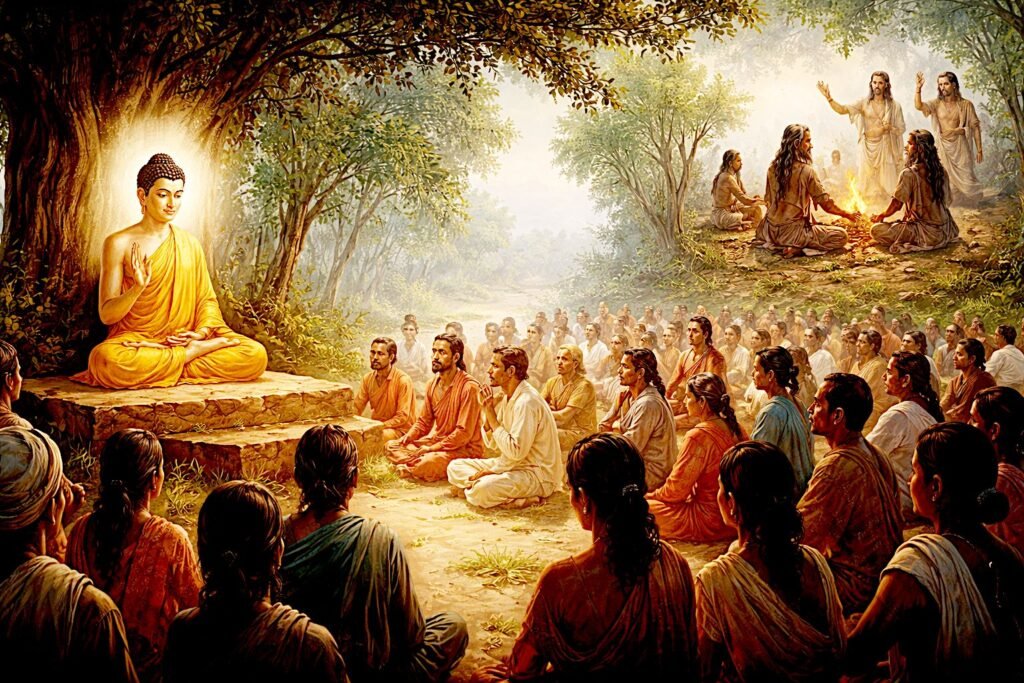
The Buddha teaching villagers amid a landscape of competing ascetic doctrines, reflecting the methodological orientation of early Buddhism discussed in the Kālāma and Apannaka Suttas.
I. Introduction: The Problem of Doctrinal Uncertainty
In the intellectual landscape of ancient India, human beings did not live within a uniform environment of thought. On the contrary, the society in which the Buddha lived was a diverse philosophical arena where multiple religious and intellectual traditions coexisted, debated, and competed for influence. Ascetics and Brahmins traveled from town to town and village to village, proclaiming different doctrines about the nature of the world, the destiny of human beings, and the path leading to happiness or liberation. In such circumstances, an ordinary person could easily fall into confusion: each teacher claimed that his own doctrine represented the truth while criticizing and rejecting the teachings of others.
Within this context, a fundamental question naturally arose: how can a thoughtful person determine what is worthy of belief and which path should be followed? This question is not merely religious; it is also epistemological and ethical in nature. Without a method for evaluating competing viewpoints, one may fall into either of two extremes: blindly accepting a doctrine without critical reflection, or descending into radical skepticism that rejects the possibility of knowing truth altogether.
Two discourses preserved in the Nikāya of the Pāli Canon directly reflect this situation: the Kālāma Sutta (Aṅguttara Nikāya 3.65) and the Apannaka Sutta (Majjhima Nikāya 60). Both texts begin from highly practical circumstances. In the Kālāma Sutta, the inhabitants of the town of Kesaputta express their uncertainty to the Buddha: many ascetics and Brahmins visit the town, each teaching different doctrines while asserting that their own view is correct and criticizing the views of others. In the Apannaka Sutta, the Buddha encounters a similar situation, in which doctrines denying moral causation and the existence of an afterlife were circulating within society.
What is striking in both cases is that the Buddha does not ask his listeners to accept his teaching merely on the authority of a spiritual master. Instead, he presents a methodological approach to evaluating beliefs and guiding human action. In the Kālāma Sutta, he advises his listeners not to accept a view simply because of tradition, rumor, scriptural authority, or the prestige of a teacher. Rather, they are encouraged to examine the ethical and practical consequences of the actions that these views promote. In the Apannaka Sutta, the Buddha develops a different but complementary line of reasoning: when confronted with doctrines that deny karma and the afterlife, one may still choose a moral way of living as the most reasonable and secure option, since such conduct brings benefits in the present and does not lead to harm even if metaphysical claims cannot be immediately verified.
When read individually, each discourse may appear to offer merely ethical advice or practical guidance. Yet when these texts are placed side by side, they reveal something deeper. Early Buddhism does not merely propose doctrinal teachings; it also suggests a method for approaching truth and guiding action under conditions of uncertainty. In other words, these discourses point to a methodological structure within early Buddhist thought in which the evaluation of beliefs and the orientation of action are shaped by empirical and ethical criteria.
This article aims to examine that methodological structure. Through an analysis of the Kālāma Sutta and the Apannaka Sutta, it argues that these two texts together present a framework of reasoning composed of two complementary steps. First, the Kālāma Sutta proposes a form of epistemic filtering, in which views are assessed according to their ethical consequences and practical experience rather than by authority or tradition. Second, the Apannaka Sutta develops a form of ethical prudential reasoning in which moral conduct is regarded as the most rational choice even in situations where metaphysical certainty has not yet been established.
By reading these two texts in relation to one another, this study suggests that early Buddhism may be understood as a tradition concerned not only with the content of truth but also with the method by which human beings approach and practice that truth. This method avoids both extremes—blind belief and radical skepticism—while laying the foundation for the emergence of right view (sammā-diṭṭhi) as the central intellectual orientation of the path of practice.
II. The Intellectual Context: Competing Doctrines in Early India
To fully understand the significance of the Kālāma Sutta and the Apannaka Sutta, it is necessary to situate these texts within the broader intellectual context of India in the sixth and fifth centuries BCE. This period was not characterized by a single unified system of thought but rather by a dynamic philosophical environment in which multiple traditions coexisted and engaged in debate. Alongside the long-established Brahmanical tradition, numerous new śramaṇa movements emerged, each proposing different explanations concerning the nature of the world, the workings of karma and human destiny, and the path leading to liberation.
Ancient textual sources suggest that this philosophical landscape was particularly vibrant. Religious teachers traveled widely from city to city and village to village, presenting their doctrines to various audiences. Each tradition not only articulated its own teachings but frequently criticized and rejected the views of rival schools. As a result, ordinary people were often confronted with conflicting claims regarding fundamental questions of life: whether there is an existence after death, whether moral actions bear consequences, and whether human life is governed by a meaningful order of causation.
Among the views mentioned in the Nikāya texts, three doctrines stand out because they explicitly deny the moral foundations of human action. The first is natthika-vāda, the view that there is no life after death and no form of existence beyond the present life. According to this perspective, the individual ceases entirely at death, rendering notions such as rebirth and the karmic fruits of action meaningless.
The second is akiriya-vāda, the doctrine that denies the moral efficacy of action. Adherents of this view maintain that good and bad actions produce no distinct moral consequences. Acts such as killing, stealing, or lying, from this perspective, carry no different outcome from any other kind of action. If such a view were widely accepted, the entire moral structure of society would be undermined, since virtuous and unwholesome conduct would no longer carry genuine significance.
The third is ahetuka-vāda, the doctrine that rejects the principle of causality in life. According to this position, events in the world do not arise from identifiable causes but occur randomly or without determining conditions. Once the principle of causation is denied, the search for a rational foundation for moral action becomes meaningless, since human behavior would no longer be connected to any meaningful consequences.
These doctrines were not merely abstract philosophical speculations. They had the potential to influence how people actually lived and behaved. If individuals believed that there was no life after death, or that moral actions produced no consequences, they might lose the motivation to uphold ethical norms that sustain social order. For this reason, the presence of such doctrines posed a serious challenge to any tradition seeking to preserve a moral foundation for human life.
It is precisely within this context that discourses such as the Kālāma Sutta and the Apannaka Sutta become particularly significant. Rather than simply rejecting rival doctrines by asserting another set of dogmatic claims, the Buddha adopts a different approach: he directs attention to the method by which views themselves should be evaluated. What matters is not only the content of a doctrine but also the criteria by which its validity is determined.
The Kālāma Sutta illustrates this point through a concrete situation. The people of the Kālāma community express their confusion when confronted with numerous teachers, each claiming to possess the truth. Instead of asking them to accept his teaching on authority, the Buddha points out that belief should not be grounded merely in tradition, rumor, or the prestige of a teacher. This response indicates that the issue he addresses is not simply the error of certain specific doctrines but the absence of a reasonable standard for evaluating competing teachings.
The Apannaka Sutta approaches the problem from a different yet closely related perspective. In this discourse, the Buddha directly addresses views that deny karma and the existence of an afterlife. Yet instead of merely declaring such views false, he constructs an argument based on the practical consequences of accepting or rejecting them. This reasoning shows that even when individuals cannot yet prove metaphysical claims such as rebirth or karmic retribution with certainty, they can still choose an ethical way of life as a rational and prudent course of action.
Taken together, these two discourses reveal an important feature of early Buddhist thought: a deep concern with the method of knowing and the guidance of action in a world where philosophical views compete with one another. Rather than constructing a system of teachings grounded in absolute authority, early Buddhism places emphasis on helping individuals develop the capacity to evaluate views for themselves and to guide their actions according to ethical consequences and practical experience.
From this competitive intellectual context, the Kālāma Sutta and the Apannaka Sutta can thus be understood as attempts to establish a method for approaching truth and action in human life. While the Kālāma Sutta focuses on establishing criteria for evaluating beliefs, the Apannaka Sutta further develops a form of ethical reasoning that guides human beings in choosing appropriate action even when absolute certainty regarding metaphysical questions is not yet attainable. When these two approaches are read together, they open the possibility of reconstructing a distinctive methodological structure of early Buddhist thought, which will be examined in greater detail in the following sections of this study.
III. Epistemic Filtering: The Method of the Kālāma Sutta
Within the entire corpus of the Nikāyas, the Kālāma Sutta is often regarded as one of the texts that most clearly presents the Buddha’s approach to questions of knowledge in the context of the diverse doctrinal landscape of ancient India. The discourse begins with a very concrete social and philosophical situation. The Kālāma people of the town of Kesaputta express their confusion to the Buddha: many ascetics and Brahmins come to their town teaching different doctrines, each praising his own teaching while criticizing those of others. In such circumstances, the listeners do not know whom to believe or which path they should follow.
The Buddha’s response to this confusion is particularly noteworthy. Rather than asking the listeners to accept his teaching on the authority of a spiritual master, he acknowledges that their doubt is natural. From this recognition, a method of inquiry begins to emerge. The Buddha lists a number of grounds upon which people commonly rely when forming beliefs and advises that these grounds, by themselves, are not sufficient to establish truth.
The list includes many familiar elements within intellectual and religious life: tradition, hearsay, scriptural authority, logical reasoning, speculative inference based on appearances, and even the prestige of a respected teacher. What is significant here is that the Buddha does not completely reject the value of these elements. Instead, he emphasizes that they should not be regarded as ultimate criteria for establishing belief. A tradition may be ancient yet mistaken; a logical argument may be internally consistent yet based on false assumptions; and the authority of a teacher cannot substitute for the necessity of examining a view through one’s own understanding.
For this reason, the teaching of the Kālāma Sutta becomes especially significant within the religious context of ancient India, where the authority of spiritual teachers was often regarded as the highest source of truth. A striking illustration of the danger of faith grounded solely in the authority of a teacher can be found in the story of Aṅgulimāla recorded in the Nikāya texts. According to this tradition, Aṅgulimāla committed extreme acts of violence—even killing many people—simply because he followed the instructions of his teacher with unquestioning trust. This case demonstrates that when belief is placed entirely in personal authority without verification through wisdom and the ethical consequences of action, it can lead to disastrous outcomes. In this light, the advice of the Kālāma Sutta that one should not accept a view merely because “this ascetic is our teacher” takes on a particularly profound meaning.
However, the purpose of the discourse is not to promote a form of radical skepticism. The Buddha does not instruct his listeners to reject all forms of authority or all traditions. Instead, he proposes another standard by which views and actions should be evaluated.
This standard is presented as a process of assessment grounded in ethical consequences. The Buddha encourages the listeners to observe directly what occurs when mental states such as greed, hatred, and delusion dominate human action. When these states arise, individuals tend to perform harmful acts toward themselves and others—such as killing, stealing, sexual misconduct, and lying. Such actions not only disrupt social harmony but also bring suffering to those who perform them.
By contrast, when mental states opposed to greed, hatred, and delusion are cultivated—such as non-greed, non-hatred, and non-delusion—human conduct tends to generate benefit and well-being for both oneself and others. A person whose mind is not dominated by greed, hatred, and delusion will refrain from harmful actions and instead practice conduct that promotes harmony and welfare.
From these observations, the Buddha proposes a methodological principle of evaluation: when an action or a view is recognized as unwholesome, criticized by the wise, and conducive to suffering when practiced, it should be abandoned. Conversely, when an action or view is recognized as wholesome, praised by the wise, and conducive to happiness when practiced, it should be accepted and cultivated.
This principle can be understood as a form of ethical verification grounded in experience. Rather than seeking absolute certainty through metaphysical claims, the method of the Kālāma Sutta directs attention to the practical consequences of mental states and actions. This does not mean that metaphysical questions are entirely dismissed, but they are not the starting point of the process of inquiry. Instead, the starting point lies in the direct observation of the relationship between mental states, actions, and their consequences in human life.
In this way, the Kālāma Sutta establishes a form of epistemic filtering. Views and actions are not accepted merely because they are supported by tradition or because they fit within a certain system of reasoning. They must be examined through a process of observation and reflection concerning their ethical consequences. Only those views and actions that successfully pass through this process of evaluation can be accepted as reliable guides for human life.
This method also clarifies the meaning of right view (sammā-diṭṭhi) in early Buddhism. Right view is not simply the acceptance of a correct set of doctrinal propositions. Rather, it emerges from a process of understanding in which individuals learn to distinguish between views that lead to suffering and those that lead to well-being. In this sense, right view is not merely the content of belief but a capacity for judgment developed through experience and ethical reflection.
From this perspective, the Kālāma Sutta does more than provide moral advice to its audience. It presents the first step in the methodological structure of early Buddhist thought: a method through which individuals can filter out unreliable beliefs and direct their attention toward principles that can be verified through the practical consequences of action. Yet this process remains incomplete. Even after individuals have established a standard for evaluating beliefs, they may still encounter questions for which absolute certainty cannot immediately be attained—particularly metaphysical issues such as the existence of an afterlife or the operation of karmic retribution.
It is precisely at this point that the Apannaka Sutta assumes an important complementary role. If the Kālāma Sutta presents a method for evaluating views, the Apannaka Sutta further develops a form of ethical reasoning that guides human action even under conditions of epistemic uncertainty. The next section will analyze this reasoning and show how it completes the methodological structure of early Buddhist thought.
IV. Ethical Prudence: The Argument of the Apannaka Sutta
If the Kālāma Sutta presents a method for evaluating views and beliefs, the Apannaka Sutta approaches the issue from a different yet complementary perspective. The discourse not only raises the question of what one ought to believe but also addresses a more practical concern: how should human beings act in situations where absolute certainty about truth cannot yet be attained? In the context of ancient Indian society, where competing doctrines were widely circulated, this question became particularly significant.
The Apannaka Sutta begins by referring to certain views present in the society of the time, especially doctrines that deny the moral foundations of human action. Among these, a prominent view maintains that there is no life after death and no karmic result of good or bad deeds. From this perspective, moral behavior carries no special significance, since death marks the complete cessation of existence and individuals will not experience any consequences from their actions.
Rather than simply rejecting these views by declaring them false, the Buddha constructs an argument based on a comparison between the consequences of two different ways of living. On the one hand is a way of life grounded in the belief that there is no karma and no afterlife. On the other hand is a way of life based on ethical conduct and the avoidance of unwholesome actions.
This reasoning may be understood as a form of prudential reasoning. The Buddha encourages his listeners to consider different possibilities and to examine the consequences associated with each. If a person adopts the view that there is no afterlife and no moral result of action, he or she may feel no need to restrain unwholesome behavior. However, if this view turns out to be mistaken, that person would then face unfavorable consequences after death. By contrast, if a person lives according to ethical principles—refraining from killing, stealing, sexual misconduct, and false speech—even in the case that no afterlife exists, such a person would still lead a harmonious life, causing no harm to oneself or to others.
From this comparison, the Buddha draws a practical conclusion: an ethical way of life is the most reasonable and secure choice because it yields benefit under every possible circumstance. If there is indeed an afterlife and karmic retribution, the ethical individual will reap favorable results. If there is no afterlife, that person will still have lived a peaceful life free from the remorse associated with harmful actions. In either case, ethical conduct does not lead to loss.
This argument is not intended as a metaphysical proof of the existence of an afterlife or of the law of karma. Instead, it represents a practical approach to guiding human action under conditions of epistemic uncertainty. When metaphysical questions cannot be immediately resolved, individuals can still rely on the practical consequences of their actions in order to make reasonable decisions.
What is particularly noteworthy is that the reasoning of the Apannaka Sutta does not stop at defending ethical conduct. The discourse proceeds to describe the path of practice that unfolds for one who adopts the correct orientation. After abstaining from unwholesome actions, the practitioner cultivates an ethical life grounded in moral discipline, guards the sense faculties, lives with mindfulness, and eventually enters the stages of meditative concentration. From this foundation, wisdom may arise, leading to a deeper understanding of the nature of existence and the path to liberation.
Thus, the Apannaka Sutta does more than present a prudential ethical argument. It demonstrates that the initial choice to live ethically can open the entire path of Buddhist practice. A fundamental decision—to follow ethical principles rather than deny them—can become the basis for the development of morality (sīla), concentration (samādhi), and wisdom (paññā).
When the argument of the Apannaka Sutta is placed alongside the epistemic method of the Kālāma Sutta, a broader methodological structure begins to emerge. If the Kālāma Sutta helps individuals filter out unreliable beliefs, the Apannaka Sutta helps them choose reasonable action even when metaphysical certainty has not yet been achieved. The two steps therefore complement one another: the first concerns the evaluation of views, while the second concerns the guidance of action in life.
In this sense, the Apannaka Sutta provides the second step in the methodological framework of early Buddhism. It shows that wisdom in the Buddhist tradition is not only the capacity to analyze doctrines but also the capacity to make prudent ethical decisions within the uncertainties of human existence. The following section will synthesize these two steps and propose a broader interpretation of early Buddhist methodology as reflected in the Kālāma and Apannaka discourses.
V. Reconstructing Early Buddhist Methodology
The analysis of the Kālāma Sutta and the Apannaka Sutta shows that these texts do not merely offer isolated pieces of ethical advice. When read in relation to one another, they allow us to identify a broader methodological structure within early Buddhist thought. This structure addresses two fundamental issues of intellectual and ethical life: how to evaluate competing views, and how to choose appropriate action under conditions of epistemic uncertainty.
Within the philosophical environment of ancient India, where numerous doctrines coexisted and competed with one another, these two issues were closely intertwined. Human beings were confronted not only with the question of what is true but also with the question of how they should live while the truth remained not yet fully determined. Early Buddhism, as reflected in these two discourses, does not resolve this problem by asserting an absolute authority. Instead, it proposes a method of reasoning through which individuals may gradually approach truth while orienting their conduct.
The first step of this method can be seen in the Kālāma Sutta, where the Buddha encourages listeners not to accept a view simply because it is supported by tradition, recorded in scripture, or taught by a respected teacher. Rather than relying on external authorities, individuals are encouraged to observe the ethical consequences of mental states and actions. Views that give rise to greed, hatred, and delusion—and thus lead to suffering—should be abandoned, while views that foster wholesome mental states and promote well-being should be accepted.
This method may be understood as a process of epistemic filtering. Its purpose is not to deny all authority or all tradition, but to establish a criterion by which they may be evaluated. A view can only be accepted when it passes a process of verification through ethical consequences and practical experience. In this sense, the Kālāma Sutta provides a mechanism through which individuals can avoid two extremes: blind belief grounded in authority and radical skepticism that denies the possibility of knowing truth.
Yet the process of epistemic filtering alone does not resolve every difficulty in human life. Even after one has rejected views that clearly lead to suffering, certain questions may remain for which absolute certainty cannot immediately be attained. Metaphysical issues such as the existence of an afterlife or the nature of karmic retribution may lie beyond the scope of direct verification within ordinary experience. In such situations, individuals still require a principle to guide their actions.
At this point, the argument of the Apannaka Sutta assumes an important complementary role. Rather than waiting for absolute certainty regarding metaphysical questions, the Buddha encourages his listeners to examine the consequences of different ways of living. A lifestyle that denies karma and the afterlife may appear to offer freedom from moral constraints, but it also carries the risk of encouraging harmful conduct. By contrast, a way of life grounded in refraining from unwholesome actions and cultivating ethical qualities not only brings benefits in the present life but also avoids negative consequences should the moral principles of the universe indeed be real.
This reasoning may be understood as a form of ethical prudence. When individuals cannot attain absolute certainty regarding certain matters, they can still make rational decisions by considering the consequences associated with different possibilities. In the case presented in the Apannaka Sutta, an ethical way of life emerges as the most reasonable choice because it brings benefit under every possible circumstance.
When these two steps are considered together, a methodological structure becomes increasingly visible. The first step, reflected in the Kālāma Sutta, concerns the evaluation of views through their ethical consequences and practical experience. The second step, presented in the Apannaka Sutta, concerns the choice of wise action in situations where epistemic certainty cannot yet be fully achieved. Together, these two steps form a practical approach to the problems of truth and action.
What is particularly noteworthy is that this method does not separate knowledge from ethics. In many philosophical traditions, the question of truth is treated as a purely epistemological matter, while the question of right action belongs to ethics. In early Buddhism, however, these two domains are closely interconnected. The evaluation of a view is not determined solely by its logical coherence but also by the ethical consequences it generates in human life.
It is precisely the combination of epistemic filtering and ethical prudence that constitutes a distinctive feature of early Buddhist methodology. Rather than constructing a system of doctrine grounded in absolute metaphysical claims, early Buddhism offers a method through which individuals can gradually orient both their understanding and their conduct. This method does not demand blind faith, yet it does not collapse into indeterminate skepticism. Instead, it encourages an ongoing process of inquiry in which beliefs, experience, and action are continually refined through the observation of their consequences.
Understood in this way, right view (sammā-diṭṭhi) in early Buddhism is not merely the acceptance of a correct set of doctrines. It is the outcome of a method of thinking through which individuals learn to evaluate views, recognize their ethical consequences, and choose actions in accordance with that understanding. Right view thus becomes not only an element of the path of practice but also an intellectual orientation that enables human beings to navigate life within a world characterized by competing doctrines and persistent uncertainty.
VI. Conclusion: Methodology and the Formation of Right View
A comparative reading of the Kālāma Sutta and the Apannaka Sutta suggests that early Buddhism was concerned not only with presenting doctrinal teachings but also with the manner in which human beings approach and evaluate those teachings. Within the intellectual landscape of ancient India—where numerous doctrines and religious traditions coexisted and competed—the crucial issue was not merely which view was correct, but how individuals could recognize and choose among competing claims. These two discourses demonstrate that Buddhism addressed this problem not only through doctrinal content but also through a method of reflection.
Rather than demanding unconditional acceptance of a system of belief, these texts encourage a process in which individuals learn to evaluate views through experience, ethical consequences, and practical observation. In this process, the search for truth is not presented as the passive reception of authority but as an active cognitive endeavor in which individuals must deliberate and choose for themselves. Such an approach helps avoid two extremes often found in intellectual life: blind faith grounded in authority and radical skepticism that denies the possibility of knowing truth.
In this sense, the method combining epistemic analysis, ethical filtering, and prudential decision-making—as reflected in the Kālāma Sutta and the Apannaka Sutta—may be seen as a notable development within the history of ancient Indian thought. In an intellectual environment where many traditions relied heavily on the authority of tradition or the prestige of spiritual teachers, these discourses propose a different orientation: encouraging individuals to observe, reflect upon, and evaluate the consequences of views and actions for themselves. This orientation reveals a distinctive level of philosophical self-reflection in which the search for truth is inseparable from a method of thinking that is both analytical and practical.
This approach also clarifies the deeper significance of the concept of right view (sammā-diṭṭhi) in early Buddhism. Right view is not merely the acceptance of a correct set of doctrines; rather, it is the outcome of a process of understanding in which individuals learn to evaluate views, recognize their ethical consequences, and adjust their actions accordingly. In this sense, right view is not simply the content of belief but an intellectual orientation shaped through a method of reflective and practical reasoning.
Although this method emerged within the intellectual context of ancient India, it continues to carry implications for contemporary intellectual life. In a modern world where systems of belief, ideologies, and streams of information constantly compete with one another, the evaluation of views through experience, ethical consequences, and careful reflection remains a practical and reasonable orientation. In this sense, the method reflected in the Kālāma Sutta and the Apannaka Sutta belongs not only to the history of Buddhist thought but also offers an approach that may assist human beings in navigating both understanding and action within the uncertainties of modern life.
Related Studies:
Bibliography
Anālayo, Bhikkhu. Early Buddhist Discourses. Cambridge: Windhorse Publications, 2011.
Bodhi, Bhikkhu, trans. The Numerical Discourses of the Buddha: A Translation of the Aṅguttara Nikāya. Somerville, MA: Wisdom Publications, 2012.
Gethin, Rupert. The Foundations of Buddhism. Oxford: Oxford University Press, 1998.
Harvey, Peter. An Introduction to Buddhism: Teachings, History and Practices. 2nd ed. Cambridge: Cambridge University Press, 2013.
Jayatilleke, K. N. Early Buddhist Theory of Knowledge. London: George Allen & Unwin, 1963.
Kalupahana, David J. A History of Buddhist Philosophy: Continuities and Discontinuities. Honolulu: University of Hawai‘i Press, 1992.
Ñāṇamoli, Bhikkhu, and Bhikkhu Bodhi, trans. The Middle Length Discourses of the Buddha (Majjhima Nikāya). Somerville, MA: Wisdom Publications, 2005.
Rahula, Walpola. What the Buddha Taught. London: Gordon Fraser, 1974.