
Le Hoang Da
Independent Philosopher & Buddhist Scholar
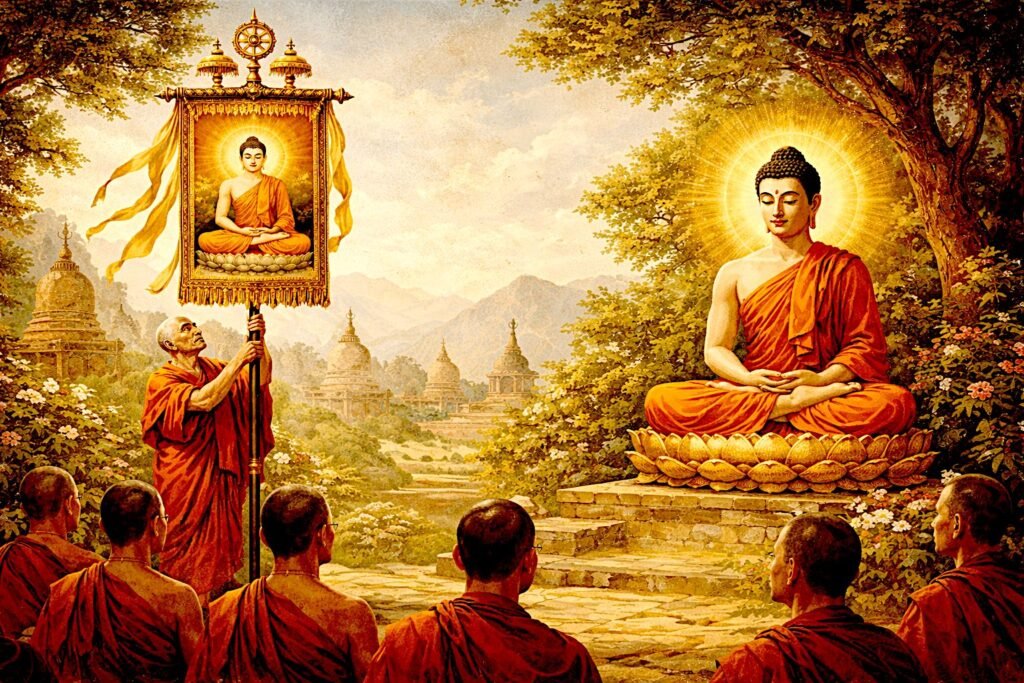
Venerable Longhu (龍護) preparing to raise a ceremonial banner in honor of the Buddha — a moment in which the Tathāgata declines public glorification in the Sūtra on the Merit of Faith in the Buddha (T01n0018).
I. Faith and the Problem of Cognition in Early Buddhism
In the Buddhist tradition, faith (śraddhā / saddhā) is often regarded as one of the foundational wholesome faculties of the spiritual life. Yet this concept is not infrequently misunderstood. At the popular level, faith is easily equated with devotional emotion, absolute submission to a spiritual authority, or an attitude of trust that requires no examination. If left unanalyzed, such identification risks reducing faith to religious belief in a theological sense—where the object is exalted for its supernatural power, and the believing subject remains only in a posture of submission.
However, in the early scriptures—particularly within the Āgama and Nikāya traditions—the structure of faith is more complex. Faith is not the endpoint of thinking, but often the result of a process of observation and verification. Disciples are not advised to believe on the basis of tradition, rumor, or the allure of miracles; rather, they are encouraged to see for themselves the ethical integrity, practical viability, and liberating potential of the Dharma. In this context, faith does not stand in opposition to wisdom. Instead, it functions as a transitional moment—an opening of the heart grounded in understanding.
The Sūtra on the Merit of Faith in the Buddha (T01n0018) offers a particularly illuminating case for examining this structure. The text does not begin with a miracle, nor does it arise from a crisis of belief. Instead, it opens with a declaration by the Venerable Śāriputra: “I now arouse profound faith in the Buddha.” What is striking is not merely the declaration itself, but the reason that accompanies it. Śāriputra does not say that he believes out of emotional fervor or because he has been overwhelmed by spiritual power. He believes because he recognizes that no ascetic or brāhmaṇa can know and practice as the Buddha has known and practiced. Faith here arises from a comparison of cognitive scope.
It is precisely this point that renders the text philosophically significant. The faith presented in the sūtra is not an affective reflex, but the outcome of a judgment concerning the structure of knowledge. Śāriputra perceives in the Buddha an ability to discern the dispositions of beings, to understand the stages of cultivation, to recognize the limitations of other practitioners, and even to detect the doubts arising in the minds of listeners. In this case, faith is the acknowledgment that there exists a vision surpassing one’s own. It is the acceptance that one’s personal understanding is not the ultimate measure.
Read in this light, the theme of “merit” does not merely amount to praise of miraculous abilities. The extended enumerations of wisdom, meditative attainments, supernormal powers, and pedagogical skill do not serve to mythologize the Tathāgata. Rather, they establish a cognitive standard—the standard of one who has fully seen suffering and the path to its cessation in all its depth. When Śāriputra declares his faith, he does not grant authority to the Buddha; he repositions himself in relation to a wisdom that has reached completion.
From this arises an important philosophical question: within this structure, is faith an act of cognition? In other words, when one arouses faith in the Buddha, what changes in the way one understands the world and oneself? If faith is an opening toward a more expansive liberative vision, then it is not the abandonment of reason, but the transformation of reason—from self-assurance to epistemic humility, from closure to readiness to learn.
This article rereads the Sūtra on the Merit of Faith in the Buddha from precisely this perspective. Rather than approaching the text as a hymn to the Buddha’s extraordinary virtues, it treats it as an implicit inquiry into the structure of authentic faith. Through an analysis of Śāriputra’s declaration, the Buddha’s response to praise, and the relationship between faith and the process of attainment, this study proposes that faith in this sūtra constitutes a cognitive turning point: it marks the shift from “what I know” to the acknowledgment of a wisdom that sees things as they truly are.
If this is so, then faith does not make the Buddha “greater”; it brings the believer closer to the cessation of suffering. And it is precisely in this reorientation that faith becomes merit.
II. Textual Position and Internal Structure of the Sūtra on the Merit of Faith in the Buddha
The Sūtra on the Merit of Faith in the Buddha (佛說信佛功德經, T01n0018) is located in the first volume of the Chinese Canon and classified within the Āgama corpus. Formally, the text exhibits the familiar features of early scriptural literature: it opens with the standard formula “Thus have I heard,” situates the Buddha together with a great assembly in a garden setting, and presents a leading disciple approaching to inquire or make a declaration. Yet the content of the sūtra reveals a noteworthy development in the way the Tathāgata is portrayed.
First, it should be observed that the text is not constructed as a purely doctrinal dialogue. It does not revolve around a specific practical issue (such as meditation or monastic discipline), nor does it center on a philosophical debate between the Buddha and non-Buddhist ascetics. Instead, the central axis of the sūtra is Śāriputra’s declaration of faith and the Buddha’s confirmation—yet simultaneous recalibration—of that declaration. The main body of the text unfolds as a sustained enumeration of the Buddha’s “supreme qualities” (最勝法).
The internal structure of the sūtra can be divided into three distinct layers.
1. The Declaration of Faith and the Buddha’s Reframing
The opening section presents Śāriputra’s statement: he arouses deep faith in the Buddha because he perceives that no ascetic or brāhmaṇa surpasses the Buddha in supernormal powers and wisdom. However, the Buddha immediately situates this declaration within a broader frame. It is not only Śākyamuni who possesses such capacities; all Buddhas of the three times are equal in morality, concentration, wisdom, and liberation.
Here we encounter a dual movement. On the one hand, the disciple’s faith is affirmed. On the other, it is released from the risk of personalizing the Tathāgata. The Buddha does not deny Śāriputra’s faith, yet he does not permit it to become a historically exclusive claim. From the outset, the text establishes a balance between praise and universalization.
2. The Enumeration of the Buddha’s “Supreme Qualities”
The central portion of the sūtra consists of an extended sequence describing the capacities of the Tathāgata. These descriptions may be grouped into four principal domains:
- Knowledge and discernment of phenomena: knowing the twelve sense bases, the seven types of individuals (pudgala), the four modes of conception, the processes of cosmic expansion and contraction, and the mental dispositions of beings.
- Meditative attainments and liberation: the various samāpattis, the four meditative absorptions, the immaterial attainments, and the liberation from the taints.
- Supernormal powers: mastery of transformations, the divine eye, recollection of past lives, and knowledge of beings’ rebirth and death.
- Pedagogical capacity: knowing the faculties of individuals and discerning who will attain stream-entry, once-returning, non-returning, or arahantship.
What must be emphasized is that although the list includes many extraordinary elements, its axis is not the display of power. Most of the capacities described are directly connected to the liberative process of sentient beings. The Buddha is supreme not because he performs marvels, but because he comprehends the structure of suffering and the path to its cessation in each individual case.
The repeated phrase “唯佛世尊悉能了知” (“Only the World-Honored Buddha fully knows”) establishes a rhythmic affirmation throughout the text. Yet this rhythm does not aim at metaphysical deification. Rather, it delineates a cognitive standard: there exists a level of complete knowing that other practitioners have not attained.
3. The Refusal of Exaltation and the Return to Practice
One of the most significant moments in the sūtra occurs when the Venerable Longhu proposes to erect a banner publicly proclaiming the Buddha’s unsurpassed merit before the world. The Buddha replies: “Do not speak in this way; I do not wish to be praised as such.”
This episode plays a decisive structural role. After a lengthy enumeration of the Buddha’s qualities, he does not allow them to become the basis of a public movement of exaltation. Instead, he redirects attention to the dissemination of the true Dharma, so that listeners may arouse faith and undertake practice.
Thus, the text does not conclude with the establishment of authority, but with an encouragement to practice. The assembly “rejoices, accepts with faith, and puts it into practice”—faith is inseparable from reception and enactment.
If we consider the structure as a whole, the Sūtra on the Merit of Faith in the Buddha operates like a circle: it begins with faith, moves through the enumeration of capacities, and returns to practice. The merits described do not create an inaccessible image of transcendence; rather, they clarify why faith in the Tathāgata possesses a cognitive foundation and leads to action.
It is precisely this architecture that allows us to read the text not as a hymn to miraculous power, but as an implicit inquiry into the conditions of authentic faith. From this perspective, the central question of the present study becomes even clearer: when Śāriputra arouses faith, he does not merely change his attitude; he transforms his understanding of himself and of the path to liberation.
III. The Structure of Faith in Śāriputra
At first glance, Śāriputra’s declaration in the Sūtra on the Merit of Faith in the Buddha may appear to be a conventional expression of praise: “I now arouse profound faith in the Buddha.” Yet when the dialogue is read carefully in its entirety, it becomes evident that this is not an emotional outburst, but the outcome of a structured evaluative process.
The first point of significance lies in the reason provided. Śāriputra does not claim that he believes because he has witnessed a miracle, nor because he has been overwhelmed by supernatural power. Rather, he states that no ascetic or brāhmaṇa in the three times can know and practice beyond the Buddha, and therefore none can attain unsurpassed awakening superior to him. Faith here is constructed upon a comparison of cognitive capacities—between the Tathāgata’s scope of knowing and the limitations of other practitioners.
Thus, faith in this text emerges only after a cognitive act: the recognition of a difference in vision. Śāriputra does not diminish others in order to elevate the Buddha; he simply acknowledges that there exists a level of understanding attainable only by a Fully Awakened One. This implies an important inward movement: from the position of one confident in his own knowledge, he accepts that there is a cognitive standard beyond the reach of any ascetic who has not attained complete awakening.
In this sense, faith is not the abandonment of reason, but the result of reason reaching its own limit. When personal understanding recognizes that it does not encompass the full structure of suffering and liberation, it opens itself to a wisdom that has reached completion. Faith, therefore, is the acknowledgment of limitation.
This acknowledgment is further clarified by the Buddha’s response. He does not reject Śāriputra’s faith, yet he does not allow it to crystallize into a historically exclusive claim. By affirming that all Buddhas of the three times are equal in morality, concentration, wisdom, and liberation, he shifts faith away from an individual object toward a universal principle. Śāriputra places his faith in the Tathāgata, but what he truly affirms is the standard of complete awakening.
This point reveals that faith in the sūtra is not directed toward an individual as a unique and isolated entity, but toward the state of full awakening embodied by the Tathāgata. Faith here does not confine the believer within dependency; rather, it situates him within a relational dynamic of learning—between one who has not yet completed the path and one who has.
Another important feature in the structure of Śāriputra’s faith is the inseparability of knowing and practice. In his declaration, knowledge is never detached from cultivation: “Understanding one dharma, he cultivates one dharma; cultivating one dharma, he abandons one dharma; abandoning one dharma, he realizes one dharma.” This formula demonstrates that he comprehends the path as a conditioned sequence of transformations. When he arouses faith in the Buddha, he does not relinquish his own path; rather, he places it under the illumination of a guiding wisdom.
Faith, therefore, does not replace practice; it orients practice. Without acknowledging that there exists a complete vision of the path to the cessation of suffering, practitioners may fall into complacency or confusion. Śāriputra’s faith marks the moment in which he situates his entire endeavor of cultivation within a higher normative framework.
At a deeper level, faith here can be described as an act of repositioning the cognitive self. Prior to arousing faith, a practitioner may treat his own understanding as the center. After faith arises, he views his understanding as one element within a larger structure. This shift does not negate personal experience; rather, it clarifies and properly situates it.
For this reason, Śāriputra’s faith does not bear the character of sentimentality, but of epistemology. It arises when he recognizes that the standard of awakening cannot be established by any individual who has not reached completion. In this sense, faith is the acceptance that the truth about suffering and its cessation does not depend upon subjective opinion.
From this structure, we may also understand why the text does not stop at Śāriputra’s declaration, but proceeds to enumerate the Buddha’s “supreme qualities.” These enumerations are not intended to intensify devotional emotion; they clarify the object of faith: a wisdom that discerns dispositions, comprehends the stages of attainment, and knows the cycles of birth and death across the three times. Faith has meaning only when its object is clearly determined.
Thus, in the Sūtra on the Merit of Faith in the Buddha, faith is not unconditional surrender, but the result of cognitive discernment. It is the moment when the disciple recognizes that there exists a seeing-as-it-is that has reached completion, and accordingly adjusts his position in relation to that truth.
It is precisely here that the thesis of this study becomes more fully visible: faith, properly understood, is an inward movement of cognition. It does not terminate thinking; it restructures thinking—from closed self-assurance to openness before liberating wisdom.
IV. Faith as a Restructuring of Cognition
If we limit ourselves to describing Śāriputra’s faith as an acknowledgment of the Tathāgata’s superior wisdom, we remain at the surface of the issue. A deeper question must be raised: when a practitioner arouses such faith, what changes occur within the structure of his cognition? Faith is not merely a psychological attitude; it is a shift in how knowledge—and the authority of knowledge—is understood.
In the sūtra, Śāriputra does not declare that he abandons thinking in order to submit to the Buddha. On the contrary, his entire statement reveals someone who clearly understands the path of cultivation, who is capable of analyzing dharmas, and who is aware of the distinctions among various levels of attainment. Precisely because he understands this process, he recognizes that there exists a vision beyond the scope of any ascetic who has not become a Buddha. Faith, therefore, is not the suspension of reason, but the consequence of reason reaching its own limit.
This movement may be described as a “restructuring of cognition.” Prior to the arising of faith, a practitioner may operate within a model in which personal understanding functions as the central reference point. Meditative experiences, insights into the Dharma, and inner realizations are all evaluated within the horizon of “what I know.” When faith arises, this model is recalibrated: the center of reference is no longer one’s personal cognition, but the perfected liberating wisdom of the Tathāgata.
This restructuring entails at least three important consequences.
1. From Self-Satisfaction to Epistemic Humility
Authentic faith contains an element of humility—but not social humility; rather, epistemic humility. The practitioner acknowledges that his understanding, however profound, is not yet the ultimate standard. This acknowledgment does not diminish personal effort; it safeguards that effort from the danger of self-absolutization.
In the context of practice, the greatest risk is not a lack of faith, but the conviction that one has already seen enough. When a practitioner equates a meditative experience with the final goal, the path may halt at an intermediate stage. Faith in the Buddha, as structured in the sūtra, disrupts this identification. It reminds the practitioner that there exists a standard of liberation beyond all incomplete experiences.
2. From Closure to Openness Before Truth
A closed cognitive structure functions through self-confirmation: what aligns with personal experience is deemed valid; what exceeds it is easily doubted. When faith arises, this structure opens. The practitioner no longer treats personal experience as the limit of truth. Instead, he becomes willing to place that experience under the illumination of a more comprehensive wisdom.
This does not negate personal experience; rather, it situates it within a dynamic process. As Śāriputra expresses: “Understanding one dharma, one cultivates one dharma; cultivating one dharma, one abandons one dharma; abandoning one dharma, one realizes one dharma.” Faith ensures that this conditioned sequence of transformation is not interrupted by complacency. It sustains the practitioner in a posture of continual learning.
3. From Power to Orientation
One of the risks inherent in speaking of the Buddha’s “supreme merit” is that faith may be transformed into the attribution of absolute power to a transcendent figure. Yet in the sūtra, the Buddha refuses to be praised in such a manner. This indicates that the purpose of faith is not to establish sacred authority, but to orient the practitioner toward the true Dharma.
When the center of reference shifts from the self to liberating wisdom, the practitioner does not become dependent; he becomes oriented. Faith does not strip him of autonomy; it enables him to situate that autonomy within a proper trajectory. In this sense, faith is a condition of freedom rather than its negation.
From these three consequences, an important conclusion emerges: in the Sūtra on the Merit of Faith in the Buddha, faith is a transformative cognitive act. It changes not only the content of belief (whom one believes in), but the structure of belief (how one believes). The one who arouses faith no longer operates within a self-referential model, but within a framework oriented toward liberating truth.
For this reason, faith does not stand in opposition to wisdom. On the contrary, it is a condition for wisdom’s proper development. When incomplete wisdom acknowledges the existence of completed wisdom, it situates itself within a continuous process of learning. Faith marks the beginning of that process.
Understood in this way, it becomes clear why the text does not encourage exuberant exaltation, but concludes with “rejoicing, accepting in faith, and putting into practice.” Faith does not end with a declaration; it must be translated into action. And that action is not the glorification of the Buddha, but the cultivation of the path leading to the cessation of suffering.
At its deepest level, faith is an inward assent to a truth that has been seen as it truly is. It is the acceptance that suffering can be brought to an end, and that there exists a wisdom that has clearly discerned the path to that end. When this assent arises, the practitioner’s cognitive structure is reorganized around a new axis—the axis of liberation.
From here, we are prepared to move to the next section, where this restructuring will be further illuminated through the Buddha’s attitude toward praise and blame—an examination that clarifies that authentic faith is not mythologization, but balance and orientation.
V. The Buddha and the Refusal of Exaltation: Equanimity Before Praise and Blame
One of the most striking episodes in the Sūtra on the Merit of Faith in the Buddha occurs when the Venerable Longhu proposes to “raise a banner” publicly proclaiming before the world that the Buddha is the unsurpassed and incomparable one. At this juncture, the text appears to stand at a crossroads. After a lengthy enumeration of the Tathāgata’s “supreme qualities,” the sūtra could easily conclude by establishing the Buddha as a transcendent figure deserving public exaltation. Yet instead of endorsing this move, the Buddha responds: “Do not speak in this way; I do not wish to be praised as such.”
This reaction is not merely a gesture of social modesty. It carries structural significance within the logic of the text. If Śāriputra’s faith is grounded in the recognition of liberating wisdom, then the Buddha’s refusal of exaltation safeguards that faith from degenerating into formalized veneration. The Buddha does not deny the merits enumerated; he refuses to allow those merits to function as instruments for asserting authority.
This point becomes even clearer when viewed in light of the spirit of the Alagaddūpama Sutta. In the Discourse on the Simile of the Snake, the Buddha declares that he remains unmoved by both disparagement and reverence. When criticized, his mind does not become angry; when praised, it does not become elated. This attitude not only expresses freedom from greed and aversion, but also establishes a principle: the truth proclaimed by the Tathāgata does not gain value through praise, nor lose value through blame.
Placed side by side, the resonance between these two texts becomes evident. In the Sūtra on the Merit of Faith in the Buddha, after hearing Longhu’s proposal to publicize the Buddha’s merits, the Buddha does not permit it to become a campaign of proclamation. Instead, he redirects attention to the dissemination of the true Dharma, encouraging the assembly to arouse faith and to practice. Faith, therefore, is not built upon the display of power, but upon understanding and enacting the Dharma.
This distinction allows us to differentiate between two markedly different forms of “belief.”
The first is belief grounded in exaltation. Here, the object is elevated as a transcendent entity, and the believer defines himself through submission and praise. Such belief may easily be accompanied by strong emotions and public symbols, yet it does not necessarily transform the cognitive structure of the subject.
The second is belief grounded in understanding the path of liberation. In this case, the object of faith is not personal authority, but the wisdom that discerns suffering and its cessation. The believer does not seek to magnify the object through praise; rather, he adjusts himself in accordance with the standard embodied by that wisdom.
The Buddha’s refusal of exaltation protects this second form of faith. Had he accepted the public proclamation of his merits as a symbolic triumph over rival ascetics, the text’s focus would have shifted from liberation to competition over authority. By declining, he ensures that faith remains bound to the Dharma rather than to a name or status.
Here we observe a subtle yet crucial point: although the text enumerates many supernormal powers and extraordinary capacities, the Tathāgata himself does not allow these to become the center. The center remains the true Dharma—the path of practice leading to the cessation of suffering. Faith possesses value only insofar as it orients toward that path.
From an epistemological perspective, this refusal of exaltation carries an even deeper implication. It indicates that the object of faith is not an “image” of the Buddha amplified through praise, but the truth that the Buddha embodies. When faith becomes preoccupied with defending an image, it easily devolves into defensiveness and polemic. When faith is centered upon liberating truth, it becomes an internal motor of practice.
Thus, within the structure of the Sūtra on the Merit of Faith in the Buddha, we encounter a striking paradox: the more the text enumerates the Buddha’s merits, the more it clarifies that the Buddha does not require exaltation. These merits do not serve to enlarge the Buddha in the eyes of the world; they clarify the basis upon which the disciple may orient his life.
It is precisely this balance that prevents faith from slipping into theological absolutization. The believer is not encouraged to proclaim “The Buddha is supreme” as a slogan, but to “rejoice, accept in faith, and put into practice.” Faith, therefore, does not close itself within admiration; it opens into practice.
If in Section IV we observed that faith restructures the practitioner’s cognition, here we encounter an additional dimension: authentic faith can endure only when its object is not conflated with exaltation. The Tathāgata does not seek renown; he merely points out the path. One who understands this will place faith not in radiance or prestige, but in the Dharma.
From this foundation, we may proceed to the next section, where the relationship between faith, practice, and the process of attainment will be clarified—showing how faith ceases to be a declaration and becomes a concrete force of inner transformation.
VI. Faith, Practice, and the Process of Attainment
One of the notable features of the Sūtra on the Merit of Faith in the Buddha is that after enumerating a wide range of the Tathāgata’s “supreme qualities,” the text does not conclude with supernormal powers or transcendent wisdom. Instead, its focus gradually shifts to something concrete: the Buddha’s knowledge of the dispositions of each individual (pudgala) and his discernment of who will attain the various stages of liberation.
Here an important structure emerges: faith does not stand alone; it is situated in relation to the process of cultivation and attainment.
1. The Buddha Knows—But the Practitioner Must Practice
The sūtra describes the Tathāgata as clearly knowing who will attain stream-entry, once-returning, non-returning, or arahantship. Yet nowhere does the text suggest that attainment occurs through faith alone. The practitioner must still:
- abandon the fetters,
- cultivate right mindfulness,
- develop the seven factors of awakening,
- and undertake the four right efforts.
Faith in the Buddha does not replace exertion; it orients exertion. When practitioners arouse faith, they place their entire discipline within a normative framework established by awakened wisdom.
2. Faith as a Condition for Steadfastness
In the course of practice, practitioners inevitably encounter periods of fluctuation: doubt, discouragement, or complacency. Faith functions here as a condition for steadfastness. When one trusts that there exists a wisdom that has clearly discerned the path, one is less likely to abandon the effort midway, and less likely to mistake an intermediate experience for the final goal.
Faith, therefore, is not an emotional surge but a stabilizing axis. It enables the practitioner to maintain direction even as inner experiences shift and evolve.
3. The Relationship Between Faith and the Factors of Awakening
The sūtra mentions the seven factors of awakening and the four right efforts as principles known and taught by the Buddha. In early Buddhist tradition, faith is often counted among the five faculties (faith, energy, mindfulness, concentration, and wisdom). Significantly, faith does not appear at the end of this sequence but at its beginning—as the motivational opening of the path.
Within the structure of the Sūtra on the Merit of Faith in the Buddha, faith performs a similar role. It is not the culmination, but the initiating condition. When faith arises, energy gains support; when energy is sustained, mindfulness is strengthened; when mindfulness is firm, concentration is established; and from concentration, wisdom emerges. In this sense, faith does not oppose wisdom—it is the seed from which wisdom grows.
4. Faith and the Abandonment of the Three Poisons
Another noteworthy element in the descriptions of attainment is the emphasis on the eradication of greed, hatred, and delusion, along with the corresponding fetters. Faith does not directly eliminate these defilements, yet it creates the conditions under which their removal becomes possible.
If practitioners do not believe that suffering can be brought to an end, practice may devolve into formality or half-hearted effort. Faith provides not only a psychological foundation but, more profoundly, a cognitive foundation for accepting that liberation is attainable. It renders the goal of liberation credible rather than a distant ideal.
5. Faith Is Not Equivalent to Guarantee
A potential misunderstanding might arise from the fact that the Buddha knows who will attain specific fruits: faith could be interpreted as a kind of predetermined assurance. However, the structure of the text does not support such a reading. Although the Buddha knows dispositions and trajectories, the practitioner must still “cultivate in accordance with the Dharma.”
This demonstrates that faith is not a ticket of passage, but a correct orientation. It does not exempt the practitioner from effort; it situates effort within the light of an already established truth.
From the foregoing analysis, we may discern more clearly the organic relationship between faith and liberation in the Sūtra on the Merit of Faith in the Buddha. Faith is not a marginal emotional quality alongside the path; it is a structural element that enables the practitioner to reposition himself in relation to the truth of suffering and its cessation.
Faith in the Buddha, understood according to the structure of the sūtra, does not serve to consolidate religious identity. Rather, it stabilizes the orientation of practice. It does not render the practitioner dependent; it assists him in entering the process of ending suffering with a conviction illuminated by insight.
At this point, the central arc of analysis may be brought to a provisional close: faith is neither the suspension of thought nor the intensification of devotional exaltation. It is a cognitive and practical condition that transforms the path of liberation from an abstract concept into a lived reality.
VII. In Light of the Nikāya Spirit: Equanimity Before Misrepresentation and Praise
In the Sūtra on the Merit of Faith in the Buddha, Śāriputra’s faith is grounded in the recognition of the Tathāgata’s perfected liberating wisdom. At the same time, the Buddha refuses the public proclamation of his own merits. This dual structure—affirming faith while declining exaltation—may be illuminated through the spirit of the Alagaddūpama Sutta (MN 22).
In the Discourse on the Simile of the Snake, the Buddha emphasizes two core points. First, he does not advocate annihilationism; he teaches only suffering and the cessation of suffering. Second, he remains unmoved by both disparagement and reverence. When criticized, his mind does not become resentful; when praised, it does not become elated. This attitude is not merely an expression of liberation from greed and aversion, but a declaration concerning the nature of truth itself: truth neither increases through praise nor diminishes through blame.
Placed alongside this spirit, the Sūtra on the Merit of Faith in the Buddha reveals a profound consonance. In T01n0018, after enumerating numerous extraordinary capacities of the Buddha, the text does not allow this enumeration to become the basis of a public movement of glorification. The Buddha refuses the proposal to “raise a banner,” that is, to transform merit into a symbol of authority. This reflects precisely the equanimity before praise and blame articulated in MN 22.
From this, an important point may be drawn: authentic faith is not constructed through opposition to rival ascetics nor through the need to assert authority before the world. If faith must be defended through slogans and public symbols, it has already departed from the cognitive structure presented in the sūtra. As previously analyzed, faith is a repositioning of oneself before liberating wisdom; it does not require the magnification of its object.
Moreover, the spirit of MN 22 highlights another danger: the misrepresentation of the Tathāgata. In this context, disparagement does not necessarily mean insult; it may consist in attributing to the Buddha views he never taught. When the Dharma is misunderstood, the image of the Buddha can be distorted, even unintentionally. This perspective allows us to reconsider the Sūtra on the Merit of Faith in the Buddha in a new light: the Buddha’s refusal of exaltation is not only an act of humility, but also a safeguard protecting the Dharma from being misconstrued as a system of divine authority.
It should also be emphasized that in both texts the final focus consistently returns to “suffering and the cessation of suffering.” In MN 22, the Buddha states clearly: formerly and now, he teaches only suffering and the ending of suffering. In T01n0018, although many passages describe supernormal powers and extraordinary knowledge, the conclusion underscores the dissemination of the true Dharma and the assembly’s response of “rejoicing, accepting in faith, and putting into practice.” This indicates that extraordinary elements are not ends in themselves, but means for clarifying the standard of liberation.
Thus, when the Sūtra on the Merit of Faith in the Buddha is read in the light of the Nikāya, one does not find a theological turn, but a distinctive emphasis on the foundation of faith. Faith is neither a substitute for practice nor a defense of the Buddha’s image before the world; it is an inward assent to liberating truth.
This comparison establishes that understanding faith as a cognitive act does not conflict with the spirit of early Buddhism. On the contrary, it highlights a continuous thread: truth does not require praise in order to be true, and the believer does not need to assert authority in order to enter the path. Authentic faith is abiding in correct orientation, undisturbed by the oscillations of praise and blame.
VIII. Faith as a Liberative Cognitive Act
Through this rereading of the Sūtra on the Merit of Faith in the Buddha, we may see that faith, in this context, is neither an emotional reaction to supernatural power nor a submission to theological authority. It emerges instead as an inward movement of cognition: the moment when personal understanding recognizes its own limitation and opens itself to a wisdom that sees things as they truly are.
Śāriputra’s faith is not grounded in miracles, but in cognitive discernment. He believes because he recognizes that only a Fully Awakened One comprehends in its entirety the structure of suffering and the path to its cessation. The Buddha affirms this faith, yet simultaneously refuses public exaltation, thereby safeguarding faith from degenerating into formalized veneration. Faith remains within the orbit of the true Dharma rather than being drawn into competition over authority.
When the internal structure of the sūtra is examined, a meaningful circle becomes visible: faith leads to practice, practice leads to the eradication of defilements, and that eradication confirms the basis of faith. Faith does not replace cultivation; it orients and stabilizes it. It does not confine the practitioner within dependency; it restructures his cognition around a liberative standard.
Seen in this light, faith may be understood as a liberative cognitive act. It is an inward assent to the truth of suffering and its cessation, expressed through placing one’s life under the illumination of that wisdom. When faith arises, the center of reference is no longer the self-satisfied ego, but the liberating truth embodied in the Tathāgata.
Accordingly, the merit of faith does not lie in magnifying the Buddha in the eyes of the world, but in clarifying the path for the one who believes. Faith does not increase the value of truth; rather, it renders the practitioner trustworthy to himself—trustworthy in his resolve to end suffering and to walk the path of the true Dharma.
Understood in this way, the Sūtra on the Merit of Faith in the Buddha may be read not as a hymn to miraculous power, but as a subtle inquiry into the conditions of authentic faith. And within those conditions, faith is not the termination of thought, but the transformation of thought—from self-reference toward liberation.
Bibliography
Ānalayo, Bhikkhu. A Comparative Study of the Majjhima-nikāya. Taipei: Dharma Drum Publishing, 2011.
Bodhi, Bhikkhu, trans. The Middle Length Discourses of the Buddha: A Translation of the Majjhima Nikāya. 2nd ed. Boston: Wisdom Publications, 2005.
CBETA (Chinese Buddhist Electronic Text Association). Fo Shuo Xin Fo Gongde Jing 佛說信佛功德經 (T01, no. 18). Taishō Shinshū Daizōkyō. Accessed [insert date]. https://cbetaonline.dila.edu.tw/zh/T01n0018_001
Gethin, Rupert. The Foundations of Buddhism. Oxford: Oxford University Press, 1998.