
Le Hoang Da
Independent Philosopher & Buddhist Scholar
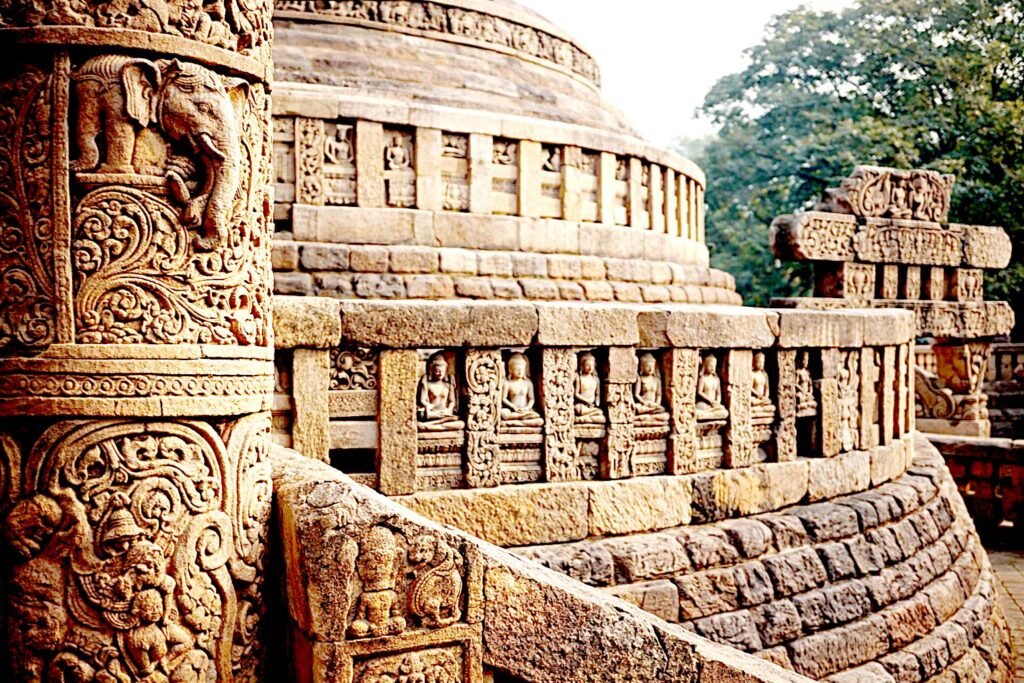
Architectural detail inspired by early Indian stupa railings, evoking the shared symbolic environment of early Buddhist art.
I. Reframing the Question of Origins
In the history of Indian Buddhist art, the iconography of the Buddha’s birth occupies a distinctive position. Even before the anthropomorphic image of the Buddha was standardized in the artistic traditions of Gandhāra and Mathurā, the moment of nativity had already appeared in various visual forms across major artistic centers such as Bharhut, Sanchi, Amarāvatī, and later Gandhāra. Yet it is precisely the diversity and complexity of these visual expressions that have sustained a long-standing scholarly question: does the iconography of the Buddha’s birth derive from pre-Buddhist Brahmanical motifs, particularly the figure of Śrī-Lakṣmī in the form of Gaja-Lakṣmī?
Formal similarities—such as the lotus pedestal, the strong central symmetry, the ritual element of ablution (abhiṣeka), and the centrality of a female figure—have led many scholars to suggest the possibility of “borrowing” or “reinterpretation” of an already established motif within the broader religious landscape of ancient India. According to this line of interpretation, Buddhist art is understood as having adopted a widely circulating symbol and transformed it into the mythic narrative of the Buddha’s birth. The question is thus frequently framed as: Lakṣmī or Māyā? Was the fertility goddess replaced by Queen Māyādevī, or merely reinterpreted within a new theological context?
This debate is not new. As early as the beginning of the twentieth century, scholars such as A. Foucher and Ananda K. Coomaraswamy engaged extensively with the relationship between the figure of Śrī-Lakṣmī and nativity iconography in early Buddhist art. Foucher tended to interpret certain Lakṣmī-type images within Buddhist contexts as “proto-nativities” or as motifs retrospectively integrated into Buddhist narrative. Coomaraswamy, by contrast, emphasized the independent Vedic and Śrī-cult foundations of Lakṣmī imagery and cautioned against reading it primarily through the lens of Buddhist myth. Despite their differing emphases, both approaches largely operate within a framework structured around “origin” and “derivation.”
However, the origin-centered model implicitly assumes that symbols belong to discrete religious traditions and can be traced in a linear fashion from one to another. Within such a framework, each image must have an original owner, and subsequent transformations are interpreted as acts of borrowing, adaptation, or replacement. This assumption risks obscuring a crucial feature of the cultural environment of ancient India: religious traditions did not exist within sealed boundaries but operated within a shared symbolic space, where visual forms could circulate, be repositioned, and re-signified without necessarily implying transfer between isolated systems.
This article proposes a different approach to the iconography of the Buddha’s birth. Rather than asking whether Buddhist art borrowed from Lakṣmī imagery, it examines how shared symbolic structures were reconfigured within a broader cultural and visual environment. In other words, the issue is not to determine “who came first” or “who influenced whom,” but to identify a “grammar of sacred emergence” that already existed within the Indian symbolic sphere and to explore how early Buddhism repositioned that grammar within the myth of the appearance of an Awakened One.
Through an analysis of three representative clusters of imagery—Gaja-Lakṣmī in the art of Bharhut and Sanchi, the image of Māyādevī beneath the tree at Amarāvatī, and the fully narrative birth scenes in Gandhāran art—this study traces a shift from symbolic condensation to narrative articulation. This process does not reflect a rupture between traditions, nor merely a doctrinal continuation; rather, it represents a reconfiguration of meaning within a shared symbolic world, where formal structures may be preserved even as semantic orientation shifts.
From this perspective, the iconography of the Buddha’s birth can no longer be understood simply as a borrowed product of Brahmanical imagery, nor as an entirely isolated innovation. It emerges instead as the result of a theological repositioning within a broader symbolic ecology—one in which the boundaries between traditions remained fluid and had not yet solidified into the rigid distinctions characteristic of later periods in the religious history of India.
II. Historical and Cultural Framework: The Space of a Shared Symbolic Ecology
1. Bharhut and Sanchi (2nd–1st century BCE): Symbolism in a Pre-Anthropomorphic Milieu
The reliefs at the Bharhut and Sanchi stupas represent an early phase of post-Mauryan–Śuṅga Buddhist art, during which the Buddha was not yet depicted in a clearly anthropomorphic form. Instead, his presence was evoked through symbolic markers such as the empty throne, the dharmacakra, the bodhi tree, or footprints. This phase is often described as “aniconic,” although the term itself remains debated.
For the purposes of this study, however, the crucial issue is not whether or not an image of the Buddha appears, but rather the symbolic structure operating within this artistic environment. The stone railings, circular medallions, and decorative motifs at Bharhut and Sanchi reveal the strong presence of Yakṣa and Yakṣī figures—divinities associated with fertility, protection, and prosperity in ancient Indian popular religion. At the same time, the image of Gaja-Lakṣmī—the goddess standing upon a lotus, flanked by two elephants performing ablution—appears within the same visual field.
At this stage, the boundary between “Buddhist” and “non-Buddhist” imagery had not yet solidified in the sense of distinct, self-contained religious systems. Motifs of fertility, prosperity, and protection operated within a shared symbolic space, where visual forms circulated widely. It was within this environment that the grammar of “sacred manifestation”—structured around a central vertical axis, symmetrical composition, and the lotus as foundational symbol—was established and disseminated.
2. Amarāvatī (1st century BCE – 2nd century CE): From Symbolic Condensation to Narrative Reorientation
The artistic center of the Amarāvatī stupa marks another stage in the development of Buddhist art, situated in the dynamic commercial and culturally interconnected environment of South India. This space functioned not only as a node within trade networks but also as a site where religious traditions and artistic forms interacted fluidly.
At Amarāvatī, one observes an increasing number of narrative panels depicting episodes from the Buddha’s life with greater specificity. Yet even within nativity scenes, the structural elements of fertility symbolism and sacred femininity remain clearly visible: Māyādevī stands beneath a tree, her body curved in the śālabhañjikā posture, directly recalling the Yakṣī tradition.
The shift here does not consist in replacing one goddess with another figure, but in a reorientation of meaning. The symbolic structure of fertility and birth is placed within a distinctly Buddhist narrative framework. Birth is no longer merely an expression of prosperity or cosmic fecundity; it becomes the appearance of an Awakened One within human history. Amarāvatī thus functions as a pivot point, where condensed symbolic structure gradually opens into narrative articulation, yet without fully abandoning the pre-Buddhist visual grammar.
3. Gandhāra (2nd–3rd century CE): Narrative Stabilization and Anthropomorphic Definition
In the art of Gandhāra, particularly under the Kushan Empire, the anthropomorphic image of the Buddha becomes clearly established. Hellenistic influence is visible in the treatment of the body, drapery, and spatial organization, producing compositions of greater depth and more complex interrelations among figures.
In Gandhāran nativity scenes, the infant is directly represented, subsidiary figures appear with explicit gestures of interaction, and space is organized in a manner closer to visual realism. Birth now assumes the character of a concrete historical event, narrated through a fully developed visual language.
Yet even as narrative becomes stabilized, the core elements of earlier symbolic structure do not entirely disappear. The tree, the standing posture, and the vertical axis of the composition continue to maintain formal continuity. What changes most significantly is the degree of theological specification: from a condensed symbol of “sacred emergence” to the story of the appearance of a sacralized historical figure.
Connecting the Three Centers
Bharhut–Sanchi provides the shared symbolic environment.
Amarāvatī demonstrates the reorientation of that structure within Buddhist narrative.
Gandhāra stabilizes and concretizes the process.
These three centers do not represent three separate religions, but rather three modes through which symbols operate under differing historical and visual conditions. It is within this process of transformation that the iconography of the Buddha’s birth gradually emerges as a form of visual theology—neither detached from the broader cultural environment nor dissolved into it.
III. The Lakṣmī Motif: Establishing a Grammar of Sacred Emergence
1. Formal Structure: Symbolic Condensation
In the circular medallions at Bharhut and Sanchi, the image of Gaja-Lakṣmī is typically organized according to a strongly symmetrical composition. The goddess stands at the center upon a blossoming lotus, flanked on either side by two elephants performing the ritual of ablution (abhiṣeka). All visual elements revolve around a central vertical axis, producing an almost perfectly balanced geometric structure.
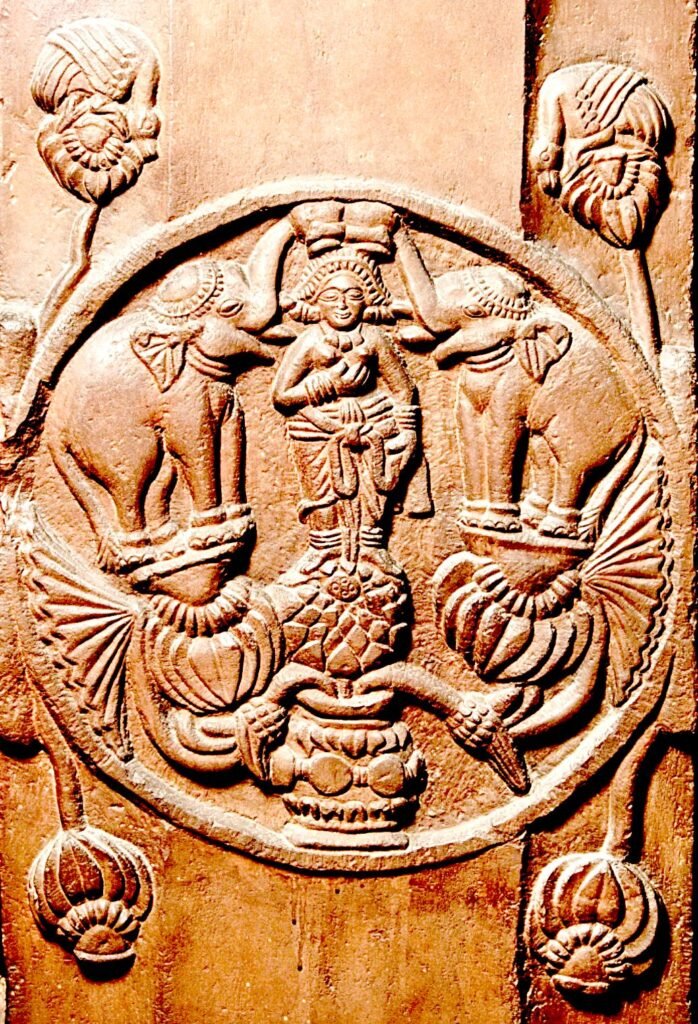
Figure 1: Gaja-Lakṣmī relief, ca. 2nd–1st century BCE, exemplifying an early Indian sacred motif of auspicious manifestation. Source: Image courtesy of a public domain archive.
This configuration displays three prominent characteristics:
- The centrality of the female figure: Lakṣmī is not merely decorative; she functions as the visual and semantic focal point of the composition.
- A vertical axis linking heaven, earth, and generation: the lotus below, the upright body at the center, and water descending from above.
- Ritual symmetry: the paired elephants reinforce the sacred structure through mirrored action.
This is not a narrative scene. There is no temporal progression, no sequence of events. Everything is condensed into a symbolic structure of manifestation.
2. The Lotus and Vedic Cosmology
In the Indian tradition, the lotus is not merely ornamental. In Vedic and post-Vedic cosmology, it is associated with the emergence of cosmic order from primordial chaos. Rising from the primal waters, the lotus marks a point of appearance—of life and structure emerging from undifferentiated potential.
When Lakṣmī stands upon the lotus, she signifies more than economic prosperity or material abundance. She embodies the manifestation of order from chaos, a generative force of cosmic significance. The lotus thus serves as the visual foundation of a transfigured act of birth—an emergence that is simultaneously fertile and cosmological.
3. Abhiṣeka and Royal Legitimation
The two elephants pouring water over Lakṣmī represent more than a fertility motif. The act of ablution (abhiṣeka) is a ritual of consecration and legitimation within Indian royal tradition. Applied to the image of Lakṣmī, this ritual transforms generative power into an affirmation of rightful order and auspicious sovereignty.
The Gaja-Lakṣmī structure therefore integrates three layers of meaning:
- Fertility
- Cosmic manifestation
- Ritual legitimation
Yet all these layers are expressed not through narrative, but through formal condensation.
4. A Grammar of Sacred Emergence
The central aim of this section is not to determine Lakṣmī’s Brahmanical identity, but to identify a standardized visual grammar:
- The centralization of a female figure
- A vertical axis of ascent or manifestation
- The lotus as foundational support
- Ritual ablution as confirmation
- Symmetry as a sign of sacred order
This grammar does not belong exclusively to any single theological system. It operates within a broad religious environment in which motifs of fertility, protection, and sacred manifestation coexist.
Accordingly, when one turns to the representations of Māyādevī in early Buddhist art, the question should not be: Did Buddhism borrow from Lakṣmī?
Rather, it should be: How was this structure of sacred emergence repositioned within a new narrative framework?
5. Interim Conclusion
The image of Gaja-Lakṣmī at Bharhut and Sanchi should neither be treated as an “original prototype” to be replicated nor as an object to be rejected. It demonstrates that a symbolic structure of sacred emergence had already been formed and circulated within the visual culture of ancient India.
Within this context, the birth of the Buddha does not arise ex nihilo. It enters a symbolic world whose grammar was already in place. What changes is not the underlying formal structure, but the theological axis that governs its meaning.
IV. Yakṣī – Māyā: Repositioning the Structure of Sacred Emergence
1. The Śālabhañjikā Posture and Formal Continuity
In the Amarāvatī reliefs depicting the birth of the Buddha, Māyādevī is typically represented standing, one hand grasping a tree branch. This posture, widely known in Indian art as the śālabhañjikā, is closely associated with the figure of the Yakṣī—tree goddesses embodying vitality, fertility, and the generative energies of nature.
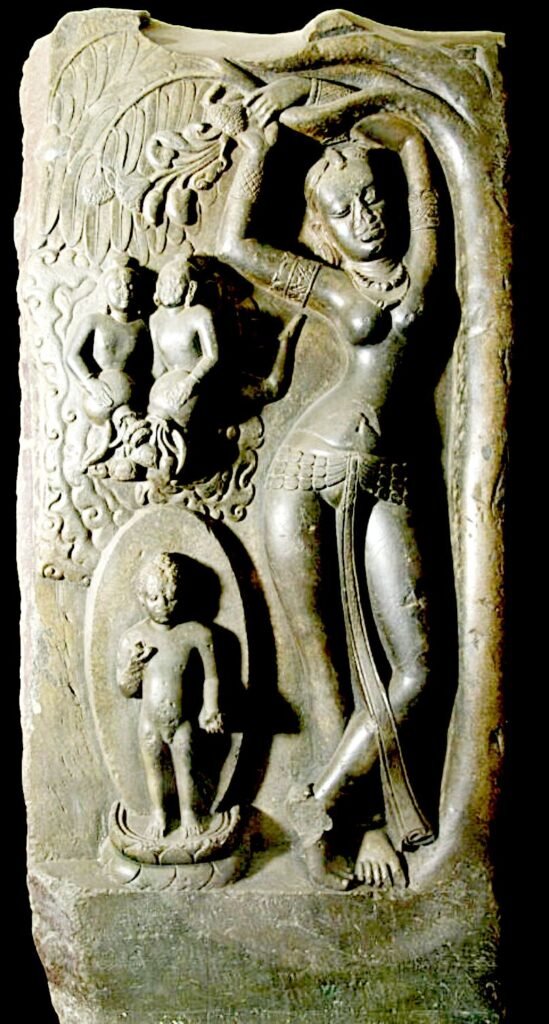
Figure 2: Māyādevī and the Buddha’s nativity, ca. 2nd–3rd century CE, reflecting the narrative development of sacred birth in early Buddhist art. Source: Image courtesy of a public domain archive
Formally, this configuration clearly continues the grammar previously observed in Lakṣmī imagery:
- A central female figure
- A vertical axis extending from the ground to the tree branch
- A softly curved S-shaped body
- Emphasis on generative vitality
Yet an important difference emerges: the elephants performing abhiṣeka are absent; the lotus pedestal disappears; and no iconographic markers confirm a Lakṣmī identity. The figure is now situated within a specific narrative moment—the birth of Prince Siddhārtha to Queen Māyā.
This suggests that continuity resides at the level of formal structure rather than theological identity.
2. The Tree as a Pre-Religious Symbol of Vitality
In ancient Indian traditions, the sacred tree occupies a central role in popular cults and Yakṣa–Yakṣī worship. The tree is not merely a natural element; it functions as an axis of life, a point of contact between earth and heaven. When Māyādevī grasps the branch, the gesture does more than supply a narrative detail—it activates a deep semantic field associated with vitality and manifestation.
More significantly, the symbol of the tree transcends the boundaries of Brahmanical and Buddhist traditions. It belongs to a deeper cultural stratum in which multiple religious systems shared a common symbolic repertoire. Within this environment, the birth of the Buddha is situated within a preexisting structure of sacred emergence.
3. Standing Birth and Theological Reorientation
According to early textual sources, Queen Māyā gave birth while standing beneath a śāla tree. This detail has both scriptural grounding and formal compatibility with the Yakṣī visual grammar. Yet the critical issue lies not in formal alignment, but in theological reorientation.
In the Lakṣmī image, birth is linked to prosperity and cosmic order.
In the Māyā image, birth becomes the appearance of an Awakened One.
The structure of sacred emergence is preserved;
the salvific meaning is repositioned.
Birth no longer signifies worldly abundance or ritual legitimation, but marks the beginning of a path of awakening that transcends social hierarchy and royal ideology.
4. From Symbolic Condensation to Narrative Expansion
If Gaja-Lakṣmī represents symbolic condensation within a static symmetrical composition, Amarāvatī begins to open that structure into narrative space. The child appears—sometimes still within a framed or separated visual unit. Subsidiary figures enter the scene. Space is no longer entirely flat and emblematic, but begins to suggest temporal progression.
This marks a crucial transition:
Lakṣmī is not replaced by Māyā.
Rather, the structure of sacred emergence is inserted into a specific historical narrative.
The event of birth now possesses time, context, and characters—yet it remains grounded in a visual grammar already in circulation.
5. Interim Conclusion
Amarāvatī demonstrates that early Buddhist art did not create ex nihilo, nor did it merely appropriate an existing motif. It operated within a shared symbolic ecology, where formal structures could be retained even as the axis of meaning was reconfigured.
At this pivotal moment, the iconography of the Buddha’s birth begins to detach from purely fertility symbolism and move toward a narrative theology—one in which sacred emergence becomes integrated into a historical and salvific framework.
V. Gandhāra and the Stabilization of Narrative: From Symbolic Structure to Historical Event
1. A New Space of Representation
In the art of Gandhāra, particularly under the Kushan Empire, the anthropomorphic image of the Buddha is established with an unprecedented level of clarity. Hellenistic influence becomes visible in the treatment of the body, drapery, movement, and spatial organization. The reliefs no longer function as primarily surface ornamentation, as in Bharhut, but generate an impression of depth and dynamic interaction among figures.
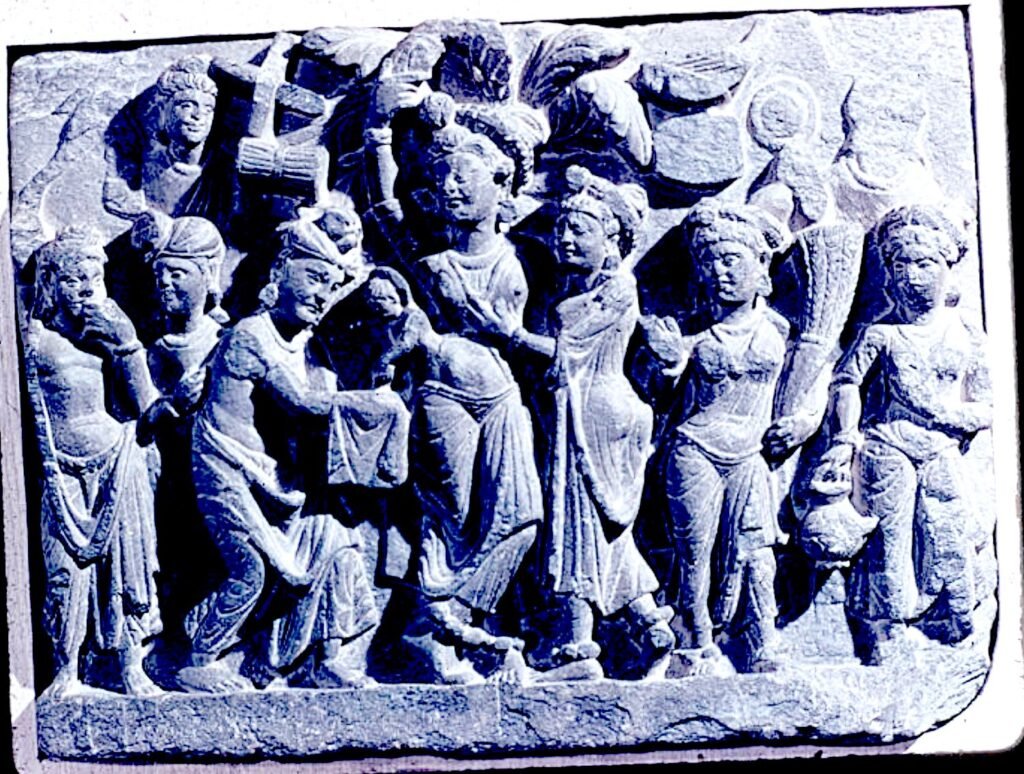
Figure 3: Buddha’s Nativity, Gandhāra, Kushan period (c. 2nd–3rd century CE), illustrating the stabilization of narrative and anthropomorphic representation in early Buddhist art. Source: Image courtesy of a public domain archive
In the nativity scenes, Māyādevī no longer appears as a condensed figure within a symbolic frame. Instead, she is situated within a concrete context populated by attendant figures: maidservants, celestial beings, and sometimes individuals receiving or supporting the child. The infant is no longer concealed or merely indicated through symbolic markers; he appears directly, rendered as a small yet clearly defined body.
Sacred birth is now narrated.
2. From Symbolic Condensation to Temporal Progression
If Gaja-Lakṣmī represents a timeless emblem—a perpetual moment of prosperity—and Amarāvatī begins to open that structure into narrative space, Gandhāra fully enters the dimension of time.
Here, one observes:
- A sequence of actions (Māyā standing – the child emerging – figures receiving him)
- Facial expressions
- Gestural interaction
- Layered spatial organization
The absolute symmetry characteristic of Lakṣmī imagery no longer governs the composition. Instead, spatial organization becomes fluid, guiding the viewer’s gaze through the movement of figures. This signals a significant shift: from a symbolic grammar to a narrative grammar.
Yet notably, the vertical axis remains present: Māyā still stands; the child still appears from above. The foundational structure has not vanished, but has been absorbed into a more complex storytelling system.
3. Anthropomorphization and Theological Specification
The clear anthropomorphization in Gandhāran art is not merely an aesthetic development. It reflects a theological process: the Buddha is presented as a specific historical figure, with biography, events, and temporal progression.
Birth is no longer solely the manifestation of cosmic vitality.
It becomes the beginning of a human life.
Within this structure, the nativity is integrated into a chain of events—renunciation, awakening, the turning of the wheel of Dharma. As a result, the birth scene ceases to function as an isolated symbol and becomes the opening chapter of a salvific history.
The transformation, therefore, does not consist in abandoning the grammar of sacred emergence, but in embedding it within a narrative structured by time and development.
4. Hellenistic Influence and Spatial Organization
The impact of Greco-Roman art is visible not only in drapery and anatomical modeling, but also in the staging of the birth scene as a dramatic “scene.” Space is articulated in layers; figures are positioned in visual relation; action acquires depth.
However, the adoption of Hellenistic elements does not entail the loss of Indian symbolic foundations. On the contrary, it provides formal means for stabilizing and consolidating Buddhist narrative.
One may say that Gandhāra does not create an entirely new grammar; rather, it fully develops the narrative potential already emerging in Amarāvatī, while remaining grounded in the prior structure of sacred emergence.
5. Stabilization and Visual Theology
By the time of Gandhāra, the iconography of the Buddha’s birth reaches a stabilized form:
- Figures are clearly identified
- The event unfolds in discernible sequence
- Visual structure supports temporal progression
This stabilization is not only aesthetic but theological. The birth image no longer appears ambiguous or dependent on a shared fertility symbolism; it becomes part of a clearly defined Buddhist symbolic system.
Yet upon closer examination, this process does not represent rupture. The vertical axis, the standing posture, and the generative structure continue to maintain continuity with earlier stages. What changes is the degree of specification and integration into a salvific narrative.
From Bharhut to Amarāvatī and Gandhāra, the birth of the Buddha reveals a dynamic progression:
- From symbolic condensation
- To narrative repositioning
- To historical and theological stabilization
This development cannot be reduced to a simple borrowing or replacement of a goddess motif by a Buddhist figure. It reflects the operation of symbols within a shared cultural space, where formal structures may be retained while semantic orientation is reconfigured.
It is in Gandhāra that the nativity ceases to function as a floating symbolic structure and becomes a clearly articulated visual theology—the narrated beginning of a history of awakening rendered in visual form.
VI. Beyond the “Borrowing” Model: Toward a Shared Symbolic Ecology and the Reconfiguration of Imagery
The analyses in the previous three sections point to a difficult reality to ignore: the iconography of the Buddha’s birth in Indian art did not develop as a linear sequence of substitution, in which an “external” motif was wholly transferred into a new tradition and subsequently erased. Rather, what emerges is a more subtle process of transformation: formal and visual structures may retain continuity, while their semantic orientation is repositioned according to differing theological priorities. This observation renders origin-based explanatory models—though useful for identifying formal correspondences—insufficient for capturing the operative dynamics of symbols within the cultural environment of ancient India.
1. The Limits of the Linear Model
In the history of scholarship, similarities between Gaja-Lakṣmī and certain nativity scenes have frequently led to a linear framing of the issue: either Buddhism “borrowed” a preexisting motif, or it “replaced” a Brahmanical goddess with a Buddhist figure. Although opposed in conclusion, both interpretations share a common assumption: that a symbol belongs to a specific tradition, and that its appearance elsewhere must be explained as a transfer between separate systems.
However, the artistic context spanning Bharhut–Sanchi–Amarāvatī demonstrates that religious boundaries and visual boundaries did not rigidly coincide. The Yakṣa cult, fertility imagery, sacred tree forms, the lotus, and auspicious signs coexisted within a shared environment, received by patrons, artisans, and devotional communities as a repertoire of usable symbols. Within such a milieu, a form does not necessarily “belong” exclusively to a single theological system; it may circulate as a visual template, available for re-signification within different narrative frameworks.
2. A Modest Proposal: “Shared Symbolic Ecology” as an Interpretive Tool
From these observations, this study proposes—more as a heuristic suggestion than as a definitive conclusion—that the formation of nativity iconography may be read as a process unfolding within a shared symbolic ecology. This concept does not seek to deny the roles of influence or adaptation; rather, it describes a fundamental condition: symbols live within environments in which multiple traditions share auspicious, fertile, protective, and manifestational forms, and within such environments, meaning can shift according to context.
In this sense, “shared symbolic ecology” emphasizes three features:
- Circulation: motifs and formal structures are widely shared, not confined to a single “religion.”
- Porosity: the boundaries between religious semantic fields are permeable, especially at the level of visual symbolism.
- Reconfiguration: transformation typically occurs through re-signification rather than total replacement.
Within this framework, the question “Lakṣmī or Māyā?” appears overly restrictive. The issue is not to identify a single origin, but to recognize a structure of sacred emergence that can be deployed in multiple directions—at times as the manifestation of prosperity, at others as the appearance of an Awakened One in history.
3. Re-Signification and Iconographic Layering
The three clusters of imagery examined earlier allow this process to be described as a form of iconographic layering. At the first level lies a “grammar of sacred emergence”: a central female figure, a vertical axis of manifestation, signs of generative vitality (lotus or tree), and a sense of sacred order. At the second level, Buddhism introduces a new theological orientation: birth no longer refers to cosmic abundance or royal legitimation, but to the inaugural event of a path toward awakening. At the third level, particularly in Gandhāra, narrative form and anthropomorphization stabilize this process, transforming “sacred emergence” into a chapter within a salvific biography.
This layered perspective helps avoid two extremes: either reducing Buddhism to a mere replication of Brahmanical motifs, or portraying it as a radical rupture that invents imagery ex nihilo. Instead, we observe a movement that is simultaneously continuous and transformative: form may endure, while semantic orientation shifts.
4. From “Borrowing” to “Reconfiguration”: A General Model
From this discussion, the article proposes a methodological model:
Step 1: Detach motif from theological identity
Do not equate “elephants/lotus/tree” with fixed religious identities; rather, treat them as components of a structural configuration.
Step 2: Identify the symbolic grammar
Examine the vertical axis, symmetry or narrativity, degree of condensation, and spatial organization.
Step 3: Trace theological repositioning
Within what frame is the structure placed—prosperity, protection, or salvific history?
Step 4: Assess the degree of narrativization
How does the shift from symbolic manifestation to narrated event alter theological meaning?
This model does not aim to replace origin-based approaches entirely; rather, it suggests that, in the case of nativity iconography, emphasizing reconfiguration within a shared symbolic ecology offers a more persuasive explanation of formal continuity and semantic transformation.
5. Broader Implications
Read in this way, the birth of the Buddha in early Indian art is not merely a biographical illustration. It reveals how a new tradition constructs visual theology by repositioning widely circulating symbolic structures within a shared cultural environment. It is precisely this act of repositioning—rather than the question of “who borrowed from whom”—that illuminates the internal logic of early Buddhist art: not the creation of symbols from nothing, nor dependence upon a single source, but the transformation of meaning within a world of already familiar forms.
VII. The Emergence of a Visual Theology
Through the examination of three clusters of imagery—from Bharhut–Sanchi to Amarāvatī and Gandhāra—this study has demonstrated that the iconography of the Buddha’s birth cannot be adequately understood within a simple model of “borrowing” or “replacement” between religious traditions. The similarities between Gaja-Lakṣmī and certain nativity scenes do not necessarily indicate a linear transfer of motifs; rather, they reflect the operation of symbolic structures within a shared cultural environment.
At Bharhut and Sanchi, one encounters a grammar of sacred emergence condensed within symmetrical form and a central vertical axis: a female figure, the lotus, ritual ablution, and a sense of manifestation and legitimated order. At Amarāvatī, this structure does not disappear but is repositioned within a Buddhist narrative, where birth no longer signifies cosmic prosperity alone, but the appearance of an Awakened One. In Gandhāra, the process becomes stabilized: nativity is rendered as a historical event narrated through anthropomorphic imagery, complete with spatial depth, identifiable figures, and temporal progression.
This movement does not represent a rupture between traditions, but a transformation within a shared symbolic world. Form may be preserved, while the axis of meaning shifts. Symbols are not wholly replaced; they are reconfigured, layered, and attached to a new theological orientation.
Seen from this perspective, the birth of the Buddha in early Indian art is not merely a biographical illustration. It is the site at which a visual theology comes into being: a new tradition defines itself not by inventing a visual language ex nihilo, but by repositioning preexisting structures of sacred emergence already circulating within a broader cultural milieu.
Accordingly, the question is no longer “Lakṣmī or Māyā?” nor “who borrowed from whom?” A more productive inquiry asks: which symbolic structures were shared, and how were they re-signified in the formation of early Buddhist identity? It is precisely within this act of re-signification that the Buddha’s birth, as depicted in ancient Indian art, reveals not a rigid boundary between traditions, but a transformation unfolding within a shared symbolic world.
At this concluding point, nativity iconography ceases to be a problem of origins and becomes instead a testimony to the resilience of symbols: enduring in form, flexible in meaning, and sufficiently profound to bear the theological movements of a tradition in the process of defining itself.
Bibliography
Coomaraswamy, Ananda K. “Review of On the Iconography of the Buddha’s Nativity, by Alfred Foucher.” Indian Historical Quarterly 11 (June 1935): 358–361.
Foucher, Alfred. On the Iconography of the Buddha’s Nativity. Memoirs of the Archaeological Survey of India, no. 46. Delhi: Government of India Press, 1934.
Huntington, Susan L. The Art of Ancient India: Buddhist, Hindu, Jain. New York: Weatherhill, 1985.
Rowland, Benjamin. The Art and Architecture of India: Buddhist, Hindu, Jain. Harmondsworth: Penguin Books, 1953.
Schopen, Gregory. “The Buddha as an Owner of Property and Permanent Resident in Medieval Indian Monasteries.” In Bones, Stones, and Buddhist Monks, 181–217. Honolulu: University of Hawai‘i Press, 1997.
Zimmer, Heinrich. The Art of Indian Asia: Its Mythology and Transformations. 2 vols. Princeton: Princeton University Press, 1955.