
Le Hoang Da
Independent Philosopher & Buddhist Scholar
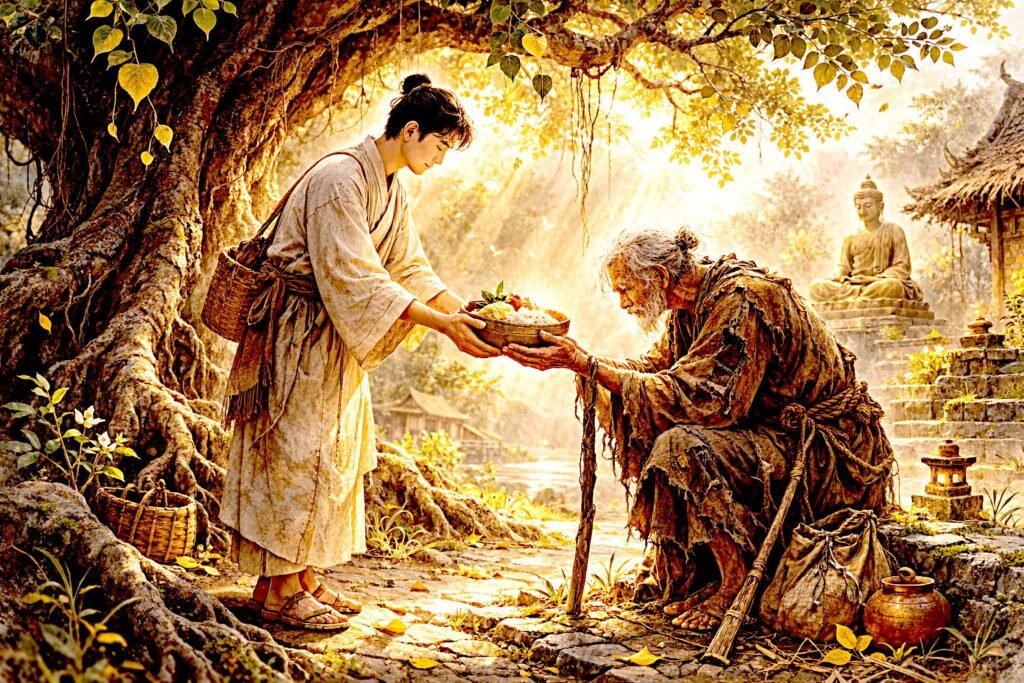
The act remains; the self recedes.
I. Merit and the Equality of the Nature of All Phenomena in Early Mahāyāna
In the study of early Mahāyāna, one of the most debated questions concerns the relationship between the philosophy of non-self-nature (niḥsvabhāvatā) and the traditional structure of karma and merit. When all dharmas are declared to be “without inherent reality,” “ungraspable,” and “without intrinsic nature,” can the model of action–accumulation–retribution still retain its foundation? Put differently, if no dharma truly exists as a substantial entity, upon what basis can merit be accumulated?
The Samādhirāja Sūtra, one of the early Mahāyāna scriptures, situates this problem within a distinctive textual structure. Its full title—The King of Samādhis, the Revealed Equality of the Nature of All Phenomena—already signals its central theme: the equality of the nature of all dharmas. Yet at the same time, the sūtra devotes an entire chapter (Ch. 27) to presenting ten concrete benefits of generosity, explicitly affirming the causal efficacy of action and the growth of merit. This coexistence generates an internal tension: on the one hand, action produces real effects; on the other hand, all dharmas are devoid of intrinsic essence.
Scholars reading early Mahāyāna texts often gravitate toward one of two interpretations. The first views the philosophy of emptiness as radically deconstructive, weakening or superseding the traditional karmic–meritorious framework. The second treats merit as a provisional means leading to wisdom, a lower stage within a hierarchical progression from accumulation to liberation. Yet both readings risk reducing the complexity of the textual architecture.
This article proposes an alternative approach. The Samādhirāja Sūtra neither negates the accumulation of merit nor regards merit as a temporary expedient to be eventually discarded. Rather, it demonstrates that merit reaches its ultimate depth only when action is performed within the insight into the equality of the nature of all dharmas—where the triadic structure (agent, act, and object) is deconstructed. In other words, merit is not replaced by emptiness; it is internally redefined through the very insight into non-self-nature.
The structure of the sūtra allows this process to be traced with clarity. Chapter 27 establishes a coherent causal model: generosity yields specific benefits, from overcoming miserliness to being reborn in favorable circumstances. Here, the acting subject, the action, and its result are all affirmed as efficacious elements. In Chapter 32, however, the tone shifts dramatically: dharmas are described as lacking inherent existence, unfindable, and beyond grasp. Those who “know the equality of the nature of all dharmas” no longer cling to any conceptual structure. Crucially, this shift does not entail the negation of action. On the contrary, the sūtra asserts that those who realize the absence of intrinsic nature excel even more in generosity.
This point forms the central axis of the present study. When a practitioner gives without perceiving a giver, a recipient, or a gift, the act is not annulled; it is purified of attachment to inherent existence. Merit is no longer something that can be possessed, accumulated as spiritual capital, or appropriated by a self. Instead, it becomes a non-possessive operation—an act that cannot be claimed.
Accordingly, this article argues that the Samādhirāja Sūtra reconfigures the Mahāyāna soteriological model from within: from a subject-centered structure of accumulation to a non-conceptual mode of action in which the subject dissolves. This is not a replacement of a lower stage by a higher one, but a transformation of action itself when illuminated by the insight into the equality of the nature of all phenomena.
The following sections will examine: (1) the model of merit accumulation in Chapter 27; (2) the deconstruction of the triadic structure in Chapter 32; (3) the text’s self-reflexive movement in Chapter 33; and (4) the theoretical implications of this process for reconfiguring early Mahāyāna soteriology.
II. The Structure of Merit Accumulation: The Architecture of Causality (Ch. 27)
Chapter 27 of the Samādhirāja Sūtra opens with a direct assertion: for Bodhisattvas who are “careful” or “attentive,” unsurpassed awakening is not difficult to attain. This “carefulness” is not an obscure inner disposition but is concretely expressed through the practice of the six pāramitās, among which generosity is placed first.
The sūtra then enumerates ten specific benefits for those who give rise to the intention of generosity. These benefits are not presented as merely symbolic; they are articulated as definite causal results:
- overcoming miserliness
- a mind constantly inclined toward generosity
- rebirth in a wealthy family
- being beloved by the four assemblies
- entering gatherings with confidence
- the spread of one’s good reputation
- a supple and attractive physical form
- not being separated from spiritual friends until attaining Buddhahood. This structure reveals several important features.
1. Action Has Genuine Efficacy
Generosity is not portrayed merely as a symbol of compassion but as an act that produces concrete transformation. The giver does not simply “become better” in a psychological sense; rather, identifiable consequences unfold within the cycle of birth and death—circumstances of rebirth, social esteem, physical attributes, and a supportive environment for spiritual practice.
This demonstrates that the sūtra does not deny the traditional framework of causality. On the contrary, it affirms that actions possess the capacity to generate real effects.
At this level, the model operates as follows:
Subject → Action → Merit → Result
Merit here is cumulative and capable of growth.
2. Merit as a Continuous Process of Growth
One of the benefits emphasized is that practitioners “will not be separated from spiritual friends until they sit at the Bodhi seat”. This suggests that merit is not merely a short-term reward. Rather, it establishes favorable conditions that sustain the long trajectory of the Bodhisattva path.
Thus, merit is not merely “worldly fortune.” It functions structurally within the path to awakening.
Here the sūtra constructs a soteriological model grounded in accumulation:
- accumulation of merit
- accumulation of conditions
- accumulation of virtuous companions
- accumulation of the capacity to approach Bodhi
This is a linear model of growth.
3. The Ethical Subject Is Affirmed
Chapter 27 clearly presupposes the existence of an ethical subject capable of choice, action, and the reception of results. The practitioner who gives rise to generosity “aspires to generosity,” overcomes miserliness, and intentionally directs their conduct.
There is no sign of deconstruction here.
The subject:
- exists
- acts
- is praised
- is recognized by the community
This structure constitutes a coherent form of moral realism.
4. No Irony or Minimization
It is crucial to note that the text offers no indication that these benefits are merely “temporary expedients.” Nowhere are these results described as illusory, inferior, or destined to be discarded. They are presented as worthy and encouraging achievements.
This observation plays a decisive role in the argument of the present study.
Without Chapter 27, Chapter 32 could be read as a radical negation. But because Chapter 27 precedes it and stands firmly in place, we are compelled to confront a text that consciously affirms the efficacy of action and merit.
5. The Phenomenal Level Is Not an Illusion
At this stage of the sūtra, the world of causality is not depicted as an illusion to be transcended. It is the very field within which the Bodhisattva practices.
We may therefore provisionally conclude that Chapter 27 establishes a complete architecture of action, in which merit can be accumulated, developed, and transformed into favorable conditions for awakening.
Precisely because this structure is clearly constructed and not weakened, when Chapter 32 introduces the declaration of non-self-nature, it cannot be read as a simple negation. Instead, a deeper question emerges: if all dharmas lack intrinsic nature, how is the structure of accumulation that has just been established to be understood anew?
The next section will address this question.
III. Deconstructing the Triadic Structure: Insight into the Equality of the Nature of All Phenomena (Ch. 32)
If Chapter 27 establishes a clearly structured model of action, Chapter 32 opens an entirely different linguistic and conceptual space. Instead of enumerating benefits and karmic results, the sūtra turns to a series of radical declarations concerning the nature of dharmas.
The central claim of this chapter is expressed directly: those who “know the equality of the nature of all dharmas” have entered a mode of cognition that transcends the ordinary structures of conceptualization and differentiation. The text emphasizes that dharmas are “without inherent existence,” “unfindable,” and that those who realize this have “eliminated all conceptual designations”
Here, the shift does not occur at the level of ethical content but at the level of epistemological foundation.
1. From Structured Action to Insight into Non-Self-Nature
Whereas in Chapter 27 action is presented as a recognizable causal sequence, in Chapter 32 the very foundation of all dharmas—including action itself—is deconstructed.
The sūtra declares:
- dharmas are “without inherent existence”;
- those who realize this have “eliminated all conceptual designations”
This is not merely a metaphysical claim. It directly affects the structure of the acting subject.
2. The Dissolution of the “Agent”
One of the key statements in the chapter affirms that those who know the equality of the nature of all dharmas “no longer give rise to the thought, ‘I am cutting off’”
This statement is crucial.
It does not deny that acts of cutting off or relinquishing occur. Rather, it denies the conceptual formation of a subject who claims ownership of the act.
At this point, the triadic structure begins to dissolve:
- no enduring “practitioner” who endures or performs;
- no fixed “object” to be eliminated;
- no substantial “achievement” to be attained.
Action itself is not negated. What is deconstructed is the notion of ownership over action.
3. Non-Arising Forbearance as Non-Conceptual Cognition
Chapter 32 repeatedly describes a mode of “knowing” that does not grasp, a mode of “seeing” that does not cling. This insight is not an object to be acquired; it is the absence of all assertions of inherent existence.
Importantly, the text does not portray this state as a withdrawal from the world. On the contrary, those who know the equality of the nature of all dharmas:
- excel in generosity;
- teach innumerable scriptures;
- liberate countless beings.
Thus, deconstruction does not lead to the suspension of action. It gives rise to a form of action that is no longer appropriated by the self.
4. The Internal Tension Is Preserved
It is essential to note that Chapter 32 does not retract or negate what was affirmed in Chapter 27. The sūtra does not declare the ten benefits of generosity to be illusory. There is no reversal.
Instead, the text preserves both models:
- a concrete model of causal efficacy;
- a radical model of non-self-nature.
The coexistence of these two models generates the internal tension of the sūtra.
If one were to read Chapter 32 in isolation, one might conclude that the karmic structure has been erased. Yet when read within the full architecture of the text, it becomes clear that what is deconstructed is not action itself, but the reification of action.
5. A Decisive Transition
After Chapter 32, the question is no longer:
“Does merit exist?”
Rather, it becomes:
“How does merit operate when there is no inherent existence?”
This question leads directly to the center of the present study—where merit is not abolished, but reconfigured in the light of the equality of the nature of all phenomena.
IV. Generosity After Emptiness: From Accumulation to Non-Appropriative Action
If one were to stop at Chapter 32, it might appear that the entire structure of merit accumulation established in Chapter 27 has been nullified. When dharmas are said to be “without inherent existence,” and when all conceptual designations are eliminated, there would seem to be no foundation left for accumulation. Yet the text does not move in that direction. On the contrary, it opens another possibility: it is precisely upon recognizing the non-self-nature of dharmas that the act of generosity reaches its ultimate depth.
Chapter 32 affirms what initially appears paradoxical: those who know that dharmas are always empty “excel in generosity”. This is not a minor detail; it serves as the bridge between two seemingly opposed models.
1. The Problem: Does Emptiness Undermine Merit?
If merit is understood as something that can be accumulated, possessed, and increased, then the philosophy of non-self-nature would seem to undermine its very foundation. If there is no inherent existence, who accumulates? If there are no substantial dharmas, what is being accumulated?
It is precisely at this point that the sūtra shifts its axis.
What is deconstructed is not action itself. What is deconstructed is attachment to action as the possession of a self.
In other words, merit is not negated; rather, the notion “I possess merit” dissolves.
2. Three Levels of Generosity
When Chapters 27 and 32 are read in dialogue, three levels of action can be discerned:
(1) Generosity for the sake of results
At the first level, generosity operates within the karmic structure. The practitioner recognizes that their actions will yield concrete benefits: favorable rebirth, an admirable physical form, social esteem, and proximity to virtuous companions. Here, merit is accumulation.
(2) Generosity motivated by bodhicitta
At the second level, motivation extends beyond karmic reward toward awakening and the welfare of beings. Yet the triadic structure remains intact: there is a giver, a recipient, and a gift.
(3) Generosity without perceiving the triad
The third level—and the distinctive emphasis of the Samādhirāja—is action performed within the insight into the equality of the nature of all dharmas. When dharmas are “without inherent existence” and all conceptual designations are eliminated, action is no longer situated within a subject–object framework.
Here:
- there is no “giver” who asserts an ego;
- no “recipient” as a fixed entity;
- no “gift” as a substantially existing possession.
Yet the act still occurs.
It is precisely this that renders generosity supreme.
3. Merit as Non-Appropriable Operation
When the triadic structure dissolves, merit cannot be appropriated. It cannot become spiritual property of the self. It no longer functions as “capital” with which one identifies.
This marks the decisive transition:
In Chapter 27, merit is described as accumulation.
In the light of Chapter 32, merit is not erased, but it loses its capacity to be possessed.
Action is no longer framed by the thought, “I am acting.” Consequently, it does not reinforce the structure of ego-clinging.
In other words, merit reaches its ultimate form precisely when it ceases to be an object of self-conscious appropriation.
4. Redefining the “Supreme”
Ordinarily, the “supreme” might be understood quantitatively—as greater or more abundant. Yet in the Samādhirāja Sūtra, supremacy is not measured by magnitude, but by the absence of attachment.
A small act performed without perceiving the triadic structure may surpass a great act still embedded within egoic appropriation.
Thus, merit is not transcended as a lower stage. It is refined from within.
5. Not Two Levels, but One Illuminated Action
It is crucial not to interpret this process as a hierarchical shift from a “phenomenal level” to an “ontological level.” Nowhere does the sūtra suggest that one must abandon merit in order to attain emptiness.
Rather, insight into non-self-nature illuminates the action already taking place.
Action remains within the world of causality. Yet it is no longer anchored in a self.
This is an internal reconfiguration.
6. The Central Thesis Summarized
The central argument may therefore be stated as follows:
The Samādhirāja Sūtra does not replace the accumulation of merit with a philosophy of non-self-nature. It demonstrates that merit attains its ultimate depth only when action is performed within the insight into the equality of the nature of all dharmas—where no giver is perceived, no recipient is perceived, and no gift is perceived. The dissolution of the triadic structure does not annul action; it transforms it into supreme generosity.
V. Text and the Paradox of Merit: When Words Have No Substance (Ch. 33)
After Chapter 32 deconstructs the ontological foundation of dharmas, Chapter 33 turns toward what appears to be a purely practical theme: the benefits of upholding, reciting, and teaching this sūtra. Yet this shift does not retreat from the preceding argument. On the contrary, it sharpens the paradox.
On the one hand, the sūtra affirms that dharmas—including words—are “without inherent existence” and that “not even an atom of them can be found”. Language has no ontological foundation; words are not entities that can be grasped. If this reasoning is followed through consistently, the scripture itself has no inherent existence.
On the other hand, Chapter 33 simultaneously asserts that upholding, reciting, and expounding this sūtra generates immeasurable merit. Those who preserve the text will not fall into unfortunate realms; they will become teachers of the Dharma, protected and entrusted by the Buddhas with the responsibility of transmitting it.
The paradox that emerges here is not a textual oversight. It is a deliberate structure.
1. When Words Have No Substance
Chapter 33 declares:
- “All words have no substance.”
- “There is not an atom of them that is to be found.”
This claim carries far-reaching implications. If words lack inherent existence, then:
- scripture is not a sacred object in itself;
- the Dharma does not exist as a fixed ontological entity;
- no “teaching” can be possessed.
The text places itself under the very principle of non-self-nature that it proclaims.
2. Yet Upholding the Sūtra Still Generates Merit
Significantly, the sūtra does not stop at negation. It immediately affirms the efficacy of practice:
- those who preserve the sūtra are protected;
- those who teach it accumulate immeasurable merit;
- transmitting the text becomes an act of liberation.
The structure here repeats the pattern already observed in Chapters 27 and 32:
Non-self-nature does not abolish action.
Action is not absolutized into substantial being.
The scripture lacks inherent existence, yet the practice of upholding it remains efficacious.
3. The Text as Non-Appropriative Action
At this point, the internal coherence of the entire sūtra becomes evident.
Just as generosity reaches its ultimate depth when the triadic structure dissolves, so too does the practice of upholding the sūtra attain its highest value when the text is not treated as an inherently existing object.
If one regards the scripture as something to possess—as proof of spiritual attainment or as a symbolic badge of identity—one remains within the structure of appropriation. But when the sūtra is practiced with the insight that words have no inherent existence, the act no longer reinforces attachment.
Thus, Chapter 33 is not merely an exhortation to propagate the text. It is the scripture’s self-reflection on its own lack of inherent existence.
4. Merit and the Performative Character of Emptiness
Notably, the sūtra does not construct a contradiction between emptiness and the efficacy of action. Rather, non-self-nature ensures that action is not enclosed within egoic appropriation.
What emerges here may be described as a form of “performative emptiness”: emptiness is not a doctrine that negates action, but the condition under which action remains non-appropriable.
Just as generosity without the triad is supreme generosity, so too the practice of the Dharma without possessiveness is supreme practice.
The paradox of Chapter 33 thus reveals itself as a heightened consistency of the preceding argument.
5. From Action to Text: Structural Unity
When the entire progression is viewed together:
- Ch. 27: Merit as structured accumulation
- Ch. 32: Non-self-nature deconstructs the triadic structure
- Ch. 33: Even words and scripture lack inherent existence, yet practice remains efficacious
A continuous thread becomes visible:
No inherent existence, yet efficacy.
No possession, yet operation.
No self-nature, yet liberation.
It is precisely here that the Samādhirāja presents a soteriological model grounded not in endless accumulation, but in the transformation of the structure of appropriation itself.
VI. From the Samādhirāja to Prajñāpāramitā and Madhyamaka: Reconfiguring Merit in the Light of Non-Self-Nature
The analysis of Chapters 27, 32, and 33 shows that the Samādhirāja Sūtra does not operate according to a model of “accumulation followed by transcendence,” but according to an internal process: action continues, yet its structure of appropriation is deconstructed. This reading allows the sūtra to be situated in profound relation to two major axes of Mahāyāna thought: the Prajñāpāramitā corpus and Madhyamaka philosophy.
1. The Emptiness of the Threefold Structure and the Prajñāpāramitā Corpus
In the Prajñāpāramitā sūtras, particularly in longer versions such as the Aṣṭasāhasrikā Prajñāpāramitā, generosity is praised as a pāramitā, yet it must be practiced “without grasping at a giver, a recipient, or a gift.” Action is maintained, but the three elements that constitute action are emptied of intrinsic nature.
The crucial point is that the Prajñāpāramitā does not negate generosity. It negates attachment to generosity as a substantial entity.
This same model is already present in the Samādhirāja. When Chapter 32 declares that dharmas are “without inherent existence” and that those who realize this have “eliminated all conceptual designations”, action is not suspended. On the contrary, such individuals “excel in generosity”.
Thus, the Samādhirāja does not stand outside the orbit of the Prajñāpāramitā tradition. It shares the same intuition: action reaches its ultimate depth when the triadic structure dissolves.
What distinguishes the Samādhirāja, however, is that it places this intuition within a text that still clearly preserves the model of merit accumulation (Ch. 27). This makes the internal transformation more visible and structurally explicit.
2. Causal Efficacy and Madhyamaka
If the Prajñāpāramitā emphasizes the emptiness of the threefold structure, Madhyamaka—especially as systematized by Nāgārjuna—emphasizes that non-self-nature does not imply annihilation. Precisely because dharmas lack fixed intrinsic nature, they are able to function within dependent relations.
This insight is often expressed as follows: emptiness does not destroy dependent origination; emptiness is the condition for dependent origination.
In this light, the model of the Samādhirāja becomes particularly illuminating.
Chapter 27 affirms the causal efficacy of generosity. Chapter 32 denies the intrinsic existence of dharmas.
These two claims are not contradictory if non-self-nature is understood as the condition for the flexible operation of dependent origination. Action is efficacious not because it rests upon a fixed substance, but because it functions within a network of interdependent relations devoid of intrinsic essence.
What is denied is not causality, but the independent self-existence of dharmas.
Here, the Samādhirāja anticipates a key premise of Madhyamaka thought: non-self-nature does not abolish ethics; it liberates ethics from rigid ontological grounding.
3. From Accumulation to the Deconstruction of Appropriation
The distinctive contribution of the Samādhirāja lies in its parallel use of two languages:
- the language of accumulation (merit, benefit, karmic result);
- the language of non-self-nature (no inherent existence, unfindability, the elimination of conceptual designation).
In the Prajñāpāramitā corpus, the emptiness of the threefold structure is often presented directly within the context of the pāramitās. In Madhyamaka, non-self-nature is elaborated through rigorous ontological argumentation. In the Samādhirāja, however, both languages coexist within a single textual architecture, compelling the reader to confront the internal transformation of action itself.
Merit is not negated; it is deconstructed from its appropriation by the self.
This allows the sūtra to be read as an important transitional moment: from a linear model of accumulation along the Bodhisattva path toward a model of non-appropriative action, where value lies not in the “quantity of merit” but in the absence of attachment.
4. A Non-Ruptural Soteriological Model
Placed between Prajñāpāramitā and Madhyamaka, the Samādhirāja does not advocate a rupture with the traditional doctrine of karma. Rather, it demonstrates how karma and merit are reinterpreted in the light of non-self-nature.
Liberation is neither infinite accumulation nor the negation of action.
Liberation is the functioning of action without a center of appropriation.
In this sense, the Samādhirāja contributes to the formation of a distinctive Mahāyāna soteriological model: one that does not rely on fixed ontology, nor on limitless accumulation, but on the transformation of the cognitive structure of action itself.
VII. The Coexistence of Two Categories and a Turning Point in Mahāyāna Thought
The most significant contribution of the Samādhirāja Sūtra does not lie in a single doctrinal argument, but in its sustained coexistence of two seemingly opposed categories: on the one hand, a structured model of merit accumulation with clear causal efficacy; on the other, the insight into the equality of the nature of all dharmas, wherein no phenomenon possesses inherent existence. These two languages are neither hierarchically reconciled nor allowed to cancel one another. They are maintained simultaneously within a single textual architecture.
It is precisely this coexistence that makes the sūtra a distinctive text within the development of Mahāyāna thought. Here, we no longer remain within the purely karmic framework of early Buddhism, where action and result are articulated primarily in pragmatic terms. Yet we have not fully entered the systematic philosophical articulation of Madhyamaka, with its rigorously dialectical language of negation. The Samādhirāja stands at a point of intersection: it preserves the efficacy of action while emptying the ontological foundation of action itself.
As an early Mahāyāna scripture, the sūtra may thus be seen as a turning point in the formation of Prajñāpāramitā doctrine and the later development of the philosophy of emptiness. What the Prajñāpāramitā corpus would later articulate explicitly as the “emptiness of the threefold structure,” and what Madhyamaka would systematize as the doctrine of non-self-nature, already appears here in a parallel configuration: action is efficacious, yet devoid of inherent existence. It is not causality that is denied, but the substantialization of causality.
From this perspective, the Samādhirāja also opens a new approach to the doctrine of non-self, a principle already present from the earliest strata of Buddhism. If in early Buddhism non-self was primarily developed as the denial of a permanent self within the five aggregates, in this sūtra non-self is extended to the very structure of action and merit. It is not only that “there is no self,” but that no entity whatsoever can be appropriated as the foundation of action. Non-self thus ceases to be merely a psycho-physical analysis and becomes a principle that deconstructs every form of appropriation.
Accordingly, rather than reading the Samādhirāja simply as a text praising samādhi or encouraging the accumulation of merit, we may understand it as a crucial link in the reconfiguration of Buddhist thought: from karmic realism to non-self-nature, from linear accumulation to non-appropriative action, from the psycho-physical doctrine of non-self to the non-self of soteriological structure itself.
At this point of intersection, the sūtra does not merely preserve tradition; it generates a new trajectory—one that would shape the entire course of Mahāyāna philosophy in the centuries that followed.
Bibliography
84000: Translating the Words of the Buddha. The King of Samādhis Sūtra (Samādhirāja Sūtra). Translated by the Dharmachakra Translation Committee. 2016.
Conze, Edward, trans. The Perfection of Wisdom in Eight Thousand Lines and Its Verse Summary (Aṣṭasāhasrikā Prajñāpāramitā). Bolinas, CA: Four Seasons Foundation, 1973.
Garfield, Jay L., trans. The Fundamental Wisdom of the Middle Way: Nāgārjuna’s Mūlamadhyamakakārikā. Oxford: Oxford University Press, 1995.
Keown, Damien. The Nature of Buddhist Ethics. New York: Palgrave, 1992.
Nattier, Jan. A Few Good Men: The Bodhisattva Path according to The Inquiry of Ugra (Ugraparipṛcchā). Honolulu: University of Hawai‘i Press, 2003.
Schopen, Gregory. Bones, Stones, and Buddhist Monks: Collected Papers on the Archaeology, Epigraphy, and Texts of Monastic Buddhism in India. Honolulu: University of Hawai‘i Press, 1997.
Williams, Paul. Mahāyāna Buddhism: The Doctrinal Foundations. 2nd ed. London: Routledge, 2009.