
Le Hoang Da
Independent Philosopher & Buddhist Scholar
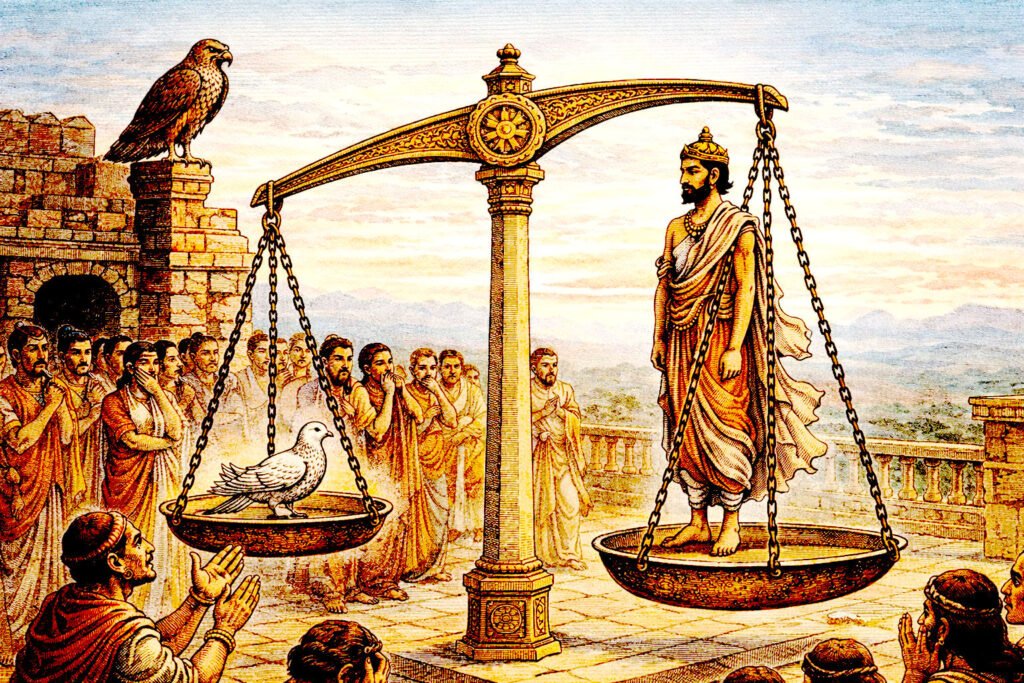
King Sibi in the Jātaka: A Former Life of the Buddha and the Bodhisatta Ideal in Early Buddhist Tradition
I. The Conceptual Problem and the Assumption of Discontinuity
In the historical development of Buddhist thought, the figure of the Bodhisattva is often regarded as a distinctive hallmark of Mahāyāna Buddhism. Mahāyāna scriptures portray Bodhisattvas as agents committed to the liberation of immeasurable sentient beings, taking great compassion as their motivating force and complete Buddhahood as their ultimate aim. Figures such as Avalokiteśvara (Guānshìyīn), Mahāsthāmaprāpta, Mañjuśrī, Samantabhadra, and Kṣitigarbha have become vivid embodiments of this ideal.
For this reason, in common understanding, the Bodhisattva is frequently identified with a model of practice specific to Mahāyāna Buddhism, whereas the Theravāda tradition is often said to center on the ideal of the Arahant and individual liberation.
Although this view has some basis at the level of doctrinal systematization, it may obscure a deeper issue at the conceptual level. The term bodhisatta already appears in early Pāli texts, where it refers to the Buddha in his previous lives prior to awakening. In the birth stories and in numerous passages of the Dīgha Nikāya, the Majjhima Nikāya, and especially the Jātaka, the Bodhisattva is depicted as a subject accumulating perfections (pāramī) across multiple lifetimes, repeatedly acting for the benefit of others, even sacrificing his own life in order to complete the path to Buddhahood.
The central question, then, is whether the Bodhisattva concept in Mahāyāna represents a radical innovation, or whether it constitutes a more expansive development of a conceptual structure already present in early Buddhism. In other words, does a fundamental rupture exist between the two traditions, or are we dealing instead with an expansion of scope and a process of systematization?
This article does not aim to reconcile sectarian positions or to evaluate the relative merits of different soteriological ideals. Rather, it focuses on analyzing the conceptual essence of the term “Bodhisattva” at a minimal level: a sentient being oriented toward complete Buddhahood with an intrinsic altruistic motivation. On this basis, the study will examine the role of great compassion as the foundational structure of the path to Buddhahood in early texts, before considering the elaboration of that same structure within Mahāyāna thought.
The central thesis proposed here is that, at the level of conceptual essence, no rupture exists between the Bodhisattva of early Buddhism and that of Mahāyāna. Mahāyāna did not create the Bodhisattva ex nihilo; rather, it universalized and systematized an already existing core. Great compassion — understood not merely as an emotion, but as an existential commitment illuminated by wisdom — is the constitutive element that secures this continuity.
II. Etymology and the Conceptual Structure of the “Bodhisattva”
1. Etymological Analysis: bodhi and sattva / satta
The term “Bodhisattva” is the transliteration of bodhisattva in Sanskrit and bodhisatta in Pāli, composed of two elements: bodhi and sattva (or satta). Bodhi denotes awakening—complete enlightenment, a direct realization of reality as it truly is, culminating in the eradication of ignorance. In the Buddhist context, it is inseparable from Buddhahood, that is, perfect and unsurpassed awakening. Sattva (Sanskrit) or satta (Pāli) is commonly understood as “sentient being,” “living being,” or “subject,” referring to an entity endowed with psychological life and subject to birth and death. When combined, bodhisattva may be minimally understood as “a sentient being oriented toward awakening,” or more precisely, “a subject on the path toward Buddhahood.” Notably, nothing in this etymological structure presupposes sectarian affiliation. The term does not inherently imply the ten stages (bhūmi), the six perfections (pāramitā), or any particular doctrinal system; it simply designates a goal (awakening) and a subject moving toward that goal. This minimal structure allows the concept to be examined at the level of its essence prior to its historical elaborations.
2. A Minimal Definition and Its Internal Structure
On the basis of this analysis, a minimal definition may be proposed: a Bodhisattva is a sentient being who orients his or her life toward complete Buddhahood. Yet this formulation remains incomplete. If one speaks merely of orientation toward awakening, the concept could encompass any practitioner pursuing liberation. What distinguishes the Bodhisattva from other soteriological models lies not simply in the pursuit of awakening, but in the motivational structure underlying that pursuit. Here, great compassion emerges as an intrinsic condition. The Bodhisattva does not seek awakening as an isolated personal end; the goal is inseparable from the welfare of sentient beings. Buddhahood is not merely the cessation of suffering for oneself, but the attainment of the capacity to guide and illuminate others. Thus, the conceptual structure of the Bodhisattva comprises three interrelated elements: a sentient subject, orientation toward complete Buddhahood, and a motivational structure shaped by altruistic intent. These elements together form a coherent conceptual framework identifiable in both early and later Buddhist sources.
3. Great Compassion as a Constitutive Element
If the altruistic dimension were removed, the Bodhisattva would be reduced to a mere “seeker of awakening,” and the concept would collapse into other models of spiritual practice. What renders the Bodhisattva distinctive is precisely the conjunction of perfect Buddhahood as its aim and great compassion as its motivating force. Great compassion does not merely supplement the path; it shapes and defines it. Buddhahood itself is understood not only as awakening, but as awakening endowed with the capacity to teach, liberate, and transform others. Without the altruistic dimension, even the concept of Buddhahood would lose part of its distinctive content. This claim concerns Buddhahood understood as the fully awakened teacher who establishes the Dhamma for the welfare of many. Accordingly, at the conceptual level, the Bodhisattva cannot be understood apart from great compassion. This element is not an external addition introduced at a later stage, but an intrinsic component that secures the distinction between “seeking liberation” and “aspiring to Buddhahood.”
4. Implicit Continuity within the Conceptual Structure
Once the concept is established at this minimal level, an important implication follows. If early Buddhist texts already present the image of a sentient being accumulating the conditions for Buddhahood under the guidance of altruistic motivation, then the conceptual structure of the Bodhisattva is already present there. Later developments—such as the systematic articulation of stages of practice or the expansion of the ideal’s scope—may enrich and elaborate the content, yet they do not necessarily alter the core structure. The analysis of etymology and conceptual architecture, therefore, is not merely philological; it provides the conceptual foundation for arguing continuity across different phases in the development of Buddhist thought.
III. The Bodhisattva in the Pāli Tradition: Conceptual Structure in Early Texts
1. The Term Bodhisatta in the Pāli Canon
Within the Theravāda tradition, the term bodhisatta is used to refer to the Buddha in the period prior to his awakening. This usage appears in numerous passages of the Dīgha Nikāya and the Majjhima Nikāya, where recollections of former lives often begin with the expression “when he was still a bodhisatta.” Notably, bodhisatta is not employed as a later honorific title but as a term designating a process. It identifies a subject who is on the path to Buddhahood yet has not attained full awakening. Thus, even in early textual strata, there exists the notion of a distinctive trajectory oriented toward Buddhahood—a trajectory that differs from the path culminating in Arahantship. At the conceptual level, this indicates two clear elements: first, the existence of a prolonged journey prior to Buddhahood; and second, the designation of the subject of that journey as bodhisatta. This structure accords with the minimal definition analyzed in Section II.
2. The Jātaka and the Accumulation of Perfections
The most significant source for understanding the Bodhisattva image within the Pāli tradition is the Jātaka. In these birth stories, the Bodhisattva appears across multiple lifetimes as one who accumulates the perfections (pāramī) in order to attain Buddhahood. The virtues emphasized include generosity, patience, energy, truthfulness, and especially compassion toward sentient beings. Many narratives depict the Bodhisattva sacrificing his own life to save humans or animals, willingly accepting personal loss in order to safeguard the welfare of others. The importance of these stories lies not in their dramatic elements but in their motivational structure. Acts of self-sacrifice are not portrayed as spontaneous emotional reactions; rather, they are situated within a clearly oriented path of accumulating perfections. Compassion here is not a fleeting sentiment but a governing principle that spans the entire process. The three elements of the conceptual structure—sentient subject, orientation toward Buddhahood, and altruistic motivation—are all present in these birth narratives.
3. Great Compassion and the Decision to Continue in Saṃsāra
A distinctive feature of the Pāli tradition is the Bodhisattva’s acceptance of continued rebirth across many lifetimes in order to fulfill the necessary conditions for Buddhahood. If the goal were solely individual liberation, prolonging saṃsāra would lack meaning. Within the Bodhisattva’s trajectory, however, time becomes the field in which merit is accumulated and the capacity for teaching perfected. Here we can discern a structure corresponding to what will later be analyzed as the “postponement of Nirvāṇa”: altruistic motivation reshapes the understanding of temporal progression. The Bodhisattva is not bound to saṃsāra through ignorance; rather, he remains within it as a deliberate and oriented decision. This indicates that great compassion plays a constitutive role in the Pāli model of the path to Buddhahood.
4. Sumedha and Processual Identity
A particularly significant illustration is the figure of the Bodhisattva Sumedha, a former life of the Buddha prior to receiving the prediction (vyākaraṇa) of future Buddhahood and continuing the accumulation of perfections until his final rebirth. According to tradition, before his last descent into the human realm, the Bodhisattva abides in the Tuṣita heaven. At this stage, he has already fulfilled most of the perfections and awaits the appropriate conditions for final awakening, yet he is still designated as bodhisatta. This has profound conceptual implications. First, the term encompasses the entire process up to the very moment of enlightenment. Second, the designation does not depend on cosmological status but on orientation toward Buddhahood. Third, Bodhisattva identity is fundamentally processual rather than static. Even while residing in Tuṣita, the Bodhisattva is not yet called a Buddha. What defines his identity is not a degree of transcendence but a directional structure: being on the path to Buddhahood for the benefit of sentient beings. His descent into the human world is not an arbitrary event but a deliberate decision to fulfill the conditions necessary for teaching. Compassion, therefore, does not cease in a celestial realm but continues to guide the choice of rebirth.
5. Distinguishing Doctrinal System from Conceptual Structure
It is crucial to distinguish between two levels of analysis: the level of doctrinal system, in which the Arahant ideal occupies a central role in communal religious life, and the conceptual level concerning the path to Buddhahood. At the latter level, the Pāli tradition acknowledges a prolonged journey toward Buddhahood driven by compassion and the accumulation of perfections. Although this ideal is not universalized as a model for all practitioners, the internal structure of the concept is nevertheless present. Consequently, when considered strictly at the level of conceptual essence, the Bodhisattva cannot be regarded as an entirely new creation of later developments. Mahāyāna expansions may universalize and systematize this ideal, but they do not necessarily alter its core structure.
IV. Great Compassion as the Existential Structure of the Bodhisattva
1. Great Compassion Beyond Mere Emotion
In ordinary language, compassion is often understood as an emotional response to the suffering of others. It may be intense yet fleeting, sincere yet unstable, profound yet dependent on circumstance. If the Bodhisattva’s great compassion were understood in this sense alone, it would be difficult to explain how such a vow could be sustained across innumerable lifetimes. In the Bodhisattva path, great compassion is not merely an affective reaction to suffering. Although it originates in genuine empathy, through the course of cultivation it is transformed into an existential orientation. The Bodhisattva does not simply “feel compassion” for sentient beings; the Bodhisattva chooses to exist for the sake of sentient beings. It is precisely this transformation—from emotion to structuring orientation—that gives great compassion its depth. It does not negate the emotional dimension, but it transcends the limitations of emotion as such.
2. Great Compassion as Existential Commitment
What distinguishes the Bodhisattva path from ordinary moral action does not lie in the degree of sacrifice but in the structure of the decision itself. Great compassion here functions as an existential commitment: a foundational determination that defines the aim, scope, and temporal horizon of one’s spiritual life. This commitment entails orientation toward complete Buddhahood, taking the welfare of immeasurable sentient beings as its guiding criterion, and accepting a path extending across countless lifetimes. Without great compassion, the journey toward Buddhahood would lose the altruistic dimension that renders it “complete.” Thus, great compassion is not an auxiliary virtue but the constitutive motivation of the path itself.
3. The Unconditional Character of Great Compassion
Ordinary compassion is often conditional. It may depend on reciprocity, on the perceived worthiness of its object, or on the psychological endurance of the subject. The Bodhisattva’s great compassion does not operate according to such mechanisms. It does not discriminate between near and distant, virtuous and unvirtuous, intimate and unfamiliar; nor does it diminish in the absence of reward. This unconditional quality is precisely what renders compassion “great.” Yet such unconditionality is not a form of impulsive sentiment. It arises from insight into the dependent origination of suffering: all sentient beings are conditioned and bound by ignorance. When this insight becomes stable, compassion no longer rests upon subjective moral judgment but upon an understanding of the nature of reality itself.
4. Great Compassion and Wisdom as Twin Axes
In Buddhism, great compassion does not exist independently of wisdom (prajñā). Wisdom enables the Bodhisattva to perceive impermanence, non-self, and dependent origination, thereby preventing compassion from collapsing into attachment or emotional overwhelm. Conversely, great compassion prevents wisdom from degenerating into cold detachment. If wisdom were present without compassion, awakening could become enclosed within private realization; if compassion were present without wisdom, it could devolve into blind sentimentality. The conjunction of great compassion and wisdom constitutes the distinctive structure of the Bodhisattva: a subject who both understands the nature of suffering and voluntarily commits to its transformation. This dynamic interplay ensures that great compassion is not merely an ethical impulse but a principle illuminated by direct insight into reality.
5. Great Compassion as the Ground of Complete Buddhahood
A being may attain individual liberation without undertaking the vow to liberate immeasurable sentient beings. However, to become a Buddha in the full sense of the term, great compassion is constitutive. Buddhahood is not only the eradication of defilements; it also entails the capacity to teach, guide, and liberate others. Such capacity cannot arise unless altruistic motivation has been foundational from the outset. Accordingly, great compassion is not simply an admirable quality but the orienting principle that grants awakening its universal dimension rather than restricting it to personal emancipation.
6. The “Postponement” of Nirvāṇa and the Temporal Structure of the Bodhisattva Path
The notion of “postponing Nirvāṇa” is often interpreted as the renunciation of personal peace in order to save others. Yet understood merely as sacrifice, its conceptual depth remains ungrasped. Postponement here does not signify incapacity for awakening, nor entanglement in saṃsāra. Rather, it denotes a conscious decision regarding how to exist within the flow of time. Great compassion reconfigures the meaning of spiritual temporality. In a model centered on individual liberation, time may appear linear: practice, realization, cessation. Within the Bodhisattva path, however, time becomes the arena in which the conditions for a universally responsive awakening are perfected. The Bodhisattva accepts a trajectory spanning countless eons because the goal itself has been expanded. Without great compassion, there would be no reason for such extension; one seeking solely personal liberation would not remain within saṃsāra once the conditions for cessation were fulfilled. Great compassion alone provides the motive for continuing the journey. Yet this continued presence does not imply bondage. Illuminated by wisdom, great compassion allows the Bodhisattva to remain within a world of suffering voluntarily—not out of ignorance, but out of altruistic commitment.
7. Internal Conclusion of Section IV
From the foregoing analysis, it becomes clear that great compassion is not an accessory element appended to the concept of the Bodhisattva. It is the structural backbone of Bodhisattva identity. If removed, the concept would lose its internal coherence. At this level of analysis, great compassion emerges as the foundational condition of the path toward complete Buddhahood.
V. The Elaboration of the Bodhisattva Structure in Mahāyāna Thought

Avalokiteśvara as the Preeminent Bodhisattva of Great Compassion in Mahāyāna Thought
1. From Processual Identity to a Universal Ideal
In Mahāyāna Buddhism, the figure of the Bodhisattva is no longer confined to the former lives of a single historical Buddha but becomes a universalized model of spiritual practice. Whereas in the Pāli tradition the term bodhisatta primarily designates the Buddha in the course of his own path to awakening, in Mahāyāna the Bodhisattva emerges as an open ideal available to all sentient beings.
Yet this universalization does not alter the core structure previously analyzed. The Mahāyāna Bodhisattva remains defined by three fundamental elements: orientation toward complete Buddhahood, motivation grounded in great compassion, and commitment to a long-term path extending across vast stretches of time. The difference lies in the scope of application rather than in the conceptual essence.
2. Systematizing the Path: The Six Perfections and the Ten Stages
Mahāyāna scriptures articulate the Bodhisattva path in greater systematic detail through frameworks such as the six perfections (pāramitā)—generosity, ethical discipline, patience, energy, meditation, and wisdom—and the ten stages (bhūmi) of spiritual development. These systems do not introduce a new conceptual structure but clarify and stratify a process already implicit in the early model of accumulating perfections.
If the Jātaka narratives portray the gradual cultivation of virtues through discrete stories, Mahāyāna organizes this cultivation into a clearly structured path. This development is therefore formal and methodological rather than substantive; it refines presentation and pedagogical articulation without transforming the underlying conceptual core.
3. The Intensification and Cosmologization of Great Compassion
A distinctive feature of Mahāyāna thought is the explicit elevation of great compassion as the central driving force of the Bodhisattva path. Figures such as Avalokiteśvara, Mañjuśrī, Samantabhadra, and Kṣitigarbha embody diverse dimensions of compassion and wisdom. In this context, great compassion is no longer confined to the personal trajectory of a single aspirant but situated within a vast cosmological horizon. Bodhisattvas appear as active agents operating continuously across innumerable worlds.
Nevertheless, even this “cosmologization” does not alter the essential conceptual structure. Great compassion remains an altruistic commitment illuminated by wisdom; only the scale of its expression is expanded. The structure persists while its representational scope becomes more expansive and symbolically articulated.
4. Bodhicitta and the Internalization of Motivation
A central concept in Mahāyāna is bodhicitta—the resolve to attain Buddhahood for the benefit of all sentient beings. Upon closer examination, bodhicitta does not introduce a foreign element into the structure of the Bodhisattva; rather, it makes explicit a motivational orientation that was already implicit.
In early traditions, this orientation manifests through the accumulation of perfections and the willingness to continue within saṃsāra for the sake of future awakening. In Mahāyāna, it is conceptualized and foregrounded as a deliberate and formal point of entry into the path. The emergence of bodhicitta, therefore, does not create a new structure but clarifies the motivational architecture already present.
5. Not Replacement, but Expansion
From the foregoing analysis, it follows that Mahāyāna does not replace the earlier Bodhisattva model with an entirely new conception. Rather, it universalizes the ideal, systematizes the path, and expands its expressive range. The core structure—a sentient being oriented toward complete Buddhahood, motivated by great compassion—remains intact. What changes is the mode of articulation and application.
At the conceptual level, this development may thus be understood as an internal expansion rather than a fundamental rupture. The Bodhisattva ideal in Mahāyāna represents not a break with early Buddhism, but the unfolding of a structure whose essential features were already present.
VI. Comparison at the Conceptual Level: Continuity and Expansion
Having examined the conceptual structure of the Bodhisattva in the Pāli texts and analyzed its elaboration within Mahāyāna thought, a comparison at the minimal level may now be undertaken in order to clarify the central thesis of this study.
First, in both contexts—early Buddhist tradition and Mahāyāna—the Bodhisattva is defined by three fundamental elements: a sentient being on the path toward complete Buddhahood; the accumulation of the necessary conditions for perfect awakening; and great compassion as the intrinsic motivation guiding the entire process. At this level of analysis, no change in essence appears. The core conceptual structure remains intact.
Differences become visible only at the level of systematization and scope. In the Pāli tradition, the Bodhisattva ideal is primarily associated with the path to Buddhahood of a single historical individual and is not universalized as a general model of practice for all. In Mahāyāna Buddhism, by contrast, the Bodhisattva becomes a universal ideal, encouraged as an open path available to all sentient beings. Yet this universalization does not alter the internal structure of the concept; it merely expands its range of application. If, in the early tradition, the Bodhisattva represents a processual identity tied to the trajectory of a future Buddha, in Mahāyāna this identity is internalized and universalized as an existential choice available to multiple subjects.
Similarly, the systematization of the six perfections and the ten stages does not introduce a new structure but clarifies the gradations of a process already dispersed throughout birth narratives and descriptions of accumulating perfections. At the philosophical level, one may therefore state that the Pāli tradition provides the nuclear form of the Bodhisattva concept, while Mahāyāna offers its developed and expanded articulation. Differences in scale, degree of systematization, and expressive range do not entail differences in essence. If essence is understood as the minimal structure comprising subject, goal, and motivation, that structure was already present in the earliest phase of Buddhist thought.
Consequently, the assumption of a radical conceptual rupture between the two traditions is not confirmed by structural analysis. What can instead be observed is a process of internal development, in which an initial structure is clarified, expanded, and universalized. At this point, the continuity of the Bodhisattva concept becomes evident—not as static repetition, but as a stream of thought unfolding in increasingly rich forms.
VII. Great Compassion and the Continuity of the Bodhisattva Concept
From the foregoing analysis, a clear conclusion may be drawn: at the level of conceptual essence, the Bodhisattva is not a sudden innovation of Mahāyāna thought. The core structure of the concept—a sentient being oriented toward complete Buddhahood with great compassion as its intrinsic motivation—was already present in early Buddhist texts.
The Pāli tradition, through the image of the bodhisatta in the Dīgha Nikāya, the Majjhima Nikāya, and especially the Jātaka, presents a prolonged process of accumulating perfections directed toward the welfare of sentient beings. The depiction of the Bodhisattva residing in Tuṣita prior to his final descent further reinforces that this designation encompasses the entire trajectory toward Buddhahood, rather than merely an initial phase.
Within Mahāyāna Buddhism, this structure is universalized and systematized. Great compassion is more explicitly emphasized, the path is articulated in graduated stages, and the ideal is extended to all sentient beings. Yet these developments do not alter the foundational structure of the concept. What is expanded is its scope and mode of articulation, not its essence.
The analysis of great compassion as an existential commitment illuminated by wisdom demonstrates that it cannot be regarded as an accessory element of the Bodhisattva path. Great compassion shapes the aim, temporality, and meaning of the journey toward Buddhahood. Without it, the Bodhisattva concept would lose its constitutive dimension.
Accordingly, rather than interpreting the emergence of the Bodhisattva path in Mahāyāna as a rupture, it is more coherent to understand it as the internal unfolding of a structure already present in the earliest phase of Buddhist thought. This development does not negate the past; it enriches and expands its original core.
At the conceptual level, such continuity allows the Bodhisattva to be understood not as a sectarian emblem, but as a distinctive configuration of the path to awakening—one in which great compassion and wisdom together constitute the identity of the subject oriented toward complete Buddhahood.
Related Studies:
Bibliography
Anālayo, Bhikkhu. A Comparative Study of the Majjhima Nikāya. Taipei: Dharma Drum Publishing, 2011.
Bodhi, Bhikkhu, trans. The Connected Discourses of the Buddha: A Translation of the Saṃyutta Nikāya. Boston: Wisdom Publications, 2000.
Bodhi, Bhikkhu, trans. The Numerical Discourses of the Buddha: A Translation of the Aṅguttara Nikāya. Boston: Wisdom Publications, 2012.
Gethin, Rupert. The Foundations of Buddhism. Oxford: Oxford University Press, 1998.
Horner, I. B., trans. The Jātaka or Stories of the Buddha’s Former Births. London: Luzac & Company, 1957.
Harvey, Peter. An Introduction to Buddhism: Teachings, History and Practices. 2nd ed. Cambridge: Cambridge University Press, 2013.
Keown, Damien. The Nature of Buddhist Ethics. New York: Palgrave, 1992.
Williams, Paul. Mahayana Buddhism: The Doctrinal Foundations. 2nd ed. London: Routledge, 2009.
Wynne, Alexander. The Origin of Buddhist Meditation. London: Routledge, 2007.