
Le Hoang Da
Independent Philosopher & Buddhist Scholar
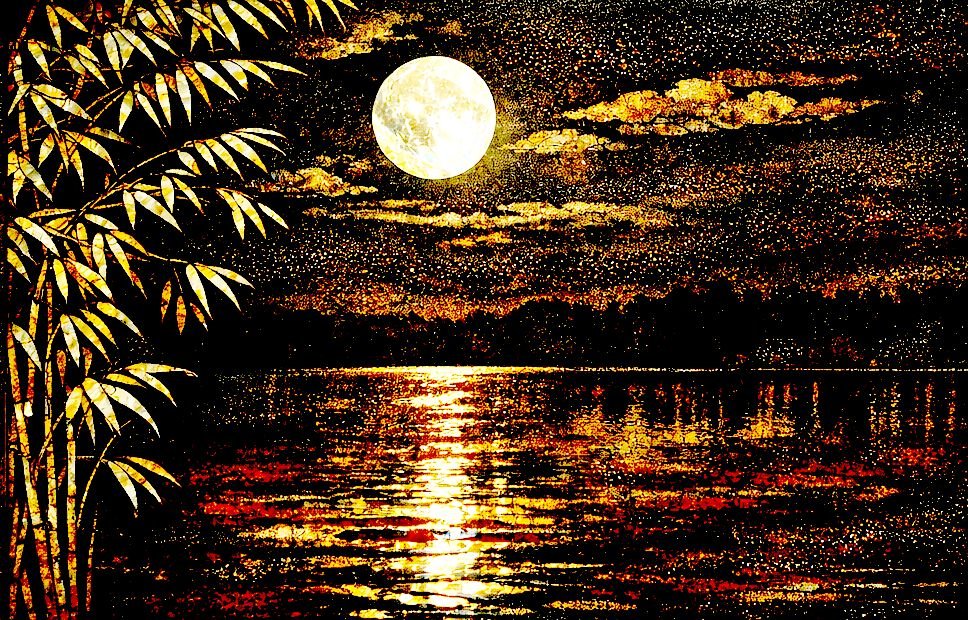
Like the moon reflected on water, imagination only mirrors what has already been.
Is Imagination Truly Free?
We often speak of imagination as though it were limitless. We encourage children to “just imagine,” as if the mind could travel anywhere, slipping effortlessly beyond the boundaries of the real. Literature constructs kingdoms that have never existed, cinema gives life to creatures no one has ever seen, and science fiction sketches futures belonging to civilizations not yet born. In ordinary experience, imagination appears to be the freest dimension of human life—a space where reality no longer holds authority.
Yet a closer look begins to unsettle this confidence. Can we truly imagine something wholly detached from our experience? Can the mind produce a color never seen, a form unrelated to any familiar object, or a world bearing no trace of this one? Consider a dragon: we find the body of a serpent, the wings of a bird, the claws of a beast, and the breath of fire. Consider a distant planet: we still borrow skies, landscapes, oceans, and living forms from the Earth we already know. Even in our strangest dreams, fragments of memory quietly recombine themselves.
The more carefully we attend, the more a simple fact emerges: imagination rarely creates anything absolutely new. It does not arise from nothingness but draws silently upon what has already been seen, heard, and lived. What we call “imagining” may therefore be less an escape from reality than another way in which reality rearranges itself within the mind—not creation out of the void, but reconstruction from memory.
If this is so, then imagination—the faculty we most readily associate with freedom—may in fact be one of our deepest dependencies. It does not float beyond the world; it carries the world with it. This essay begins from a modest but unsettling hypothesis: imagination does not generate novelty ex nihilo; it simply reorganizes what memory has already provided. In this sense, imagination may be nothing more—and nothing less—than memory rearranged.
II. A Simple Observation — Nothing Imagined Is Truly Unfamiliar
If we step away from abstract speculation and return to the texture of ordinary experience, a simple fact begins to emerge. Imagination rarely carries us into territories that are wholly alien. Instead, it seems to move quietly within the boundaries of what we have already known, seen, and lived. What appears “new” often turns out to be only the familiar rearranged into a different form.
Consider the Loch Ness Monster. In the collective imagination, it rises from the water as a long-necked creature, part serpent, part enormous fish, sometimes resembling the prehistoric reptiles we know from museum displays and children’s books. Yet this image does not truly come from nowhere. It is assembled from very concrete memories: the bodies of reptiles, the movements of large aquatic animals, and the lingering visual traces of dinosaurs preserved in illustrations, films, and popular culture. The mysterious creature, upon closer inspection, is less an invention than a careful collage of elements already stored in experience.
The same pattern appears elsewhere. When we picture extraterrestrial beings, we still borrow the structure of the human or animal body, merely stretching limbs, enlarging eyes, or altering colors. When we imagine the future, we rarely escape the present; we simply extend it. Future cities still have roads and buildings, new technologies remain variations of old ones, and even the most daring visions are recognizably continuous with today’s world. Even in dreams—where the mind seems most free—faces we have seen, places we have visited, and emotions we have felt quietly intermingle to form strange but oddly familiar scenes.
The more closely we attend to these examples, the clearer a shared structure becomes: nothing we imagine is entirely without the traces of memory. Images that seem novel are in fact recompositions of older materials. Imagination, therefore, is not a doorway into an empty void but more like a room in which fragments of experience are moved, combined, and reorganized in new configurations.
What appears to be our freest faculty may, in fact, be the one most subtly anchored to everything we have already lived through.
III. The Structure of Imagination
These everyday observations lead us to a deeper question: if every image we form carries the traces of memory, how does imagination actually function? Is it truly a spontaneous and independent faculty, or merely a later link within a broader chain of conditions that structure experience?
A closer analysis suggests that imagination does not stand alone. It is not the beginning of mental life but a relatively late development within it. Before we can imagine, we must remember. Before we can remember, we must perceive. And before perception can arise, there must already be a world providing data to the senses. Nothing can take shape in the mind unless something has first made contact with it.
Imagination, then, appears only at the end of a sequence of dependencies. The world stimulates the senses; the senses give rise to perception; perception settles into memory; and from memory imagination finally draws its materials. What seems to be our freest capacity is, in fact, one of the most conditioned.
If any link in this chain is severed, imagination immediately weakens or disappears. Without sensory input from the world, perception has no anchor from which to form; without perception, memory cannot crystallize; and without memory, imagination has nothing to work with. How could a person blind from birth picture the color of a rose without ever having had the corresponding visual experience? In the absence of such perceptual foundations, the mind simply lacks the raw materials from which an image could be constructed. An empty room cannot produce pictures out of nothing, and a mind that has never encountered the world cannot do so either.
In this sense, imagination does not supply its own raw material. It does not create content out of the void. What it performs is transformation: separating, recombining, enlarging, reducing, reversing, or rearranging fragments of what memory has already stored. Much of what we call “creativity” in imagination is, in fact, an act of reconstruction.
Structurally speaking, imagination is not a primary faculty but a secondary—perhaps even tertiary—one: dependent on memory, which depends on perception, which in turn depends on the world. It does not float free from reality; it is anchored to reality from the very beginning.
At this point, what first seemed paradoxical becomes clear. Imagination does not generate new substance; it reorganizes what memory provides. The “newness” we experience is not the emergence of something that has never existed, but merely a configuration that has never before been arranged in quite that way. Imagination, therefore, is not an escape from the world, but one of the ways the world continues its movement within the mind.
IV. Imagination as Reconstruction
Once we recognize the dependent structure of imagination, we can take a further step. If imagination does not supply its own raw material, if every image ultimately arises from memory, then what, precisely, does imagination actually do?
The answer may be simpler than we assume. Imagination does not create in the sense of bringing something entirely new into existence. Rather, it reconstructs what is already there. It invents no new substance; it merely rearranges existing materials. What we often call “new” is, in fact, only a configuration that has never before been assembled in quite that way, not the appearance of something wholly unfamiliar.
In this sense, imagination functions less like an act of creation than like an art of recomposition. It resembles a collage, where fragments of old images are cut and reassembled into a different composition. It resembles a mosaic, where small, unremarkable pieces of stone, once placed together, give rise to an entirely new picture. It resembles a remix, where familiar sounds are reordered into another melody. Or like an architect constructing a new house from old bricks.
In each case, nothing emerges from nothing. There is only combination, reorganization, and transformation.
Imagination operates in much the same way. It detaches fragments of memory from their original contexts, places them into new arrangements, enlarges one detail, diminishes another, and connects elements that have never previously stood side by side. From these operations, something “new” appears. Yet this newness is not the birth of new material, but merely a new relation among materials that were already there.
It may therefore be time to revise one of our most habitual ways of speaking. We often say that imagination “creates” worlds. More precisely, it only rearranges the world as preserved in memory. It does not create out of nothing; it builds from what experience has already left behind. And in this sense, imagination does not give rise to the world; rather, the world itself is the generative ground from which imagination arises.
Imagination, then, is not a transcendent miracle standing outside reality. It is an internal power of reconfiguration within experience itself. We are not creators who bring forth worlds from the void, but careful editors of what the world has already given us. It is precisely in this capacity to reorganize that what we call “creativity” truly takes shape.
V. A Contemporary Mirror — What AI Reveals About Imagination
Up to this point, our reflections may still seem largely philosophical, confined to the interior space of thought itself. Yet in the contemporary world, a technological development has unintentionally provided a more vivid and concrete illustration than any abstract argument could offer: the emergence of generative artificial intelligence. Generative AI systems—from language models to image generators—are often described in emotionally charged terms: “creative,” “imaginative,” even “artistic.” They write poems, compose music, paint pictures, and produce worlds that have never existed. At first glance, such achievements appear to confirm the familiar belief that creativity is the power to bring something new into being out of nothing.
But a closer look at how these systems function tells a different story. No system “imagines” spontaneously. Every model must be trained on vast amounts of data: texts, images, and sounds produced by humans in the past. Without data, there is no learning; without learning, there is no output. A system that has never encountered the world cannot generate anything meaningful. AI can only work with what it has already been given. When a model produces a “new” image, it does not invent colors or shapes that have never existed; it recombines patterns it has learned. When it writes a “creative” paragraph, it does not summon language from the void, but reorganizes structures absorbed from millions of prior sentences. What we call creativity here is, in fact, recombination on a massive scale. AI does not create the new; it rearranges the old.
And precisely here, an important philosophical insight becomes visible. What surprises us about AI is not how different it is from human beings, but how similar it is. The way it “creates” closely mirrors the way our own imagination operates: gathering data, storing patterns, and restructuring them into new configurations. In this sense, AI does not diminish or threaten human imagination; it functions as a mirror, exposing a structure we rarely notice in ourselves. What once appeared to be a mysterious or magical faculty of the mind turns out to follow remarkably simple principles: accumulation, memory, and reorganization.
Of course, this comparison is meant only to clarify the structural workings of imagination, not to equate human beings with machines. To say that both AI and the mind depend on memory and data is not to reduce human thought, feeling, or inner life to mere algorithms. A human being is not simply an information-processing system; we live, we feel, we suffer, we hope, and we confer meaning upon the world. The similarity lies in the mechanism of reorganizing experiential material, not in the depth of lived existence. AI may reflect the structure of imagination, but it cannot replace the lived experience that nourishes it.
If a machine can “create” only by recombining the past, then perhaps human imagination operates according to a similar structural principle. The difference lies not in the mechanism itself, but in the subtlety of experience, the depth of emotion, and the richness of a life actually lived. AI, therefore, is not a substitute for imagination. It is empirical evidence for what we have argued all along: imagination does not arise from nothing, but always grows out of memory and experience. In this technological mirror, we unexpectedly catch sight of ourselves.
VI. Existential and Ethical Implications
If imagination is not a miracle that conjures something out of nothing, but merely a reconstruction of what experience has already left behind, then this insight does more than reshape our understanding of the mind. Quietly, it also alters our attitude toward ourselves and toward the world. It invites a certain humility. We often think of ourselves as “creators,” as though every idea originated from an independent and self-sufficient self. Yet if every act of imagining depends on memory, if memory depends on perception, and perception itself is always conditioned by the world, then what we call “creation” has never been separate from the conditions already given. We are not magicians summoning worlds from the void; we are more like patient craftsmen, working with materials that life has placed in our hands.
Looking more carefully, we begin to notice something deeper: we have never existed as isolated entities. Every thought, every image, every way of expressing ourselves arises only through ongoing interaction with the surrounding world. What we call “my idea” always bears the traces of countless encounters—the language we learned from others, the images we once saw, the memories shaped by circumstances we did not choose. Imagination, therefore, is not the private property of an individual, but the crystallization of innumerable intertwined relations. From this recognition, another feeling naturally emerges: gratitude. If every image in the mind is nourished by the world—by the faces we have met, the sounds we have heard, the roads we have walked—each thought appears less like a possession and more like the continuation of a larger current.
Imagination thus reveals itself not as ownership, but as participation. We do not possess the world in order to create it; rather, we participate in its flow and gently rearrange what has passed through us. Seen in this light, creativity is not a declaration of the self’s power, but a quiet collaboration between the individual and circumstance, between personal memory and collective inheritance. We do not stand outside the conditions that shape us; we are always already within them, and it is from within them that every image comes into being. Perhaps for this reason, instead of viewing ourselves as “world-makers,” we may begin to see ourselves as participants—those who listen, receive, and carefully reorganize what life has entrusted to them. And within this quiet participation, what we call creativity finds a meaning that is simpler, yet also more genuine.
VII. A Quiet Realization
By now, imagination no longer appears as a mysterious power that lifts us beyond the world, nor as a private realm where the mind escapes reality to fabricate something wholly new. Instead, it reveals itself as something quieter and more intimate. Imagination does not depart from the world; it remains within it. Every image it forms is woven from threads already given by experience, every vision shaped by memories gathered along the way. What once felt like invention now appears as return—a gentle rearrangement of what has always been there.
Perhaps, then, imagination is not an act of transcendence at all, but simply the world turning inward and reflecting upon itself through the medium of a living mind. What we call “my ideas,” “my creations,” or “my visions” are less personal possessions than passing configurations within a larger flow. The boundary between self and world grows thinner. To imagine is not to stand apart from reality, but to participate more deeply in it. We do not create ex nihilo; we continue what has already begun.
We do not imagine beyond the world.
The world remembers itself through us.