
Le Hoang Da
Buddhist Scholar
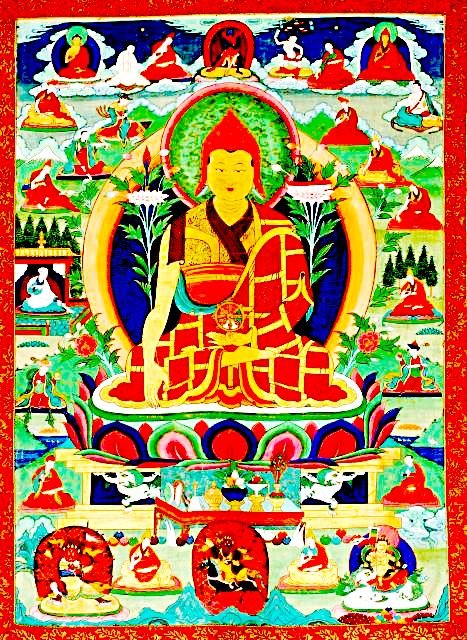
Figure 1: Portrait of Tārānātha (1575–1635), a prominent scholar of the Jonang tradition and author of History of Buddhism in India, one of the most influential Tibetan historical accounts of Indian Buddhism. Source: Wikimedia Commons.
I. Introduction
In the history of Tibetan Buddhism, few figures combine the roles of Vajrayāna practitioner and influential historian as prominently as Tārānātha (1575–1635). Emerging from the Jonang tradition and trained in multiple doctrinal systems of Tibetan Buddhism, Tārānātha is renowned not only for his philosophical and tantric writings but also for his major historical work, History of Buddhism in India. Composed in the early seventeenth century, this text represents one of the most systematic efforts by Tibetan scholars to reconstruct the history of Buddhism in India after the tradition had largely declined in its land of origin.
For Tibetan Buddhist communities, India was not merely the geographical birthplace of the Dharma but also the source of religious and intellectual authority. Consequently, writing the history of Buddhism in India was not simply an academic undertaking; it was also an act of preserving the religious memory of the tradition. Within this context, Tārānātha’s History of Buddhism in India occupies a particularly important place. The work attempts both to gather historical traditions about Indian Buddhism and to preserve numerous legendary and hagiographic narratives that had been transmitted over many centuries.
For modern researchers, therefore, reading Tārānātha’s work raises an important methodological question: should this text be understood as a strictly historical record, or as a composite narrative in which history, legend, and the religious memory of Buddhist communities are intertwined? Many passages in the work—for example, stories about the creation of Buddha images at Mahābodhi or the miraculous missionary activities of elders after the time of the Buddha—clearly demonstrate that Tārānātha was not concerned solely with recording historical events. Rather, he also sought to preserve the sacred images of the past that had been constructed within Buddhist tradition.
This article approaches History of Buddhism in India from the perspective of Buddhist historiography. Instead of treating the mythical elements in the work as distortions that must be discarded, it interprets them as expressions of the religious memory and historical imagination of Buddhist communities. Through an analysis of several representative passages in the text—particularly those concerning the origin of the first Buddha image, debates between Buddhism and the Brahmanical tradition, and the transmission of the Dharma before the reign of King Aśoka—this study argues that Tārānātha’s narrative preserves a layered form of historical memory in which history, legend, and religious belief are closely interwoven.
From this perspective, the significance of Tārānātha’s work lies not only in the historical information it provides but also in its ability to illuminate how later Buddhist communities imagined and reconstructed their own past. In other words, History of Buddhism in India is not merely a narrative of Buddhist history; it is also a window into the ways in which religious memory was formed and transmitted within the Buddhist tradition.
II. Tārānātha and Tibetan Memory of Indian Buddhism
To understand the significance of History of Buddhism in India, it is first necessary to place the work within the historical and intellectual context of Tibet in the late sixteenth and early seventeenth centuries. Its author, Tārānātha (1575–1635), was a distinguished scholar and practitioner of the Jonang tradition, a lineage closely associated with the teachings of the Kālacakra and the philosophical interpretation of zhentong Madhyamaka. In Tārānātha’s time, Indian Buddhism—the original cradle of the Dharma—had almost entirely disappeared after several centuries of decline. For Tibetan Buddhist communities, this situation created a particular task: to preserve the memory of the Indian tradition and to maintain the continuity of the Dharma within a new historical setting.
It was within this context that Tibetan scholars began to take a deep interest in recording and reconstructing the history of Buddhism in India. These efforts were not merely scholarly in nature; they also carried profound religious and cultural significance. For Tibetan Buddhists, India was not simply a geographical region. It was the sacred source of the Dharma, the land where the Buddha had appeared and where the philosophical and contemplative traditions of Buddhism had first taken shape. Writing the history of Indian Buddhism therefore became a means of reinforcing the religious and intellectual authority of Tibetan Buddhist traditions.
Among Tibetan historical works, Tārānātha’s History of Buddhism in India occupies a particularly prominent position. Unlike many earlier, shorter narratives, his work attempts to present a comprehensive account of the development of Buddhism from the time of the Buddha to the period of its decline in India. To accomplish this, Tārānātha drew upon a wide range of sources, including earlier Tibetan texts, oral traditions, and especially traditions believed to have originated from Indian scholars and practitioners. As a result, the work preserves a large number of stories and traditions that might otherwise have been entirely lost.
Yet the richness of these sources also gives Tārānātha’s work a distinctive character: the boundary between history and legend is often blurred. Alongside valuable information about Buddhist scholars, monasteries, and lineages, the text also contains many narratives with a strongly hagiographic character, in which religious figures perform miraculous acts or display supernatural abilities. Such stories should not simply be dismissed as historical inaccuracies. Rather, they reflect the ways in which later Buddhist communities remembered and interpreted their own past.
From this perspective, Tārānātha’s work can be seen not merely as a historical record but also as a repository of collective religious memory. It reveals how Tibetan Buddhist communities—centuries after Buddhism had disappeared from much of the Indian subcontinent—continued to imagine and reconstruct the history of the tradition they regarded as their spiritual origin. Consequently, when reading History of Buddhism in India, it is important not only to determine which elements may correspond to historical facts, but also to understand how religious memory, oral tradition, and historical imagination together shaped the narrative of Buddhism’s past.
Seen in this light, the stories preserved by Tārānātha—such as the legend of the creation of a Buddha image at Mahābodhi or the missionary activities of Buddhist elders after the Buddha’s time—become valuable sources for understanding how Buddhist tradition constructed its historical memory. These narratives do not merely reflect the religious beliefs of Buddhist communities; they also reveal how later Buddhists sought to connect the sacred past of India with the living traditions of Tibetan Buddhism.
III. The Legend of the First Buddha Image at Mahābodhi
One of the most striking passages in Tārānātha’s History of Buddhism in India concerns a story about the creation of a Buddha image at Mahābodhi, the site associated with the Buddha’s enlightenment. According to Tārānātha’s account, the story unfolds in the context of three brothers who, having developed a deep faith in the Dharma, decided to construct shrines dedicated to the Buddha at several sacred locations. Among these, the temple at Mahābodhi was regarded as the most important.
According to the legend preserved in the text, those entrusted with the creation of the statue were not ordinary craftsmen but “divine artisans” who appeared in human form. They sealed the temple for seven days in order to complete their work. However, on the sixth day, the mother of the three brothers—who was said to have personally seen the Buddha during his lifetime—asked that the door be opened earlier so that she could verify whether the statue truly resembled the Buddha. When the door was opened before the appointed time, the mysterious artisans immediately vanished, leaving the statue unfinished.
According to the mother’s judgment, the statue had reproduced the appearance of the Buddha with considerable accuracy, although certain details remained incomplete. The story then continues with elements that clearly bear a mythical character: precious jewels were discovered and placed as the eyes of the statue, another gem was set between the eyebrows to represent one of the Buddha’s distinctive marks, and a miraculous light was said to radiate from the image, illuminating the entire temple during the night. Such elements move the narrative beyond the realm of ordinary historical description and into the sphere of hagiographic tradition.
When viewed within the broader context of Buddhist art history, this story becomes particularly significant. Modern archaeological research indicates that anthropomorphic representations of the Buddha appeared only around the first century CE, especially in the two major artistic centers of Gandhāra and Mathurā. Prior to this period, Buddhist art typically employed aniconic symbols—such as the Bodhi tree, the wheel of Dharma, or the Buddha’s footprints—to represent the presence of the Buddha without directly depicting his physical form. For this reason, Tārānātha’s story about the creation of a Buddha image during a period close to the Buddha’s own lifetime cannot be understood as a historical record in the strict sense.
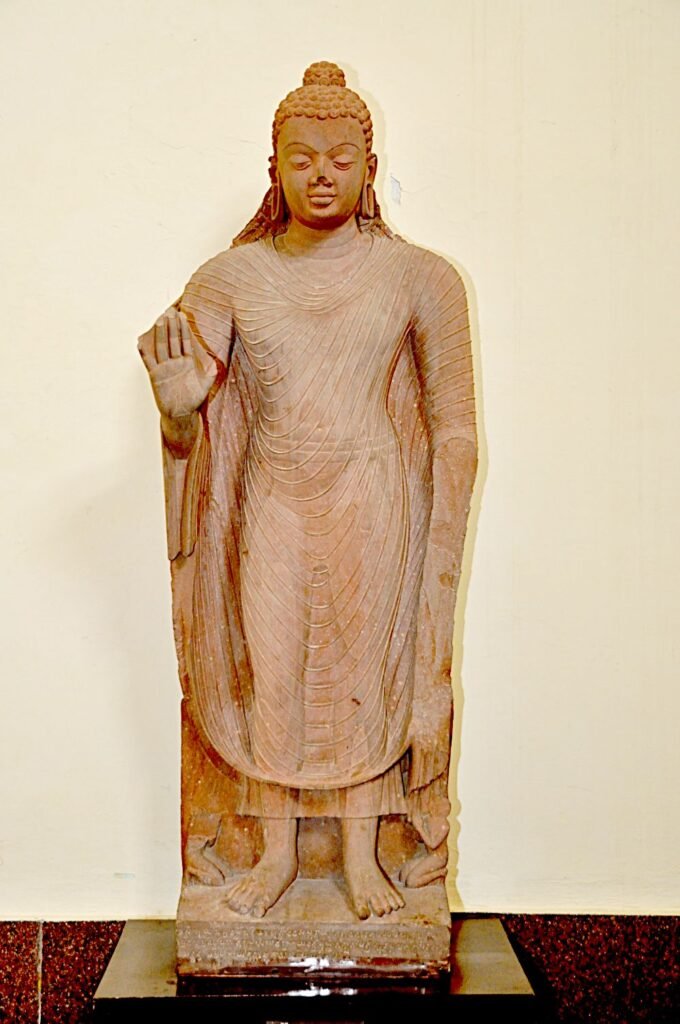
Figure 2: Standing Buddha in the Mathurā style, dated to 434 CE and installed by the Buddhist monk Yasadinna, discovered at Govind Nagar and now preserved in the Government Museum, Mathura. Source: Wikimedia Commons.
The value of this legend, however, does not lie in its historical accuracy but in the way it reflects the religious memory of Buddhist tradition. As Buddha images gradually became central to Buddhist religious life and artistic expression over the centuries, Buddhist communities began to ask questions about the origin of these images. Legends such as the one recorded by Tārānātha can therefore be understood as attempts by the tradition to connect the later practice of image worship with the very age of the Buddha himself.
In this sense, the story of the Buddha image at Mahābodhi is not merely an isolated legend but part of a broader pattern in the history of religion: the tendency to link important religious symbols of a community with the founding period of the tradition. By narrating that the first Buddha image was created near the time of the Buddha—and even verified by someone who had personally seen him—the Buddhist tradition provided a sacred and historical foundation for the practice of image veneration.
Thus, this passage in History of Buddhism in India allows us to glimpse an important dimension of Buddhist memory: the past is not only recorded but also reconstructed through symbolic narratives. Such stories are not intended merely to report events from the past; they also serve to explain and legitimize the religious practices of Buddhist communities in later periods.
IV. Dhītika and the Critique of Vedic Sacrificial Rituals
Alongside the legends concerning the formation of Buddhist symbols, Tārānātha’s History of Buddhism in India also contains numerous narratives that reflect the relationship between Buddhism and other religious traditions in ancient India. One of the most notable passages is the story of the elder Dhītika, a figure described as the successor to the lineage of the Dharma after the time of Upagupta. Through this story, Tārānātha presents a motif characteristic of Buddhist literature: the contrast between the ethical ideal of compassion in Buddhism and the practice of animal sacrifice within the Brahmanical tradition.
According to the account preserved in the text, Dhītika, together with a group of elders, traveled to a region where Brahmins were conducting large-scale sacrificial rituals. These ceremonies involved the killing of numerous animals—from goats to cattle—as part of Vedic offerings intended to appease the gods. When Dhītika arrived at the site of the sacrifice, he witnessed a scene that, from the Buddhist perspective, was regarded as an act of cruelty and a violation of the principle of ahiṃsā, or non-violence.
The narrative then unfolds according to a familiar pattern in Buddhist literature: the intervention of a religious elder who seeks to halt the sacrificial practice. According to Tārānātha’s account, once Dhītika appeared at the sacrificial ground, the rituals began to encounter strange obstacles. The fire would not ignite, the animals could not be killed, and the Brahmins were unable to continue reciting their mantras. When they attempted to attack the elder with stones and clods of earth, these objects were transformed into flowers and sandalwood powder. Such miraculous elements clearly bear the marks of hagiographic tradition, serving to emphasize the moral power of the Dharma.
Yet the significance of the story does not lie in its miraculous details but in the religious message it conveys. In Dhītika’s teaching, animal sacrifice is criticized not only because of its violence but also because of the internal contradictions within the logic of the ritual itself. If the gods are noble and pure beings, why would they require the blood and flesh of slaughtered animals? And if the Brahmins themselves regard certain kinds of meat as impure, how could the gods be pleased with offerings of that very nature? These questions reflect a form of ethical and philosophical reasoning that appears repeatedly in early Buddhist scriptures, where the Buddha and his disciples frequently criticize sacrificial rituals as practices that do not lead to liberation.
When viewed within the broader context of the religious history of India, the story can be understood as a reflection of Buddhist memory concerning debates among religious traditions in ancient times. For many centuries after the Buddha’s passing, Buddhist communities, Brahmanical groups, and other śramaṇa traditions coexisted and competed within the same cultural landscape. Discussions concerning the nature of ritual, morality, and the path to liberation thus became an important part of the intellectual life of ancient India.
Within this context, the story of Dhītika should not be regarded merely as a religious legend. Rather, it reflects the way in which Buddhist tradition imagined the relationship between its own teachings and the Vedic traditions. By portraying a Buddhist elder who possesses the power to halt sacrificial rituals and convert Brahmins, Tārānātha’s narrative presents Buddhism as an ethical path that transcends religious practices based on violence.
After hearing Dhītika’s teaching, the Brahmins in the story develop faith in the Three Jewels and decide to abandon their sacrificial rituals. A new monastery is then established, and the Dharma spreads widely throughout the region. This conclusion follows a common motif in Buddhist literature: religious confrontations often end with the moral transformation of those who had previously stood in opposition.
From the perspective of Buddhist historiography, this narrative illustrates how later Buddhist communities reimagined their past as a process in which the Dharma gradually replaced earlier religious forms. Although the miraculous elements of the story cannot be interpreted as historical facts, they nevertheless reflect a form of religious memory in which Buddhism is portrayed as a moral force capable of transforming society and bringing an end to practices regarded as cruel.
V. The Transmission of the Dharma before the Time of Aśoka
Alongside narratives that bear a strongly legendary character, Tārānātha’s History of Buddhism in India also contains a clear attempt to reconstruct the lineage of the Dharma during the period between the lifetime of the Buddha and the emergence of the most famous royal patron of Buddhism in Indian history, Aśoka. Within the broader context of Buddhist history, this period is often regarded as particularly difficult to reconstruct, since direct historical sources from the time are extremely limited. As a result, many later Buddhist traditions developed stories and lineage lists in order to fill this historical gap.
In Tārānātha’s narrative, the transmission of the Dharma after the Buddha is presented through a series of representative figures, among whom the elder Upagupta and his successor Dhītika play especially prominent roles. According to the traditions preserved in the text, Upagupta was one of the key teachers responsible for maintaining and spreading the Dharma after the Buddha’s parinirvāṇa. In many northern Buddhist traditions, Upagupta is also portrayed as having a special influence on King Aśoka and is sometimes described as the king’s spiritual mentor.
Within Tārānātha’s account, the role of Dhītika becomes particularly significant. After receiving the responsibility of leading the Dharma from Upagupta, Dhītika not only instructed existing Buddhist communities but also participated in broader missionary activities. Stories describing his conversion of Brahmins, his intervention against sacrificial rituals, and his propagation of the Dharma across different regions of India portray Buddhism as a tradition that was gradually expanding and consolidating its presence within ancient Indian society.
It is noteworthy that in Tārānātha’s narrative the events associated with Dhītika are placed immediately before the appearance of King Aśoka. This arrangement is not accidental. In many Buddhist traditions, the age of Aśoka is regarded as a decisive turning point in the history of the Dharma: from a relatively limited religious movement, Buddhism became a tradition supported by political power and capable of spreading widely across Asia. By describing Dhītika’s missionary activities in the period just before Aśoka, Tārānātha creates a narrative bridge between the era of the elders following the Buddha and the golden age of Buddhism under the patronage of the Mauryan dynasty.
From the perspective of Buddhist historiography, this narrative structure can be understood as an attempt to ensure the continuity of the Dharma across multiple generations. The chronological gap between the Buddha and Aśoka—largely undocumented in direct historical sources—is filled with stories about elders, missionary activities, and religious debates. These narratives not only maintain the lineage of the Dharma but also construct a historical picture in which the rise of Aśoka appears not as an isolated event, but as the culmination of a long process of Buddhist development within Indian society.
Within this context, Tārānātha’s account allows us to see how later Buddhist communities imagined their history as a continuous flow. Elders such as Upagupta and Dhītika are not merely religious figures; they function as links connecting the age of the Buddha with the period in which Buddhism began to emerge as a major religious and cultural force in Indian history. Through these figures, the religious memory of Buddhist tradition constructs a bridge between the sacred past of the Dharma and the historical transformations of subsequent centuries.
VI. Between Legend and History: Reading Tārānātha in Light of Modern Scholarship
The narratives preserved in Tārānātha’s History of Buddhism in India raise an important methodological question for modern scholars of Buddhism: how should one evaluate the accounts contained in this text when they include both historical elements and clearly mythical details? In many passages of the work, religious figures are described as performing miraculous acts, extraordinary events occur to confirm the truth of the Dharma, and religious traditions are presented as having continued uninterrupted from the time of the Buddha to later centuries. Such features make it difficult to read the text as a historical record in the strict sense defined by modern historiography.
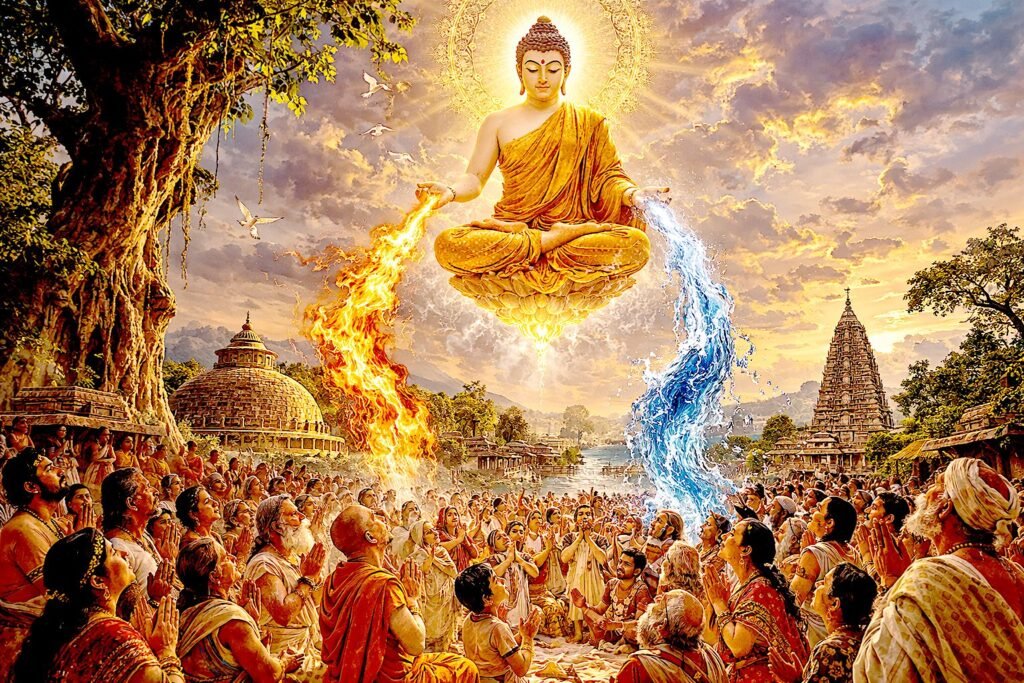
Figure 3: The Twin Miracle (Yamaka-pāṭihāriya) of the Buddha at Śrāvastī, depicted in later Buddhist artistic imagination. Miracle narratives of this kind illustrate the hagiographic dimension through which Buddhist traditions expressed the spiritual authority of the Buddha.
A clear example of this issue can be found in the story concerning the creation of the Buddha image at Mahābodhi. In Tārānātha’s narrative, the statue is produced by “divine artisans,” completed with precious jewels, and said to emit a miraculous light. However, modern archaeological and art historical research indicates that anthropomorphic representations of the Buddha became widespread only around the first century CE, particularly in artistic centers such as Gandhāra and Mathurā. Prior to that period, Buddhist art generally relied on aniconic symbols to represent the Buddha’s presence. For this reason, Tārānātha’s story about the creation of a Buddha image during a period close to the lifetime of the Buddha cannot be interpreted as a historical event, but should instead be understood as a legend intended to explain the origins of image worship in Buddhism.
Another example can be found in the stories describing the missionary activities of elders such as Upagupta and Dhītika. In these accounts, religious transformation is often portrayed through miraculous events: fires refuse to burn, sacrificial rituals are disrupted, and objects thrown at the elder are transformed into flowers. Such details reflect a common motif in the hagiographic literature of many religious traditions, in which the moral authority of holy figures is expressed through miraculous occurrences. Although these elements cannot be verified by independent historical sources, they remain valuable for understanding how Buddhist communities imagined the power of the Dharma.
Recognizing the mythical elements within the text, however, does not mean that Tārānātha’s work should be dismissed entirely as a historical source. On the contrary, many modern scholars argue that the value of History of Buddhism in India lies precisely in the fact that it preserves traditions and memories that might otherwise have been lost. Lists of scholars, monasteries, and religious sites recorded in the text often provide important clues for reconstructing the history of Buddhism in India, particularly for periods in which other historical sources are scarce.
For this reason, rather than placing Tārānātha’s text within a simple opposition between “history” and “myth,” many scholars today approach it as a form of religious historical memory. From this perspective, legendary and hagiographic elements are not treated as distortions that must be removed, but as expressions of the ways in which Buddhist communities interpreted and reconstructed their past. Stories about Buddha images, religious debates, and missionary activities do not merely recount events that supposedly occurred; they also reveal how later Buddhists sought to understand the origins and development of their own tradition.
Viewed in this light, Tārānātha’s work can be understood as a point of intersection between two forms of discourse. On the one hand, it attempts to preserve historical memories of Indian Buddhism; on the other, it participates in the process of constructing religious meaning for the past. It is precisely this combination that makes History of Buddhism in India a particularly valuable source, not only for the study of Buddhist history but also for understanding how religious traditions remember and narrate their own past.
VII. Conclusion
The analyses presented in the preceding sections demonstrate that Tārānātha’s History of Buddhism in India cannot be understood simply as a historical record in the strict sense of modern historiography. In this work, historical events, religious legends, and hagiographic elements are woven together to form a complex narrative about the Buddhist past. Stories concerning the creation of the Buddha image at Mahābodhi, the missionary activities of elders such as Upagupta and Dhītika, and the debates between Buddhism and Brahmanical traditions all illustrate that Tārānātha’s text was not intended solely to document historical events. Rather, it also sought to preserve the religious memory of Buddhist communities.
When read within the broader context of Tibetan Buddhist history, this characteristic becomes easier to understand. For Tibetan scholars and practitioners in the seventeenth century, India was not merely a historical location but the sacred source of the Dharma. Writing the history of Buddhism in India was therefore not only an effort to reconstruct the past but also a means of maintaining a spiritual connection between Tibetan tradition and the origins of the Dharma. In this context, the stories recorded by Tārānātha can be interpreted as attempts to recreate a sacred past in which the Dharma is transmitted continuously across generations—from the time of the Buddha to later historical periods.
At the same time, comparing Tārānātha’s narratives with modern archaeological and historical research shows that many details in the work cannot be interpreted as direct historical evidence. This, however, does not diminish the value of the text. On the contrary, the very combination of historical and mythical elements makes History of Buddhism in India a particularly valuable source for studying how later Buddhist communities imagined and interpreted their past. Legends concerning the origins of Buddha images, stories about the conversion of Brahmins, and accounts of the transmission of the Dharma all reflect the ways in which Buddhist tradition constructed a collective memory of its history.
From this perspective, Tārānātha’s work can be understood as a form of religious historiography, in which the past is narrated not only to record events but also to affirm the religious significance of the Dharma for the community. Reading this text therefore requires a balanced approach: one that recognizes the legendary and hagiographic elements within the narrative while also appreciating its value as a repository of religious memory and Buddhist intellectual tradition.
Ultimately, History of Buddhism in India reminds us that religious history does not exist solely in the form of verifiable events. It also lives in the stories that communities tell about themselves. Within those stories—where history, memory, and belief intertwine—we can perceive how religious traditions understand their past and seek meaning for their existence in the present.
Bibliography
DeCaroli, Robert. Image Problems: The Origin and Development of the Buddha’s Image in Early South Asia. Seattle: University of Washington Press, 2015.
Gombrich, Richard. Theravāda Buddhism: A Social History from Ancient Benares to Modern Colombo. London: Routledge, 1988.
Huntington, Susan L. The Art of Ancient India: Buddhist, Hindu, Jain. New York: Weatherhill, 1985.
Lamotte, Étienne. History of Indian Buddhism: From the Origins to the Śaka Era. Translated by Sara Webb-Boin. Louvain-la-Neuve: Université Catholique de Louvain, 1988.
Schopen, Gregory. Bones, Stones, and Buddhist Monks: Collected Papers on the Archaeology, Epigraphy, and Texts of Monastic Buddhism in India. Honolulu: University of Hawai‘i Press, 1997.
Strong, John S. The Legend and Cult of Upagupta: Sanskrit Buddhism in North India and Southeast Asia. Princeton: Princeton University Press, 1992.
Strong, John S. Relics of the Buddha. Princeton: Princeton University Press, 2004.
Tāranātha. History of Buddhism in India. Translated by Lama Chimpa and Alaka Chattopadhyaya. Simla: Indian Institute of Advanced Study, 1970.
Trainor, Kevin. Relics, Ritual, and Representation in Buddhism: Rematerializing the Sri Lankan Theravāda Tradition. Cambridge: Cambridge University Press, 1997.