
Le Hoang Da
Buddhist Scholar
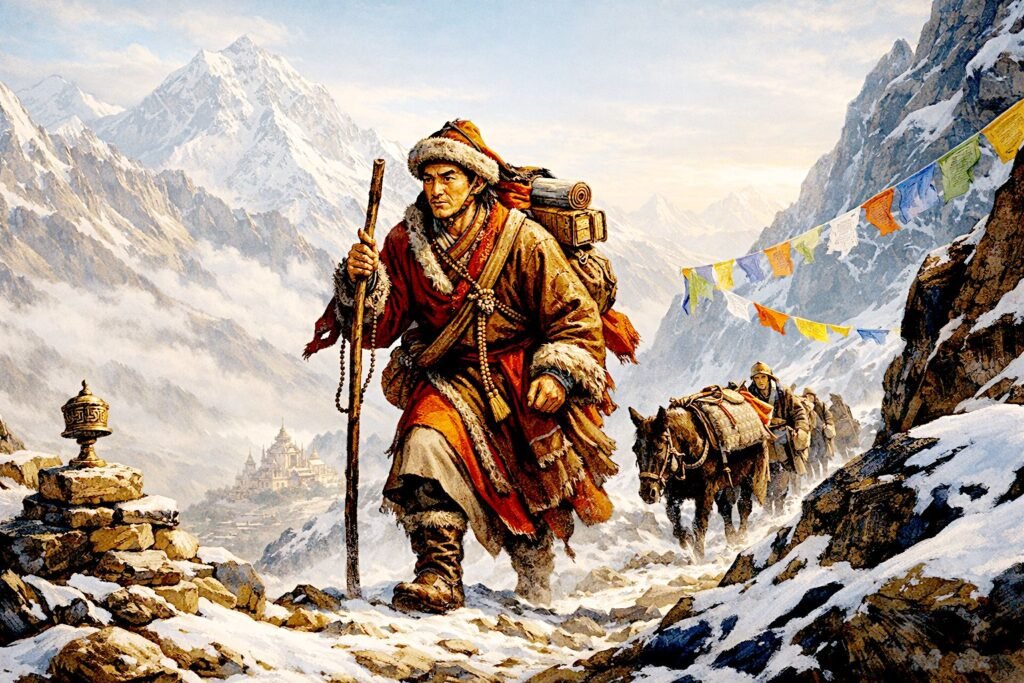
Figure 1: Illustration of Marpa Lotsawa crossing a Himalayan mountain pass on his journey to India in search of Buddhist teachings. Such journeys by Tibetan translators played a crucial role in the transmission of Buddhist scriptures and tantric traditions between India and Tibet.
I. Introduction: The Himalaya as a Corridor of Buddhist Transmission
In the history of Asian civilizations, the Himalayan mountain range has often been imagined as a vast natural barrier separating the Indian subcontinent from the Tibetan Plateau. The highest snow-covered peaks in the world, deep valleys, and treacherous mountain passes have long led this region to be regarded as one of the most difficult terrains to traverse on the planet. Yet when viewed from the perspective of religious history and cultural exchange, the Himalaya were not merely a geographical obstacle. On the contrary, during many periods of Buddhist history, these mountains functioned as a corridor of religious and intellectual exchange linking the Indian world with Tibet and its neighboring regions.
From the earliest stages of Tibetan Buddhism, monks, translators, and tantric practitioners repeatedly crossed the formidable mountain routes connecting these two cultural spheres. For Tibetan scholars, India was regarded as a sacred land—the place where the Buddha attained enlightenment and where the Buddhist scriptures were first composed. Pilgrimage to sacred sites such as Bodh Gaya, the location of the Buddha’s awakening, became a profound aspiration for many generations of Tibetan monks. Conversely, numerous Indian masters also crossed the Himalaya to teach Buddhist doctrine and tantric ritual in Tibet, thereby contributing to the formation of the distinctive Buddhist traditions that developed on the plateau.
Within this context, the trans-Himalayan routes became the lifelines of Buddhist transmission. These paths did not merely facilitate individual pilgrimage but also functioned as corridors for cultural and intellectual exchange. Sanskrit scriptures were carried from India into Tibet, where they were translated into Tibetan and preserved within the vast canonical collections. At the same time, traditions of meditation, tantric ritual practices, and philosophical systems of Buddhism spread through the long journeys undertaken by teachers and translators.
One of the most notable figures associated with this process of exchange was Marpa Lotsawa, the celebrated translator of the Kagyu tradition. Marpa traveled across the Himalaya several times to study tantric teachings in India under renowned masters. After receiving these teachings, he returned to Tibet and transmitted them to his disciples. Such journeys not only reflected the intellectual aspirations of Buddhist practitioners but also demonstrated the strong connections that linked the Buddhist worlds of India and Tibet.
In addition to the well-known routes passing through Nepal, historical sources also suggest the existence of several lesser-known corridors. Some Tibetan texts indicate that monks and tantric practitioners may have traveled along eastern Himalayan routes connecting Assam with Bhutan before entering the Tibetan Plateau. Although these paths have received relatively little attention in modern scholarship, they may have played an important role in the transmission of tantric traditions between India and Tibet.
This article examines the pilgrimage and transmission routes that crossed the Himalaya in order to clarify how monks, translators, and tantric practitioners moved between India and Tibet during different periods of history. Rather than viewing the Himalaya as a boundary separating two civilizations, this study proposes understanding the mountain range as a space of connection in which pilgrimage routes, monastic centers, and scholarly networks together formed a system of transregional religious exchange. By analyzing the major routes—including the Nepal corridor, the eastern Himalayan pathways, and the role of important monastic centers—this article argues that the history of Tibetan Buddhism cannot be fully understood without considering the mountain journeys undertaken by generations of monks and scholars in the past.
II. The Nepal Corridor: The Classical Route Between India and Tibet
Among the trans-Himalayan routes that connected the Buddhist world of India with Tibet, the corridor passing through Nepal has long been regarded as the most important and most frequently used pathway. From the perspective of Tibetan Buddhist history, Nepal was not merely a country situated between two major cultural regions but also served as an intermediary gateway through which Buddhist scriptures, ritual traditions, and intellectual knowledge were transmitted from the Indian subcontinent to the Tibetan Plateau. For this reason, for many centuries the routes passing through the Kathmandu Valley and the northern passes of Nepal functioned as some of the most significant pilgrimage and scholarly corridors in the Himalayan Buddhist world.
At the center of this network was the Kathmandu Valley, a region that historically stood at the intersection of multiple cultures and religious traditions. During the medieval period, the Kathmandu Valley was a place where Buddhism and Hinduism coexisted, while also serving as a meeting ground for merchants, scholars, and religious practitioners from various regions. Owing to its favorable geographical location, Kathmandu became a natural stopping point for Tibetan monks traveling southward to India to undertake pilgrimage and study at major Buddhist centers such as Bodh Gaya or the renowned monastic universities of Nālandā and Vikramaśīla.
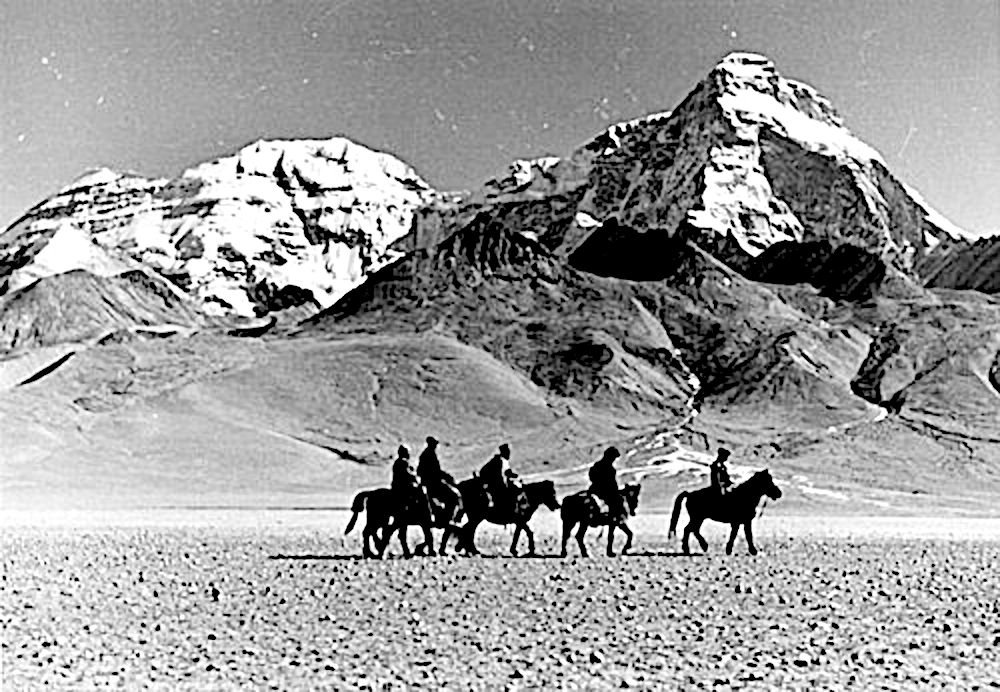
Figure 2: Caravan traveling across the Himalayan plateau near Mount Chomolhari, Tibet, 1938. For centuries, similar caravans carried merchants, pilgrims, and monks along the routes linking Nepal, India, and Tibet. Source: Wikimedia Commons
From Kathmandu, pilgrimage groups would typically continue northward, crossing mountain passes to enter Tibetan territory. Among the most important routes were those passing through Kyirong and the Kuti Pass. Despite their harsh terrain and severe climatic conditions, these paths were used continuously for many centuries by merchants, envoys, and especially Buddhist monks. It was along these routes that Sanskrit scriptures were carried into Tibet, where they were translated into Tibetan and incorporated into the vast canonical collections known today.
One of the most prominent figures associated with this pilgrimage route was Marpa Lotsawa, the great translator of the Kagyu tradition. According to Tibetan biographies, Marpa repeatedly left his homeland and crossed the Himalaya in order to study tantric teachings in India. During these journeys, which often lasted for many months, he traveled through Nepal and crossed treacherous mountain passes to meet Indian masters such as Nāropa and Maitrīpa. After receiving these meditation traditions and tantric ritual teachings, Marpa returned to Tibet, where he transmitted them to his disciples and laid the foundations for one of the most influential lineages of Tibetan Buddhism.
Journeys such as Marpa’s were by no means exceptional. For centuries, Tibetan monks regularly followed the Nepal route to travel to India for study. For them, pilgrimage to Buddhist sacred sites was not only a spiritual undertaking but also part of a broader pursuit of knowledge and religious authority. Studying directly with Indian masters was regarded as a source of doctrinal authenticity, and the arduous journeys across the Himalaya thus became an important rite within the intellectual life of Tibetan Buddhism.
Beyond its role as a pilgrimage route, the Nepal corridor also functioned as a channel of cultural and economic exchange between the two regions. Merchant caravans carried goods from India to Tibet, while monks and scholars traveled along the same routes to disseminate Buddhist teachings. The intersection of commerce and religion created an extensive network of interaction in which monasteries, towns, and valleys along the routes became important stopping points for traveling groups.
The Nepal corridor was therefore more than a simple geographical pathway. In the history of Buddhism, it became an intermediary space for the transmission of knowledge and religious practice, where Buddhist traditions from India were received, transformed, and reconfigured within the Tibetan cultural context. It was through these mountain routes that scriptures, tantric rituals, and philosophical systems were transmitted to Tibet, contributing to the formation of one of the richest and most creative Buddhist traditions in the world.
III. The Assam–Bhutan Corridor: A Lesser-Known Route
In addition to the well-known pilgrimage routes passing through Nepal, historical sources also suggest the existence of another corridor connecting the Indian subcontinent with Tibet through the eastern Himalaya. This route began in the region of Assam, crossed the valleys and mountain passes of Bhutan, and then entered the Tibetan Plateau. Compared with the Nepal routes, this corridor has received relatively little attention in modern scholarship. Nevertheless, Tibetan texts and several studies by Tibetologists indicate that it once played a significant role in linking the Buddhist centers of northeastern India with the Tibetan world.
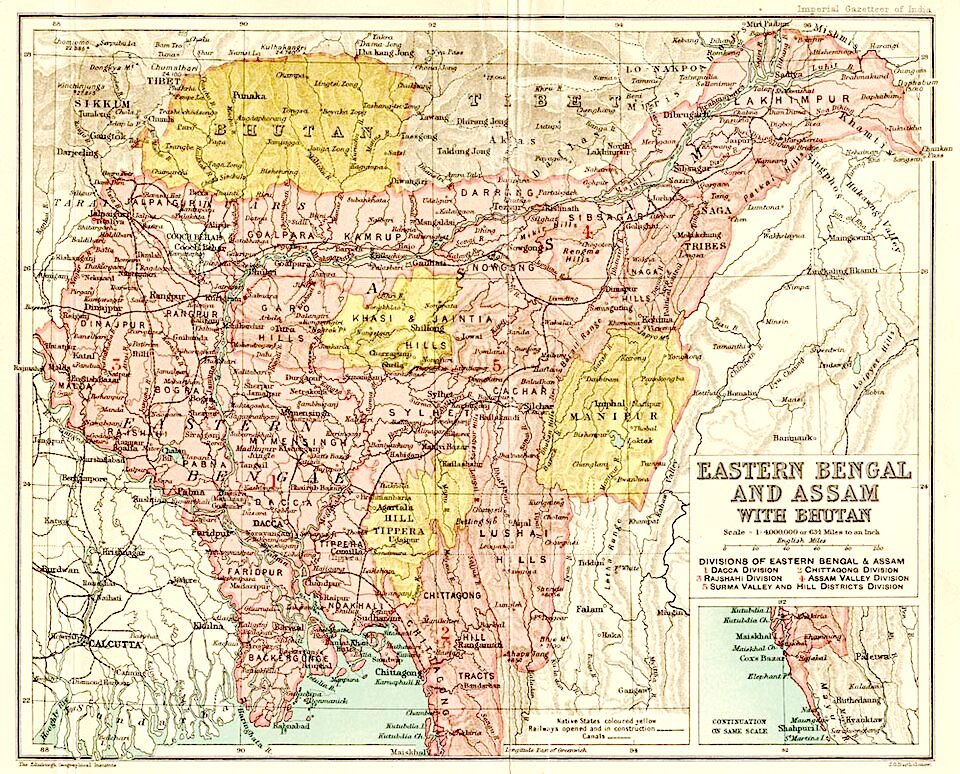
Figure 3: Historical map of Eastern Bengal and Assam with Bhutan, illustrating the eastern Himalayan region through which routes may have connected Assam with the Tibetan Plateau. Source: Wikimedia Commons
In the religious history of the region, Assam occupied a particularly important position. The area hosted influential centers of worship and ritual practice, most notably the Kamakhya Temple, a site closely associated with the tantric traditions of India. Although Kamakhya today is primarily known as a center of Śākta Tantra within Hinduism, various sources suggest that during the medieval period the region also saw the presence of Buddhist tantric practitioners and traditions. Within this diverse religious landscape, Assam may have served as an important point of transition for practitioners traveling between the Indian subcontinent and the eastern Himalaya.
Some Tibetan texts and traditions indicate that monks and tantric practitioners once followed routes from Assam through Bhutan before entering Tibet. Unlike the Nepal corridor, which passed through major commercial and urban centers, this eastern route likely traversed forested mountain regions and sparsely populated valleys. This may explain why it appears less frequently in official historical sources, yet surfaces in accounts describing the journeys of certain ascetics and yogis.
The geography of Bhutan played a crucial role in shaping this corridor. Situated between the Tibetan Plateau and the plains of Assam, Bhutan consists of a network of deep valleys and mountain ranges running roughly in a north–south direction. These valleys created natural passageways linking different regions of the eastern Himalaya. Historically, routes through Bhutan were used by merchants, envoys, and pilgrimage groups, thereby contributing to the formation of transregional networks connecting Tibet with the Indian subcontinent.
Tibetan sources also indicate that Bhutan became an important center of Himalayan Buddhism at an early stage. In later centuries, the region became particularly associated with the Drukpa Kagyu tradition, an important branch of the Kagyu lineage. The development of monasteries and centers of learning in Bhutan further strengthened the region’s role as an intermediary zone between Tibet and the southern Himalayan regions.
If the Nepal corridor can be regarded as the principal route used by Tibetan translators and scholars during the formative period of Tibetan Buddhism, the Assam–Bhutan corridor may represent a parallel network through which tantric practitioners and religious travelers moved across less-documented regions of the Himalaya. The existence of such routes demonstrates that the spread of Buddhism did not occur along a single pathway but rather through multiple corridors, each shaped by distinct geographical and cultural contexts.
Viewed more broadly, the Assam–Bhutan corridor suggests that the eastern Himalaya once functioned as a dynamic zone of religious exchange where tantric traditions, local cultic centers, and Buddhist networks intersected. Rather than focusing solely on the well-known routes through Nepal, examining these lesser-studied corridors expands our understanding of how Buddhism spread across the mountainous regions of Asia. In this sense, the eastern Himalaya should not be seen merely as a peripheral region of the Buddhist world but as one of the important spaces through which religious traditions and intellectual knowledge circulated among different cultural spheres.
IV. Monastic Centers within the Himalayan Pilgrimage Network
The trans-Himalayan pilgrimage routes cannot be fully understood if they are viewed merely as geographical pathways linking different regions. In reality, these routes were closely connected with a network of monasteries, sacred sites, and centers of learning where monks could rest, exchange knowledge, and receive religious teachings. These locations functioned as “nodes” within the Buddhist network, transforming the pilgrimage routes into a system of religious and intellectual connections stretching from India to Tibet.
Among the Buddhist sacred sites of the Indian subcontinent, none held greater importance than Bodh Gaya, the place where the Buddha attained enlightenment beneath the Bodhi tree. From an early period, this site became a major center of pilgrimage for Buddhists across Asia. For Tibetan monks, Bodh Gaya was not only a sacred destination but also a symbolic source of the Buddhist teaching itself. Tibetan biographies often recount the long journeys undertaken by monks who crossed the Himalaya to pay homage at this site while seeking opportunities to study with Indian masters.
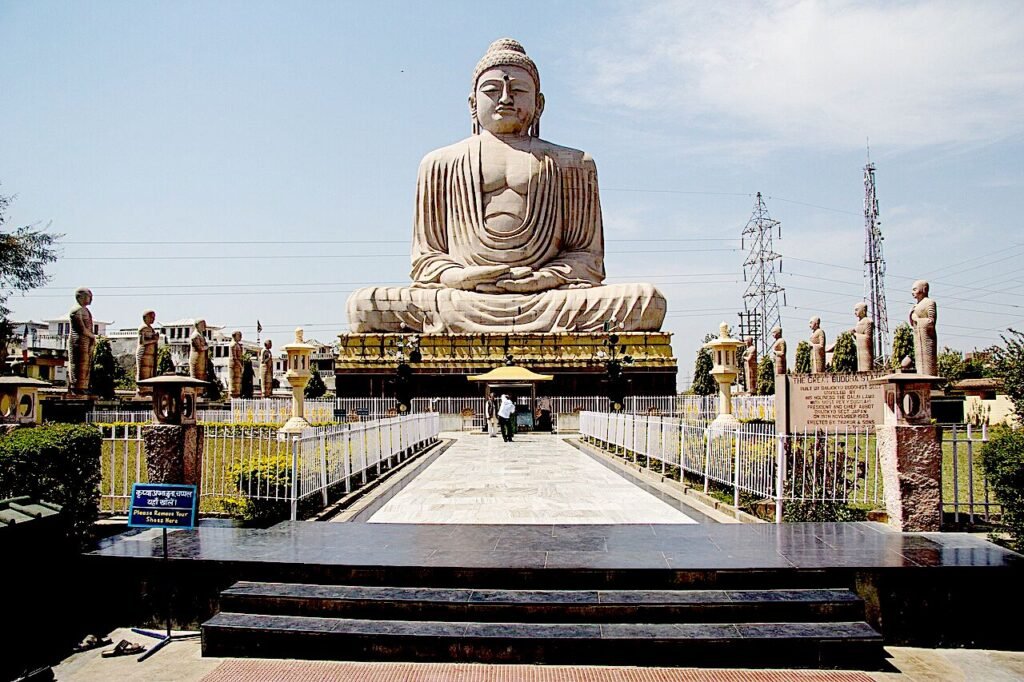
Figure 4: The Great Buddha Statue at Bodh Gaya, one of the most important Buddhist pilgrimage sites associated with the Buddha’s enlightenment. For centuries, Bodh Gaya has attracted pilgrims from across Asia, including monks traveling between India and Tibet. Source: Wikimedia Commons
In addition to sacred pilgrimage sites, the great Buddhist universities of ancient India—such as Nālandā and Vikramaśīla—also served as central institutions within the network of Buddhist transmission. Although these institutions declined around the twelfth century, their influence continued to spread through the philosophical traditions and ritual systems that were transmitted to Tibet. It was within these centers of learning that major Buddhist philosophical systems—from Madhyamaka to Yogācāra—were systematized before being carried to Tibet by traveling scholars and translators.
North of the Himalayan range, one of the most important centers of Tibetan Buddhism was Samye Monastery. Founded in the eighth century under the reign of King Trisong Detsen, Samye is often regarded as the first Buddhist monastery established in Tibet. It also became a major site of translation activity, where Buddhist scriptures were rendered from Sanskrit into Tibetan—an undertaking that played a decisive role in the formation of Tibetan Buddhist tradition. The scholars and translators working at Samye served as crucial intermediaries in transmitting Buddhist knowledge from India to Tibet.
Monasteries such as Samye were not only religious institutions but also important stopping points along the pilgrimage routes. Monks came to these sites to study, participate in rituals, and receive lineage transmissions before continuing their journeys. In this way, monasteries functioned as vital points of connection within the Buddhist exchange network, where philosophical traditions, ritual practices, and meditative teachings circulated among different communities.
Beyond the major centers, numerous smaller monasteries and local religious communities existed along the pilgrimage routes. These locations provided practical support for traveling groups, offering shelter, food, and information about the routes ahead. At the same time, they contributed to the spread of Buddhist teachings into the remote mountainous regions of the Himalaya, where Buddhism gradually interacted with and adapted to local cultural traditions.
Viewed from the perspective of religious geography, monasteries and sacred sites can thus be understood as nodal points within a transregional pilgrimage network. The routes connecting them formed a religious landscape extending from the sacred sites of India to the monasteries of Tibet. Through this network, Buddhism was transmitted, adapted, and reconfigured within the cultural context of the Himalayan world.
Therefore, when studying the pilgrimage routes between India and Tibet, it is important not only to identify the geographical pathways themselves but also to understand the role played by monastic centers in sustaining and expanding this religious network. Sites such as Bodh Gaya and Samye were not merely sacred destinations but also centers of knowledge and lineage transmission where generations of monks and scholars collectively shaped the traditions of Himalayan Buddhism.
V. Pilgrims and Translators along the Himalayan Routes
1. Padmasambhava and the Early Phase of Tibetan Buddhism
In Tibetan Buddhist traditions, Padmasambhava—revered with the honorific title Guru Rinpoche—is regarded as one of the central figures in the establishment of Buddhism in Tibet. According to both historical traditions and legendary accounts, he was invited to Tibet in the eighth century during the reign of King Trisong Detsen to assist in the founding of Samye Monastery. In this context, Padmasambhava is believed to have introduced a range of tantric rituals and distinctive Vajrayāna meditative practices.
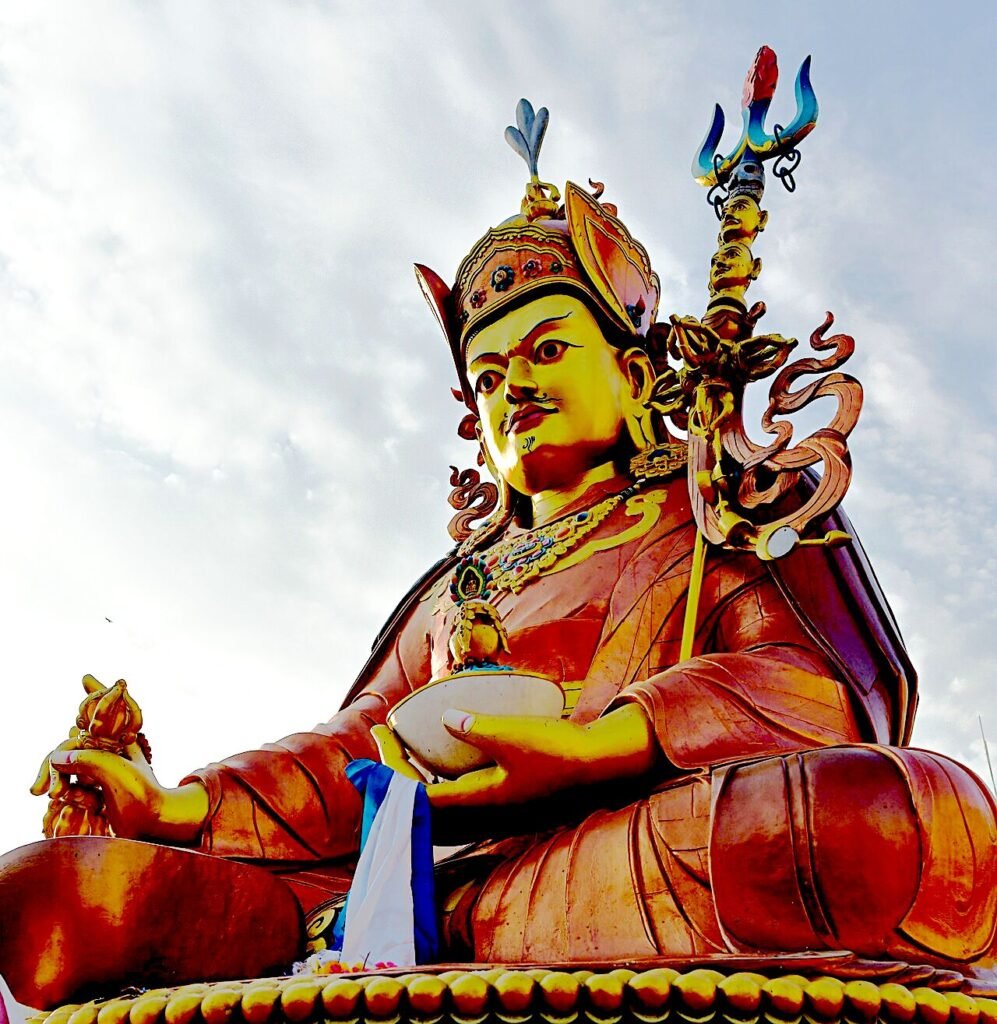
Figure 5: Statue of Padmasambhava (Guru Rinpoche) at Boudhanath, Nepal. Revered as one of the founding figures of Tibetan Buddhism, Padmasambhava is traditionally believed to have traveled across the Himalaya in the eighth century to establish Buddhist teachings in Tibet. Source: Wikimedia Commons
Although the narratives surrounding Padmasambhava contain many legendary elements, his figure reflects an important historical reality: the presence of Indian masters during the formative period of Tibetan Buddhism. Figures such as Padmasambhava crossed the Himalaya to bring tantric traditions to Tibet, thereby contributing to the foundations upon which Tibetan Buddhism would later develop.
2. Atiśa and the Revival of Tibetan Buddhism
One of the most influential historical figures in the development of Tibetan Buddhism was Atiśa, a Buddhist scholar and practitioner from Bengal. After studying at major Indian centers of learning such as Vikramaśīla, Atiśa was invited to Tibet in the eleventh century during a period when Buddhism in the region was undergoing significant transformation.
Atiśa’s journey across the Himalaya to Tibet was not merely a personal voyage but also marked a crucial turning point in the history of Tibetan Buddhism. In Tibet, he taught Buddhist doctrines and composed several influential works, most notably teachings on the gradual path to enlightenment (lamrim). These teachings later became the foundation of the Kadampa tradition, a lineage that exerted a profound influence on Tibetan Buddhism.
3. Marpa Lotsawa and Journeys in Search of the Dharma
If Atiśa represents the transmission of Buddhist teachings from India to Tibet, Marpa Lotsawa illustrates the reverse direction of religious exchange. A Tibetan translator and tantric practitioner, Marpa repeatedly left his homeland to travel to India in search of instruction from renowned masters. His journeys often lasted many months, sometimes even years, and required crossing the formidable routes of the Himalayan mountains.
During these travels, Marpa received tantric teachings from masters such as Nāropa and Maitrīpa. Upon returning to Tibet, he translated numerous scriptures and transmitted the teachings he had received to his disciples. These teachings eventually became the foundation of the Kagyu tradition, one of the most important lineages within Tibetan Buddhism.
4. Taranatha and the Historical Memory of the Pilgrimage Routes
While figures such as Padmasambhava, Atiśa, and Marpa represent different phases of the transmission of Buddhist teachings, Taranatha played a different role as a historian who preserved the memory of this process. A renowned Tibetan scholar and monk of the sixteenth and seventeenth centuries, Taranatha authored several works on the history of Buddhism, including valuable accounts of Indian masters and the pilgrimage routes connecting India and Tibet.
Taranatha’s writings provide important insights into the religious and scholarly networks that had existed for many centuries before his time. Through his records, we gain a glimpse of the vast Buddhist world of the medieval period, in which monks and scholars continually traveled across mountains, valleys, and cultural frontiers in search of the Dharma.
5. Pilgrims as Agents of the Buddhist Network
Taken together, figures such as Padmasambhava, Atiśa, Marpa, and Taranatha demonstrate that the history of Himalayan Buddhism was shaped not only by places and routes but also by the individuals who traveled along them. It was these traveling monks, translators, and scholars who carried scriptures, meditative traditions, and religious knowledge from one region to another.
These practitioners can therefore be understood as agents of transregional Buddhist transmission, linking the religious centers of India with the Buddhist communities of Tibet. Through their journeys, the trans-Himalayan routes became more than simple geographical pathways; they functioned as corridors for the circulation of knowledge and religious practice within the wider Buddhist world of Asia.
VI. Himalayan Routes within the Network of Buddhist Transmission in Asia
1. Comparison with Other Buddhist Networks
When the trans-Himalayan pilgrimage routes are placed within the broader context of the history of Buddhism in Asia, it becomes clear that these pathways were only one part of a much larger system of religious transmission. Over many centuries, the teachings of the Buddha spread through various types of geographical corridors, including transcontinental land routes, maritime networks across the Indian Ocean, and mountain corridors connecting the high plateaus of Asia. Comparing the Himalayan routes with these other transmission networks helps clarify the distinctive role played by this region in the history of Buddhism.
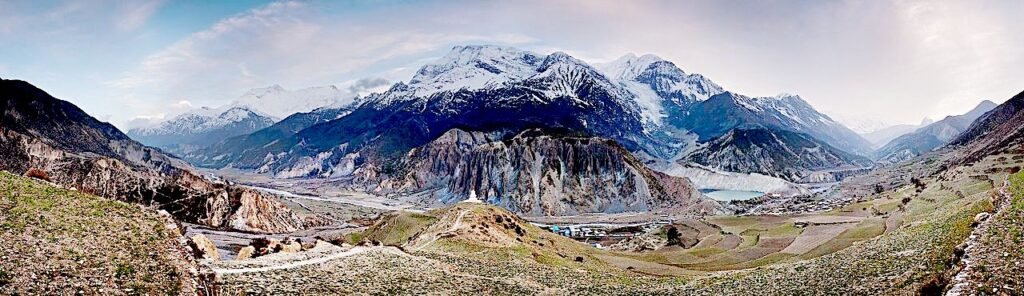
Figure 6: The Annapurna Massif in the Himalayas of Nepal. For centuries, mountain passes within the Himalayan range served as corridors through which monks, translators, and pilgrims traveled between India and Tibet. Source: Wikimedia Commons
One of the most well-known of these networks was the system of trade routes commonly referred to as the Silk Road, which linked Central Asia with China and the Mediterranean world. Through these routes, Buddhism spread from the centers of India and the region of Gandhāra to the oasis cities of Central Asia before continuing eastward into China. Monks and merchants traveling along these commercial pathways carried scriptures, Buddhist images, and ritual traditions, thereby contributing to the formation of a Buddhist world that extended from India to East Asia.
In addition to these overland routes, the history of Buddhism was also closely connected to maritime trade networks. For many centuries, the sea routes of the Indian Ocean linked the Indian subcontinent with Sri Lanka, Southeast Asia, and even the eastern coast of Africa. Through these maritime connections, merchants and monks played an important role in transmitting Buddhist traditions to distant regions. Ports and island trading centers became important sites of religious interaction, where different Buddhist traditions encountered and influenced one another.
When compared with these two major networks, the Himalayan pilgrimage routes can be understood as a vertical corridor of transmission linking the plains of India with the Tibetan Plateau. While the Silk Road extended primarily along an east–west axis and the Indian Ocean networks connected coastal regions, the Himalayan routes created a north–south corridor of religious exchange. Through the mountain passes and valleys of the Himalaya, monks and scholars carried Buddhist philosophical traditions and ritual practices from the centers of India to the Tibetan Plateau.
Within this broader context, the Himalayan routes cannot be understood as isolated pathways. In reality, they often intersected with other networks of Buddhist transmission. Tibetan monks who crossed the Himalaya to reach India could continue their pilgrimages to major Buddhist sacred sites, while Indian masters themselves could travel along wider commercial routes across Asia before arriving in Tibet. In this way, the Himalayan routes formed part of a vast system of religious interaction that connected diverse cultural regions within the Buddhist world.
2. Mountain Corridors as Bridges of Buddhist Knowledge
From the perspective of intellectual history, the Himalayan routes can also be understood as bridges of knowledge linking the Buddhist centers of India and Tibet. Through these mountain corridors, Sanskrit scriptures, meditative traditions, and philosophical systems were transmitted to Tibet, where they were received and developed in new ways.
Tibetan monks and scholars played a crucial role in this process. Figures such as Marpa Lotsawa and Atiśa demonstrate that the transmission of Buddhism across the Himalaya involved not only the movement of people but also the transfer of knowledge and religious traditions. Through their journeys, the philosophical systems and tantric practices of India were introduced into the Tibetan cultural context, where they continued to evolve and gave rise to a distinctive form of Buddhist tradition.
The circulation of knowledge was also closely connected to the monastic centers discussed in the previous sections of this article. Monasteries served not only as places of religious practice but also as centers of scholarship where scriptures were translated and studied. Through the connections between these monasteries and the pilgrimage routes, an intellectual network of Buddhism emerged, allowing philosophical traditions and meditative practices to circulate across different regions of Asia.
3. The Himalaya in the Wider Buddhist World
When the Himalayan routes are placed within the wider landscape of Buddhist history, the region emerges as a point of intersection between several networks of religious transmission. The mountain routes connected with the trade routes of Central Asia and the maritime networks of the Indian Ocean, forming a vast system of religious and cultural exchange that extended across much of Asia.
Through these corridors, Buddhism was able to spread from the ancient centers of India to distant regions such as Tibet, China, and Southeast Asia. In this process, religious traditions were not only transmitted but also reshaped within new cultural environments. It was the interaction between pilgrimage routes, monastic centers, and communities of practitioners that ultimately gave rise to a diverse and dynamic Buddhist world throughout the history of Asia.
VII. Conclusion: Pilgrimage Mobility and the Formation of Tibetan Buddhism
The history of Tibetan Buddhism is often described through the monasteries, lineages, and philosophical systems that developed on the Tibetan Plateau. Yet a closer examination of historical sources reveals that the formation of this religious tradition was also closely linked to another factor that is less frequently emphasized: the continual movement of practitioners and scholars across the Himalayan mountains.
For many centuries, Tibetan monks left their homeland to travel to the sacred sites and centers of learning of India in search of the Dharma. These journeys often lasted for many months, sometimes even years, and required crossing the formidable mountain passes of the Himalaya. Yet it was precisely these arduous travels that enabled the transmission of philosophical traditions, meditative practices, and ritual systems from India to Tibet.
Masters such as Atiśa and Marpa Lotsawa clearly illustrate the importance of religious mobility in the history of Himalayan Buddhism. They were not merely individual scholars or practitioners but living bridges between the religious centers of India and the Buddhist communities of Tibet. Through their journeys, Buddhist teachings crossed geographical and cultural boundaries and contributed to the emergence of a new Buddhist tradition on the Tibetan Plateau.
From this perspective, Tibetan Buddhism can be understood as the product of a process of transregional religious exchange. Monks and translators carried not only scriptures and doctrines but also meditative techniques, ritual practices, and scholarly traditions. As these elements were received within the Tibetan cultural context, they were transformed and reconfigured, giving rise to a Buddhist tradition that both inherited the legacy of India and developed distinctive Tibetan characteristics.
The history of Himalayan Buddhism, therefore, cannot be understood solely through religious sites or monastic institutions. It is also the history of mountain journeys, of encounters between teachers and disciples, and of pilgrimage networks that connected different regions of Asia. Through these movements, the Himalaya—often imagined as a geographical barrier—were transformed into a dynamic space of religious exchange within the history of Buddhism.
Seen in this light, the trans-Himalayan pilgrimage routes were more than pathways leading to sacred destinations. They functioned as corridors for the circulation of knowledge and spiritual traditions, through which ideas, scriptures, and religious practices were transmitted from one generation to the next. It was through these corridors that the Buddhist heritage of India was carried into Tibet and continued to develop for many centuries thereafter.
Related Studies:
- Maritime Buddhism: Vajrayāna Networks Across the Indian Ocean
- Tantric Buddhism and the Himalayan World: Cultural Exchanges and Religious Transformation
- The World as Mandala: Sacred Geography in the Late Vajrayāna World
Bibliography
Bentor, Yael. Consecration of Images and Stūpas in Indo-Tibetan Tantric Buddhism. Leiden: Brill, 1996.
Davidson, Ronald M. Indian Esoteric Buddhism: A Social History of the Tantric Movement. New York: Columbia University Press, 2002.
Davidson, Ronald M. Tibetan Renaissance: Tantric Buddhism in the Rebirth of Tibetan Culture. New York: Columbia University Press, 2005.
Kapstein, Matthew T. The Tibetan Assimilation of Buddhism: Conversion, Contestation, and Memory. Oxford: Oxford University Press, 2000.
Lopez, Donald S., Jr. The Story of Buddhism: A Concise Guide to Its History and Teachings. New York: HarperCollins, 2001.
Martin, Dan. Tibetan Histories: A Bibliography of Tibetan-Language Historical Works. London: Serindia Publications, 1997.