
Le Hoang Da
Independent Philosopher & Buddhist Scholar
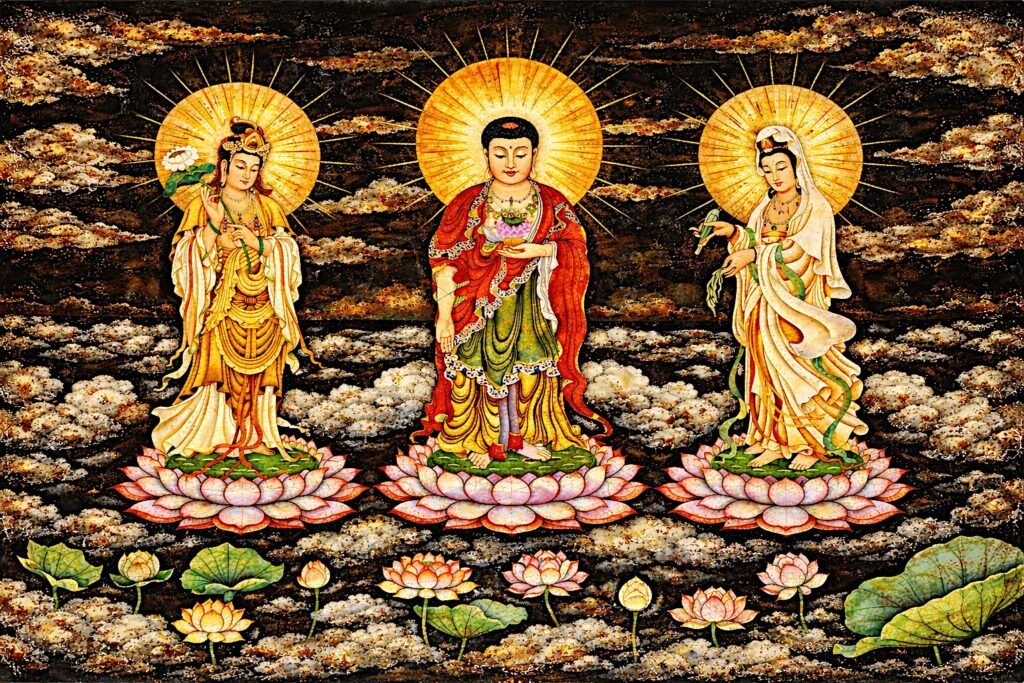
The Pure Land Trinity as the focal axis of recollection and awakening.
I. Recollection of the Buddha (Nianfo) and the Question of Origins
In the common perception of many East Asian Buddhists, nianfo (recollection of the Buddha) is almost synonymous with Pure Land practice. The recitation of Amitābha’s name, the vow for rebirth, and the orientation of one’s mind toward the Pure Land of Sukhāvatī have become so familiar that they are often assumed to represent the original form of this practice. Yet, when approached from the perspective of intellectual history and textual studies, a critical question arises: did nianfo truly originate within the Pure Land tradition?
This question does not aim to diminish the value of Pure Land Buddhism, but rather to investigate the formative process of a practice that appeared at a very early stage in the Buddhist tradition. In the Pāli canon of Theravāda, the practice of Buddhānussati—the recollection of the qualities of the Tathāgata—is presented as a contemplative method capable of generating joy, concentration, and mental purification. Within another stratum of the Chinese canonical tradition, the scripture Fo shuo shiyi xiang si nian rulai jing (佛說十一想思念如來經, T.791) describes eleven “contemplations” for recollecting the Tathāgata, emphasizing reflection on the ethical and cognitive states of the awakened one. Both sources reveal a practice that is fundamentally inward-oriented and psychologically structured.
Only when we enter the Pure Land scriptural system—particularly the three principal texts, the Amitābha Sūtra, the Larger Sukhāvatīvyūha Sūtra, and the Contemplation Sūtra—does nianfo become situated within a distinctly soteriological framework shaped by vow-power and other-power. Here, recollection of the Buddha is no longer limited to remembering the qualities of awakening; it also establishes a soteriological relationship between the practitioner and a transcendent realm.
Therefore, rather than viewing nianfo as a practice exclusive to the Pure Land tradition, this article proposes to approach it as a continuous developmental process across multiple Buddhist traditions. From the recollection of the ten epithets of the Tathāgata in Theravāda, to the eleven contemplative elements in the Chinese scripture, and finally to its systematic formulation in Pure Land Buddhism, one may discern a common axis: nianfo as an act of restructuring consciousness through the recollection and contemplation of the model of awakening.
At a deeper level, “recollection” is not merely the repetition of a sacred name. It is a cognitive operation in which the memory of the Buddha—whether expressed as epithet, quality, or visualized form—serves as a stabilizing reference point through which the mind is oriented and transformed. When a practitioner recites “Arahaṃ” or contemplates “purity of moral intention,” they are not simply naming a virtue; they are allowing that virtue to become an operative structure within their own mental life. In this sense, nianfo is first and foremost an act of internalization before it becomes a means of salvation.
This study will examine three stages in the development of nianfo: (1) Buddhānussati in the Theravāda tradition with its ten epithets of the Tathāgata; (2) the system of eleven contemplations in the scripture Fo shuo shiyi xiang si nian rulai jing (T.791); and (3) the formation of nianfo practice within the Pure Land tradition. The aim is not to compare traditions in order to rank them, but to identify the continuity and transformation of a practice that has accompanied Buddhist history from its earliest period to its later articulation as a fully developed soteriological system.
II. Buddhānussati in the Theravāda Tradition: Recollecting the Ten Epithets of the Tathāgata
Within the Pāli canonical system, the practice of recollecting the Buddha is known by the term Buddhānussati—“recollection of the Buddha.” This practice appears in several discourses of the Dīgha Nikāya and the Aṅguttara Nikāya, where the Buddha instructs monks to contemplate the qualities of the Tathāgata as a means of purifying the mind and generating joy.
The familiar formula of recollection begins:
Iti’pi so Bhagavā Arahaṃ Sammāsambuddho Vijjācaraṇasampanno Sugato Lokavidū Anuttaro Purisadammasārathi Satthā devamanussānaṃ Buddho Bhagavāti.
According to the standard Theravāda exegetical understanding, this formula comprises ten epithets of the Tathāgata. Each epithet is not merely an honorific expression, but a designation of a specific ethical and cognitive quality.
- Arahaṃ signifies complete purity and the eradication of all defilements.
- Sammāsambuddho affirms perfect awakening realized through one’s own direct knowledge.
- Vijjācaraṇasampanno unites knowledge and conduct—wisdom and ethical action.
- Sugato conveys the sense of one who has “gone well,” both in speech and in the path traversed.
- Lokavidū emphasizes comprehensive knowledge of the world in its total functioning.
- Anuttaro and Purisadammasārathi evoke the image of the unsurpassed guide who tames beings not yet tamed.
- Satthā devamanussānaṃ identifies the Buddha as teacher of gods and humans alike.
- Buddho denotes the awakened one.
- Bhagavā signifies the Blessed One, worthy of reverence.
What is significant here is that the content of the practice is not supplication for divine intervention, but recollection of qualities already perfected in the Tathāgata. When a practitioner contemplates “Arahaṃ,” they are not merely pronouncing a sacred title; they are directing the mind toward the state of complete purity. When reciting “Vijjācaraṇasampanno,” they reflect upon the integration of wisdom and conduct. Recollection of the epithets thus becomes a cognitive operation—a process of reorienting the mind according to the model of awakening.
The Nikāya discourses describe the effects of Buddhānussati in concrete psychological terms: the mind becomes settled, joy (pīti) arises, leading to tranquility (passaddhi), and subsequently to concentration (samādhi). In this context, recollection of the Buddha functions as a meditative technique. Its aim is not to establish a future rebirth in another realm, but to transform the mind in the present.
This reveals an important characteristic: within Theravāda, recollection of the Buddha is an inward-oriented contemplative practice with a clearly psychological structure. The Buddha is not presented as a distant transcendent being, but as the consummate embodiment of the path the practitioner is undertaking. Recollecting the epithets is a way of rendering that model operative within the stream of consciousness.
From a structural perspective, Buddhānussati may be understood as a form of “systematic recollection.” Rather than allowing thought to wander in a fragmented manner, the practitioner focuses on a sequence of established qualities. This sequence forms a stable axis of orientation for the mind. Conscious repetition reduces agitation and dispersion.
Thus, at the first stage of its historical development, recollection of the Buddha does not function in a soteriological sense as a means of aspiring to rebirth elsewhere, but as a technique of mental stabilization and purification. One recollects the Buddha in order to abide in the qualities of awakening—not in order to invoke external intervention.
It is from this foundation that the next question naturally emerges: when the practice entered the Chinese canonical and Mahāyāna traditions, how was it expanded or restructured?
It is precisely this development that the next section—on the Scripture of Eleven Contemplations of the Tathāgata—will illuminate.
III. The Scripture on the Eleven Contemplations of the Tathāgata (T.791)
If Buddhānussati in the Theravāda tradition presents recollection of the Buddha as the remembrance of the ten epithets of the Tathāgata, the scripture Fo shuo shiyi xiang si nian rulai jing (佛說十一想思念如來經, Taishō No. 791) reveals another form of the same practical axis: recollection of the Buddha as a structured system of eleven “contemplations” (xiang, 想).
This brief text, translated into Chinese in the fifth century by Guṇabhadra (求那跋陀羅), is preserved in the Taishō Shinshū Daizōkyō. Its structure is concise and direct. At the outset, the Buddha instructs the monks:
“當以十一想思念如來…” — “One should use eleven contemplations to recollect the Tathāgata…”
The eleven contemplations are listed as follows:
- Purity of moral intention
- Completeness of deportment
- Faultlessness of the sense faculties
- Undistracted faith
- Constant courageous resolve
- Freedom from sorrow in the face of pleasure and pain
- Non-forgetfulness of mind
- Presence of calm and insight
- Unceasing samādhi
- Boundless wisdom
- Tireless contemplation of the Buddha
What is noteworthy is that these items are not honorific epithets, but operative states or qualities embodied in the Tathāgata. Whereas in Buddhānussati the practitioner recollects “Arahaṃ” or “Sammāsambuddho,” here one is invited to contemplate specific inner characteristics: purity of conduct, stability of the faculties, equanimity toward pleasure and pain, the presence of concentration and wisdom.
In other words, epithets are replaced by psychological structure.
1. From Epithets to Inner Qualities
Compared with the ten Pāli epithets, the eleven contemplations in this scripture tend to concretize qualities that were previously condensed within honorific titles. For example, Arahaṃ implies purity and the eradication of defilements; T.791 expresses this through “purity of moral intention” and “faultlessness of the faculties.” Vijjācaraṇasampanno refers to knowledge and conduct; here we encounter “boundless wisdom” and “completeness of deportment.”
This shift marks an important development. Rather than emphasizing epithets as symbolic condensations, this early Chinese canonical text disaggregates and articulates the qualities of awakening into distinct elements suitable for individual contemplation. The practitioner is not only to remember the Tathāgata as a totality, but to examine each dimension of awakened life in detail.
2. A Systematic Structure of Contemplation
One of the most striking features of the scripture is its systematic organization. The eleven contemplations do not form a random list; rather, they suggest a progression: beginning with ethical purity (purity of intention), moving through the discipline of the faculties, toward psychological stability (freedom from sorrow amid pleasure and pain), and culminating in concentration and wisdom (unceasing samādhi, boundless wisdom). The apex is “tireless contemplation of the Buddha”—a sustained abiding in the model of awakening.
This structure reflects a clearly contemplative orientation. Recollection of the Buddha is not merely remembrance, but a reconfiguration of consciousness according to an integrated model. Each “contemplation” functions as a focal point at which the mind pauses, reflects, and internalizes.
3. Recollection and Loving-Kindness
Significantly, the scripture does not conclude with individual contemplation alone. It emphasizes that after practicing the eleven contemplations, the practitioner “arouses a mind of loving-kindness toward the Tathāgata.” The latter portion of the text further describes eleven fruits associated with liberation through loving-kindness.
Here, recollection of the Buddha and the cultivation of loving-kindness are placed within the same continuum of practice. This suggests that recollection is not solely intended to stabilize attention, but also to open an ethical dimension: contemplation of the qualities of the Tathāgata gives rise to compassion and inner liberation.
In comparison with Buddhānussati in Theravāda—where the primary results are described in terms of joy and concentration—T.791 introduces a more explicit emphasis on compassion and the attainment of spiritual fruition. This constitutes a significant expansion.
4. Recollection as Internalization
From a conceptual standpoint, the eleven contemplations do not transform the Tathāgata into a distant transcendent object. On the contrary, contemplating specific qualities renders the model of awakening operative within the practitioner’s own mental structure. When one reflects on “purity of moral intention,” one installs that norm of purity within one’s own life. When one contemplates “boundless wisdom,” one directs the mind toward expansiveness of insight.
Thus, recollection of the Buddha in this scripture retains the core characteristic of the earlier layer: it remains an act of internalization rather than supplication. Yet it has moved from concise epithets to a more detailed contemplative system capable of guiding the practitioner step by step.
5. An Intermediate Position in the Historical Development
Within the historical axis traced in this study, T.791 may be viewed as an intermediate point between Theravāda Buddhānussati and the later Pure Land formulation of nianfo. It preserves the essential orientation toward contemplating the qualities of awakening, while simultaneously demonstrating a stronger tendency toward systematization and analytical elaboration.
Recollection of the Buddha here is no longer confined to repeating a formula of epithets; it becomes a multi-layered contemplative structure interwoven with ethics, concentration, and wisdom. This structural development will help illuminate the further transformation that occurs in the visualization systems of the Contemplation Sūtra.
IV. From Ten Epithets to Eleven Contemplations: Structural Analysis and Transformation
Having examined Buddhānussati in the Theravāda tradition and the eleven contemplations in T.791, a natural question arises: how should the relationship between these two forms be understood? Are they independent practices, or variations of a single underlying structure of cultivation?
At first glance, the differences appear evident. The Pāli tradition centers on ten epithets—concise honorific titles dense with doctrinal meaning. T.791, by contrast, enumerates eleven specific “contemplations,” articulating the qualities of the Tathāgata in the form of ethical and psychological states. One emphasizes symbolic designation; the other, interior description.
Yet when examined structurally, a continuous axis becomes apparent.
1. The Epithet as Symbolic Condensation
In Buddhānussati, each epithet functions as a condensed symbol. “Arahaṃ” is not merely a title; it encapsulates the entire notion of purity and the eradication of defilements. “Vijjācaraṇasampanno” integrates knowledge and conduct into a single formulation. The epithet is compact, economical, and symbolically charged.
Such a structure corresponds to the pedagogical environment of the Nikāyas, where brief formulas are repeated as stabilizing devices for the mind. The practitioner need not analyze each component in detail; through recollecting a single epithet in its fullness, the entire constellation of meanings it contains is evoked.
Here, recollection of the Buddha operates as symbolic remembrance.
2. Contemplation as Analytical Expansion
By contrast, T.791 tends to “unfold” what had previously been compressed within the epithets. Instead of “Arahaṃ,” the text speaks of “purity of moral intention” and “faultlessness of the faculties.” Instead of “Vijjācaraṇasampanno,” it enumerates “boundless wisdom,” “unceasing samādhi,” and “completeness of deportment.”
The eleven contemplations may thus be understood as an analytical elaboration of the condensed symbolic core found in the earlier epithets. If the epithet functions as a nucleus, the contemplation unfolds its distinct dimensions.
Recollection of the Buddha here becomes an act of symbol-explication.
3. From Symbol to Structured Contemplation
This difference is not merely linguistic; it reflects a methodological shift. In the Pāli tradition, recollection of the Buddha emphasizes psychological effects: joy, tranquility, and mental purification. In T.791, we encounter a clearly structured contemplative progression: from moral purity, through discipline of the faculties, to concentration and wisdom.
In other words, from a symbolically condensed formula, recollection of the Buddha develops into a layered contemplative system with discernible stages. The practitioner does not simply remember; they move through specific dimensions of awakened life.
Yet despite methodological differences, the core axis remains unchanged: recollection of the Buddha directs the mind toward the qualities of awakening in order to reconfigure the practitioner’s own mental structure.
4. A Shift in Emphasis, Not in Essence
It is important to emphasize that the transition from ten epithets to eleven contemplations does not imply rupture. Both forms maintain their focus on the qualities of the Tathāgata rather than on supernatural intervention or external salvation.
If in Buddhānussati one recollects “Lokavidū” to contemplate knowledge of the world, in T.791 one reflects on “boundless wisdom.” If the Pāli epithet “Anuttaro Purisadammasārathi” evokes the unsurpassed trainer of beings, the Chinese text speaks of “completeness of deportment” and “courageous resolve.”
The difference lies in expression and systematization, not in the fundamental aim of practice.
5. Preparing the Transitional Threshold
This analysis clarifies that prior to being placed within the soteriological framework of Pure Land Buddhism, recollection of the Buddha had already undergone at least two structural forms: symbolic condensation and analytical contemplation. Both revolve around the internalization of the model of awakening.
What remains to be examined is the following: when recollection of the Buddha enters the Pure Land system, which structural elements are retained, and which are reoriented? Does the structure of “recollecting qualities” persist, but become embedded within a newly articulated relational framework between practitioner and Buddha?
It is precisely this question that leads to the next section, where recollection of the Buddha is situated within the context of the three Pure Land sūtras and the emergence of a soteriological system shaped by vow-power.
V. Pure Land and the Reconfiguration of Recollection of the Buddha
When we enter the Pure Land scriptural system, recollection of the Buddha is situated within a new context. The three principal scriptures of this tradition—the Amitābha Sūtra, the Larger Sukhāvatīvyūha Sūtra, and the Contemplation Sūtra—do not negate the earlier tradition of recollecting the qualities of awakening. Rather, they reorient it toward a more explicitly soteriological dimension.
1. From Contemplating Qualities to Contemplating a Realm
In the Contemplation Sūtra, the practitioner is instructed to undertake sixteen visualizations, beginning with contemplation of the setting sun, water, and ground, and gradually progressing toward visualization of the bodily marks and merits of Amitābha Buddha. Here, recollection of the Buddha is no longer confined to recalling inner qualities; it involves constructing a concrete image and a clearly defined salvific realm.
Compared with the eleven contemplations in T.791, we observe a significant expansion: from inward contemplation of ethical and psychological states to visualization of form and sacred space. The qualities of awakening are not only internalized but also imagined within a purified world into which the practitioner may aspire to be reborn.
Yet the structural principle of “recollection” remains intact. The practitioner still gathers the mind upon a single object—now Amitābha Buddha and the realm of Sukhāvatī. This focused attention continues to function as a means of stabilizing and purifying the mind.
2. The Emergence of Vow-Power
A defining feature of Pure Land Buddhism is its emphasis on the vow-power of Amitābha. In the Larger Sukhāvatīvyūha Sūtra, the forty-eight great vows of the bodhisattva Dharmākara establish the salvific foundation for sentient beings. Recollection of the Buddha thus becomes more than an internal cognitive operation; it is a response to a vow articulated for the benefit of all beings.
Whereas in the Theravāda layer and in T.791 the practitioner recollects the Buddha in order to restructure their own mind, in the Pure Land context recollection also signifies participation in a salvific relationship. This shift does not abolish the earlier structure, but supplements it with a new dimension: from self-cultivation alone to an interplay between self-power and other-power.
3. From Meditation Technique to Salvific System
In the Pāli tradition, recollection of the Buddha gives rise to joy and concentration; in T.791, it is associated with loving-kindness and spiritual fruition. In Pure Land Buddhism, recollection becomes directly linked with the aspiration for rebirth in Sukhāvatī. This marks a shift in ultimate orientation.
Nevertheless, upon closer analysis, the psychological foundation of recollection remains unchanged: the mind must be gathered upon a single object, stabilized, and purified. Reciting “Namo Amitābha Buddha” functions as a form of concentrated attention. The difference lies in the interpretive horizon within which that object is placed—a clearly articulated salvific framework.
In this sense, Pure Land Buddhism does not invent recollection of the Buddha ex nihilo. Rather, it receives an existing practice and reconfigures its telos.
4. Continuity and Transformation
If the three layers are placed side by side, a developmental trajectory becomes visible:
- Theravāda: recollection of epithets as remembrance of the qualities of awakening.
- T.791: recollection of qualities through structured contemplative analysis linked with loving-kindness.
- Pure Land: recollection of name and visualization within a vow-based salvific system.
The differences among these layers do not lie in the act of “recollection” itself, but in the horizon of meaning within which the act is situated. In the first layer, recollection functions as a meditative stabilization technique; in the second, as a structured contemplative interiorization; in the third, as the establishment of a salvific relationship.
Yet all three operate according to the same fundamental principle: memory of the Buddha—whether as epithet, quality, or visualized form—serves as a focal axis for the transformation of consciousness.
5. Pure Land as Systematization
It may be said that Pure Land Buddhism systematized and universalized recollection of the Buddha on a broader scale. While Buddhānussati and T.791 reflect contemplative settings largely associated with monastic practice, Pure Land extends this mode of cultivation to lay communities at large. The simplification of form—especially through vocal recitation—renders recollection widely accessible.
Yet such simplification does not entail loss of depth. Continuous recitation still produces mental concentration and abiding, much as recollection of epithets in the Pāli tradition or contemplative reflection in the Chinese canonical layer.
Viewed within its historical trajectory, Pure Land does not represent a rupture with earlier forms of recollection. Rather, it constitutes a further development in which the structure of “recollecting the qualities of awakening” is embedded within an expanded salvific framework.
VI. Three Forms of Recollection of the Buddha: A Synthetic Analysis
From the examination of the three developmental layers—Buddhānussati in Theravāda, the eleven contemplations in T.791, and the systematization in Pure Land Buddhism—it becomes evident that recollection of the Buddha has operated in three distinct forms, yet without severing its foundational structural continuity.
1. Recollection as Remembrance of Qualities
In its earliest layer, recollection of the Buddha consists in remembering the qualities of the Tathāgata through the ten epithets. Here, the epithet functions as a symbolic condensation. When a practitioner recites “Arahaṃ” or “Sammāsambuddho,” the mind is directed toward qualities already perfected in the awakened one.
The operational structure of this form may be described as follows:
- Object: qualities of awakening
- Method: systematic recollection
- Effect: generation of joy, tranquility, and mental purification
Recollection does not aim to establish a salvific relationship, but to orient the interior life. The Buddha serves as the consummate model of the path, and recollection renders that model psychologically operative.
2. Recollection as Structured Contemplation
In the second layer, recollection develops into a detailed contemplative system. The eleven contemplations of T.791 do not merely invoke honorific titles; they analyze specific dimensions of awakened life: purity of conduct, stability of the faculties, concentration, and wisdom.
The structure of this form includes:
- Object: specific ethical and psychological states
- Method: analytical contemplation of each dimension
- Effect: arousal of loving-kindness and orientation toward liberation
If in the earlier layer the epithet functioned as a symbolic nucleus, here that nucleus unfolds into an articulated structure. Recollection becomes an act of analytical interiorization. The practitioner does not simply remember the Buddha as a totality, but traverses the constituent dimensions of awakening.
3. Recollection as Salvific Act
The third layer emerges when recollection of the Buddha is situated within the Pure Land framework. Here, recitation of the name and visualization of form are linked with the vow-power of Amitābha and the aspiration for rebirth.
The operational structure shifts accordingly:
- Object: the Buddha and the salvific realm
- Method: recitation, visualization, and vow
- Effect: establishment of a salvific relationship and reorientation of the cycle of birth and death
The crucial transformation lies not in the act of recollection itself, but in the horizon of meaning within which it is embedded. Recollection no longer merely restructures interior consciousness; it situates the practitioner within a soteriological relationship with a transcendent realm.
4. The Continuous Axis of Recollection
Despite differences in emphasis and ultimate aim, all three forms share a common principle: recollection is a cognitive operation grounded in memory of awakening. This memory may appear as epithet, ethical quality, or visualized form; yet in every case, it functions as a focal axis around which the mind gathers.
At the psychological level, recollection reduces dispersion and reorients attention.
At the ethical level, it integrates awakened qualities into lived practice.
At the salvific level, it opens a horizon beyond present existence.
These three forms may therefore be understood not as separate doctrines, but as successive expansions of a single structural principle.
5. Recollection as Transformative Structure
Setting aside sectarian distinctions, one may observe that recollection of the Buddha across all three traditions operates as a transformative mechanism: the mind is oriented by reference to a consummate model. The clearer and more stable the model, the more coherent the axis of transformation.
In the first layer, the model is condensed within epithets.
In the second, it is unfolded into an interior contemplative structure.
In the third, it is situated within a salvific realm.
Yet in every case, recollection remains the act by which awakening becomes the center of consciousness.
It is precisely this continuity that allows us to read the historical development of recollection of the Buddha not as a sequence of ruptures, but as a gradual expansion of a single underlying principle of practice.
VII. Recollection of the Buddha as a Tradition of Diverse Expressions
Through the examination of three forms of recollection of the Buddha—the ten epithets in Theravāda Buddhānussati, the eleven contemplations in the scripture Fo shuo shiyi xiang si nian rulai jing (T.791), and the practice of nianfo within the Pure Land system—it becomes clear that recollection of the Buddha has been articulated in multiple forms throughout Buddhist history. These differences do not necessarily indicate mutual replacement or doctrinal negation; rather, they reveal diverse modes of expressing and practicing a shared axis of cultivation.
Within the Pāli canonical layer, recollection of the Buddha is presented as remembrance of the qualities of the Tathāgata, aimed at stabilizing and purifying the mind. In T.791, this structure unfolds into eleven specific contemplations that emphasize the ethical and cognitive dimensions of awakened life. Upon entering the Pure Land system, recollection of the Buddha is situated within a broader horizon in which practitioners engage in visualization, vow-making, and orientation toward a purified realm.
The differences among these forms do not lie in the presence or absence of recollection itself, but in how recollection is expressed and in which practical aim is foregrounded. In every instance, recollection of the Buddha operates as a cognitive gathering of consciousness around the model of awakening. Whether through epithet, ethical quality, or visualized form, the object of recollection remains the perfected characteristics attributed to the Tathāgata.
This study does not address the question of “Buddha’s own words” in the sense of devotional belief or historical revelation. Rather, it focuses on the structure of practice and the diversity of textual articulation. From this perspective, the coexistence of multiple forms of recollection of the Buddha demonstrates the flexibility of the Dharma as it is expressed within different social and spiritual contexts.
It is precisely this flexibility that has enabled recollection of the Buddha to become a practice adaptable across environments—from the contemplative setting of the monastic community to the devotional life of lay practitioners, and across distinct Buddhist traditions. Rather than being confined to a single framework, recollection of the Buddha may be understood as a continuous current within Buddhist history—a current in which memory of awakening is repeatedly reformulated in ways responsive to the needs of each era. Differences in form do not diminish the religious value of any tradition; they instead reveal the richness with which the Dharma has been received and enacted.
Related Research on Nianfo and Sacred Name:
Bibliography
Bhikkhu Bodhi, trans. The Numerical Discourses of the Buddha: A Translation of the Aṅguttara Nikāya. Boston: Wisdom Publications, 2012.
Buddhaghosa. The Path of Purification (Visuddhimagga). Translated by Bhikkhu Ñāṇamoli. Kandy: Buddhist Publication Society, 2010.
Cleary, J. C., trans. Pure Land, Pure Mind: The Buddhism of Masters Chu-hung and Tsung-pen. New York: Ballantine Books, 1994. (Includes translation of the Amitabha Sutra.)
Gómez, Luis O. The Land of Bliss: The Paradise of the Buddha of Measureless Light. Honolulu: University of Hawai‘i Press, 1996. (Translation and study of the Larger Sukhāvatīvyūha Sūtra.)
Inagaki, Hisao, trans. The Three Pure Land Sutras. Kyoto: Nagata Bunshodo, 1995. (Includes the Contemplation Sutra.)
Taishō Shinshū Daizōkyō. Vol. 17. 佛說十一想思念如來經 (T.791).
Walshe, Maurice, trans. The Long Discourses of the Buddha: A Translation of the Dīgha Nikāya. Boston: Wisdom Publications, 1995.