
Le Hoang Da
Independent Philosopher & Buddhist Scholar
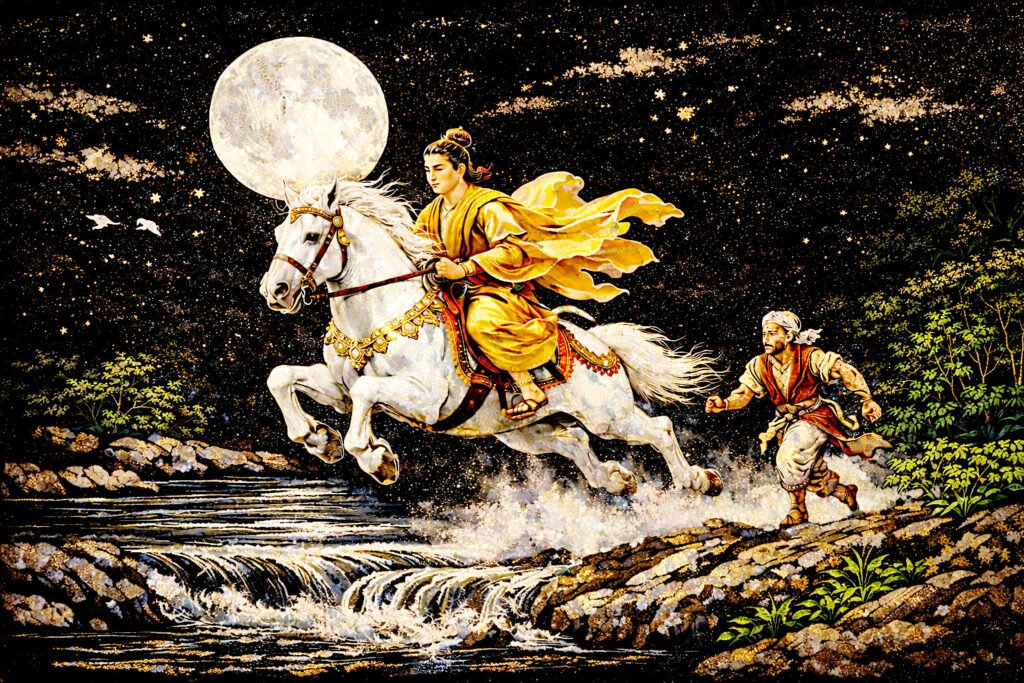
The Great Renunciation: Prince Siddhārtha and Kanthaka crossing the Anomā River, marking the inward turn of heroic destiny.
I. Heroism and the Question of Textual Transmission
In the history of Indian Buddhist literature, Aśvaghoṣa’s Buddhacarita occupies a distinctive place. It is not merely a narrative of the Buddha’s life; it is a Sanskrit epic composed according to the refined conventions of classical kāvya. This formal choice immediately raises an important scholarly question: why is the life of an awakened renunciant—one who relinquishes worldly power—constructed through the language and structure of epic heroism?
In ancient Indian tradition, epic was not simply narrative literature; it was a symbolic space of power, honor, and conquest. The epic hero is typically born under extraordinary signs, prophesied to kingship, tested through crisis, victorious over adversaries, and ultimately reaffirming cosmic or social order. By portraying Prince Siddhārtha within this same aesthetic framework, Aśvaghoṣa places the Buddha’s life squarely within the familiar heroic structure of Indian culture. Yet what demands attention is not the repetition of that model, but its transformation from within.
Before proceeding, it is necessary to clarify the textual state of the work. The extant Sanskrit version of the Buddhacarita survives in full only up to Canto XIV. The remainder of the poem is not preserved completely in Sanskrit, but is transmitted primarily through the Chinese translation (Fo suoxing zan, 佛所行讚) and the Tibetan version. Accordingly, the present study—particularly in its discussion of epic structure and poetic strategy—will focus primarily on the surviving Sanskrit portion (Cantos I–XIV), while acknowledging the continued transmission of the narrative in broader Buddhist traditions across Asia. Distinguishing the textual scope is essential in order to avoid conflating Aśvaghoṣa’s original composition with later forms of preservation.
This limitation does not diminish the value of the work. On the contrary, within the first fourteen cantos the heroic structure is already fully established: the auspicious birth, the prophecy of becoming a cakravartin, the splendor of palace life, the existential crisis before old age, sickness, and death, and the decisive act of renunciation. On a surface reading, one encounters a hero relinquishing royal destiny; yet on a deeper symbolic level, the heroic model is not abandoned but redefined.
This article therefore does not aim to retell the life of the Buddha in chronological sequence. Rather, it raises a conceptual question: how does the Buddhacarita restructure heroism? Did Aśvaghoṣa employ the epic form as a cultural strategy, transforming the ideal of conquering the world into the ideal of conquering oneself? If, in classical epic, ultimate victory consists in the assertion of external power, then in the Buddhacarita that victory appears to be interiorized into the eradication of ignorance and desire.
From this perspective, the central thesis of the present study may be stated as follows: the Buddhacarita does not merely narrate enlightenment; it redefines the very concept of the “hero” within the aesthetic horizon of classical India, converting the external battlefield into the battlefield of consciousness and transforming royal sovereignty into sovereignty of the Dharma.
The following section situates the work within the traditional epic model of heroism, in order to clarify the structural foundation upon which this transformation unfolds.
II. The Heroic Model in Classical Indian Epic
To understand the redefinition of heroism in the Buddhacarita, it is first necessary to outline the heroic model shaped by ancient Indian culture through the traditions of epic and kāvya poetry. Within that cultural space, the hero is not merely the central character of a narrative, but a symbol of cosmic order and political authority.
In major epics such as the Rāmāyaṇa and the Mahābhārata, the heroic structure typically follows a relatively stable pattern: (1) birth accompanied by extraordinary signs or divine sanction; (2) prophecy or destiny of kingship; (3) confrontation with trials or crisis; (4) conquest of adversaries; and (5) restoration or consolidation of world order. In this sense, the hero is the victor—not only in battle, but in the affirmation of legitimacy and power.
The concept of the cakravartin (Wheel-Turning Monarch) occupies a pivotal position in the ancient Indian ideal of heroism. The ideal king rules not solely through military strength but also through moral authority; he sets the wheel of law—or the wheel of sovereignty—in motion across the four quarters of the world. Whether understood in political or religious terms, this figure rests upon the same fundamental assumption: supreme power is manifested in the capacity to govern and shape the external world.
Within the tradition of kāvya—courtly poetry that flourished in the early centuries of the Common Era—the heroic ideal was further aestheticized. The protagonist is not only courageous but beautiful, noble, and endowed with extraordinary physical and intellectual qualities. Poetic language celebrates glory, triumph, and worldly fulfillment. It is precisely within this cultural environment that narrating the life of a renunciant in epic form becomes a strategically significant choice.
It is important to note that the heroic structure in Indian culture does not correspond exclusively to a purely “warrior” model. The hero may be a conqueror, but he may also be a protector of dharma—order, righteousness, and justice. Yet even when framed in moral terms, the hero remains a figure who asserts strength within the existing world. His actions are outwardly directed; his battlefield lies within the social and political sphere.
This cultural foundation makes the Buddhacarita particularly striking. When Aśvaghoṣa constructs the figure of Prince Siddhārtha, he does not place him outside the traditional heroic model. On the contrary, the early cantos present a nearly complete epic structure: an auspicious birth, prophecies of future greatness, exceptional beauty and qualities, and a resplendent palace environment. All these elements correspond closely to the classical heroic ideal.
Yet here a paradox emerges. If the epic hero strives toward the affirmation of worldly power, Siddhārtha ultimately refuses it. If the destiny of becoming a cakravartin represents the pinnacle of glory, then the act of renunciation appears to be a withdrawal from the heroic structure itself. It is precisely this paradox that provides the foundation for the redefinition explored in the sections that follow.
In other words, Section II clarifies that the heroic model inherited by the Buddhacarita is not an abstract concept, but a clearly defined cultural structure embedded in the ancient Indian imagination. Only by understanding its logic—extraordinary birth, prophecy, conquest, restoration of order—can we fully perceive the depth of transformation enacted by Aśvaghoṣa.
At this point, it should be emphasized that the adoption of epic form does not necessarily entail an endorsement of kingship. It may function as an aesthetic and cultural strategy: employing the language of power to articulate an ideal that transcends power. When an awakened being is portrayed through the language of epic heroism, the effect is not merely to enhance symbolic prestige, but to open the possibility of restructuring the very concept of heroism itself.
The following section will examine more closely how Prince Siddhārtha is constructed as an ideal hero in the early cantos, before the turning point of renunciation reveals the internal inversion of this model.
III. Prince Siddhārtha as an Epic Hero: Reception and Reconfiguration of Tradition
In the extant Sanskrit portion of the Buddhacarita, particularly from Canto I to Canto IV, Aśvaghoṣa presents Siddhārtha within a structure fully compatible with the classical Indian ideal of heroism. It must be emphasized from the outset, however, that the core narrative elements—auspicious birth, prophetic destiny, the four sights, and the decision to renounce—are not Aśvaghoṣa’s invention. They already existed within early Buddhist traditions and had been preserved across multiple lineages before being rendered into the refined idiom of Sanskrit poetry.
The distinctiveness of the Buddhacarita lies not in the creation of a new storyline, but in the relocation of inherited tradition into the aesthetic space of kāvya. It is precisely this repositioning that generates the dimension of heroism under examination here.
1. Birth and Dual Destiny
The account of Siddhārtha’s birth in the Buddhacarita contains all the symbolic elements familiar from earlier Buddhist sources: auspicious signs, sages recognizing extraordinary marks, and the prophecy of two ultimate possibilities—becoming either a cakravartin or a Buddha. Aśvaghoṣa does not alter this structural framework of destiny; he situates it within the elevated tone of Sanskrit epic.
What is particularly noteworthy is that these two possibilities—worldly sovereignty and awakening—are presented as parallel summits of greatness. In ancient Indian culture, the cakravartin represents supreme authority in the secular sphere. When early Buddhist tradition drew symbolic parallels between the Buddha and the cakravartin, it was already engaging in a powerful act of comparative revaluation. Aśvaghoṣa adopts this symbolic parallel and allows it to operate within epic structure, where heroic destiny is typically bound to political glory.
Thus, Siddhārtha is placed at the very center of the heroic model—not to consolidate kingship, but to prepare the ground for transformation.
2. Courtly Splendor and Worldly Fulfillment
In the kāvya tradition, heroism is established not only through martial achievement but also through charisma, beauty, and completeness. The early cantos of the Buddhacarita devote considerable space to depicting palace life, natural scenery, music, and courtly elegance. These descriptions are not ornamental excess. They underscore the fact that Siddhārtha inhabits a state of complete worldly fulfillment.
This point is crucial. If renunciation were merely the consequence of personal suffering or social failure, it would lack heroic magnitude. But when the protagonist is portrayed as standing at the apex of potential power and prosperity, the decision to relinquish that position becomes an act that transcends fulfillment itself. Worldly completeness gives symbolic weight to the act of abandonment.
Here again, Aśvaghoṣa does not alter inherited content; he intensifies it through epic poetics.
3. Existential Crisis and the Heroic Trial
Siddhārtha’s confrontation with old age, sickness, and death had long been embedded in Buddhist tradition. In the Buddhacarita, however, these encounters are framed as a heroic trial. Unlike classical epic trials, they do not culminate in battle or political conflict, but in a crisis of perception.
At this point, epic structure remains intact, but its content shifts. The hero still confronts the limits of existence; yet those limits are no longer embodied in external adversaries, but in the impermanence of life itself. Siddhārtha does not respond with violence but with reflection. The battlefield begins to migrate from the external world to the interior domain.
This does not mean that Aśvaghoṣa merely “literarizes” a historical episode. Rather, he employs epic language to illuminate the universal dimension of existential confrontation.
4. Refusal of Destiny and the Threshold of Transformation
In classical heroic structure, prophecy is typically fulfilled as an inevitable destiny. Siddhārtha, however, stands before two possibilities and chooses to refuse kingship. Renunciation therefore does not signal the collapse of the heroic model, but its stretching to the breaking point.
On the surface, one might see a hero departing the battlefield. At a deeper symbolic level, however, this act of relinquishment begins to define a new form of heroism. If in classical epic victory consists in possession and domination, here victory begins with non-possession.
At this stage, Siddhārtha may still be read as an ideal hero according to classical Indian standards: extraordinary birth, prophetic destiny, exceptional qualities, confrontation with trial, and a decisive choice. The divergence has not yet fully manifested; it stands at the threshold of transformation.
It is precisely this threshold that prepares for the inversion in the later cantos—where heroism is not abolished, but radically restructured through interiorization.
IV. The Great Inversion: Renunciation as a Redefinition of Heroism
If the early cantos of the Buddhacarita situate Siddhārtha within the classical Indian model of heroism, the act of renunciation marks the decisive inversion of that model. Yet this inversion does not dismantle epic structure; rather, it redefines it from within.
1. The Decision to Depart and the Depth of Heroic Action
In epic tradition, the hero affirms himself by fulfilling destiny. A prophecy of becoming a cakravartin typically culminates in the expansion of power and the consolidation of world order. Siddhārtha, standing before that possibility, chooses a different path. His renunciation is therefore not the outcome of failure or personal crisis; it is a decision made in the midst of worldly completeness.
Precisely because Siddhārtha possesses every qualification to become an ideal king, his renunciation acquires a distinct heroic quality. It demands a rupture not only with the throne but with the entire structure of security and glory that palace life guarantees. If the classical hero struggles to attain power, here the hero must struggle to transcend it.
At this level, renunciation is not a withdrawal from the battlefield; it is a transformation of the battlefield.
2. From External Conquest to Interior Mastery
In the traditional epic model, ultimate victory consists in conquering the external world: enemies are defeated, territories unified, order restored. The hero compels the world to move according to his will.
In the Buddhacarita, the structure remains intact, but its direction shifts. After renunciation, the battlefield is no longer political space but the interior domain. The enemy is no longer an external adversary, but ignorance, craving, and fear.
Here the internalization of heroism becomes unmistakable: trials remain, tension persists, decisions retain their fateful character—but all unfold within the sphere of consciousness.
This shift forms the foundation of the article’s central claim:
Heroic achievement is no longer the defeat of others, but the overcoming of oneself.
This statement is not merely rhetorical. It expresses a fundamental redefinition of power. If classical power is the capacity to dominate others, the new form of power is the capacity for self-mastery. The hero is no longer measured by the number of subdued opponents, but by the degree of ignorance eradicated.
3. Anti-Conquest: Victory Through Non-Possession
This transformation may be understood as a form of “anti-conquest.” In epic tradition, triumph is inseparable from possession and expansion. Siddhārtha enacts the opposite: he relinquishes. Yet this relinquishment is not a negation of power; it is a transcendence of the need for power.
This should not be interpreted as political protest against kingship. The Buddhacarita does not diminish the ideal of the cakravartin. On the contrary, it acknowledges kingship as the highest expression of worldly order. But precisely because it recognizes that summit, surpassing it acquires powerful symbolic force.
Siddhārtha does not refuse because power is inferior; he refuses because there exists a form of freedom beyond power. Within this logic, renunciation becomes a heroic act at a deeper level: instead of conquering the world, the protagonist seeks to end the very conditions that compel conquest.
4. Inversion Without Structural Collapse
The subtlety of the Buddhacarita lies in the fact that epic structure is not abolished. The elevated rhythm, the language of exaltation, the pattern of trial—all remain. What changes is the content of victory.
The classical hero achieves glory through the assertion of selfhood. The hero in the Buddhacarita moves toward awakening by dismantling the very structure of selfhood. If traditional epic seeks to stabilize world order, here the aim is to recognize the impermanence and non-self nature of all such orders.
This inversion does not repudiate classical Indian culture; it enters into dialogue with it. By employing the language of heroism to articulate the path of liberation, Aśvaghoṣa opens the possibility of redefining the concept of the hero within the symbolic system of his time.
At the close of this section, one point becomes clear: heroism is not eliminated from the story of the Buddha. It is interiorized, refined, and transformed into the capacity for self-overcoming. The next stage—the confrontation with Māra—will reveal how this restructuring reaches its culmination.
V. Māra and the Interior Battlefield: The Apex of Heroism
If the act of renunciation in the Buddhacarita marks the reorientation of heroism, the confrontation with Māra represents the moment at which that reorientation reaches its fullest expression. Here the epic structure reappears in complete form: there is an adversary, a trial, tension, and victory. Yet all unfolds within a spiritual dimension.
1. Māra as the Epic Adversary
In Buddhist tradition, Māra is not merely a mythological figure. He embodies the forces that obstruct awakening: desire, fear, attachment, and the illusion of selfhood. When situated within epic structure, the Buddhacarita does not transform Māra into a purely mythic demon; rather, he becomes the symbolic representation of the conditions that bind beings within saṃsāra.
Significantly, this confrontation is depicted with a solemn intensity comparable to any classical epic battle. The imagery of Māra’s armies, the trembling of the cosmos, and the charged atmosphere evoke a scene equivalent to the traditional battlefield. Yet the weapons here are neither bows nor chariots, but concentration and wisdom.
The structure of “trial – confrontation – victory” remains intact. What changes is the nature of victory itself.
2. Victory Without Violence
In traditional epic, triumph is secured through physical strength or strategic superiority. Here, Siddhārtha does not defeat Māra through violence. He does not annihilate his adversary; rather, he deprives Māra of ground by the unwavering stability of his mind.
This difference reveals a fundamental shift in the definition of heroism. If the classical hero affirms himself by subduing others, the hero of the Buddhacarita affirms himself through interior stillness. That stillness is not passivity; it is an expression of spiritual power.
The victory achieved here leaves behind no corpses and no newly conquered territory. It leaves instead the silence that follows the dismantling of ignorance.
3. The Complete Interiorization of the Battlefield
In Section IV, we observed the gradual migration of the battlefield into the interior sphere. In the confrontation with Māra, this migration is completed. The external enemy is revealed as the outward manifestation of inner conflict. When Siddhārtha touches the earth to bear witness, the gesture should not be understood as magical spectacle; it symbolizes the groundedness of realization.
This act may be read as the ultimate heroic gesture: instead of asserting power through action, the protagonist affirms truth through unwavering presence. If classical victory is the explosion of action, victory here is the stillness of awakening.
At this moment, the redefinition of heroism reaches completion. The hero is no longer the one who reshapes the world through force; he is the one who sees the nature of the world and is no longer dominated by it.
4. From Heroism to Awakening
The confrontation with Māra makes clear that the Buddhacarita does not abolish epic structure. On the contrary, it employs that structure to lead the reader beyond epic itself. When victory is achieved not through violence but through insight, heroism transforms into awakening.
One might say that the heroic model here reaches its summit and simultaneously transcends itself. The battlefield disappears when ignorance dissolves. There is no adversary left to defeat, because the conditions that generate conflict no longer persist.
This transformation confirms the central thesis of this study: the Buddhacarita does not narrate an anti-heroic story. It narrates a story in which heroism is refined into the capacity for self-overcoming. The struggle with Māra represents the final form of heroic achievement—not the triumph of domination, but the triumph of freedom.
VI. From Heroism to Awakening: The Redefinition of Power
After the confrontation with Māra in the Buddhacarita, epic structure no longer operates according to the familiar logic of conquest. The battlefield disappears, the adversary vanishes, and what is called “victory” does not result in territorial expansion or the consolidation of worldly order. At this point, heroism assumes an entirely new form: it dissolves into awakening.
1. Glory No Longer at the Center
In classical epic, victory culminates in glory. The hero’s fame spreads, social order is reinforced, and the individual attains symbolic immortality. In the Buddhacarita, however, after overcoming Māra, Siddhārtha does not seek affirmation of selfhood. There is no coronation, no proclamation of dominance, no celebration of personal triumph.
This marks a fundamental shift: victory no longer serves to consolidate the “I,” but to dismantle the conditions that give rise to it. If the classical hero is defined by a powerful and enduring self, awakening here is defined by insight into the non-self nature of all phenomena.
Heroism, therefore, is not negated; it is refined to the point where it no longer requires glory to establish itself.
2. Power as Freedom from Conditioning
Having conquered himself, Siddhārtha does not become a ruler of the world; he becomes free from the conditions that govern it. This shift is central to the redefinition of power.
Within traditional epic structure, power is the capacity to act upon others. In the vision articulated by the Buddhacarita, power is the capacity no longer to be ruled by greed, hatred, and delusion. It is not the ability to control the world, but the ability not to be controlled by it.
This freedom gives rise to a new form of sovereignty—not political sovereignty, but interior sovereignty. One might speak here of a kind of “Dharma-sovereignty”: authority grounded in truth rather than force.
3. Heroism Transcending Itself
A subtle feature of the Buddhacarita is that the heroic model is not erased at the moment of awakening. It is driven to its limit—and then surpassed. When victory no longer requires an adversary, the conflict structure that underlies epic dissolves.
This produces a paradox: the hero reaches his summit precisely when he no longer needs to be a hero. If the classical hero exists through conflict, the hero of the Buddhacarita arrives at a point where conflict ceases. That cessation is not the failure of heroism, but its completion.
4. Reconfiguring the Ideal of Greatness
By interiorizing the battlefield and redefining power, the Buddhacarita opens a new understanding of greatness. Greatness no longer signifies domination; it signifies liberation. The hero is no longer measured by the expansion of influence, but by the ending of the conditions that bind.
On a cultural level, this redefinition carries profound implications. In a milieu where the ideal of the cakravartin retained powerful appeal, placing awakening alongside—and even beyond—royal sovereignty constitutes a symbolic repositioning. This is achieved not through negation, but through transformation.
The Buddhacarita, therefore, does more than recount the life of the Buddha in epic language. It demonstrates that heroism can be refined into awakening, and that power can be transformed into freedom from power.
From this point, the analysis may be extended to the broader historical and cultural plane: when the ideal of conquest is interiorized within a literary text, does it generate parallel shifts in the political and ethical life of ancient India?
The following section explores that dimension.
VII. Cultural and Historical Implications: From Epic to Political Ethics
If the Buddhacarita redefines heroism within poetic space, the next question arises: what implications might this redefinition carry within the broader cultural landscape of ancient India? Is the interiorization of the battlefield and the transformation of power into freedom from power merely a literary maneuver, or does it reflect—and perhaps even contribute to—a deeper shift in the ideal of greatness?
1. The Cakravartin Ideal and Symbolic Reorientation
Within Indian culture, the ideal of the cakravartin stands as one of the most powerful symbols of supreme authority. The ideal king unifies territory, establishes order, and protects dharma. When Buddhist tradition places the Buddha alongside the cakravartin, it already engages in a symbolic strategy: if the king turns the wheel of sovereignty, the Buddha turns the wheel of the Dharma.
The Buddhacarita adopts and refines this strategy. Rather than negating kingship, the text presents an alternative form of sovereignty—interior sovereignty. Greatness is no longer defined by the capacity to dominate, but by the capacity to end the conditions that make domination meaningful.
At this level, heroism is reconfigured not only at the level of individual character, but at the level of cultural symbolism.
2. Aśoka: Between Conquest and Transformation
A historical illustration of this shift may be found in the case of Aśoka. Following the devastating Kalinga War, Aśoka recorded in his edicts a profound remorse for the suffering and destruction caused by his conquest. This moment marked a turning point in his policy: from military expansion to the promotion of dhamma as an ethical principle.
Aśoka did not renounce political power as Siddhārtha renounced the throne; he remained an emperor. Yet he began to redefine victory: triumph through dhamma rather than through the sword. If the classical epic hero asserts himself through warfare, here a historical conqueror recognizes the limits of conquest.
In this comparison, Siddhārtha and Aśoka do not occupy the same plane. One rejects power before exercising it; the other exercises power and then transforms its meaning. Yet both reveal a shift in the understanding of greatness: from domination to the moralization of power, from external conquest to self-limitation.
One might say that while the classical epic hero expands territory, Aśoka—after Kalinga—begins to expand ethical space. He stands at the intersection of two models: conquest and transformation.
3. From Martial Achievement to Self-Limitation
The essential point here is not to equate Aśoka with the ideal of awakening, but to recognize a broader cultural tendency: victory through violence is no longer the unquestioned measure of greatness. When an emperor publicly acknowledges remorse, heroism acquires an additional dimension—the dimension of self-restraint.
Seen in this light, the Buddhacarita may be read as participating in a symbolic dialogue of its time. It does not merely narrate the awakening of an individual; it articulates a possibility: greatness itself may be redefined. Power may be transformed. Victory need not be synonymous with violence.
4. Redefining Greatness in Ancient India
The interiorization of heroism in the Buddhacarita does not destroy epic structure; it renders it more flexible. When the hero is defined by victory over himself, the standard of greatness shifts. This shift opens a space in which ethical and contemplative authority may stand alongside—and even surpass—political power.
On the cultural level, this constitutes a profound symbolic transformation. Not by denying martial achievement, but by placing it within a different scale of value. Glory is no longer measured by the extent of territory, but by the degree of freedom from ambition.
Thus, from text to history, from poetry to politics, one can trace a line of transformation: heroism refined into awakening, conquest transformed into the ethical reconfiguration of power. The Buddhacarita is not the direct cause of these shifts, but it stands as a significant expression of a broader redefinition unfolding within ancient Indian cultural space.
VIII. When Heroism Becomes Awakening
This study has traced a subtle yet radical transformation in the Buddhacarita: from the classical epic model of heroism to a form of heroism interiorized within consciousness. By receiving and re-presenting Buddhist tradition within the aesthetic framework of Sanskrit kāvya, Aśvaghoṣa does not reject the heroic ideal of Indian culture; he brings it to a new limit.
Siddhārtha appears fully as an ideal hero: born under extraordinary signs, prophesied to kingship, endowed with exceptional qualities, and confronted with trials of destiny. Yet rather than affirming himself through external conquest, he relocates the battlefield to the interior domain. The confrontation with Māra completes this process of interiorization, and victory is achieved not through violence, but through the dismantling of ignorance.
From this point onward, heroism is redefined. Power no longer signifies the capacity to dominate others, but freedom from the conditions that dominate oneself. Glory no longer resides in territorial expansion, but in the cessation of suffering’s causes. When heroic achievement is understood as victory over oneself, epic structure is not destroyed; it is refined into awakening.
This transformation is not merely literary. It participates in a broader cultural dialogue in ancient India concerning the meaning of greatness and power. If the classical hero reshapes the world through force, the hero of the Buddhacarita transforms himself through wisdom—and from that transformation, a different mode of influence emerges.
One might say that in the Buddhacarita, the hero reaches his summit not by conquering the world, but by no longer needing to conquer. When inner conflict ceases, epic structure fulfills itself. And at that point, heroism dissolves into awakening.
Bibliography
Aśvaghoṣa. Buddhacarita: The Acts of the Buddha. Translated by E. H. Johnston. 2 vols. Delhi: Motilal Banarsidass, 1995.
Beal, Samuel, trans. The Fo-sho-hing-tsan-king: A Life of Buddha by Aśvaghoṣa Bodhisattva. Oxford: Clarendon Press, 1883.
Bronkhorst, Johannes. Greater Magadha: Studies in the Culture of Early India. Leiden: Brill, 2007.
Gombrich, Richard. Theravāda Buddhism: A Social History from Ancient Benares to Modern Colombo. London: Routledge, 1988.
Hiltebeitel, Alf. Rethinking the Mahābhārata: A Reader’s Guide to the Education of the Dharma King. Chicago: University of Chicago Press, 2001.
Johnston, E. H. The Buddhacarita or Acts of the Buddha. 2 vols. Lahore: Punjab University Press, 1936.
Pollock, Sheldon. The Language of the Gods in the World of Men: Sanskrit, Culture, and Power in Premodern India. Berkeley: University of California Press, 2006.
Thapar, Romila. Aśoka and the Decline of the Mauryas. Rev. ed. Oxford: Oxford University Press, 1997.
Williams, Paul. Mahayana Buddhism: The Doctrinal Foundations. 2nd ed. London: Routledge, 2009.