
Le Hoang Da
Independent Philosopher & Buddhist Scholar
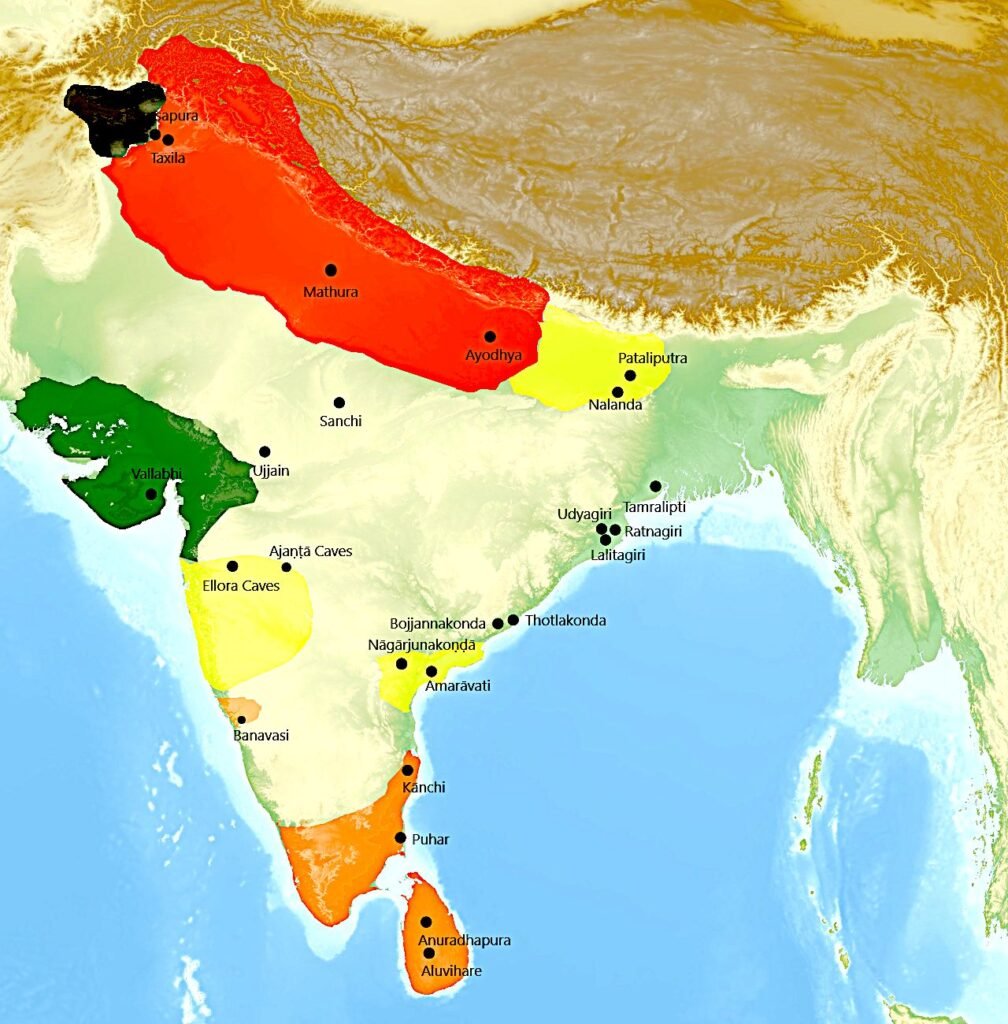
Figure 1. Distribution of major sectarian Buddhist traditions in India around the seventh century CE, based on Xuanzang’s records. The Sarvāstivāda domain (red) highlights its strong presence across Kashmir, Gandhāra, and the northwestern trade corridors connected to Central Asia. Source: Wikimedia Commons.
I. The Forgotten Giant of Early Buddhist Thought
Modern discussions of Buddhism tend to move along familiar lines. When the history of the tradition is sketched in classrooms, popular books, or public discourse, two names usually dominate the landscape: Theravāda and Mahāyāna. One is associated with early monastic discipline and meditation practice; the other with grand cosmologies, bodhisattva ideals, and philosophical innovation. Between these two poles, the intellectual terrain of Buddhism appears already mapped and complete.
Yet this picture is historically incomplete.
Alongside these well-known traditions once stood another school—equally influential, intellectually formidable, and institutionally powerful: the Sarvāstivāda. For several centuries, especially across the regions of Kashmir, Gandhāra, and Central Asia, Sarvāstivāda scholasticism shaped monastic education, systematized Abhidharma analysis, and produced some of the most sophisticated philosophical reflections in the early Buddhist world. Its textual legacy, most notably the Mahāvibhāṣā, testifies to a scale of doctrinal organization comparable to the great scholastic enterprises of classical India.
And yet, outside specialist circles, the name Sarvāstivāda rarely surfaces. It is largely absent from popular introductions to Buddhism, seldom appears in general surveys, and is often overshadowed by the more familiar binary of Theravāda and Mahāyāna. In this cultural sense—within the sphere of public memory rather than academic scholarship—the tradition has become strangely invisible.
This invisibility presents a historical puzzle. How could a school that once functioned as a major intellectual center of Buddhist thought come to occupy so marginal a place in contemporary imagination? How did a system capable of developing intricate ontological and causal theories fade from common awareness while leaving only faint traces of its former prominence?
To ask these questions is not to claim that Sarvāstivāda disappeared entirely. On the contrary, it remains well represented in formal Buddhist studies, preserved in Chinese translations, Sanskrit fragments, and the sustained attention of modern scholars. The issue is not erasure from the archive, but eclipse within cultural consciousness. The tradition survives in texts and curricula, yet it no longer figures prominently in the broader narrative of what Buddhism is or has been.
This essay argues that Sarvāstivāda was not a marginal sect but one of the most philosophically rigorous and institutionally significant forms of early Buddhism. Far from being a minor doctrinal curiosity, it represented a high point in the “philosophization” of Buddhist thought—a moment when questions of time, causality, and ontology were pursued with remarkable analytical precision. Its apparent disappearance therefore masks not a failure, but a transformation: its ideas were gradually absorbed, dispersed, and rearticulated across later Buddhist traditions.
To recover the Sarvāstivādins is thus not merely to add another name to a historical catalogue. It is to restore a missing chapter in the intellectual history of Buddhism and to recognize that early Buddhist thought once sustained a philosophical ambition as systematic and rigorous as any tradition in classical Asia.
II. Historical Formation and Institutional Power
From the perspective of sectarian history, Sarvāstivāda was neither an isolated anomaly nor a minor doctrinal offshoot. Most traditional sources classify it within the Sthaviravāda lineage (the “Elders”), one of the two principal streams that emerged from the early divisions of the Indian Buddhist Saṅgha. In the classical enumerations of the “eighteen” or “twenty” schools, the Sarvāstivādins are consistently counted among the major and most influential branches. In other words, this was not a marginal community on the periphery of Buddhist history, but a central constituent of early Buddhism’s institutional and doctrinal landscape.
The rise of Sarvāstivāda is generally situated in the centuries following the reign of King Aśoka, a period during which the monastic order underwent significant reorganization and differentiation. The convening of councils, together with the political patronage of the Mauryan state, helped consolidate communal discipline while simultaneously bringing doctrinal distinctions into sharper relief. Within this historical environment—at once unified and pluralistic—large monastic lineages gradually articulated distinct identities. Sarvāstivāda emerged from this process as one of the most structured and enduring traditions.
Yet to grasp the real strength of Sarvāstivāda, one must look beyond sectarian classification and return to the concrete geographical settings in which the school flourished. Its sphere of activity extended across Kashmir, Gandhāra, and into Central Asia—a region that functioned as a crossroads of Indian, Persian, and Hellenistic civilizations. Far from being a remote frontier, this area formed a strategic corridor linking the Indian subcontinent with West and East Asia. For centuries, the trade routes later known collectively as the Silk Road facilitated not only the movement of goods, but also the circulation of texts, ideas, and people.
Within this environment of exchange, Buddhism developed not merely as a soteriological religion but also as an increasingly sophisticated intellectual culture.
Sarvāstivāda monasteries were therefore more than places of meditation and ritual practice. They operated as organized centers of learning, where scriptures were memorized, commentaries composed, and doctrines analyzed, classified, and debated with methodological rigor. Monks were not only practitioners but also scholars, exegetes, and dialecticians. In many respects, these monastic institutions functioned like premodern universities—communities of learning sustained by systems of training, transmission, and shared scholarly standards.
In such settings, Abhidharma was not a peripheral philosophical appendix but the very core of monastic life. The classification of dharmas, the refinement of conceptual categories, and the resolution of logical problems concerning causality, time, and existence were treated as serious intellectual tasks. Over time, Sarvāstivāda cultivated a distinctive form of scholasticism in which analytical precision and doctrinal coherence were valued no less than ethical discipline or contemplative practice.
This intellectual foundation was further reinforced by institutional and political support. Monastic communities in Kashmir and Gandhāra benefited from substantial patronage, particularly during the Kushan period. Such backing enabled monasteries to expand, preserve texts, convene assemblies, and maintain networks of transmission across a wide territory. As a result, Sarvāstivāda was not merely a body of ideas, but a structured religious–scholarly system with tangible social and cultural influence.
Seen from this perspective, Sarvāstivāda was anything but an isolated or marginal movement. It stood instead as one of the most dynamic intellectual centers of the Buddhist world. The sophisticated philosophical developments examined in the following sections did not arise in abstraction; they were nurtured by an interwoven network of monasteries, economic exchange, and political support.
In short, before it was a doctrine, Sarvāstivāda was an institution. And it was precisely this organizational strength that made its later philosophical ambition possible.
III. The Kashmir Zenith: Council, Canon, and the Mahāvibhāṣā
If the preceding sections have shown that Sarvāstivāda possessed a strong geographical and institutional foundation, it was in Kashmir that the tradition reached the height of its intellectual development. There, the resources accumulated over several centuries—monastic networks, scholastic habits, and political patronage—converged to enable a decisive transformation: from a disciplined community of practice into a fully articulated scholastic philosophy.
This flourishing phase is commonly associated with the reign of Kanishka I of the Kushan Empire, who ruled in the late first to early second century CE. Under his patronage, Kashmir and Gandhāra were not only major commercial centers but also important cultural and religious hubs within the Buddhist world. Political stability and material resources allowed monasteries to expand, attract learned monks, preserve texts, and organize systematic scholarly activities on an unprecedented scale.
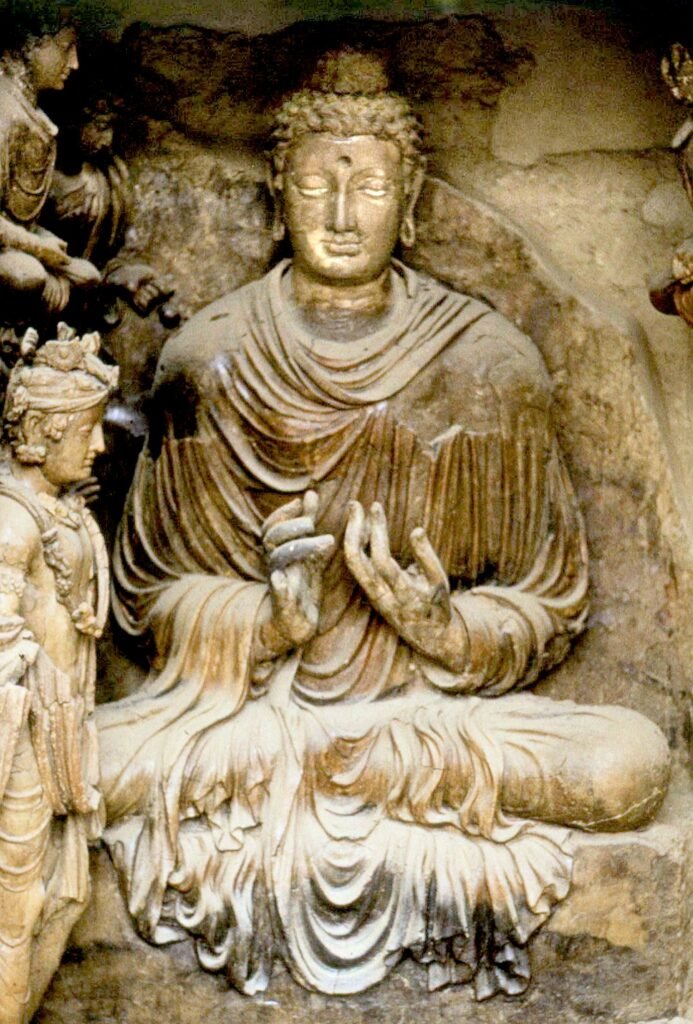
Figure 2. Seated Buddha in Gandhāran style, Tapa Shotor Monastery, Hadda (Afghanistan), 2nd century CE. This Greco-Buddhist artistic tradition reflects the cosmopolitan monastic environment of the northwestern regions where Sarvāstivāda scholasticism flourished. Source: Wikimedia Commons.
Within this context, Sarvāstivāda sources frequently refer to a council convened in Kashmir—sometimes described as a “fourth council”—at which monks and scholars gathered to systematize doctrine and address internal disagreements. Although the precise historical details of this assembly remain debated among modern scholars, there is little doubt that in Kashmir the Sarvāstivādins undertook a large-scale project of compilation and exegesis that marked the maturation of their scholastic tradition.
The most emblematic achievement of this period was the Abhidharma Mahāvibhāṣā Śāstra, an encyclopedic treatise devoted to the comprehensive analysis and defense of the Sarvāstivāda Abhidharma system. Far more than a simple commentary, the Mahāvibhāṣā records multiple doctrinal positions, stages extensive debates, and develops detailed arguments in order to establish what came to be regarded as orthodox interpretations. Its sheer scale and conceptual sophistication testify to an intellectual environment in which philosophical disputation had become both specialized and self-conscious.
At this stage, Abhidharma was no longer a loose collection of doctrinal lists but a tightly organized system of thought. Dharmas were classified within coherent structural frameworks; problems concerning causality, temporality, existence, and cognition were addressed through increasingly refined conceptual analysis. The language of spiritual experience was gradually translated into the language of rigorous argument. Buddhism, in this sense, began to assume the contours of philosophy in the fullest meaning of the term.
For this reason, the Kashmir phase may be understood as the moment when Buddhism decisively moved from primarily ethical instruction and contemplative discipline toward a highly systematic mode of reflection. If earlier generations had preserved the Buddha’s teaching through memory and practice, here that teaching was analyzed, structured, and embedded within an intricate network of conceptual relations. It was at this juncture that Buddhism first displayed, with clarity and ambition, the features of a scholastic intellectual tradition.
From the perspective of intellectual history, Sarvāstivāda in Kashmir represents one of the earliest sustained efforts to construct what may legitimately be called a systematic metaphysics within the Buddhist world. For the first time, fundamental questions concerning the ontological status of dharmas, their existence across time, and the structure of reality were addressed within a coherent and comprehensive theoretical framework. It was within this environment that key doctrines—most notably the theory of tri-temporal existence—could emerge as deliberate philosophical responses to explicitly formulated problems.
Kashmir, therefore, was more than a geographical center. It was a historical moment in which the institutional strength of Sarvāstivāda was transmuted into intellectual ambition. From that zenith, Buddhism revealed a face that was not only soteriological and ethical, but rigorously philosophical—systematic, methodological, and increasingly aware of itself as a sustained project of thought.
IV. The Problem of Time and Causality:
Tri-Temporal Existence as an Ontological Model in Sarvāstivāda Thought
If one were to identify the most distinctive—and also the most controversial—doctrinal position associated with Sarvāstivāda, it would be the theory of tri-temporal existence (sarvam asti, “everything exists”). In its most general formulation, this doctrine maintains that dharmas are not confined to existence in the present moment alone, but that past and future dharmas also “exist” in a certain qualified sense. In later doctrinal summaries, this position is often encapsulated in the evocative phrase “the enduring reality of dharmas.”
Yet to understand this “endurance” as the eternal persistence of a substantial entity would be to fundamentally misread Sarvāstivāda. The tradition does not deny impermanence, nor does it posit an immutable substratum underlying phenomena. What is at stake is not the existence of things as substances, but the ontological status of dharmas as analyzable units within a causal order that must remain intelligible and coherent.
In this sense, “existence” does not refer to physical persistence or to a robust metaphysical realism, but rather to a minimal ontological reference—an existence-as-dharma-status—sufficient to render causal relations conceptually explicable.
Situated within the broader framework of early Buddhist thought, this doctrine emerges at the intersection of a persistent philosophical tension. On the one hand, the teaching of impermanence appears to imply that all phenomena arise and cease moment by moment, such that what belongs to the past has entirely vanished. On the other hand, Buddhism simultaneously affirms the continuing efficacy of karma: actions performed in the past are said to bear fruit in the present or future.
Taken together, these two intuitions—radical impermanence and sustained causal efficacy—generate a conceptual strain. If the past no longer exists in any sense whatsoever, on what basis can a completed action be said to produce a later effect? This difficulty, viewed from a philosophical rather than a devotional standpoint, constitutes a problem of conceptual coherence rather than a merely religious puzzle.
Within this context, the doctrine of tri-temporal existence may be understood as a theoretical attempt to preserve both dimensions at once: the impermanent nature of phenomena and the intelligibility of causal continuity. Rather than treating the past as having collapsed entirely into non-being, Sarvāstivāda affirms that past and future dharmas continue to “exist” in ways appropriate to their respective temporal modes. The past exists as past, the future as future, and the present as present. Through this differentiation, causal relations can be articulated without invoking a permanent entity that stands outside time.
Crucially, Sarvāstivāda does not claim that a single dharma exists simultaneously in all three temporal modes as a physical reality. Instead, the tradition appears to extend the concept of “existence” in a technical sense, ensuring that dharmas remain legitimate objects of reference and analysis within the full causal network. Under this interpretation, existence serves a logical and explanatory function rather than asserting a strong metaphysical thesis.
Seen in this light, tri-temporal existence can be placed alongside other Buddhist attempts to confront the internal tensions of doctrine. A familiar parallel arises in discussions of non-self: if no enduring subject exists, what continues through the process of rebirth, and how can moral responsibility be meaningfully sustained? Although Sarvāstivāda does not formulate its doctrine primarily as a theory of personal rebirth, both cases reveal a shared intellectual pattern. When core Buddhist claims are pressed to their conceptual limits, increasingly refined theoretical models emerge to prevent those claims from collapsing into contradiction.
On the one hand, Buddhism consistently rejects any notion of an immutable self or substance. On the other, it insists upon the enduring efficacy of action and consequence. Tri-temporal existence, from this perspective, may be interpreted as one such ontological strategy: a way of safeguarding causal continuity without reintroducing a permanent self.
From the standpoint of intellectual history, this approach reflects a growing degree of philosophical self-consciousness within Sarvāstivāda. Doctrine is no longer merely repeated or preserved, but transformed into explicit conceptual problems, which are then addressed through systematic theoretical frameworks. It is within such a scholastic milieu that questions concerning time, existence, and causality are posed deliberately and answered through increasingly sophisticated ontological tools.
In this sense, tri-temporal existence should not be understood as a speculative metaphysics or a theological assertion, but as a theoretical model designed to secure the internal coherence of dependent origination. It exemplifies Sarvāstivāda’s ambition to present Buddhism as a system of thought capable of sustaining itself through rational analysis, rather than through scriptural authority or inherited belief alone.
V. Sarvāstivāda as Philosophical Buddhism
If we step back from the historical and doctrinal details surveyed thus far—its institutional foundations, political patronage, councils, the compilation of the Mahāvibhāṣā, and its increasingly refined analyses of time, existence, and causality—a broader picture gradually comes into view. Sarvāstivāda appears not merely as a “sect” in the conventional historical sense, but as a distinctive mode of thinking within early Buddhism itself.
What ultimately distinguishes Sarvāstivāda lies less in geography or monastic organization than in its intellectual style: an approach to the Dharma characterized by analysis, systematization, and conceptual self-consciousness.
From a comparative perspective, the major Buddhist traditions may be seen as emphasizing different dimensions of the path. Theravāda, for instance, often foregrounds disciplined practice and experiential cultivation—a pragmatic and phenomenological orientation in which doctrine primarily serves the transformation of the mind. Later Mahāyāna traditions, by contrast, tend to expand the religious horizon in visionary and soteriological directions, articulating grand cosmologies and bodhisattva ideals that highlight the salvific and symbolic dimensions of Buddhism.
Sarvāstivāda seems to represent yet another tendency: the systematic and analytic articulation of doctrine. Rather than focusing primarily on meditative experience or expansive religious vision, Sarvāstivādins devoted considerable effort to clarifying the conceptual structure of the teaching itself. Dharmas were defined, classified, and organized into increasingly rigorous systems; questions of causality, temporality, cognition, and existence were addressed through careful argumentation; disagreements were treated as matters for scholastic debate rather than appeals to authority.
Within such an environment, we witness the emergence of what may properly be called a scholastic style of thought. Doctrine was not merely preserved but commented upon, criticized, and reconstructed with ever greater analytical precision. Sarvāstivāda scholars functioned not only as custodians of scripture but also as taxonomists, logicians, and ontologists in a substantive sense.
Abhidharma, accordingly, ceased to be a peripheral supplement to the sūtras and became the very center of intellectual life. The formulation of categories, the definition of terms, and the construction of coherent conceptual frameworks were treated as essential tasks, nearly on par with contemplative practice itself. At this point, Buddhism began to assume the contours of a methodologically self-aware philosophical tradition, rather than remaining solely a body of ethical or spiritual instruction.
From the standpoint of intellectual history, Sarvāstivāda may therefore be regarded as one of the clearest expressions of the “philosophization” of early Buddhist thought. Whereas earlier generations primarily preserved the Buddha’s teaching as a path of liberation, Sarvāstivāda sought to present that teaching as a system capable of defending itself through reasoning—one that could respond to objections and maintain internal coherence as a structured body of thought.
Emphasizing this philosophical character, however, does not imply that Sarvāstivāda was somehow more rational or more correct than other traditions. Rather, it highlights the internal diversity of Buddhism itself. A shared doctrinal inheritance could be developed in markedly different ways—experiential, visionary, or analytic. Sarvāstivāda represents the analytic pole within this broader spectrum.
In this sense, its role may be understood as that of an indispensable philosophical component within a larger intellectual map of Buddhism—a conceptual “piece” that contributes to the overall architecture of the tradition. Rather than existing in isolation or competition with other schools, Sarvāstivāda complements them by providing a dimension of rigorous analysis and systematic reflection, thereby enriching and balancing the Buddhist heritage as a whole. It is precisely through the interaction of such differing intellectual styles that Buddhism acquired its historical depth and plurality.
For this reason, Sarvāstivāda should not be regarded simply as a closed chapter in sectarian history. It marks a moment when Buddhism became explicitly aware of itself as an intellectual project. At that moment, Buddhism appeared not only as a path of liberation, but also unmistakably as a philosophy in the fullest sense of the term.
VI. Historical Eclipse — Why Was It Forgotten?
If Sarvāstivāda once stood as one of the most powerful and intellectually sophisticated traditions of Indian Buddhism, a natural question arises: why does its name rarely appear in popular Buddhist memory today? How did a school that developed such a refined philosophical system come to seem almost absent from the mainstream historical narrative?
Yet framing the issue in terms of “decline” or “failure” may already be misleading. Rather than recounting a familiar story of rise and fall, it may be more appropriate to interpret this development as a structural transformation within Buddhist intellectual history. Sarvāstivāda did not simply collapse; the conditions that sustained it gradually shifted.
First, many of the school’s primary centers were located in frontier regions such as Kashmir, Gandhāra, and Central Asia. These areas were once vital corridors of trade and cultural exchange, but they were also particularly vulnerable to political upheaval and shifting economic networks. As trade routes weakened and regional powers changed, the monastic infrastructures that had flourished in those areas faced increasing instability.
Second, Sarvāstivāda appears to have relied significantly on political patronage, especially under the Kushan Empire. Large scholastic institutions required material resources for manuscript production, preservation, and education. When state support diminished, the sustainability of such institutional networks inevitably declined. The weakening of political backing thus had direct consequences for the continuity of organized scholastic activity.
Third, the rise of Mahāyāna movements introduced new religious energies into the Buddhist world. Expansive cosmologies, bodhisattva ideals, and newly emerging scriptures reshaped the imaginative and soteriological horizons of Buddhist communities. This shift did not necessarily refute Sarvāstivāda, but it altered the intellectual center of gravity. The analytic rigor of Abhidharma scholasticism no longer occupied the same central position within the evolving religious landscape.
Fourth, the geographical center of Buddhist scholarship gradually moved beyond India to regions such as China and Tibet. In the process of transmission, reinterpretation, and translation, Sarvāstivāda doctrines were absorbed, reconfigured, and integrated into new frameworks. The name of the school may have receded, but many of its conceptual tools continued to circulate within different intellectual contexts.
Finally, the loss of a substantial portion of Sanskrit textual materials over the centuries contributed significantly to the fading visibility of the tradition. When primary textual foundations disappear, even once-prominent schools can lose their direct historical presence. What survives is often mediated through translation, commentary, or later reinterpretation.
Taken together, these factors suggest not a simple narrative of decline, but rather a process of dispersion and transformation. Sarvāstivāda did not vanish abruptly; it gradually dissolved into broader currents of Buddhist thought. Its institutional identity weakened, but its intellectual influence persisted in subtler forms.
Under this interpretation, Sarvāstivāda’s apparent disappearance reflects less a failure than a historical reconfiguration. The boundaries of the school blurred, its name faded, yet many of its conceptual structures remained active within the evolving architecture of Buddhist philosophy.
VII. Afterlife of Ideas — The Hidden Legacy
If Sarvāstivāda did not simply disappear, then the more fruitful question may not be why it vanished, but where its ideas went.
Rather than searching for Sarvāstivāda as a self-contained historical entity, it may be more illuminating to trace the afterlife of its conceptual habits within later Buddhist traditions. Viewed from this perspective, many elements once associated specifically with Sarvāstivāda appear not to have ended at all, but to have continued in dispersed and transformed forms.
To begin with, the analytic discipline of Abhidharma—the careful classification of dharmas, the systematic definition of terms, and the rigorous articulation of causal relations—became foundational to much of subsequent Buddhist scholastic culture. The methods of categorization, argumentation, and conceptual clarification cultivated by Sarvāstivāda did not vanish with the school’s institutional decline. On the contrary, they came to shape the very grammar of Buddhist intellectual inquiry for centuries to come.
Even traditions that positioned themselves as critics of Sarvāstivāda, such as the Sautrāntikas or later Yogācāra thinkers, continued to operate within conceptual spaces first structured by Abhidharma analysis. Their alternative theories—whether framed in terms of “seeds,” latent dispositions, or storehouse consciousness—may have rejected specific Sarvāstivādin claims, yet they nevertheless inherited the same commitment to systematic explanation. In this sense, critique itself often functioned as a form of continuation.
A similar pattern can be observed in East Asian and Tibetan scholastic Buddhism. Traditions of commentary, debate, classification, and doctrinal synthesis—features that had been central to Sarvāstivāda monastic culture—became standard components of Buddhist education in these regions. The institutional form changed, languages shifted, and new doctrinal vocabularies emerged, yet the underlying analytic method remained recognizable.
For this reason, to say that Sarvāstivāda “disappeared” may ultimately be misleading. More precisely, the school seems to have dissolved into the wider bloodstream of Buddhist philosophy. It ceased to exist as a clearly bounded sect, but persisted as a style of reasoning, a set of conceptual tools, and a scholastic temperament. It survived less as a name than as a method; less as a community than as an intellectual habit.
Seen in this light, Sarvāstivāda’s legacy lies not in the preservation of a historical label, but in the quiet endurance of its ways of thinking. Its influence is detectable wherever Buddhist thought becomes systematic, wherever doctrines are organized into coherent taxonomies, and wherever philosophical problems are addressed through careful analysis rather than appeal to authority alone.
In this respect, Sarvāstivāda did not so much vanish as become invisible. Its ideas were absorbed, redistributed, and naturalized within later traditions, no longer identifiable as belonging to a single school. Yet precisely this loss of distinct form may also explain the depth of its survival. What disperses widely often endures more thoroughly than what remains intact.
Thus, the history of Sarvāstivāda is perhaps best understood not as a story of extinction, but as one of diffusion. Its identity faded, but its intellectual DNA continued to circulate—shaping the development of Buddhist philosophy long after the name itself receded from view.
VIII. Restoring a Missing Chapter of Buddhist Philosophy
The story traced in the preceding pages began with a simple puzzle: how could a tradition once so prominent in the intellectual life of Indian Buddhism come to occupy so faint a place in modern memory? Sarvāstivāda appeared at first as a forgotten name—an obscure entry in lists of early Buddhist schools, overshadowed by the more familiar categories of Theravāda and Mahāyāna.
Yet as we have seen, this obscurity reflects less an absence of significance than a distortion of perspective.
Historically, Sarvāstivāda was sustained by extensive institutional networks, monastic centers, and political patronage across Kashmir, Gandhāra, and Central Asia. Intellectually, it cultivated one of the most systematic and analytically sophisticated forms of Abhidharma thought in the Buddhist world. Philosophically, it confronted fundamental problems—time, causality, existence, and moral continuity—with a rigor that transformed inherited teachings into explicit conceptual inquiry. And even after its institutional identity faded, its methods and categories continued to shape later Buddhist traditions in dispersed but enduring ways.
What initially appeared as disappearance thus emerges, on closer examination, as reinterpretation and diffusion.
To restore Sarvāstivāda to view is therefore not simply to recover a neglected historical sect. It is to recognize that early Buddhism once sustained a philosophical ambition of remarkable scope. Far from being limited to ethical instruction or contemplative practice alone, Buddhist thought also generated sustained efforts at systematic analysis, conceptual clarification, and ontological reflection. In Sarvāstivāda, we encounter Buddhism not only as a path of liberation, but as a disciplined intellectual project.
Seen in this light, the history of Sarvāstivāda expands our understanding of what Buddhism has been—and what it is capable of being. It reminds us that the tradition has always contained multiple modes of engagement with reality: experiential, devotional, and analytic. The Sarvāstivādins represent one of the clearest expressions of this analytic impulse, a moment when the Dharma was articulated with the precision of philosophy without losing its soteriological orientation.
To recover their legacy, then, is not merely to fill a gap in the historical record. It is to restore a missing chapter in the intellectual history of Buddhism itself—a chapter in which the pursuit of liberation was accompanied by an equally serious pursuit of conceptual coherence.
In acknowledging this dimension, we gain a fuller picture of Buddhism: not only as ethics, not only as meditation, but also as thought.
Bibliography
Cox, Collett. Disputed Dharmas: Early Buddhist Theories on Existence. Tokyo: International Institute for Buddhist Studies, 1995.
Gethin, Rupert. The Foundations of Buddhism. Oxford: Oxford University Press, 1998.
Kalupahana, David J. A History of Buddhist Philosophy: Continuities and Discontinuities. Honolulu: University of Hawai‘i Press, 1992.
Potter, Karl H., ed. Encyclopedia of Indian Philosophies, vol. 7: Abhidharma Buddhism to 150 A.D. Delhi: Motilal Banarsidass, 1996.
Willemen, Charles, Bart Dessein, and Collett Cox. Sarvāstivāda Buddhist Scholasticism. Leiden: Brill, 1998.