
Le Hoang Da
Buddhist Scholar
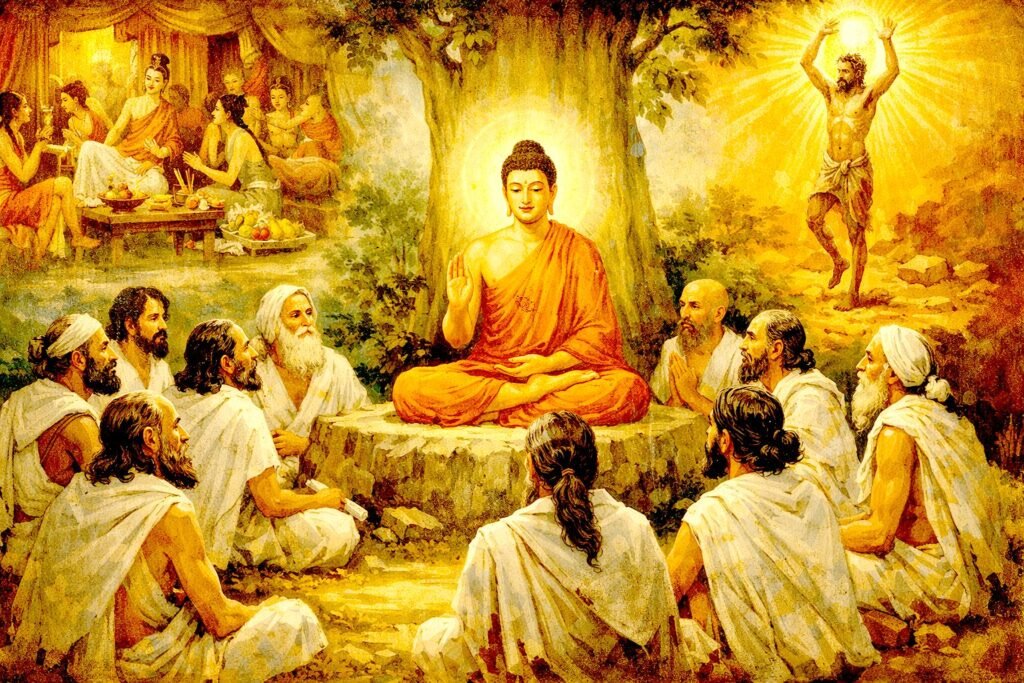
The Buddha teaching the Middle Way to wandering ascetics, set between the two extremes of sensual indulgence and severe asceticism.
I. Introduction: Spiritual Authority and the Question of the Teacher
Within the religious landscape of ancient India, the question of spiritual authority occupied a central place. Numerous teachers, ascetics, and philosophical schools coexisted and competed for disciples, each tradition claiming to possess the correct understanding of the nature of reality and the path to liberation. In such a pluralistic environment, seekers often evaluated the credibility of a teacher through visible signs of religious life, such as the degree of ascetic practice, mastery of ritual, or achievements believed to possess supernatural significance. Severe austerities, ritual expertise, and metaphysical speculation were frequently regarded as marks of religious prestige. Consequently, the authority of a spiritual teacher was often associated with outward forms of ascetic discipline or with claims to esoteric knowledge.
Early Buddhist scriptures, however, present a markedly different understanding of the foundations of religious authority. Rather than grounding authority in extreme ascetic practices or in claims of divine revelation, the discourses preserved in the Nikāyas repeatedly emphasize the coherence of a path of practice that can be undertaken, examined, and verified through experience. The authority of the Buddha does not rest upon divine revelation or the mystical charisma of an individual, but upon his discovery and teaching of a method leading to the cessation of suffering. In this sense, early Buddhist literature presents a distinctive model of spiritual authority—one that is grounded not merely in the status of the teacher, but in the reliability of the path that the teacher reveals.
Several discourses in the Nikāyas illustrate this perspective with particular clarity. Among them, three texts are especially significant: the Mahāsakuludāyi Sutta, the Cūḷahatthipadopama Sutta, and the Sāmaññaphala Sutta. Each of these discourses approaches the question of spiritual authority from a different angle. In the Mahāsakuludāyi Sutta, a wandering ascetic asks why the Buddha’s disciples hold him in such profound respect, thereby opening a reflection on the origin of religious authority. The Cūḷahatthipadopama Sutta addresses the problem of how a genuine teacher may be recognized, employing the well-known simile of the elephant’s footprint to illustrate a gradual process of verifying spiritual claims. Meanwhile, the Sāmaññaphala Sutta presents the “fruits of the contemplative life” through a systematic description of the path of practice, demonstrating how the authority of a teaching may be confirmed through the transformative results it produces.
When read together, these three discourses reveal a coherent structure of thought. They suggest that early Buddhism articulated spiritual authority through three closely related dimensions: the origin of authority, the recognition of authority, and the confirmation of authority through lived experience. Rather than relying upon supernatural revelation or the prestige of extreme asceticism, the authority of the Buddha emerges from his presentation of a path that can be practiced, examined, and realized by those who follow it.
This article examines the concept of spiritual authority in early Buddhism through a comparative reading of the three Nikāya discourses mentioned above. By analyzing the narrative contexts, arguments, and doctrinal structures of the Mahāsakuludāyi Sutta, the Cūḷahatthipadopama Sutta, and the Sāmaññaphala Sutta, the study aims to show how early Buddhist texts redefine the foundations of religious authority. In doing so, they outline a model of spiritual leadership grounded not in revelation or mystical power, but in the verifiable effectiveness of the path leading to liberation.
II. Ascetic Prestige and the Problem of Religious Authority
To understand the distinctive conception of spiritual authority presented in early Buddhist texts, it is first necessary to situate them within the broader religious context of ancient India. During the centuries in which the Buddha lived and taught, northern India was a vibrant landscape of religious movements and philosophical teachers. Wandering ascetics, speculative thinkers, and ritual specialists frequently traveled between towns and villages, attracting disciples and engaging in debates about the nature of reality, the self, and the path to liberation. In such a pluralistic environment, those seeking a spiritual path were confronted with a variety of teachers, each claiming to possess true insight.
Within this context, spiritual authority was often associated with visible signs of ascetic renunciation. Many ascetic traditions regarded the deliberate mortification of the body as evidence of seriousness in spiritual life and of moral purity. Practices such as prolonged fasting, sleeping on the ground, exposing oneself to harsh natural conditions, or abandoning conventional social norms were frequently interpreted as expressions of a radical break from worldly life. The greater the degree of ascetic severity, the greater the reputation of the renunciant. In this cultural setting, extreme renunciation often functioned as a powerful marker of religious prestige.
Such assumptions strongly shaped the way disciples evaluated spiritual teachers. Religious authority was commonly inferred from outward forms of ascetic discipline or from the reputation associated with a teacher’s lifestyle. A teacher capable of enduring harsh austerities could easily be regarded as someone who had attained profound spiritual achievements. As a result, the prestige of many ascetic figures rested less on the presentation of a systematic path of practice and more on the symbolic power of their renunciant way of life.
Against this background, the discourses preserved in early Buddhist literature reveal a notable shift in the understanding of spiritual authority. Rather than treating the severity of asceticism as the primary sign of religious authenticity, these texts repeatedly emphasize the coherence and transformative capacity of a clearly structured path of practice. What ultimately matters is not the extremity of renunciation, but the ability of a teaching to guide practitioners toward liberation from suffering.
The significance of this shift becomes particularly clear when examining several Nikāya discourses that directly address the question of the authority of religious teachers and the value of the contemplative life. In the Mahāsakuludāyi Sutta, a wandering ascetic suggests that the authority of the Buddha might derive from his ascetic lifestyle, yet this assumption is immediately challenged. The Cūḷahatthipadopama Sutta approaches the issue from a different angle, raising the question of how a genuine teacher may be recognized and warning against drawing quick conclusions based solely on reputation. Meanwhile, the Sāmaññaphala Sutta discusses the “fruits of the contemplative life,” presenting in systematic form the path of practice that leads to liberation.
When read together, these discourses reveal that early Buddhism reconfigures the question of spiritual authority. Rather than grounding authority in extreme asceticism or in the personal prestige of a religious teacher, these texts present a model in which authority arises from the verifiable effectiveness of a path of practice. The credibility of a spiritual teacher, therefore, is not merely tied to personal reputation, but to the clarity, coherence, and transformative power of the teaching that the teacher presents.
This reorientation provides the conceptual background for the sections that follow. By examining the narrative contexts and doctrinal structures of the three Nikāya discourses discussed above, it becomes possible to see how early Buddhist texts articulate a distinctive conception of authority—one grounded not in outward ascetic display, but in the experiential realization of the path leading to liberation.
III. The Origin of Spiritual Authority: The Mahāsakuludāyi Sutta
One of the Nikāya discourses that directly raises the question of the origin of spiritual authority is the Mahāsakuludāyi Sutta. This discourse records a dialogue between the Buddha and a wandering ascetic named Sakuludāyī, in which the issue is stated clearly: why do the monks hold the Buddha in such profound respect?
This question is not merely personal. Within the intellectual world of the ascetic movements of ancient India, the fact that a teacher was deeply respected by many disciples was often interpreted as a sign of religious authority. Sakuludāyī’s inquiry therefore reflects a broader assumption: that the spiritual authority of a teacher must arise from certain distinctive qualities in his religious life.
Sakuludāyī proceeds to offer several hypotheses to explain the respect that the monks show toward the Buddha. According to him, such reverence might stem from elements of the Buddha’s ascetic lifestyle—for example, his moderation in eating, his simplicity in clothing, his frugal way of living, or his preference for secluded places. These suggestions reflect a widespread assumption in the culture of renunciant movements: the more severe the ascetic practice, the greater the spiritual prestige of the teacher.
The Buddha, however, rejects each of these explanations. He points out that within the monastic community there are many monks who practice austerities even more rigorously than he does. If the reverence of the disciples were based merely on outward ascetic practices, then those monks should be the ones most highly honored. Through this reasoning, the Buddha undermines the assumption that the degree of ascetic severity can automatically generate spiritual authority.
Having dismissed Sakuludāyī’s hypotheses, the Buddha then presents the genuine reasons why the monks respect him. These reasons are not connected with the harshness of ascetic practice, but with deeper qualities of the teaching and of the teacher. The monks honor the Buddha because he possesses moral purity, teaches a doctrine that is coherent and systematically structured, has profound wisdom concerning the nature of reality, and is able to guide others along a path leading to the cessation of suffering.
What is particularly noteworthy is that these elements are not symbolic or outward signs. Rather, they are directly related to the character of the teaching and the effectiveness of its practice. Spiritual authority, according to the understanding presented in the discourse, does not arise from the image of an extreme ascetic, but from the capacity of a teacher to discover and communicate a path of liberation.
The discourse further reinforces this perspective by describing in detail the path of practice undertaken by a monk. The Buddha outlines a progression that begins with moral discipline and the guarding of the senses, continues with mindfulness and clear comprehension in daily life, and gradually leads to the abandonment of the mental hindrances. On this foundation, the practitioner develops concentration through the meditative absorptions, from which deeper forms of insight into the nature of existence emerge, ultimately culminating in complete liberation.
Within the context of the dialogue with Sakuludāyī, this detailed description of the path serves not only to explain the method of Buddhist practice. It also demonstrates that the authority of the Buddha is inseparable from a clearly structured path capable of producing concrete results. His prestige does not rest on personal reputation or on the image of a severe ascetic, but on the fact that he has discovered, realized, and taught a path that others can follow for themselves.
For this reason, the Mahāsakuludāyi Sutta plays a particularly important role in clarifying the origin of spiritual authority in early Buddhism. The discourse shows that such authority is grounded neither in extreme asceticism nor in supernatural revelation, but in the practical effectiveness of the path leading to liberation. It is precisely the Buddha’s ability to teach and open this path that makes him the object of profound respect among his disciples.
IV. Recognizing Spiritual Authority: The Cūḷahatthipadopama Sutta
If the Mahāsakuludāyi Sutta raises the question of the origin of spiritual authority, the Cūḷahatthipadopama Sutta approaches the issue from a different perspective: how can a genuine spiritual teacher be recognized? In the context of the ascetic world of ancient India, where numerous teachers and doctrines coexisted, this question held particular importance. Those seeking a spiritual path were not only required to choose a teacher, but also had to confront the risk of being persuaded by reputation or by the outward signs of religious life.
In this discourse, the Buddha addresses the problem through a well-known illustration: the simile of the elephant’s footprint. He explains that an experienced hunter, upon entering the forest and seeing a large footprint, would not immediately conclude that it must belong to a great elephant. Instead, the hunter continues to follow the trail, observing additional footprints, until eventually seeing the elephant directly. Only then can the hunter confirm that he has indeed been tracking a large elephant.
This example illustrates the process of recognizing a genuine renunciant. According to the Buddha, merely hearing that a teacher enjoys great fame or has many followers is not sufficient grounds for affirming the validity of the teaching he presents. Reputation may arise from many different causes, and the outward appearance of ascetic discipline does not guarantee that a teacher has attained liberating wisdom.
Instead, the recognition of genuine spiritual authority must unfold through a gradual process of observation and verification. A seeker of truth should listen to the teaching, observe the conduct of the teacher, and most importantly examine the path of practice that the teacher presents. Only when that path is seen to be coherent, reasonable, and capable of producing genuine transformation in the life of the practitioner can the authority of the teacher be confirmed.
In the discourse, the Buddha proceeds to describe in detail the path of practice undertaken by a monk, beginning with the observance of moral discipline, the guarding of the senses, and the cultivation of mindfulness and clear comprehension. From there, the practitioner abandons the mental hindrances and develops the meditative absorptions. This sequence closely resembles the structure of practice found in many other Nikāya discourses, indicating that the evaluation of a teaching cannot be separated from the observation of the entire path of practice that it proposes.
The crucial point here is that spiritual authority cannot be determined instantly, nor can it be inferred from outward signs. It becomes evident only through an ongoing process of verification. A seeker of truth must follow the path that is presented, just as the hunter follows the elephant’s footprints, until he directly witnesses the results of that path.
Through the simile of the elephant’s footprint, the Cūḷahatthipadopama Sutta articulates an important epistemological principle for spiritual life. The authority of a teacher should not be accepted merely on the basis of reputation, tradition, or first impressions. Rather, it must be evaluated through careful observation and through the practice of the path that the teacher teaches.
In this way, the discourse adds an important dimension to the understanding of spiritual authority in early Buddhism. If the Mahāsakuludāyi Sutta shows that the authority of the Buddha originates from the teaching and the path of liberation he has discovered, the Cūḷahatthipadopama Sutta demonstrates that recognizing such authority also requires a serious process of inquiry and verification on the part of the seeker. Spiritual authority, therefore, is not something imposed from the outside, but something gradually recognized through experience and practice.
V. The Confirmation of Spiritual Authority: The Sāmaññaphala Sutta
If the Mahāsakuludāyi Sutta clarifies the origin of spiritual authority and the Cūḷahatthipadopama Sutta explains how a genuine teacher may be recognized, the Sāmaññaphala Sutta approaches the issue from yet another perspective: how the authority of a teaching is confirmed through the practical results of the contemplative life.
This discourse is set within a distinctive narrative context. King Ajātasattu, having heard of the reputation of several renowned teachers of his time, poses a direct question: “What are the fruits of the contemplative life?” In other words, the king wishes to know what concrete benefits may arise from abandoning the household life and entering the path of renunciation. The question reflects a practical concern: if many teachers claim to possess the truth, what demonstrates that their path truly has value?
In responding to this question, the Buddha does not offer a doctrinal proclamation or appeal to personal authority. Instead, he systematically presents the entire path of practice undertaken by a monk, beginning with the initial transformations in moral life and gradually leading toward deeper spiritual states. First, the practitioner abandons the household life and enters the life of renunciation, maintaining moral discipline and living a simple and purified way of life. Upon this ethical foundation, the practitioner develops restraint of the senses and sustains mindfulness and clear comprehension in all activities of daily life.
Building upon the foundations of morality and mindfulness, the practitioner gradually abandons the mental hindrances such as sensual desire, ill will, sloth and torpor, restlessness, and doubt. When these obstacles are overcome, the mind becomes calm and concentrated, opening the way for the development of the meditative absorptions. These states of deep concentration not only bring profound tranquility but also create the conditions for the emergence of higher forms of knowledge. In the discourse’s description, the practitioner may attain abilities such as recollecting past lives, perceiving the passing away and rebirth of beings according to their actions, and ultimately eliminating the defilements of the mind entirely.
The important point in this presentation is that the entire path of practice is described as an ordered and verifiable process of transformation. Each stage of the path leads to a specific result, ranging from the stability of moral conduct to the complete liberation from suffering. The value of the contemplative life is therefore not affirmed through mere declaration, but through the results that the path of practice produces in the practitioner.
Within the context of King Ajātasattu’s question, this presentation carries particular significance. The authority of the Buddha is not established through personal prestige or through outward displays of asceticism, but through his ability to point to a path that leads to clear and directly experiential results. Practitioners are not required to accept the teaching solely on the basis of faith; they can follow the path themselves and verify the transformations it brings.
In this way, the Sāmaññaphala Sutta completes the picture of spiritual authority presented in early Buddhist texts. If the earlier discourses show that the authority of the Buddha originates in the teaching and can be recognized through the observation of the path of practice, this discourse demonstrates that such authority is ultimately confirmed through the practical results of the contemplative life. It is precisely the capacity to guide human beings toward liberation from suffering that provides the firm foundation for the credibility of the teaching proclaimed by the Buddha.
VI. The Architecture of the Path of Practice
When the Mahāsakuludāyi Sutta, the Cūḷahatthipadopama Sutta, and the Sāmaññaphala Sutta are placed side by side, a striking feature of early Buddhist literature becomes clear: all three discourses present a remarkably similar structure of practice. Although the narrative contexts and the purposes of the dialogues in each discourse differ, the path of practice described in these texts follows a common architecture that is repeated with notable consistency.
This structure typically begins with a transformation in moral life. One who enters the path of practice first abandons the household life and adopts a disciplined way of living grounded in moral precepts. The observance of moral discipline does not merely establish ethical standards; it also creates a stable foundation for the development of the mind. On the basis of this ethical life, the practitioner continues with the guarding of the senses and the cultivation of mindfulness and clear comprehension, thereby learning to observe and regulate the mind’s responses to the surrounding world.
From this foundation of morality and mindfulness, the practitioner gradually overcomes internal obstacles such as sensual desire, ill will, sloth and torpor, restlessness, and doubt. As these hindrances subside, the mind becomes purified and increasingly concentrated, opening the way for the development of meditative concentration through the absorptions. These states of concentration not only bring profound tranquility but also create the conditions for the emergence of more refined forms of cognition.
In the Nikāya discourses, the development of concentration is often followed by the arising of extraordinary forms of knowledge. These include the ability to recollect past lives, to perceive the passing away and rebirth of beings according to their actions, and ultimately to eliminate the defilements of the mind completely. It is at this final stage that the path of practice reaches its ultimate goal: liberation from suffering.
What is noteworthy is that this process is not presented as a loose collection of separate practices. On the contrary, the discourses depict a structured architecture of practice characterized by internal coherence. Each stage of the path creates the conditions for the next, and the entire process unfolds as a continuous transformation of moral, psychological, and cognitive life.
The consistency of this architecture helps explain why the Nikāya discourses repeatedly emphasize the value of the path of practice rather than the personal prestige of the teacher. In the dialogues recorded in the three discourses analyzed above, the Buddha does not attempt to assert his authority through supernatural claims or by emphasizing the severity of his ascetic lifestyle. Instead, he continually directs the attention of his interlocutors to the structure of the path of practice and to the transformations that the path can produce.
When these three discourses are read together, it becomes evident that spiritual authority in early Buddhism is closely linked to the coherence of a method of practice. The prestige of the Buddha lies not only in the fact that he has attained awakening, but also in the fact that he has articulated a clearly structured path in which each step of practice leads to results that can be experienced and verified.
In this way, the architecture of the path becomes the deeper foundation of spiritual authority in early Buddhism. It is the consistency and effectiveness of this path that inspire the confidence of the disciples in the Buddha and in the teaching he proclaims. When authority is grounded in a method of practice that can be personally realized, it no longer depends entirely on the status of an individual, but becomes an intrinsic characteristic of the path leading to liberation.
VII. Authority Without Revelation
When examining the way spiritual authority is presented in discourses such as the Mahāsakuludāyi Sutta, the Cūḷahatthipadopama Sutta, and the Sāmaññaphala Sutta, a striking feature of early Buddhism gradually becomes clear: religious authority in this tradition is not grounded in divine revelation.
In many religious traditions throughout the world, the authority of a spiritual teacher is often justified by the claim that he has received truth from a supernatural source. Assertions of revelation, direct communication from divine beings, or access to transcendent powers frequently function as the foundation for the credibility of a doctrine. In such cases, religious authority is tied to a unique revelatory event that cannot be independently verified through the experience of others.
Early Buddhist texts, however, present a markedly different model. In the dialogues recorded in the Nikāyas, the Buddha does not claim that his teaching originates from a supernatural revelation. Instead, he repeatedly describes his awakening as the result of a process of discovery and direct insight into the nature of reality. As a result, the authority of the Buddha lies not in his role as a messenger conveying a message from a divine power, but in the fact that he himself discovered the path leading to the cessation of suffering.
This difference gives the Buddhist conception of authority a distinctive character. Authority is not grounded in a revelatory event accessible only to a single individual. Rather, it is grounded in a path of practice that others can also follow and verify through their own experience. What the Buddha presents is not a truth guaranteed by supernatural power, but a method of practice confirmed through the experience of those who undertake it.
This understanding is clearly reflected in the argumentative structure of the discourses analyzed above. In the Mahāsakuludāyi Sutta, the authority of the Buddha is not explained through mystical claims but through his ability to present a path leading to liberation. In the Cūḷahatthipadopama Sutta, seekers of truth are encouraged to observe and examine the teaching rather than accept it merely on the basis of the teacher’s reputation. And in the Sāmaññaphala Sutta, the value of the contemplative life is demonstrated through the concrete transformations that the path of practice produces.
These elements indicate that spiritual authority in early Buddhism possesses a fundamentally methodological character. The credibility of the teaching does not arise from a supernatural source of power, but from the experiential verifiability of the path of practice. The teaching has value because it can be practiced, examined, and confirmed through the experience of those who follow the path.
In this way, early Buddhism presents a distinctive form of religious authority within the history of religious thought. Authority does not lie in a single revelatory event, nor in the personal prestige of a teacher, but in the capacity of a path to guide human beings toward inner transformation and liberation from suffering. It is precisely this characteristic that allows the Buddha’s teaching to be received not merely as a system of belief, but as a method of practice that can be verified through lived experience.
VIII. The Middle Way and the Critique of Extreme Asceticism
The analyses presented in the preceding sections indicate that the conception of spiritual authority in early Buddhism is closely connected with a profound redefinition of the value of the ascetic life. When read together, the Mahāsakuludāyi Sutta, the Cūḷahatthipadopama Sutta, and the Sāmaññaphala Sutta do not merely present different aspects of spiritual authority; they also reflect an important orientation within Buddhist thought: a critique of extreme forms of asceticism.
In the religious context of ancient India, many renunciant traditions regarded severe ascetic practices as the primary sign of authentic spiritual life. Practices such as prolonged fasting, bodily mortification, or the complete abandonment of ordinary comforts were often interpreted as expressions of a radical break from worldly existence and were therefore seen as conferring religious prestige upon the practitioner. The reputation of a spiritual teacher was frequently measured by the severity of the austerities he undertook.
The discourses analyzed in this study, however, show that early Buddhism did not accept this assumption as the foundation of spiritual authority. In the Mahāsakuludāyi Sutta, the Buddha directly rejects the idea that the respect shown by the monks toward him arises from his ascetic lifestyle. In the Cūḷahatthipadopama Sutta, seekers of truth are cautioned against hastily judging the value of a teacher based solely on reputation or on outward appearances of renunciant discipline. And in the Sāmaññaphala Sutta, the value of the contemplative life is demonstrated not through ascetic display but through the profound transformations that the path of practice brings about in those who follow it.
These arguments reflect a fundamental principle within the Buddha’s teaching: the path to liberation does not lie in either of the extremes of life. On the one hand, indulgence in sensual pleasures does not lead to liberating wisdom; on the other hand, extreme forms of asceticism do not in themselves bring about awakening. Instead, the Buddha repeatedly emphasizes a balanced path of practice in which moral discipline, the cultivation of concentration, and the development of wisdom work together to bring about the cessation of suffering.
In this way, spiritual authority in early Buddhism is closely tied to the spirit of the Middle Way. Such authority does not arise from the pursuit of extreme forms of religious discipline, but from the capacity of a path of practice to guide human beings beyond both extremes. For this reason, when the Buddha is held in deep respect by his disciples, it is not reverence for a prominent ascetic figure, but trust in a teacher who has discovered and taught a balanced and effective path of practice.
Seen from this perspective, the three discourses analyzed in this study may be understood as different illustrations of the same foundational principle of the Buddha’s teaching. They demonstrate that spiritual authority does not rest on reputation, on ascetic severity, or on supernatural claims, but on the coherence and effectiveness of the Middle Way. When this path is practiced with seriousness and consistency, it becomes the firm foundation for the confidence that disciples place in the teaching proclaimed by the Buddha.
IX. Conclusion: Spiritual Authority and the Path to Liberation
The analyses presented in the preceding sections indicate that early Buddhist texts articulate a distinctive understanding of spiritual authority. When read together, the Mahāsakuludāyi Sutta, the Cūḷahatthipadopama Sutta, and the Sāmaññaphala Sutta are not merely independent discourses but may be understood as complementary approaches to the same issue: the nature of authority in spiritual life.
In the Mahāsakuludāyi Sutta, the question of why the Buddha’s disciples hold him in deep respect leads to a redefinition of the origin of authority. The prestige of the Buddha is not explained by the severity of his ascetic practices, but by the purity of his moral conduct, the depth of his wisdom, and his ability to teach a path leading to liberation. The Cūḷahatthipadopama Sutta further clarifies that recognizing a genuine teacher cannot be based on reputation or first impressions, but must arise from a careful process of observation and verification. Finally, the Sāmaññaphala Sutta demonstrates that the authority of the contemplative life is confirmed through the concrete results produced by the path of practice, ranging from the initial transformation of moral conduct to complete liberation from suffering.
When these three discourses are considered together, a coherent argumentative structure emerges. Spiritual authority in early Buddhism can be understood through three closely related dimensions: the origin of authority, the recognition of authority, and the confirmation of authority through experiential practice. None of these dimensions relies on supernatural revelation or on the prestige associated with extreme forms of asceticism; rather, all are grounded in the practical effectiveness of a path of practice that can be undertaken and verified.
This characteristic makes the Buddhist conception of authority particularly distinctive within the history of religious thought. The authority of the Buddha is not that of a prophet transmitting a message from a divine power, but that of one who has discovered and articulated a method of practice capable of guiding human beings toward the cessation of suffering. The credibility of the teaching therefore lies not only in the status of the teacher, but in the coherence and effectiveness of the path of liberation that the teacher presents.
This understanding of spiritual authority has implications not only for the interpretation of the Nikāya texts, but also for the later development of Buddhist thought. The principle of the Middle Way, expressed in the rejection of both sensual indulgence and extreme asceticism, continued to serve as a central orientation in many subsequent Buddhist traditions. In the philosophical developments of Mahāyāna Buddhism, particularly in the thought of Nāgārjuna, the Middle Way was elaborated into a profound philosophical system concerning the nature of reality and the transcendence of metaphysical extremes.
From this perspective, the Nikāya discourses do more than record religious dialogues within the historical context of ancient India. They also lay the foundations for a distinctive conception of spiritual authority throughout the Buddhist tradition. Such authority does not reside in extreme asceticism, in supernatural revelation, or in the personal power of an individual. Rather, it lies in a path of practice capable of guiding human beings toward inner transformation and liberation from suffering. It is this path—when practiced and realized—that becomes the enduring foundation for confidence in the Buddha’s teaching across centuries of Buddhist history.
Bibliography
The Long Discourses of the Buddha: A Translation of the Dīgha Nikāya. Translated by Maurice Walshe. Boston: Wisdom Publications, 1995.
The Middle Length Discourses of the Buddha: A Translation of the Majjhima Nikāya. Translated by Bhikkhu Ñāṇamoli and Bhikkhu Bodhi. Boston: Wisdom Publications, 1995.
Richard Gombrich. What the Buddha Thought. London: Equinox Publishing, 2009.
Johannes Bronkhorst. Greater Magadha: Studies in the Culture of Early India. Leiden: Brill, 2007.
Rupert Gethin. The Foundations of Buddhism. Oxford: Oxford University Press, 1998.
Peter Harvey. An Introduction to Buddhism: Teachings, History and Practices. Cambridge: Cambridge University Press, 2013.
Alexander Wynne. The Origin of Buddhist Meditation. London: Routledge, 2007.
Edward Conze. Buddhist Thought in India. London: George Allen & Unwin, 1962.
Nāgārjuna. The Fundamental Wisdom of the Middle Way (Mūlamadhyamakakārikā). Translated by Jay L. Garfield. Oxford: Oxford University Press, 1995.