
Le Hoang Da
Buddhist Scholar
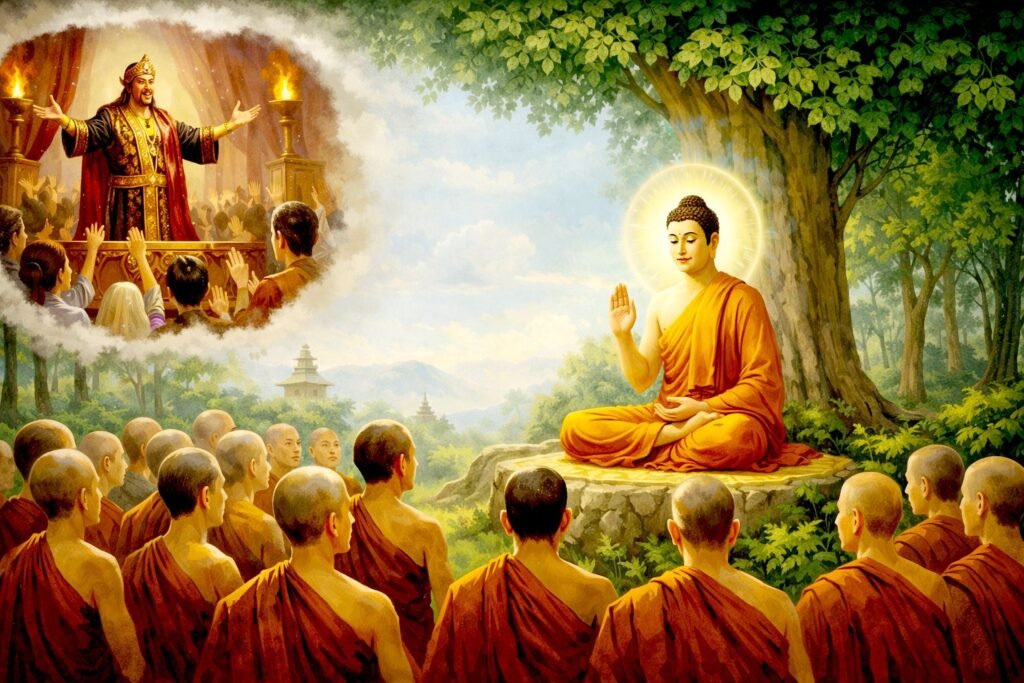
The Buddha teaching monks. The contrast between genuine spiritual humility and self-proclaimed spiritual authority reflects the central theme of the Sappurisa Sutta (MN 113).
I. Introduction: The Problem of Conceit in the Spiritual Life
In many religious and philosophical traditions, the path of spiritual practice is often understood as a process of inner transformation aimed at overcoming the self-centered tendencies of human beings. In Buddhism, however, the ultimate goal of the spiritual life is not merely the accumulation of knowledge or moral virtues, but liberation from the various forms of attachment associated with the sense of self. For this reason, Buddhist scriptures frequently emphasize the danger of conceit (māna)—a psychological state in which individuals place themselves above others through comparison and evaluation.
Yet an important paradox arises within the spiritual life: even the qualities considered most noble—such as purity of moral conduct, extensive knowledge of the teachings, or achievements in meditation—can become the basis for a subtler form of conceit. When these qualities are regarded as evidence of one’s superiority, they may unintentionally reinforce a sense of self-importance, leading practitioners to look down upon or disparage others. In such cases, spiritual accomplishments that were expected to weaken the sense of self instead become the very means through which the self reasserts itself in a new and more refined form.
This phenomenon is not merely a matter of moral concern; it also carries significant psychological implications. It reveals that the sense of self does not always manifest in crude forms such as the pursuit of power or material desire. In many situations, the self can conceal itself behind values that society and religion regard as admirable. For this reason, identifying the subtle forms of conceit that may arise within the spiritual life becomes an important task in understanding the path of practice taught by the Buddha.
One early Buddhist text that addresses this issue directly and explicitly is the Sappurisa Sutta. Delivered at Jetavana in Sāvatthī, this discourse presents a distinction between two types of conduct: asappurisa dhamma (“the ways of the ignoble person”) and sappurisa dhamma (“the ways of the true person” or “noble person”). Through a series of concrete examples, the Buddha illustrates how a person may use his own qualities—such as social background, moral discipline, doctrinal knowledge, or meditative attainment—as grounds for self-exaltation and the disparagement of others. In such situations, although these qualities may in themselves be positive, the way they are employed reveals a psychological state governed by conceit.
By contrast, the Buddha also describes the figure of the “true person” (sappurisa)—someone who may possess admirable qualities yet does not regard them as a basis for comparison or self-glorification. Rather than treating his achievements as evidence of superiority, such a person understands these qualities simply as elements of the path of practice. This attitude of not identifying oneself with one’s own qualities constitutes the fundamental difference between the “ways of the ignoble person” and the “ways of the true person.”
This article seeks to examine how the Sappurisa Sutta (MN 113) identifies and critiques the phenomenon of subtle conceit within the spiritual life. By analyzing the structure and content of the discourse, it becomes clear that the text offers more than simple moral exhortations. Instead, it provides a profound psychological analysis of the ways in which the sense of self can re-emerge even in contexts that appear to transcend it. From this perspective, the Sappurisa Sutta is not merely a reminder of the importance of humility in spiritual practice, but also an important illustration of how early Buddhism understood and analyzed the nature of conceit within the search for liberation.
II. The Sappurisa Sutta in the Context of the Majjhima Nikāya
Within the corpus of early Buddhist scriptures, the Sappurisa Sutta belongs to the Majjhima Nikāya, the collection of “Middle-Length Discourses” in the Pāli Canon. Many discourses in this collection not only present the fundamental teachings of Buddhism but also reflect pedagogical dialogues between the Buddha and his disciples. In this context, the Sappurisa Sutta can be understood as a discourse intended to define the ethical and psychological standards of spiritual practice within the monastic community.
According to the canonical tradition, the discourse was delivered at Jetavana, the famous monastery located in the city of Sāvatthī, where the Buddha spent many rainy seasons teaching the monks. In this setting, the Buddha begins the discourse by announcing that he will explain two distinct modes of conduct: asappurisa dhamma (“the ways of the ignoble person”) and sappurisa dhamma (“the ways of the true person” or “noble person”). From the outset, this distinction reveals that the aim of the discourse is not to present abstract doctrines, but to analyze specific psychological tendencies that may arise within the spiritual life.
The term sappurisa plays a central role in the conceptual structure of the discourse. In the Pāli context, the word is often translated as “a true person,” “a noble person,” or “a person of genuine virtue.” However, its meaning extends beyond the idea of an ethical individual in a conventional sense. In many early Buddhist texts, sappurisa also implies a type of character shaped by a correct understanding of the nature of life and by freedom from psychological tendencies governed by the sense of self.
For this reason, when the Buddha speaks of “the ways of the ignoble person” and “the ways of the true person,” he is not merely describing two different forms of ethical behavior. Rather, he is pointing to two fundamentally different ways in which individuals may relate to their own qualities. A person may possess admirable qualities yet remain dominated by comparison and self-exaltation; another person may possess similar qualities yet not treat them as a basis for affirming the self.
The structure of the discourse clearly reflects this analytical purpose. The first part of the discourse presents a series of examples illustrating the “ways of the ignoble person.” In each case, the Buddha describes an individual who possesses a particular quality—such as noble birth, purity of moral conduct, extensive knowledge of the teachings, or achievements in meditation—but who uses these very qualities as grounds for comparison and contempt toward others. These examples are not intended to deny the value of such qualities; rather, they demonstrate how these qualities can become the foundation for a subtle form of conceit.
After describing the forms of asappurisa dhamma, the discourse proceeds to present corresponding examples of “the ways of the true person.” In these cases, an individual may possess the same qualities mentioned earlier, yet does not use them to elevate himself above others. Instead of regarding these qualities as evidence of superiority, the person understands them simply as elements of the path of practice. It is precisely this shift in perspective that creates the fundamental difference between the two forms of conduct the Buddha seeks to analyze.
From the perspective of textual structure, the Sappurisa Sutta illustrates a pedagogical method characteristic of many early Buddhist discourses. Rather than presenting abstract philosophical concepts, the Buddha frequently employs concrete examples arranged in a parallel and repetitive pattern. This method not only makes the teaching easier for listeners to remember, but also highlights the contrast between the two psychological states being described. In the case of the Sappurisa Sutta, this structure is particularly effective in illustrating the difference between possessing a quality and identifying oneself with that quality.
Through this clear structure and method of concrete analysis, the Sappurisa Sutta offers more than a moral exhortation toward humility in the spiritual life. It also opens a deeper perspective on how subtle psychological tendencies may arise even within a religious environment. From this textual foundation, we can proceed to examine how the discourse describes the specific forms of asappurisa dhamma, thereby illuminating the mechanisms through which subtle conceit may arise in the life of spiritual practice.
III. The Ways of the Ignoble Person: When Spiritual Qualities Become the Source of Conceit
After introducing the distinction between asappurisa dhamma (“the ways of the ignoble person”) and sappurisa dhamma (“the ways of the true person”), the Sappurisa Sutta proceeds to present a series of concrete examples illustrating how admirable qualities within the spiritual life can become the basis for a subtle form of conceit. What is particularly noteworthy in this section is that the Buddha does not directly criticize the qualities themselves. Instead, he focuses on the psychological attitude that individuals may develop when they possess such qualities.
One of the first examples mentioned in the discourse concerns the issue of social background. The Buddha describes a situation in which a person is born into a noble family or belongs to a socially respected class. Rather than seeing this as a contingent aspect of one’s circumstances, the individual uses it as a basis for self-exaltation and for looking down upon those of lower birth. In this case, the problem does not lie in social origin itself, but in the way it is employed to reinforce a sense of personal superiority.
Another example addressed in the discourse concerns the observance of moral discipline. A monk may carefully observe the precepts, live in purity, and faithfully follow the rules of the monastic community. However, instead of understanding moral discipline as a means of cultivating mindfulness and liberation, he begins to compare himself with others, thinking: “I observe the precepts better than they do.” When this attitude arises, moral discipline—originally the foundation of monastic life—is transformed into an instrument of self-exaltation. At that very moment, a valuable ethical quality becomes the basis for conceit.
The discourse also extends this analysis to the domain of knowledge. A monk may be highly learned, well-versed in many scriptures, and capable of explaining the teachings with great eloquence. Yet if this knowledge is used as evidence of personal superiority, it can give rise to an attitude of disdain toward those who are less learned. In such a case, knowledge of the Dhamma—normally regarded as an important element of the path—becomes a means through which the sense of self asserts its position.
Another subtle form of conceit mentioned in the discourse concerns meditative attainment. Within the Buddhist tradition, deep states of meditation (jhāna) are often regarded as important accomplishments in the life of spiritual practice. Nevertheless, the Buddha points out that even these meditative experiences can become grounds for comparison. A practitioner may think that he has attained deeper or more refined states of meditation than others. When such thoughts arise, meditation no longer functions simply as a means toward liberation but becomes a factor reinforcing the sense of self.
These examples demonstrate that conceit does not necessarily have to be associated with worldly elements such as power, wealth, or social status. In many cases, conceit may arise precisely within those areas that people regard as the most noble aspects of the spiritual life. This makes the phenomenon of conceit within a religious environment particularly subtle, since it can conceal itself behind qualities that both society and religion regard as admirable.
An important point in the discourse’s analysis is that the qualities mentioned—social background, moral discipline, knowledge, or meditative attainment—are not regarded as wrong in themselves. On the contrary, they may all be positive elements within the life of practice. The problem arises only when individuals begin to use these qualities as a basis for comparison and for affirming their own superiority. At that moment, these qualities no longer function as supports for liberation but instead become factors reinforcing the feeling that “I am better than others.”
From this perspective, asappurisa dhamma does not refer to the absence of good qualities. Rather, it describes a psychological condition in which such qualities are placed within a structure of comparison. Individuals no longer perceive them as elements of the path of practice but as signs confirming their own worth. This subtle shift in perception transforms admirable qualities into the foundation of conceit.
By presenting these examples, the Sappurisa Sutta reveals a profound understanding of the psychology of the spiritual life. The discourse shows that the path does not merely require the development of ethical and intellectual qualities; it also requires awareness of the ways in which the sense of self can infiltrate the very achievements of that path. From this point, the discourse proceeds to its next stage of analysis, describing the “ways of the true person,” in which the Buddha presents a completely different attitude toward the qualities of spiritual practice.
IV. The Ways of the True Person: When Qualities No Longer Nourish the Sense of Self
After describing the various forms of asappurisa dhamma (“the ways of the ignoble person”), the Sappurisa Sutta proceeds to present a series of corresponding cases illustrating what the Buddha calls sappurisa dhamma (“the ways of the true person”). What is particularly noteworthy in this section is that the qualities mentioned are almost entirely the same as those presented in the previous examples. The difference, however, lies not in the qualities themselves but in the way the practitioner relates to them.
In the case of sappurisa dhamma, a person may possess admirable qualities—such as noble birth, purity in moral discipline, extensive knowledge of the teachings, or attainments in meditation—yet does not regard them as a basis for affirming personal worth. Instead of using these qualities as signs of superiority, the individual understands them simply as elements of the spiritual path. This shift in perspective fundamentally transforms the psychological meaning of these qualities.
For example, a person may be born into a family that is respected in society. However, rather than seeing this as evidence of being superior to others, such a person understands that birth is merely a condition of circumstance. It is not a valid basis for judging the value of a human being. With this attitude, social background no longer becomes a foundation for comparison or self-exaltation.
Similarly, in the context of moral discipline, a monk may observe the precepts with purity and live carefully according to the regulations of the monastic community. Yet he does not treat his own observance of discipline as a reason to look down upon others. Instead, moral discipline is understood simply as a natural component of the path of practice. When viewed in this way, the precepts no longer function as instruments through which the sense of self asserts its position.
The same principle applies to knowledge of the teachings. A person may be highly learned and deeply familiar with the scriptures, yet does not regard such knowledge as evidence of personal superiority. In the attitude of the “true person,” understanding is not a means of establishing hierarchy among individuals but a tool for comprehending the nature of life and the path to liberation. When knowledge is placed in this context, it no longer serves self-exaltation but becomes a support for awareness.
Even meditative attainments are regarded in a similar spirit. In many religious traditions, profound spiritual experiences can easily become the basis for feelings of specialness or superiority. However, in the perspective of the “true person,” meditative states are not signs of being better than others; they are simply stages within the process of practice. They do not constitute one’s identity, nor do they provide grounds for comparison with others.
Through these examples, the discourse demonstrates that the difference between asappurisa dhamma and sappurisa dhamma does not lie in whether positive qualities are present or absent. In both cases, the same qualities may exist. The true distinction lies in how individuals relate to these qualities within their own minds. When such qualities become the basis for comparison and self-exaltation, they lead to the “ways of the ignoble person.” Conversely, when they are understood merely as elements of the path of practice and are not identified with the self, they become expressions of the “ways of the true person.”
From this perspective, the analysis presented in the Sappurisa Sutta reveals a subtle understanding of the nature of conceit. The discourse does not merely warn against the crude manifestations of ego; it also demonstrates how the sense of self can reappear even in contexts that seem to have transcended it. For this reason, sappurisa dhamma does not simply consist in possessing moral or spiritual qualities, but in the capacity not to identify oneself with those qualities.
Through this approach, the discourse opens a profound perspective on the spiritual life. The path of practice requires not only the development of wholesome qualities but also a continuous awareness of how the sense of self may infiltrate the very achievements of that path. From this point, we can proceed to examine more deeply the phenomenon of subtle conceit in the spiritual life, particularly in situations where spiritual values may inadvertently become the foundation for the affirmation of the self.
V. Subtle Conceit and the Psychology of the Spiritual Practitioner
The analyses presented in the previous sections show that the Sappurisa Sutta does not merely offer moral advice concerning humility. When read in its full structure, the discourse can also be understood as a subtle investigation into the psychology of the spiritual life. By describing the cases of asappurisa dhamma and sappurisa dhamma, the text illuminates an important paradox: the very qualities of spiritual practice can become the foundation for a more refined form of conceit.
In ordinary worldly life, conceit is often associated with easily recognizable factors such as power, wealth, or social status. These forms of ego are relatively easy to identify because they are connected with visible signs of success. In a religious context, however, the sense of self does not necessarily manifest in such direct ways. Instead, it may appear in more subtle forms, when the values of the spiritual life themselves become the basis for comparison among individuals.
A person may renounce wealth, status, and worldly ambitions, yet still retain another form of ego—the ego of the spiritual practitioner. This form of identity is no longer built upon the standards of worldly life but upon the standards of religious life: the purity of moral discipline, the depth of meditation, or the extent of one’s understanding of the teachings. When these elements become the basis for comparison with others, they may give rise to a sense of spiritual superiority.
It is precisely at this point that the analysis of the Sappurisa Sutta becomes particularly significant. The discourse shows that conceit does not always appear in crude or obvious forms. Rather, it can re-emerge in more refined ways when individuals begin to identify themselves with the qualities of spiritual practice. When a person thinks that he understands the teachings more deeply than others, meditates more successfully than others, or lives more purely than others, a structure of comparison has already formed within the mind. This structure of comparison is the very foundation of conceit.
This phenomenon is not limited to Buddhism alone. Throughout the history of many religious traditions, one can observe the emergence of individuals who are regarded by their communities as possessing a special form of spiritual authority. Such positions often develop around religious experiences, doctrinal knowledge, or abilities considered extraordinary. In many cases, the reverence and expectations of the community itself may contribute to the formation of religious power structures centered around such individuals.
However, when spiritual authority is constructed primarily upon personal assertion without being accompanied by corresponding ethical and intellectual qualities, it can become an expression of subtle conceit. In such situations, religious values—originally intended to weaken the sense of self—may unintentionally become the very means through which the self reconstructs itself. This phenomenon not only reflects an individual problem but also reveals how structures of religious authority can form around claims of spiritual legitimacy.
For this reason, the analysis offered by the Sappurisa Sutta carries significance beyond the historical context of the early Buddhist monastic community. It demonstrates that the spiritual path always contains a paradox: the very achievements of the path may simultaneously become subtle obstacles when they are used to reinforce the sense that “I am superior to others.” In such cases, the problem lies not in the spiritual qualities themselves but in the way they are integrated into the structure of the self.
From this perspective, “subtle conceit” is not merely a simple moral mistake but a complex psychological structure. It arises when individuals begin to construct their identity around the accomplishments of spiritual practice. Once such an identity is formed, every comparison with others can become an opportunity to reaffirm one’s own position.
For this reason, the warning conveyed by the Sappurisa Sutta does not simply emphasize humility as a moral virtue. More profoundly, it suggests that recognizing these subtle forms of conceit is an essential part of the path of practice. If the sense of self can reappear even within the achievements of the spiritual path, then awareness of these psychological structures becomes a crucial condition for ensuring that the path truly leads toward liberation.
VI. The Philosophical Significance of the Sappurisa Sutta
When read in its full structural context, the Sappurisa Sutta is not merely a discourse about ethical attitudes within the spiritual life; it also contains a profound philosophical significance. Through the distinction between asappurisa dhamma (“the ways of the ignoble person”) and sappurisa dhamma (“the ways of the true person”), the discourse points to a fundamental issue in spiritual life: the relationship between the qualities of the path of practice and the structure of the self.
In many systems of thought, moral and intellectual virtues are often regarded as signs of personal perfection. From the Buddhist perspective, however, these qualities are not the foundation for asserting a more elevated self. Rather, they are simply elements of the path that leads to the cessation of attachment. For this reason, when qualities such as moral discipline, knowledge, or meditative attainment are used to reinforce the sense that “I am superior to others,” they are placed within a psychological structure entirely contrary to the goal of liberation.
A distinctive aspect of the analysis presented in the Sappurisa Sutta is that the discourse does not deny the value of spiritual qualities. A person may indeed live a life of purity, possess extensive knowledge of the teachings, or attain profound states of meditation. Yet what is crucial is that these qualities are not regarded as the essence of a person’s identity. When individuals begin to identify themselves with such qualities, the sense of self reappears in a subtler form.
From a philosophical standpoint, this issue can be understood as a consequence of the principle of non-self (anattā). If there is no fixed and independent self, then the qualities of spiritual practice cannot constitute the essence of an individual. They are merely states or conditions that arise within the process of practice. When these states are understood as phenomena that arise and pass away, they no longer function as a basis for affirming the self.
Within this framework, the distinction between asappurisa dhamma and sappurisa dhamma can be understood as two different ways in which individuals relate to their own qualities. In the case of asappurisa dhamma, these qualities are placed within a structure of identification: the practitioner regards them as evidence of personal worth. In the case of sappurisa dhamma, by contrast, these qualities are understood simply as elements of the path of practice and are not identified with the self. This difference in perception gives rise to two entirely different attitudes toward the same reality.
The philosophical significance of this analysis becomes particularly clear when viewed within the broader framework of Buddhist thought. One of the central aims of the path of practice is the cessation of clinging (upādāna)—the tendency to grasp aspects of experience as if they were “mine” or “myself.” When a person clings to the accomplishments of the spiritual life, those very accomplishments may become new objects of attachment. In such cases, the sense of self does not disappear but merely transforms into a subtler form.
From this perspective, the Sappurisa Sutta demonstrates that letting go of the self is not limited to abandoning the coarse attachments of worldly life. It also involves relinquishing attachment to the very achievements of the spiritual path. This insight explains why many later Buddhist traditions emphasize that even profound meditative experiences should not be regarded as signs of personal superiority. They are simply stages along the path, not the identity of the practitioner.
For this reason, the discourse can be understood as a philosophical reminder concerning the nature of the path to liberation. Progress in the spiritual life does not lie in accumulating qualities in order to construct a spiritual identity, but in the capacity not to identify oneself with those very qualities. Only when the qualities of practice cease to serve as a foundation for affirming the self can they truly function as conditions leading toward liberation.
VII. Conclusion: Conceit and the Deep Challenge of the Spiritual Path
The analyses presented in the previous sections show that the Sappurisa Sutta does not merely offer a set of moral instructions for the life of spiritual practice. When read in its full structural context, the discourse can be understood as a profound recognition of one of the most fundamental challenges of the spiritual path: the tendency of the self to reassert itself even within contexts that aim at liberation from the self.
In many other discourses of early Buddhism, the obstacles on the path of practice are often described in familiar forms such as the five hindrances (nīvaraṇa), the attraction of sensual pleasures, or the three poisons of greed, hatred, and delusion. These factors are regarded as powerful impediments to the development of the spiritual life. Yet the analysis offered in the Sappurisa Sutta suggests that even when these coarse obstacles have been restrained to some degree, the path of practice is not entirely free from the danger of attachment.
The deeper danger lies in the fact that the sense of self can re-emerge in more subtle forms. When the qualities of the spiritual life—such as moral discipline, knowledge of the teachings, or meditative attainment—become the basis for comparison with others, the self can reconstruct itself within the very achievements of the spiritual path. For this reason, the teaching of the discourse does not merely encourage the cultivation of wholesome qualities; it also emphasizes the importance of constant vigilance regarding the tendency to identify oneself with those qualities.
From this perspective, the Sappurisa Sutta can be understood as a profound warning about the nature of the spiritual life. The path toward liberation is not only a process of abandoning the coarse obstacles of worldly existence, but also a process of recognizing and relinquishing the more subtle forms of attachment that may arise within the spiritual life itself. Only when the qualities of the path are no longer used as a basis for affirming the self can they truly function as conditions leading to liberation.
In this sense, the message of the Sappurisa Sutta retains its relevance for spiritual life in every age. The discourse reminds us that progress on the path does not lie in accumulating signs of spiritual accomplishment, but in the capacity to maintain a deep awareness of the subtle tendencies of the self. It is precisely this awareness that ensures that the spiritual path genuinely leads toward liberation, rather than becoming a new form of self-affirmation.
Related Studies:
Bibliography
Anālayo, Bhikkhu. A Comparative Study of the Majjhima-nikāya. Taipei: Dharma Drum Publishing, 2011.
Bodhi, Bhikkhu, trans. The Middle Length Discourses of the Buddha: A Translation of the Majjhima Nikāya. Boston: Wisdom Publications, 1995.
Bodhi, Bhikkhu. The Noble Eightfold Path: Way to the End of Suffering. Kandy: Buddhist Publication Society, 1994.
Gethin, Rupert. The Foundations of Buddhism. Oxford: Oxford University Press, 1998.
Harvey, Peter. An Introduction to Buddhism: Teachings, History and Practices. 2nd ed. Cambridge: Cambridge University Press, 2013.
Ñāṇamoli, Bhikkhu, and Bhikkhu Bodhi, trans. The Middle Length Discourses of the Buddha: A New Translation of the Majjhima Nikāya. Boston: Wisdom Publications, 2005.
Williams, Paul. Mahayana Buddhism: The Doctrinal Foundations. 2nd ed. London: Routledge, 2009.