
Le Hoang Da
Buddhist Scholar
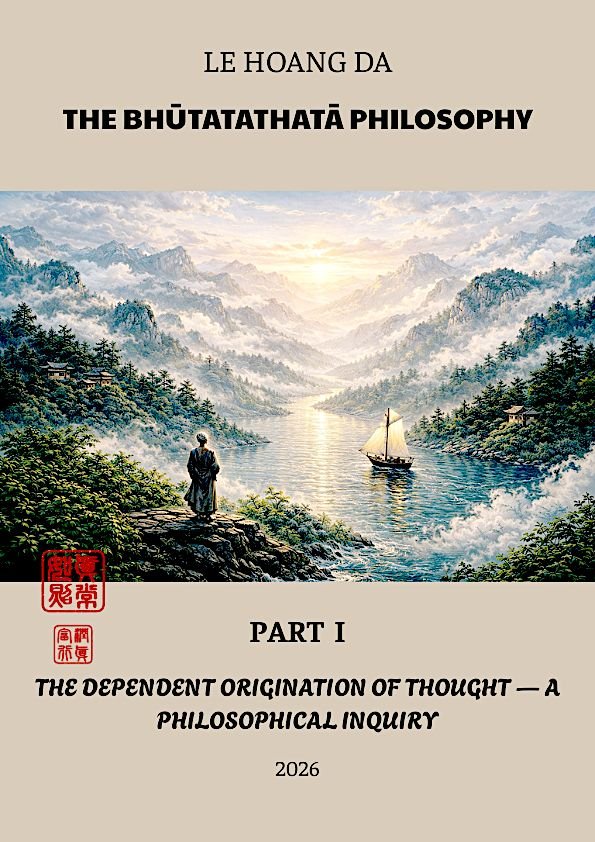
Cover image for The Dependent Origination of Thought: A Philosophical Inquiry (Bhūtatathatā Philosophy, Part I) — depicting a contemplative figure overlooking a river landscape, symbolizing the interdependent flow of cognition and reality.
Abstract
The Principle of Dependent Origination of Thought proposes that all forms of thought, creation, imagination, and evolution arise not from independent origin, but from interdependent conditions of existence. Rooted in early Buddhist epistemology and informed by modern phenomenology, this inquiry reconsiders human cognition as a process of co-arising rather than individual invention.
Through a series of aphoristic formulations — ranging from the “Paper and Boat” metaphor to a critique of “absolute creation” — this study outlines a conceptual framework that brings together ontology, epistemology, and ethics within a unified vision of interbeing. Within this perspective, even the most refined acts of creativity may be understood as reconfigurations of conditions that have always already been present within nature. Human beings, therefore, appear less as autonomous creators than as participants in a broader process of manifestation.
Rather than advancing a definitive philosophical program, this work invites a reconsideration of anthropocentric assumptions in accounts of thought and creativity. In doing so, it suggests that a deeper understanding of cognition may be grounded in humility, relational awareness, and an ecological sensitivity to the conditions that make thinking possible. In this sense, the inquiry also gestures toward a contemplative dimension, in which cognition is understood as both dependent and luminous in its unfolding.
Preface — A New Way of Seeing Thought
For centuries, philosophy has sought the origin of thought. From Descartes’ Cogito to Hegelian dialectics, much of the Western tradition has proceeded from the assumption that thinking arises from an autonomous subject — an “I” capable of creating, inventing, and defining reality. Yet such a premise may also give rise to a subtle illusion: that cognition can exist independently from the totality of conditions that sustain it.
The inquiry into the Dependent Origination of Thought begins by reconsidering this assumption. It suggests that cognition is not self-originating, but conditioned, relational, and co-arising with the world. Every discovery, invention, or act of imagination may be understood not as an emergence from nothingness, but as a reconfiguration of what is already present within the fabric of nature. Just as fire cannot be discovered without the latent presence of heat, so too thought does not arise without the prior network of conditions that make it possible.
Emerging at the intersection of Buddhist dependent origination (paṭiccasamuppāda) and modern epistemology, this perspective invites a shift in orientation — not toward transcendence above the world, but toward a deeper attunement within it. In recognizing the interdependence of thought, one may begin to rediscover humility, compassion, and an ecological sensitivity to the conditions of cognition. To understand thought, in this sense, is not to claim mastery over it, but to see through it — to observe how the world becomes intelligible through the very processes that constitute awareness.
In this light, the Principle of Dependent Origination of Thought may be approached both as a critical reflection on modern assumptions of intellectual autonomy and as a renewed engagement with older insights into relational being. It does not aim to establish a final doctrine, but to recall a simple insight: that no truth, however profound, arises apart from the web of conditions from which it emerges.
Proposition I — The Myth of Invention and the Mirage of Absolute Creation
Reconsidering the notion of human originality in light of interdependence.
Human civilization has long celebrated invention as the summit of intellect and creativity. We speak of the “discoverer” of fire, the “inventor” of electricity, the “creator” of art, as though these phenomena were brought forth ex nihilo — from nothing. This inherited image of invention, shaped in part by Enlightenment thought, tends to place the human being at the center of becoming: as maker, origin, and even a kind of demiurge of reality.
Yet, upon closer examination, such a view may obscure a more fundamental insight — that no invention, however ingenious, arises apart from conditions already present within nature. Fire is not created by human hands; it is revealed through friction. Light does not begin with the electric bulb; it is encountered long before in lightning. Even the flight of aircraft may be seen as echoing patterns already inscribed in the movement of air.
From the perspective of dependent origination, what is called “invention” may be more fruitfully understood as a mode of disclosure — a process through which consciousness reorganizes and brings into view what nature already contains. In this sense, “creation” does not imply emergence from nothingness, but the reconfiguration of conditions that have always been available within the field of experience.
Seen in this way, the figure of the “creative genius” appears less as an isolated originator than as a point of resonance within a wider network of conditions. The artist, the scientist, and the contemplative alike participate in processes that exceed individual authorship. What is expressed through them may be understood not as the production of something entirely new, but as the articulation of relations that were already latent.
Accordingly, the idea of “absolute creation” becomes difficult to sustain. Within the framework of dependent origination (paṭiccasamuppāda), even thought itself appears as conditioned, contingent, and relational — arising within, and inseparable from, the broader web of existence.
Proposition II — From Cogito to Paṭiccasamuppāda
Reinterpreting the Cartesian subject through dependent origination.
When René Descartes articulated the proposition Cogito, ergo sum — “I think, therefore I am” — it came to occupy a central place within the development of Western philosophy. From this formulation, the thinking subject was often taken as a point of certainty: an “I” that appears to ground knowledge, creation, and the interpretation of reality. In this sense, thought has frequently been understood as prior to being, and cognition as a basis for selfhood.
Yet, this formulation may also be reconsidered in light of the conditions that make thinking possible. The very act of thinking presupposes language, perception, memory, culture, biological processes, and a world in which cognition can arise. Without these conditions, what is called “thinking” becomes difficult to sustain as an independent foundation. The “I” that appears as origin may instead be approached as one of the most conditioned aspects of experience.
From the perspective of dependent origination (paṭiccasamuppāda), the Cogito may be read differently. To think is not necessarily to establish existence, but to participate in a network of conditions through which experience unfolds. Thought, in this sense, does not function as the origin or proof of being, but as a relational event within it. Consciousness arises interdependently, conditioned by contact, feeling, and perception — as expressed in the classical formulation: “Because there is this, that comes to be.”
Seen in this way, Descartes’ formulation may be approached not as a final statement, but as a point of departure for further reflection. One possible rearticulation might be expressed as follows:
“Thinking occurs within conditions that exceed the individual subject.”
To inquire into the nature of self, therefore, is not to isolate the mind as an independent entity, but to attend to the conditions through which cognition arises — the body, the senses, the environment, and the broader field of existence. Within this orientation, philosophical reflection may shift from a focus on self-grounding rationality toward an awareness of co-dependent arising. The subject no longer appears as standing apart from the world, but as participating within a dynamic and relational whole.
Proposition III — The Principle of Dependent Origination of Thought
Articulating the conditional nature of cognition.
The Principle of Dependent Origination of Thought proposes that thought does not arise independently. Each act of cognition — from perception to invention — may be understood as conditioned by prior impressions, experiences, and the broader structures of reality. In this sense, thinking does not emerge in isolation, but unfolds within an ongoing process shaped by multiple interdependent factors.
From this perspective, the notion of “absolute creation” becomes increasingly difficult to sustain. What appears as a “new idea” may instead be approached as a reconfiguration of elements already present within nature and consciousness. Even imagination — often regarded as the highest expression of human creativity — operates not in a void, but within the structuring conditions of memory, language, and sensory experience.
In its philosophical formulation, the principle may be expressed as follows:
“One cannot think of what has never existed within the field of cognition.”
To invent, then, is to rearrange; to imagine is to recall in a transformed or more subtle form. Human creativity, in this light, may be understood as dependent creativity — an interplay between what is already given and what has not yet been explicitly recognized, between perception and the disclosure of new relations.
Accordingly, the Principle of Dependent Origination of Thought may be approached as a bridge between epistemology and ontology. It suggests that knowing is not an isolated event, but a phenomenon emerging within a broader network of conditions through which the world becomes intelligible. Just as a flame depends upon air, fuel, and space, so too thought arises in dependence upon a multiplicity of mental and material conditions.
The implications of this perspective extend beyond metaphysical reflection. Ethically, it may encourage a form of humility — an awareness that what is taken as individual intelligence is inseparable from the conditions that make it possible. Environmentally, it invites a sense of reverence toward the natural world, insofar as it constitutes the very matrix within which cognition arises. In a more contemplative register, it may also give rise to a form of gratitude, as cognition itself is recognized as participation within a larger field of interdependent becoming.
Proposition IV — Redefining Creativity and Invention in the Light of Dependent Origination of Thought
Reconsidering creativity as relational rather than autonomous.
Modern civilization has often elevated creativity as a defining mark of human superiority. To invent is frequently understood as a form of transcendence; to create, as an assertion of mastery over nature. Yet such confidence may also obscure a more fundamental insight: that no human creation, however remarkable, arises outside the network of conditions that makes it possible.
From the perspective of dependent origination, creativity may be approached differently. Rather than the production of the unprecedented, it can be understood as the recognition and articulation of relationships that were previously unnoticed. What appears as a “new” invention may instead be seen as a reconfiguration of possibilities already present within the structures of nature and experience. The steam engine, for instance, reflects processes already latent in the behavior of heated water; the internet may be read as echoing patterns of connectivity found within neural systems. Even artificial intelligence can be interpreted as an externalization of cognitive processes that are themselves conditioned and relational.
In this light, invention no longer appears as domination over nature, but as participation within it. The figure of the inventor shifts accordingly — from originator to mediator, from autonomous creator to a point of convergence within multiple conditions. The notion of “absolute originality” becomes increasingly difficult to maintain when one attends to the ways in which every insight, design, or scientific formulation depends upon prior discoveries, cultural frameworks, and biological capacities.
Seen in this way, the distinction between “creator” and “created” may be reconsidered. Creativity does not necessarily assert individuality in isolation, but may instead reveal patterns of connectedness. The artist, the engineer, and the scientist alike participate in processes through which relations become intelligible — processes that exceed any single point of authorship.
If this perspective is taken seriously, the orientation of invention itself may begin to shift. Rather than being directed toward control or exploitation, creative activity may come to be understood as a form of attunement — a way of working with, rather than against, the conditions that sustain it. In this sense, creativity may be seen less as an effort to conquer the world than as an attempt to enter into a more harmonious relation with it.
Proposition V — Ethical and Ecological Dimensions of the Principle of Dependent Origination of Thought
Exploring the ethical implications of interdependent cognition.
If thought is understood as interdependent, then ethical reflection may also require reconsideration. Rather than resting upon the assumption of an autonomous self, the moral life can be approached as arising within a network of relations, in which actions unfold and reverberate across multiple conditions. From this perspective, what is called “ethical responsibility” may be seen less as adherence to abstract rules and more as sensitivity to the interdependence that sustains both self and other.
Within the history of philosophy, ethics has often been articulated as a system of principles imposed upon the individual. Yet when the self is understood as dependently arisen, morality may be approached differently — not primarily as obligation, but as a form of awareness. In such a framework, compassion does not appear merely as an added virtue, but as a possible response emerging from the recognition of relational existence. To understand interdependence, in this sense, is to recognize that actions cannot be fully isolated from the conditions they affect.
This perspective also extends toward an ecological dimension. The distinction between mind and environment may be reconsidered, insofar as both participate in a shared field of dependent origination. Cognitive processes arise in relation to environmental conditions, just as environmental transformations shape the possibilities of cognition. In this light, ecological degradation may be understood not only in material terms, but also as affecting the conditions through which experience becomes intelligible.
Accordingly, contemporary environmental challenges may be approached not solely as political or scientific issues, but also as questions concerning how interdependence is perceived and enacted. From the standpoint of dependent origination, ethical reflection may invite a form of humility — an acknowledgment that human life unfolds within, rather than above, the conditions that sustain it. To live ethically, then, may involve attending to the ways in which thought, speech, and action participate in a broader web of relations.
In this sense, ethical inquiry does not necessarily prescribe fixed rules, but may instead reveal patterns of interconnection through which certain forms of action become more or less sustainable. What is often described as “good” may be understood as that which supports the continuity of relational conditions, while “harm” may be associated with their disruption. Such an approach does not impose morality from without, but seeks to understand how ethical responsiveness may arise from the recognition of interdependence itself.
Proposition VI — The Future of Human Thought: From Individual Intelligence to Relational Awareness
Reconsidering the trajectory of cognition in light of interdependence.
Human history may be read, in part, as the gradual development of intelligence toward forms of self-recognition. From early tools to contemporary scientific theories, thought has not only increased in complexity but has also deepened its capacity for reflection. Yet even within these developments, cognition is often understood as confined within the boundaries of the individual mind — as though thinking begins and ends within a single organism.
From the perspective of dependent origination, this assumption may be reconsidered. Consciousness need not be approached as a property of an isolated subject, but may instead be understood as emerging from a convergence of conditions. In this sense, cognition does not belong exclusively to the individual, but arises within relational processes that exceed any single point of reference.
Within contemporary contexts, developments in fields such as artificial intelligence, neuroscience, and physics have increasingly emphasized patterns of interconnection, distribution, and systemic dependence. While these domains differ in method and scope, they may be seen as converging upon a shared insight: that cognition is not reducible to isolated units, but unfolds across networks of relations. In this light, thought may be approached not as a self-contained function, but as a process shaped by interdependence.
Accordingly, the future of philosophical reflection may not lie solely in extending the capacities of isolated reasoning, but in attending more closely to the conditions through which knowing arises. Rather than asking only “What can be known?”, inquiry may shift toward examining how cognition is conditioned, sustained, and transformed within a broader field of relations.
Within such a perspective, the boundaries of the self may also be reconsidered. The distinction between “individual” and “world” becomes less rigid when cognition is understood as arising through interdependent processes. What is experienced as “self” may be seen as a provisional configuration within a larger field of becoming, rather than as a fixed and autonomous center.
This orientation does not necessarily prescribe a definitive future, but suggests a possible direction of inquiry: one in which thought is approached less as a property to be possessed, and more as a process to be understood in relation to the conditions that sustain it. In this sense, the study of cognition may open toward a more contemplative dimension — not as a rejection of technological development, but as a complementary effort to understand how awareness itself unfolds within the wider fabric of existence.
Proposition VII — The Return to Silence: Thought as Contemplation
Approaching the contemplative limits of philosophical reflection.
Every philosophy, when pursued to its limits, may be said to approach a kind of silence. Such silence need not be understood as the absence of thought, but rather as a dimension in which thought encounters what exceeds its capacity to fully articulate. Within this horizon, cognition may be seen less as a process of accumulation, and more as a movement that gradually relinquishes its own claims.
From the perspective of dependent origination, this trajectory can be read as a shift in how thought relates to itself. Conceptual distinctions — between subject and object, knower and known — may be recognized as arising within conditions, rather than as fixed foundations. As attention turns toward these conditions, the activity of thought may become less oriented toward grasping and more toward observation.
In this sense, what is here described as “silence” does not negate cognition, but may be understood as a transformation in its mode of operation. Knowing does not disappear; rather, it becomes less assertive, less inclined to stabilize itself in rigid distinctions. What remains is a form of awareness in which experience unfolds without the same compulsion to define, possess, or divide.
To approach such a mode of awareness is not necessarily to withdraw from the world, but to encounter it differently — with a reduced tendency to impose conceptual structures upon it. Within this orientation, understanding may take on a contemplative character, in which thought does not cease, but becomes more transparent to the conditions from which it arises.
Seen in this way, the inquiry into the dependent origination of thought does not conclude with a final proposition, but with a shift in orientation. Rather than offering a definitive answer, it may open a space for reflection in which the limits of conceptual thought become apparent. In that space, what is often described as “silence” may be understood not as an endpoint, but as a mode of attentiveness in which philosophical reflection continues in a different form.
Appendix — The Nine Aphorisms of Dependent Origination of Thought
Summarizing the principle through concise formulations.
The following aphorisms present key aspects of the Principle of Dependent Origination of Thought in a condensed and reflective form. Each formulation highlights a particular dimension of the insight that thought, invention, and creation do not arise independently, but within a network of conditions.
Taken together, these aphorisms may be read as a conceptual summary of the inquiry developed throughout this work, offering a more distilled expression of its central orientation.
1. The Paper and the Boat
“If there were no paper, not only would no paper boat be made, but even the idea of such a boat could never exist.”
2. The Relativity of Invention
“If there were no Newton, the apple would still fall; if there were no Edison, lightning would still flash; if there were no musical instruments, the wind would still sing through the leaves.”
3. The Law of Cognitive Containment
“You cannot think of what has never existed within the field of cognition.”
4. The Reconstruction of the Known
“Even imagination and creation are reconstructions — the reshaping of what has always been within experience.”
5. The Fire Analogy
“How could one ever invent fire if the nature of fire were not already present in nature?”
6. The Myth of Absolute Creation
“All inventions, however great, are acts of reconfiguration, not creation ex nihilo.”
7. The Humility of Humanity
“Human beings are not the masters of the universe, but the highest channels through which the universe manifests itself.”
8. The Ethics of Interbeing
“When we realize we are part of the web, morality ceases to be a rule and becomes awareness.”
9. The Cognitive Ecology Principle
“If the conditions that sustain life did not exist, the idea of evolution would be an illusion; we evolve only because nature evolves through us.”
Culminating Statement
A concluding reflection on the principle.
“Therefore, whether we speak of thought, invention, imagination, or evolution — all are but reconfigurations of what has existed since time immemorial, arising to meet the needs of each age. There is nothing absolutely new; only new awakenings.”
Archived Version (Zenodo DOI):
Le Hoang Da (2026). The Dependent Origination of Thought: A Philosophical Inquiry
👉 https://doi.org/10.5281/zenodo.19144715
Related Studies: