
Le Hoang Da
Buddhist Scholar
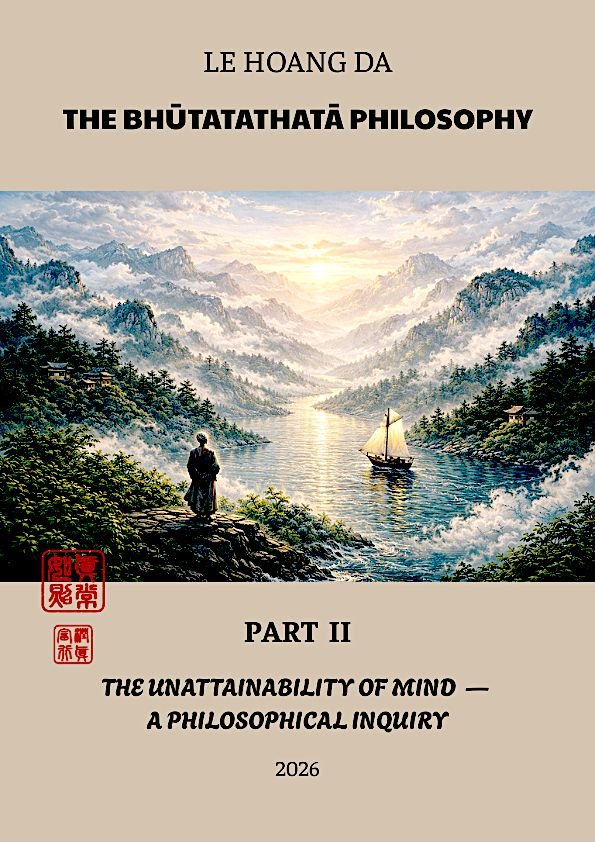
Cover image for The Unattainability of Mind: A Philosophical Inquiry (Bhūtatathatā Philosophy, Part II) — depicting a solitary contemplative figure overlooking a luminous river valley, symbolizing the dissolution of conceptual grasping and the quiet disclosure of awareness beyond thought.
Abstract — On the Ontological Status of Awakening
This treatise explores the ontological status of Awakening from a non-dual perspective, considering whether it may be understood as a form of irreducible reality—one that is not easily situated within conventional dualistic frameworks. Rather than approaching Awakening as a state attained through progressive effort, the present study tentatively examines the possibility that it may function as an intrinsic dimension of mind itself, within which what is commonly termed “ignorance” could be interpreted as a diminished or obscured mode of that same luminosity.
From this perspective, the familiar notion of a transition “from ignorance to Awakening” is reconsidered. It is suggested that such a transition may not represent a symmetrical or reversible movement between two opposing states, but rather an asymmetrical clarification—whereby certain conditions of obscuration give way to a more transparent mode of awareness. If this is the case, Awakening may not be subject to regression in the conventional sense, not because it is metaphysically isolated, but because the very framework of opposition begins to lose its coherence upon closer examination.
Accordingly, Awakening is not treated here as an object to be known, but as a condition that may underlie the possibility of knowing itself. It is approached not as an ontic entity among others, but as a ground-like dimension within which cognition unfolds, without necessarily being reducible to conceptual articulation.
Through a series of nine Propositions, this inquiry re-examines the relationship between ignorance, spiritual methods, and the luminous character of mind. Rather than positing ignorance and Awakening as strictly opposed substances, the analysis considers whether they might be more coherently understood as differing modalities within a single continuum of manifestation. Within such a framework, spiritual methods retain their provisional significance, yet their role may be reinterpreted as contingent upon conditions that are themselves subject to transformation.
The Appendix presents nine Aphorisms intended as concise reflections—symbolic and suggestive rather than definitive—offered to support a more direct engagement with the questions at hand. The metaphor of “pure gold” is employed not as a doctrinal claim, but as a heuristic device, pointing toward the possibility that what is most fundamental, once recognized, may not easily revert to its prior obscured form.
Preface — A Reflective Orientation
The present treatise turns toward a fundamental question concerning the ontological status of Awakening. Rather than approaching Awakening as a distant goal or the culmination of spiritual effort, this work explores the possibility that it may be more appropriately understood as an intrinsic dimension of mind itself.
From this perspective, Awakening is not framed as something to be attained, but as a mode of clarity that may already be present, though not always recognized. The familiar distinction between ignorance and Awakening is therefore reconsidered—not as a strict opposition between two separate states, but as a difference in the degree to which this underlying clarity is disclosed or obscured.
Within such a framework, terms such as “indestructible” are used with caution. They are not intended to assert an absolute metaphysical claim, but to suggest that what is most fundamental may not be subject to negation in the usual sense, insofar as the very structure of opposition begins to lose its coherence at this level of analysis.
The nine Propositions that follow aim to examine the relationship between ignorance, spiritual methods, and the luminous character of mind. Practices and methods are not dismissed; rather, their significance is considered in relation to the conditions under which clarity has not yet fully emerged. When such clarity becomes evident, the role of method may be understood differently—not as something to be maintained, but as something whose function has been fulfilled.
In this sense, the present Preface is offered not as a declaration, but as an invitation. The reflections that follow do not seek to establish a final position, but to open a contemplative space in which Awakening may be approached not as an endpoint, but as the very ground within which the search itself unfolds.
PROPOSITION I — On the One-Way Character of Awakening
1. Core Thesis
This proposition explores the possibility that Awakening, while often described as emerging in contrast to ignorance, may exhibit an asymmetrical or one-directional character.
It is suggested that when awareness becomes sufficiently clear to illuminate its own conditions, the structures that previously sustained obscuration may no longer operate in the same way. In this sense, what is termed “darkness” may not reappear as it once did, not because it has been destroyed as an independent entity, but because its conditions have been fundamentally altered.
2. Awakening as Non-Production
From the perspective developed in this treatise, Awakening is not approached as a state newly produced through effort or method. Rather, it may be more coherently understood as an intrinsic dimension of mind—one that is continuously present, though variably disclosed.
Accordingly, what is commonly described as a movement “from ignorance to Awakening” can be reconsidered as a process of unveiling rather than production: not the coming-into-being of something new, but the clarification of what was already operative, though not fully recognized.
3. On the Asymmetry of Illumination
The apparent one-directional character of Awakening may be clarified through the relation between illumination and obscuration:
- When awareness is limited, obscuration appears to persist.
- As awareness becomes more refined, such obscuration may diminish.
- When awareness becomes sufficiently transparent, the conditions that sustain obscuration may no longer be present in the same form.
Within this framework, obscuration does not function as an independent force capable of opposing illumination. Rather, it may be understood as dependent upon the absence or limitation of clarity. If so, the relationship between the two is not symmetrical: illumination does not merely counter obscuration, but transforms the very conditions under which obscuration appears.
4. Philosophical Implications
If Awakening is understood in this way, the notion of “regression” may require reconsideration. What is often described as a loss of clarity may not necessarily imply the disappearance of Awakening itself, but rather a shift in the conditions through which it is expressed or recognized.
Thus, Awakening may be interpreted not as a fragile attainment, but as a dimension of awareness that does not depend on fluctuation in the same way as ordinary cognitive states. Terms such as “indestructible” are therefore employed cautiously, to indicate not an absolute metaphysical assertion, but the possibility that what is most fundamental may not be subject to opposition in the usual sense.
5. On Irreversibility and Recognition
From this perspective, the irreversibility attributed to Awakening does not necessarily imply that experiential clarity is constant or uninterrupted. Rather, it may suggest that once certain structures of understanding have been seen through, they cannot be reinstated in exactly the same way.
What appears as “loss” may belong to the level of recognition, not to that which has been recognized. In this sense, Awakening may be understood less as a fixed state to be maintained, and more as a transformation in the way experience is structured—one that, once fully realized, may not simply revert to its prior form.
PROPOSITION II — On the “Golden Veil” Paradox
1. Core Thesis
This proposition examines the relationship between ignorance and Awakening through what may be termed the “golden veil” paradox.
It is suggested that what is commonly described as ignorance may not constitute an independent obstruction, but rather a provisional mode in which the underlying clarity of mind is not yet fully evident. From this perspective, the unveiling of Awakening does not involve the removal of a separate entity, but the transformation of how obscuration is understood.
2. The Nature of the Veil
Within this framework, the “veil” of ignorance is not treated as a distinct substance that conceals an otherwise separate reality. Rather, it may be interpreted as a diminished or obscured manifestation of the same underlying luminosity.
Accordingly, what appears to be “removed” in the process of Awakening may not be an actual barrier, but the misapprehension of concealment itself. The distinction between what is hidden and what is revealed becomes less stable upon closer examination.
3. On the Conditional Meaning of “Breaking Through”
Expressions such as “breaking through,” “refining,” or “overcoming” presuppose the presence of a real and substantial obstacle. However, if obscuration is dependent upon limited clarity rather than constituted as an independent entity, the meaning of such expressions may require reconsideration.
It may be suggested that as awareness becomes more transparent, the conceptual structure that supports the distinction between “breaker,” “barrier,” and “act of breaking” begins to dissolve. These distinctions do not necessarily vanish as empirical events, but they may lose their explanatory necessity within a non-dual framework.
4. Philosophical Implications
From this perspective, spiritual methods and practices retain their significance within a provisional context—namely, where clarity has not yet been fully disclosed. Their function may be understood as oriented toward the conditions under which obscuration appears.
However, if clarity becomes sufficiently self-evident, the role of such methods may be reinterpreted. They are not negated, but their necessity diminishes, as the framework that once required them is no longer operative in the same way.
5. On the Non-Dual Relation Between Gold and Veil
At a more fundamental level of analysis, the distinction between “gold” and “veil” may be understood as conceptually constructed rather than ontologically separate. The metaphor of “gold” is therefore not intended to designate a substance hidden beneath another, but to point toward a mode of understanding in which concealment and disclosure are no longer treated as opposites.
In this sense, what is described as the “veil” may be considered as that same luminosity not yet recognized in its full expression. When such recognition becomes clear, the distinction between “covering” and “covered” may no longer function in the same way, and the entire framework of concealment may be seen as provisional.
PROPOSITION III — On the Ineffability and Non-Objectifiability of Awakening
1. Core Thesis
This proposition considers the possibility that Awakening cannot be adequately understood as an object of knowledge.
Rather than standing as something to be grasped, it may be more coherently approached as a condition that underlies the very possibility of knowing. In this sense, attempts to conceptualize or objectify Awakening may transform it into something other than what is intended, thereby obscuring the dimension it seeks to articulate.
2. On the Limits of Objectification
Within conventional epistemic structures, an object is understood as that which stands in relation to a subject. However, if Awakening is considered as the condition that makes such relations possible, it may not be appropriately situated within this subject–object framework.
Knowledge can operate only within its own domain—namely, that which can be represented, distinguished, and articulated. If Awakening functions as a prior condition for such operations, then it may not be fully accessible through the same mechanisms that depend upon it.
3. Language and the Boundary of Expression
Language typically functions by means of differentiation, classification, and attribution. It presupposes form, boundary, and conceptual distinction.
If Awakening does not conform to these structures, then its articulation through language may encounter inherent limitations. This does not imply that language is without value, but rather that its role may be indirect—pointing toward, rather than capturing, that which exceeds its descriptive capacity.
4. On Conceptual Knowledge and Direct Recognition
A distinction may be drawn between conceptual understanding and what might be termed direct recognition.
Conceptual knowledge operates through mediation—through symbols, definitions, and inferential structures. By contrast, the recognition of Awakening, if such a term is appropriate, may not occur through these mediating processes, but through a mode of awareness that is not structured by conceptual differentiation in the same way.
From this perspective, the paradox often associated with discussions of Awakening may arise not from inconsistency, but from the attempt to express, within conceptual language, that which is not constituted by conceptual form.
5. Philosophical Implications
If Awakening cannot be fully constituted as an object of knowledge, then philosophical discourse concerning it may need to be understood as provisional. Models, descriptions, and classifications do not lose their value, but their status shifts: they function as orientations rather than definitive accounts.
In this sense, philosophical reflection does not aim to possess its object, but to clarify the limits within which such possession is possible. What is indicated as “Awakening” may therefore be approached not as something to be captured in thought, but as that in relation to which thought discovers its own boundary.
PROPOSITION IV — On the “Hidden Bodhi” and Degrees of Self-Luminosity
1. Core Thesis
This proposition examines the relationship between ignorance and Awakening through the possibility that they may not constitute strictly opposing realities.
It is suggested that what is described as “delusion” and “Awakening” may be more coherently understood as differing degrees or modes of manifestation within a single underlying field of awareness, rather than as two independent substances in opposition.
2. One Reality, Differing Modes of Clarity
To clarify this relation, it may be helpful to consider analogical models. Just as water remains the same whether clear or turbid, the underlying structure of awareness may remain constant, even as its degree of clarity varies.
Within this perspective, what is termed “delusion” does not necessarily indicate the presence of a separate entity, but may instead reflect a mode in which clarity is diminished or obscured. Conversely, Awakening may be understood as a mode in which this same clarity becomes more fully evident.
3. On the Question of Duality
The interpretation of delusion and Awakening as dual opposites presupposes the existence of two distinct and independently grounded realities. This proposition invites reconsideration of that assumption.
If neither delusion nor Awakening can be shown to possess an independent ontological substrate, then their apparent opposition may arise from conceptual differentiation rather than from an actual dual structure. In such a case, both may be interpreted as variations within a single continuum, rather than as mutually exclusive domains.
4. The Dependent Character of Ignorance
From this perspective, ignorance may be understood as dependent rather than self-sufficient. It does not necessarily possess an autonomous essence, but appears in relation to conditions under which clarity is limited or not fully disclosed.
Accordingly:
- When clarity is limited, obscuration appears to persist.
- As clarity increases, such obscuration may diminish.
- When clarity becomes sufficiently evident, the conditions that sustain obscuration may no longer operate in the same way.
This does not require positing ignorance as a substantive entity, but allows it to be understood in terms of conditional appearance.
5. Philosophical Implications
If delusion and Awakening are approached as differing modes within a single continuum, then the relation between them may be reinterpreted. Awakening would not necessarily involve an “escape” from a separate domain of delusion, but a transformation in the degree to which underlying clarity is manifest.
Within such a framework, the metaphor of opposition—conflict, struggle, or eradication—may give way to a more nuanced understanding in which what appears as obscuration is not eliminated as an independent reality, but loses its explanatory role as clarity becomes more fully disclosed.
Thus, what is described as the “disappearance” of delusion may not indicate the destruction of an entity, but the dissolution of a mode of appearance that depended upon conditions no longer present.
PROPOSITION V — On the Conditional Role and Eventual Dissolution of Methods
1. Core Thesis
This proposition examines the role of methods, practices, and conceptual frameworks in relation to Awakening.
It is suggested that such methods may retain significance only under conditions in which Awakening is not yet fully disclosed. When clarity becomes sufficiently evident, the function of these methods may naturally diminish—not because they are invalid, but because the conditions that once necessitated them are no longer present in the same way.
2. On the Presumption of Distance
Many forms of practice appear to presuppose a certain distance between the practitioner and what is sought. This distance, whether explicitly articulated or implicitly assumed, provides the basis upon which methods operate.
If Awakening is understood as something to be approached or attained, then methods retain their coherence within that framework. However, if the underlying ground of awareness is no longer experienced as distant or separate, the conceptual structure that sustains this distance may begin to lose its relevance.
3. The Metaphor of Refinement
The metaphor of refining gold may serve as a provisional illustration. Processes of purification, transformation, or “breaking through” appear meaningful insofar as something is presumed to be concealed.
Yet, if what is sought becomes evident, the role of such processes may be reinterpreted. The tools and operations do not become false; rather, their function is understood as having been fulfilled. In this sense, what is described as the “end” of method does not indicate rejection, but completion.
4. On the Function of Methods
From this perspective, methods may be understood not as producing Awakening, but as operating within the conditions under which obscuration appears. Their role is therefore relational and contingent, rather than generative in an absolute sense.
When the conditions of obscuration are no longer operative in the same way, the applicability of such methods may diminish accordingly. This does not negate their earlier significance, but situates them within a broader framework in which their function is context-dependent.
5. Philosophical Implications
If Awakening is not constituted as an object to be attained, then the role of method may need to be reconsidered. Rather than serving as a means toward an external goal, method may function as a provisional orientation within a particular mode of understanding.
When this mode shifts—when the presupposition of distance is no longer operative—the conceptual necessity of method may recede. What remains is not the absence of activity in an absolute sense, but a transformation in how activity is understood: no longer as directed toward attainment, but as unfolding within a field that is not structured by lack or separation in the same way.
PROPOSITION VI — On the Apparent “Unbreakability” of Awakening
1. Core Thesis
This proposition examines the possibility that Awakening, if understood as a fundamental dimension of awareness, may not be subject to destruction in the same way as conditioned phenomena.
Rather than asserting an absolute indestructibility in a doctrinal sense, it is suggested that the notion of “destruction” itself may not be fully applicable at this level of analysis, particularly where the framework of opposition and interaction becomes less clearly defined.
2. On the Absence of an Opposing Counterpart
Destruction is typically understood as the result of interaction between opposing or conflicting forces. Within such a framework, one state gives way to another through processes of negation or transformation.
However, if Awakening is not constituted as a distinct entity standing in opposition to something else, the applicability of this model may require reconsideration. What is described as “ignorance” may not function as an independent counter-force, but as a mode in which clarity is limited or not fully disclosed.
If so, the relation between Awakening and ignorance may not be symmetrical, and the notion of one “destroying” the other may not accurately describe their interaction.
3. Awakening and the Question of Causality
Phenomena that arise within causal networks are typically subject to transformation, modification, and dissolution. They depend upon conditions, and therefore change as those conditions change.
If Awakening is approached not as a product of such conditions, but as a dimension within which conditioned processes are disclosed, then its relation to causality may differ from that of ordinary phenomena. In this sense, it may not be appropriate to describe Awakening as something that can be “broken” by external causes, since it is not constituted within the same causal framework.
4. Form, Contact, and the Limits of Destruction
Destruction, as ordinarily understood, presupposes form, structure, and points of interaction. Something is altered because it has a definable configuration upon which forces can act.
If Awakening is not characterized by such form or structure, then the model of destruction through impact or opposition may not be directly applicable. This does not establish an absolute metaphysical claim, but rather suggests that the conceptual tools used to describe change in the phenomenal domain may not extend seamlessly to this level of inquiry.
5. Philosophical Implications
From this perspective, Awakening may be interpreted as not subject to destruction in the conventional sense—not because it exists as an isolated absolute, but because the conditions that define destruction do not fully apply to it.
Accordingly, terms such as “unborn,” “undying,” or “indestructible” may be understood as heuristic expressions, intended to indicate a limit case in which ordinary categories of arising and ceasing lose their explanatory force.
In this way, philosophical reflection does not aim to assert an immutable entity, but to clarify the boundaries within which concepts such as causality, opposition, and transformation remain meaningful.
PROPOSITION VII — On the Limits of Thought and the Role of Silence
1. Core Thesis
This proposition examines the possibility that, at a certain limit of reflection, conceptual thought may no longer function as an adequate medium for articulating what is referred to as Awakening.
It is suggested that when discursive activity subsides, what remains is not a lack of expression, but a different mode of disclosure—one that does not rely on conceptual mediation in the usual sense.
2. Thought and the Structure of Differentiation
Thought typically operates through distinction, classification, and relational structure. It introduces differentiation in order to make phenomena intelligible.
If Awakening is not constituted within such structures of division, then its relation to thought may be indirect. As long as thought remains active in its differentiating function, Awakening may appear as something to be understood. When this activity is suspended or quieted, what is disclosed may no longer present itself as an object of cognition, but as a mode of immediacy.
3. On the Function of Silence
Silence, in this context, may be understood not as the mere absence of sound, but as the suspension of conceptual imposition.
Language, while indispensable for communication, operates through delimitation and form. In doing so, it may introduce a certain distance between what is described and the act of describing. Silence, by contrast, does not add further structure; it allows what is present to appear without additional conceptual framing.
In this sense, silence may function not as an alternative “language,” but as a limit condition in which the constraints of language become evident.
4. Silence Beyond Negation
It is important to distinguish this account of silence from a notion of emptiness as mere absence. The absence of conceptual articulation does not necessarily imply the absence of content or reality.
Rather, what is indicated here is a mode of presence that does not depend upon verbal or conceptual validation. The metaphor of “pure gold” may serve as a heuristic illustration: its value does not require continual assertion, nor does it depend upon descriptive reinforcement.
Thus, silence in this context does not negate, but refrains from superimposing additional interpretive structures.
5. Philosophical Implications
If the articulation of Awakening encounters limits at the level of language and thought, then philosophical discourse concerning it may be understood as inherently provisional.
The role of philosophy, in this case, may not be to produce exhaustive descriptions, but to clarify the point at which description reaches its boundary. What is often presented as “silence” may therefore mark not the end of inquiry, but a transformation in its mode—from discursive elaboration to reflective restraint.
In this sense, the culmination of philosophical reflection may lie not in the proliferation of concepts, but in the capacity to recognize when conceptualization is no longer adequate to what is being considered.
PROPOSITION VIII — On the Non-Sequential Character of Awakening and the Variability of Illumination
1. Core Thesis
This proposition examines the possibility that Awakening may not be adequately described in terms of linear sequence or hierarchical progression.
Rather than unfolding through fixed stages, it is suggested that what appears as “sudden” or “gradual” realization may reflect differences in the intensity or clarity of awareness, rather than differences in the nature of what is realized.
2. On the Question of Sequence
Concepts such as sequence, progression, and hierarchy typically presuppose a temporal framework in which events unfold step by step.
However, if Awakening is approached as a mode of disclosure rather than a process of construction, the applicability of such sequential models may require reconsideration. What is revealed may not necessarily come into being through stages, but may appear as already present, though not previously recognized.
3. Variability in the Strength of Illumination
Within this framework, distinctions between “sudden” and “gradual” realization may be interpreted not as properties of Awakening itself, but as differences in how awareness discloses its own ground.
One might therefore distinguish between varying degrees of clarity:
- where awareness is limited, disclosure may appear gradual;
- where clarity increases, insight may unfold more rapidly;
- where awareness becomes sufficiently transparent, recognition may appear immediate.
These variations do not necessarily indicate different realities, but different modes of access to what is ultimately the same.
4. On the Unity of What Is Revealed
The metaphor of striking gold may serve as an illustrative device. Whether through a single decisive act or through repeated refinement, what is encountered is not multiple distinct realities, but a single underlying dimension.
Differences in method, intensity, or duration do not imply a plurality of ultimate grounds, but rather a diversity of approaches conditioned by the capacities and circumstances of the practitioner.
5. Philosophical Implications
If Awakening is not intrinsically structured by sequence, then distinctions such as “early” and “late,” or “higher” and “lower,” may need to be understood as relative rather than absolute.
What varies is not the nature of what is realized, but the conditions under which realization becomes evident. Factors such as readiness, clarity, and depth of insight may differ, yet the reality to which they relate may not itself admit of such gradation.
In this sense, philosophical reflection may shift from evaluating stages of attainment to examining the conditions that shape how and when clarity becomes manifest.
PROPOSITION IX — On the Conditional Nature of Understanding and the Limits of Conceptualizing Awakening
1. Core Thesis
This proposition considers the possibility that any conceptual understanding of Awakening is conditioned by the state of awareness from which it arises.
It is suggested that when cognition operates under conditions of limited clarity, what is described as “Awakening” may reflect those limitations, rather than the full scope of what the term intends to indicate.
2. On the Conditioning of Cognition
All cognition arises within a particular mode of awareness and is shaped accordingly. If awareness is obscured or not fully clarified, then what is apprehended may be correspondingly partial or transformed.
In this sense, descriptions of Awakening may not be neutral representations, but expressions conditioned by the interpretive framework through which they are formed. The analogy of perception may be instructive here: what is perceived is not necessarily independent of the conditions of perception itself.
3. Conceptual Knowledge and Its Limits
A distinction may be drawn between conceptual understanding and what might be termed direct recognition.
Conceptual knowledge operates through representation, abstraction, and mediation. It constructs models, definitions, and images that point toward their object. However, such representations may not coincide with what they attempt to indicate, particularly when the latter is not constituted within conceptual structures.
Thus, knowing “about” Awakening may not be equivalent to recognizing it in a non-mediated sense.
4. On the Transformation of Conceptual Distinctions
If the conditions that sustain conceptual differentiation are altered, the structures of knowing may also shift. In such cases, distinctions such as knower, known, and the act of knowing may no longer function in the same way as before.
This does not necessarily imply their absolute disappearance, but suggests that their explanatory role may diminish as awareness becomes less dependent on representational frameworks.
5. Philosophical Implications
If understanding is conditioned by the state of awareness, then philosophical discourse concerning Awakening may be inherently provisional. Descriptions, models, and analyses do not lose their value, but their scope must be carefully situated.
Rather than claiming to capture Awakening as such, they may be understood as articulations arising within particular conditions of cognition. In this sense, philosophical reflection becomes an inquiry into its own limits: not abandoning discourse, but recognizing the extent to which discourse can adequately represent what it seeks to describe.
APPENDIX — Nine Aphorisms of Unbreakable Awakening
Aphorism I — The One-Way Path
“Awakening may arise from ignorance; but once Awakening is complete, ignorance has no conditions left to return.”
→ Awakening may be understood as an asymmetrical movement: from obscuration toward clarity, where the conditions that sustain ignorance no longer operate in the same way.
Aphorism II — The Golden Veil Paradox
“Ignorance is only a temporary shell over Awakening. When pure gold reveals itself, there is nothing left to break.”
→ The metaphor of “breaking the shell” applies only while concealment is presumed; when clarity becomes evident, the distinction between breaker and barrier may lose its relevance.
Aphorism III — The Ineffable Reality of Awakening
“Awakening is not an object of knowledge but the ground of all knowing.”
→ It may be said to possess a form of reality, yet not one that can be grasped as a discrete object within conceptual thought.
Aphorism IV — The Hidden Bodhi
“Ignorance is not the opposite of Awakening; it is simply Awakening not yet illuminated.”
→ Delusion and Awakening may be understood as differing modes within a single continuum of luminosity, rather than as independent opposites.
Aphorism V — The End of Means
“When Awakening is complete, all methods of cultivation dissolve by themselves.”
→ Methods retain their significance under certain conditions; when those conditions shift, their role may naturally diminish as their function is fulfilled.
Aphorism VI — The Unbreakable Reality
“Awakening is indestructible, for the absolute has no opposing force that can break it.”
→ Terms such as “indestructible” may be interpreted as indicating that the usual conditions of opposition and destruction do not apply in the same way at this level.
Aphorism VII — The Silence of Gold
“Where thought comes to rest, pure gold speaks through silence.”
→ This “silence” may be understood not as absence, but as the point at which conceptual articulation reaches its limit.
Aphorism VIII — The Hammer of Awakening
“There is no sequence or hierarchy; only the strength of illumination.”
→ Differences in realization may reflect variations in clarity or readiness, rather than differences in the nature of what is realized.
Aphorism IX — The Child’s Eyes and the Blind Enlightenment
“If one remains in ignorance while speaking of Awakening, that ‘Awakening’ is also ignorance.”
→ Understanding may be conditioned by the state of awareness from which it arises, shaping how Awakening is interpreted and expressed.
Archived Version (Zenodo DOI):
Le Hoang Da (2026). The Unattainability of Mind — A Philosophical Inquiry.
👉 https://doi.org/10.5281/zenodo.19159003
Related Studies: