
Le Hoang Da
Buddhist Scholar
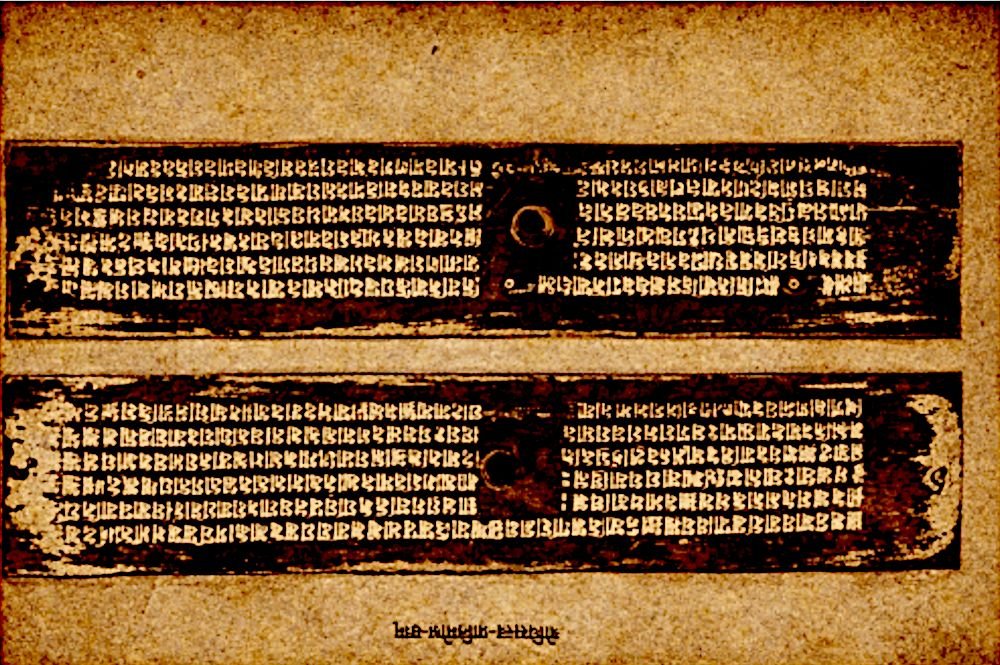
Figure 1: Facsimile of a Sanskrit manuscript of the Bodhisattva-Prātimokṣa, reproduced from Nalinaksha Dutt, “Bodhisattva-Prātimokṣa Sūtra,” Indian Historical Quarterly 7 (1931), and digitally reconstructed to represent the appearance of a palm-leaf manuscript.
Epigraph
नमः सर्वबुद्धबोधिसत्त्वेभ्यः ।
बोधिचित्तं सर्वसत्त्वहितसुखार्थम् उत्पद्यते ॥
namaḥ sarva-buddha-bodhisattvebhyaḥ |
bodhicittaṃ sarva-sattva-hita-sukhārtham utpadyate ||
Homage to all Buddhas and Bodhisattvas.
The awakening mind (bodhicitta) arises for the welfare and happiness of all beings.
I. Introduction: The Problem of Bodhisattva Discipline in the Mahāyāna Tradition
Within the Mahāyāna Buddhist tradition, the Bodhisattva ideal has long occupied a central place in both religious life and philosophical reflection. Unlike the figure of the śrāvaka, whose spiritual path is directed toward personal liberation from the cycle of rebirth, the Bodhisattva is portrayed as a practitioner who arouses the awakening mind (bodhicitta) and vows to attain Buddhahood for the benefit of all sentient beings. This ideal is articulated with particular depth in several well-known Mahāyāna works, most notably Śāntideva’s Bodhicaryāvatāra and Śikṣāsamuccaya, where Bodhisattva ethics is presented as a path grounded in great compassion and dedication to the welfare of the world.
Alongside these philosophical and ethical treatises, however, the Mahāyāna tradition also developed a distinctive system of discipline and ritual intended to shape the practical life of those who entered the Bodhisattva path. In early Buddhism, the term prātimokṣa referred to the fundamental code of monastic discipline that formed the foundation of the Vinaya system governing the Buddhist Saṅgha. Within the Mahāyāna context, this concept came to be extended to designate a specific form of discipline associated with the Bodhisattva path. The text known as the Bodhisattva-Prātimokṣa Sūtra therefore constitutes an especially important source for understanding how the Mahāyāna tradition sought to systematize the ethical life of the Bodhisattva.
Modern studies of Mahāyāna ethics have tended to focus primarily on major philosophical works, while texts directly related to the ritual conferral of the Bodhisattva vows and the structure of Bodhisattva discipline have received comparatively less detailed attention. The publication of a Sanskrit manuscript of the Bodhisattva-Prātimokṣa Sūtra in the early twentieth century, however, opened a new avenue for the study of this subject. Written in the Rañjanā script and originating from Nepal, this manuscript reveals that the extant text is not a complete canonical sūtra in the conventional sense, but rather a compilation of excerpts and ritual formulas assembled from multiple sources.
Among these sources, the most significant parallels can be found in the Bodhisattvabhūmi of the Yogācāra tradition and in the Upāli-paripṛcchā Sūtra, a text in which the venerable Upāli asks the Buddha about the discipline appropriate to the Bodhisattva path. These connections suggest that the Bodhisattva-Prātimokṣa Sūtra should not be regarded as an independent and original scripture, but rather as a ritual and disciplinary manual that emerged within the historical development of the Mahāyāna tradition.
One of the most striking features of the text is its relatively detailed description of the ritual for receiving the Bodhisattva vows. According to the Sanskrit manuscript, this ritual consists of a carefully structured sequence of actions, including confession of faults (pāpadeśanā), taking refuge in the Three Jewels (śaraṇagamana), dedication of merit (pariṇāmanā), and above all the generation of the awakening mind (bodhicittotpāda), which is regarded as the central element of the entire Bodhisattva discipline. Through this act of generating bodhicitta, the reception of the vows becomes not merely the acceptance of a disciplinary code but also a solemn commitment to pursue the path to awakening for the benefit of all beings.
In addition to the ritual of receiving the vows, the text also presents the structure of Bodhisattva discipline through a classification of three distinct forms of śīla: the discipline of restraint (saṃvara-śīla), the discipline of cultivating wholesome qualities (kuśala-dharma-saṃgrāhaka-śīla), and the discipline of acting for the benefit of sentient beings (sattvārtha-kriyā-śīla). This classification demonstrates that Bodhisattva ethics is not limited to the avoidance of harmful actions, but also includes the active cultivation of virtue and the deliberate commitment to serve the welfare of the world.
These features indicate that the Bodhisattva-Prātimokṣa Sūtra represents a text of particular importance for the study of the historical formation of Bodhisattva discipline within Mahāyāna Buddhism. Rather than functioning merely as a set of moral rules, the text reflects a comprehensive system of practice in which ritual, discipline, and religious ideals are integrated into a coherent structure.
On this basis, the present study will examine the Bodhisattva-Prātimokṣa Sūtra from the perspectives of textual history and intellectual development. It will first consider the manuscript context and textual transmission of the work. It will then analyze the composite character of the text and its relationship to other Mahāyāna sources. Finally, the study will investigate the structure of the Bodhisattva vow ritual as well as the disciplinary system presented in the text. Through this analysis, the article aims to clarify the role of the Bodhisattva-Prātimokṣa as an important document in the formation and systematization of Bodhisattva discipline within the Mahāyāna tradition.
II. Manuscript Tradition and Historical Context of the Bodhisattva-Prātimokṣa Sūtra
The study of Bodhisattva discipline within the Mahāyāna tradition cannot be separated from the question of the textual transmission of the Bodhisattva-Prātimokṣa Sūtra. Unlike many well-known Mahāyāna scriptures that have been preserved through multiple translations and textual lineages, this work is known primarily through a limited number of relatively late Sanskrit manuscripts, most of which originate from the Nepalese region. These manuscripts provide valuable evidence not only for understanding the content of the text but also for determining its place in the historical development of Bodhisattva discipline.
One of the most important manuscripts examined by modern scholars is written in the Rañjanā script, a form of writing widely used in the Buddhist manuscript tradition of medieval Nepal. This script frequently appears in Buddhist manuscripts copied in Newar monasteries between approximately the eleventh and thirteenth centuries. Although the surviving manuscript may have been copied during this period, the content of the text itself likely reflects a considerably earlier origin, preserving disciplinary traditions that had already taken shape during earlier phases of the development of Mahāyāna Buddhism.
Another notable feature of the manuscript concerns its physical form. The text is written on palm-leaf folios (tāla-patra), each leaf pierced with a central hole through which a cord was threaded in order to bind the entire manuscript together. This format was characteristic of the manuscript culture of India and Nepal for many centuries. Furthermore, various elements of the layout—such as the style of writing, the division of textual units, and the presence of ritual formulas—suggest that the text may have been used within a ritual setting rather than serving merely as a doctrinal document.
Early scholarly studies of the manuscript have suggested that the Bodhisattva-Prātimokṣa Sūtra is not a unified text composed at a single moment in time. Rather, it appears to be a compilation of passages and ritual formulas assembled from multiple Mahāyāna sources. Certain sections of the text show clear parallels with portions of the Bodhisattvabhūmi, an important work within the Yogācāra tradition. Other passages correspond closely to material found in the Upāli-paripṛcchā Sūtra, a scripture in which the venerable Upāli asks the Buddha about the discipline appropriate to the Bodhisattva path.
This combination of materials suggests that the Bodhisattva-Prātimokṣa Sūtra may have developed as a practical manual intended to systematize the rituals and rules associated with the reception of the Bodhisattva vows. Such a function would be consistent with the broader Mahāyāna context, in which the generation of bodhicitta and the acceptance of Bodhisattva discipline were commonly enacted through formal ritual ceremonies conducted under the guidance of a teacher (ācārya) and symbolically witnessed by the Buddhas and Bodhisattvas.
In addition to the Sanskrit manuscripts, certain elements of the Bodhisattva-Prātimokṣa have also been preserved indirectly through quotations in other Mahāyāna works. For example, Śāntideva’s Śikṣāsamuccaya cites numerous passages concerning Bodhisattva discipline, indicating that the ethical principles represented in the text circulated widely within the Mahāyāna world. Such evidence suggests that although the surviving manuscripts may be relatively late, the doctrinal and disciplinary traditions reflected in the text likely existed several centuries earlier.
For this reason, the study of the Bodhisattva-Prātimokṣa Sūtra is not merely the examination of an isolated text. It also provides an important window into the ways in which the Mahāyāna tradition appropriated and reinterpreted the concept of prātimokṣa, which had originally been associated with the disciplinary code of the early Buddhist monastic community. Within the Mahāyāna context, this concept was expanded to encompass a new system of discipline in which the observance of ethical rules was intended not only for personal purification but also to support the Bodhisattva’s mission of liberating all sentient beings.
These observations indicate that the Bodhisattva-Prātimokṣa Sūtra occupies a distinctive position in the historical development of Buddhist discipline. The text reflects not only the continuation of the Vinaya tradition but also the ways in which Mahāyāna communities developed new forms of discipline adapted to the Bodhisattva ideal. Consequently, analyzing the structure and content of this text can shed important light on the process through which Bodhisattva discipline was formulated and systematized within the Mahāyāna tradition.
III. The Composite Character of the Bodhisattva-Prātimokṣa Sūtra
One of the most significant features of the Bodhisattva-Prātimokṣa Sūtra is the heterogeneous character of its textual origins. Unlike many Mahāyāna scriptures that are structured as complete sermons delivered by the Buddha, this text clearly exhibits the characteristics of a compilation consisting of passages and ritual formulas drawn from multiple sources. Philological analysis of the Sanskrit manuscript suggests that the Bodhisattva-Prātimokṣa can best be understood as a ritual manual formed through a process of editorial compilation and synthesis of various disciplinary traditions within Mahāyāna Buddhism.
One of the most important sources for the text appears to be the Bodhisattvabhūmi, a section of the Yogācārabhūmi-śāstra. This work provides one of the earliest and most influential systematic presentations of Bodhisattva discipline. In particular, the classification of the three forms of Bodhisattva discipline found in the Bodhisattva-Prātimokṣa—saṃvara-śīla, kuśala-dharma-saṃgrāhaka-śīla, and sattvārtha-kriyā-śīla—corresponds closely to the formulation found in the Bodhisattvabhūmi. This similarity suggests that the compilers of the text either directly drew upon, or were strongly influenced by, the Yogācāra tradition in their attempt to systematize Bodhisattva discipline.
A second identifiable source within the text is the Upāli-paripṛcchā Sūtra, a scripture in which the venerable Upāli—renowned among the Buddha’s disciples for his mastery of the Vinaya—asks the Buddha about the discipline appropriate to the Bodhisattva path. In this text, various issues concerning Bodhisattva conduct and moral discipline are presented in the form of dialogue, reflecting an effort within the Mahāyāna tradition to extend the concept of Buddhist discipline beyond the framework of the śrāvaka monastic community. Several passages in the Bodhisattva-Prātimokṣa display close thematic and structural parallels with corresponding sections in this sūtra, suggesting that the text incorporated or adapted elements from that tradition.
The combination of these different sources indicates that the Bodhisattva-Prātimokṣa Sūtra was not composed as a single unified scripture. Rather, it appears to be the product of a prolonged process of compilation in which different doctrinal and ritual traditions were brought together to form a coherent disciplinary manual. This interpretation also corresponds with the practical function of the text. Instead of merely conveying doctrinal teachings, it was intended to provide a concrete framework for the reception of the Bodhisattva vows and the practice of the Bodhisattva way of life.
In addition to the two primary sources mentioned above, the text also contains a number of standard ritual formulas commonly encountered in Buddhist liturgical contexts. Sections such as the confession of faults (pāpadeśanā), the taking of refuge in the Three Jewels (śaraṇagamana), and the dedication of merit (pariṇāmanā) follow forms familiar from other Buddhist ritual traditions. This suggests that the text was not designed solely as a doctrinal treatise but was intended for direct use within ritual practice.
The composite nature of the Bodhisattva-Prātimokṣa therefore reflects an important stage in the historical development of the Mahāyāna tradition, during which Buddhist communities began to systematize the various elements of the Bodhisattva path into a relatively coherent disciplinary framework. Through the integration of different textual and ritual traditions, the text contributed to the formation of a distinct form of prātimokṣa for Bodhisattvas, existing alongside the Vinaya systems of the śrāvaka traditions.
For this reason, the Bodhisattva-Prātimokṣa Sūtra represents an important source for the study of the history of Buddhist discipline. The text not only reflects the continuation of the Vinaya tradition but also demonstrates how the Mahāyāna tradition reinterpreted the concept of discipline in order to accommodate the Bodhisattva ideal. Identifying the various sources incorporated into the text is therefore an essential step toward understanding how Bodhisattva discipline emerged through the interaction of multiple doctrinal and textual traditions within Mahāyāna Buddhism.
IV. The Ritual of Receiving the Bodhisattva Vows in the Bodhisattva-Prātimokṣa Sūtra
One of the most significant contributions of the Bodhisattva-Prātimokṣa Sūtra to the study of Bodhisattva discipline lies in its relatively detailed description of the ritual for receiving the Bodhisattva vows. Unlike many Mahāyāna scriptures that primarily present doctrinal teachings in the form of sermons, this text clearly demonstrates that the Bodhisattva path was not understood merely as an ethical ideal but was also expressed through a carefully structured initiation ritual. This ceremony marks the moment at which a practitioner formally enters the Bodhisattva path and commits to observing the distinctive discipline of the Mahāyāna tradition.
According to the Sanskrit manuscript, the ritual for receiving the Bodhisattva vows is organized as a sequence of ritual actions performed in the symbolic presence of the Buddhas and Bodhisattvas. The structure of the ceremony can be analyzed as consisting of several stages, each of which carries its own religious and ethical significance.
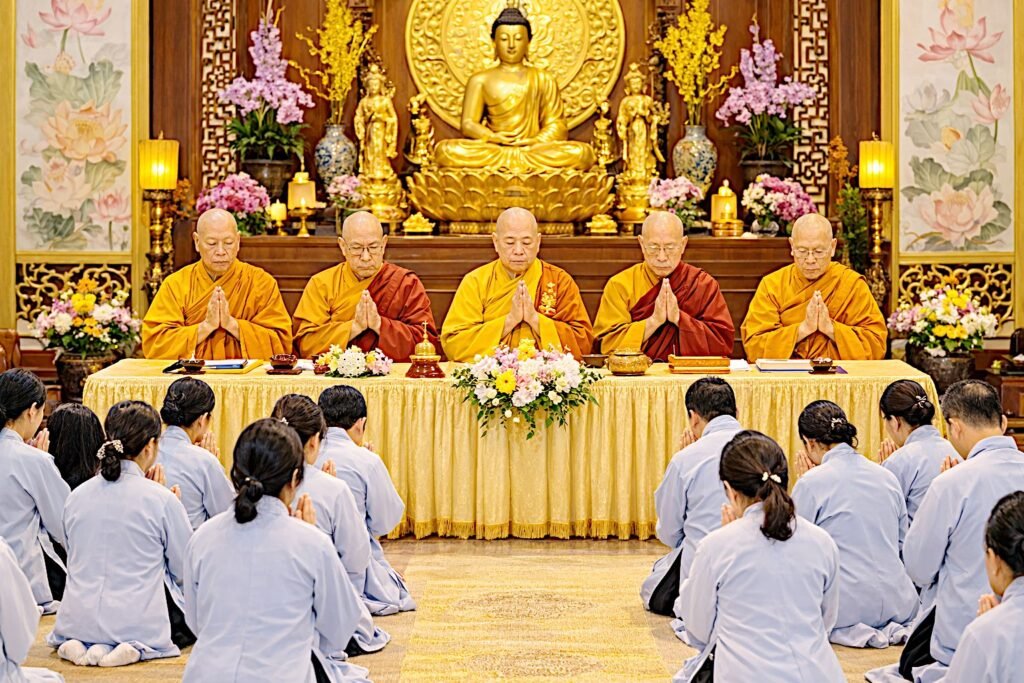
Figure 2: A Buddhist ritual ceremony attended by both monastics and lay practitioners. In many Mahāyāna traditions, the Bodhisattva vows are conferred upon both monks and lay followers, reflecting the universal scope of the Bodhisattva ideal.
1. Request for the vows
The ritual begins with the aspirant formally requesting permission from a teacher (ācārya) to receive the Bodhisattva vows. In many Buddhist traditions, the reception of vows is embedded within a relationship between the disciple and the preceptor, and the procedure described in the Bodhisattva-Prātimokṣa reflects this principle. The act of requesting the vows is not merely a formal requirement but also expresses humility and determination to enter the Bodhisattva path.
2. Confession of faults (pāpadeśanā)
After requesting the vows, the aspirant performs a ritual confession of past transgressions. In the text, this step is referred to as pāpadeśanā, meaning the public acknowledgment of unwholesome actions committed in the past. The purpose of this ritual is to purify the practitioner’s mind before embarking upon the new path of practice. The act of confession also reflects an important principle of Buddhist ethics: the observance of discipline cannot be separated from the process of self-reflection and inner transformation.
3. Taking refuge in the Three Jewels (śaraṇagamana)
Following the confession ritual, the aspirant proceeds to take refuge in the Three Jewels—namely the Buddha, the Dharma, and the Saṅgha. Taking refuge constitutes the foundation of all forms of Buddhist practice, and within the context of the Bodhisattva vow ceremony it affirms that the Bodhisattva path remains firmly grounded in the fundamental Buddhist tradition. By taking refuge, the practitioner acknowledges that the generation of bodhicitta does not represent a path separate from the Buddha’s teaching, but rather an expansion of the Buddhist path within the Mahāyāna framework.
4. Dedication of merit (pariṇāmanā)
Another important step in the ritual is the dedication of merit. At this stage, the aspirant dedicates all accumulated merit toward the attainment of awakening for the benefit of all sentient beings. This ritual reflects a distinctive feature of Bodhisattva ethics: all virtuous actions are framed within the universal perspective of benefiting the world, rather than being directed solely toward the attainment of personal merit.
5. Generation of the awakening mind (bodhicittotpāda)
The central moment of the entire Bodhisattva vow ritual is the generation of the awakening mind (bodhicittotpāda), the vow to attain supreme enlightenment in order to liberate all sentient beings. In the Sanskrit text, this act is expressed through solemn ritual formulas in which the practitioner proclaims before the Buddhas and Bodhisattvas the determination to follow the Bodhisattva path until Buddhahood is attained. This moment marks a fundamental transformation in the religious orientation of the practitioner: from an individual seeking personal liberation to a Bodhisattva committed to the liberation of all beings.
6. Confirmation and conferral of the vows
After the aspirant has generated bodhicitta, the preceptor formally confirms the reception of the vows and declares that the practitioner has entered the Bodhisattva path. The ceremony is typically concluded with words of encouragement or reminders concerning the ethical responsibilities of a Bodhisattva. From this point onward, the practitioner is regarded as having accepted the Bodhisattva discipline and is expected to observe the ethical principles presented in the text.
Significance of the ritual
An analysis of the structure of the Bodhisattva vow ceremony reveals that the Bodhisattva-Prātimokṣa Sūtra is not merely a doctrinal text but also a ritual manual designed for concrete religious practice. The ceremony integrates several elements familiar within the broader Buddhist tradition—such as confession, taking refuge, and dedication of merit—while placing them within a new framework centered on the generation of bodhicitta.
Consequently, the ritual of receiving the Bodhisattva vows described in the text does more than mark the acceptance of a set of ethical rules. It also signifies a fundamental shift in the orientation of the practitioner’s spiritual life. Whereas the disciplinary systems of the śrāvaka traditions primarily emphasize the cessation of personal suffering, the discipline of the Bodhisattva is structured to guide the practitioner toward a broader goal: the attainment of awakening for the benefit of all sentient beings.
In this context, the Bodhisattva-Prātimokṣa Sūtra demonstrates how the Mahāyāna tradition developed a new form of Buddhist discipline in which the Bodhisattva ideal was embodied not only in doctrinal teachings but also in concrete ritual practices that shaped the lived experience of practitioners.
V. The Structure of Bodhisattva Discipline: The Threefold Śīla (tri-vidha śīla)
After describing the ritual of receiving the Bodhisattva vows, the Bodhisattva-Prātimokṣa Sūtra proceeds to present the structure of Bodhisattva discipline through a classification of three different forms of śīla. This classification reflects a characteristic conception of Mahāyāna ethics, in which the observance of discipline is not limited merely to the avoidance of unwholesome actions but also includes the active cultivation of virtue and the performance of actions for the benefit of sentient beings. These three forms of discipline are commonly referred to as tri-vidha śīla, the “threefold discipline of the Bodhisattva.”
1. Saṃvara-śīla: The discipline of restraint
The first form of discipline is saṃvara-śīla, which may be understood as the discipline of restraint or moral regulation. This type of discipline closely resembles the Vinaya system of the śrāvaka traditions. The primary purpose of saṃvara-śīla is to prevent unwholesome actions through the regulation of body, speech, and mind.
Within the context of the Bodhisattva path, saṃvara-śīla retains its foundational role. A practitioner cannot cultivate great compassion or engage in altruistic actions if one’s ethical life is not grounded in moral purity. Consequently, the observance of fundamental ethical principles—such as refraining from killing, stealing, sexual misconduct, false speech, and other harmful behaviors—remains the first step in Bodhisattva discipline.
However, within the Mahāyāna tradition saṃvara-śīla is not regarded as the ultimate goal of spiritual practice. Rather, it serves as the ethical foundation upon which the higher dimensions of the Bodhisattva path can be developed.
2. Kuśala-dharma-saṃgrāhaka-śīla: The discipline of cultivating wholesome qualities
The second form of discipline is kuśala-dharma-saṃgrāhaka-śīla, the discipline of collecting and cultivating wholesome qualities. While saṃvara-śīla focuses on avoiding evil, this form of discipline emphasizes the active cultivation of virtuous qualities and constructive states of mind.
Within the Bodhisattva path, the cultivation of wholesome qualities is often expressed through the practice of the pāramitās, such as generosity (dāna), moral discipline (śīla), patience (kṣānti), energy (vīrya), meditation (dhyāna), and wisdom (prajñā). These qualities not only purify the practitioner’s mind but also prepare the ground for the realization of the Bodhisattva ideal within the world.
An important feature of this form of discipline is that moral conduct is no longer understood merely as a system of prohibitions. Instead, it becomes an active process of cultivating positive virtues. In this sense, kuśala-dharma-saṃgrāhaka-śīla reflects a broader understanding of ethics, in which spiritual life is seen as a continuous process of self-cultivation and moral development.
3. Sattvārtha-kriyā-śīla: The discipline of acting for the benefit of beings
The third form of discipline is sattvārtha-kriyā-śīla, the discipline of acting for the benefit of all sentient beings. This aspect represents the most distinctive feature of Bodhisattva discipline and also marks the clearest difference between the Bodhisattva path and the path of the śrāvaka.
Within this framework, practitioners are encouraged to perform actions that help, guide, and protect other beings. Such actions may include teaching the Dharma, assisting those in need, encouraging others to cultivate wholesome conduct, or any activity that contributes to the alleviation of suffering in the world.
What distinguishes sattvārtha-kriyā-śīla is its emphasis on the active expression of compassion. Whereas the first two forms of discipline primarily concern the regulation and cultivation of the practitioner’s inner life, this form directs spiritual practice outward, toward engagement with the world and with other sentient beings.
For this reason, many scholars have observed that sattvārtha-kriyā-śīla most clearly embodies the spirit of the Bodhisattva ideal: the practitioner does not seek liberation solely for oneself but actively commits to working for the welfare and liberation of all beings.
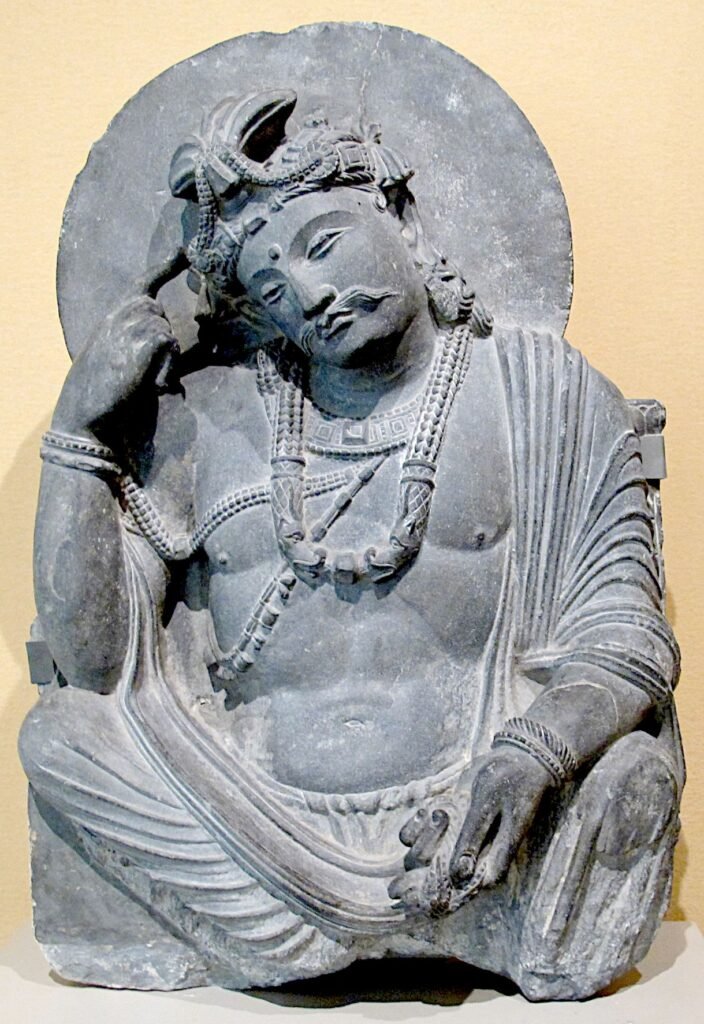
Figure 3: Bodhisattva Padmapāṇi (Avalokiteśvara), Gandhāra, 2nd–3rd century CE, schist. The Bodhisattva ideal, centered on compassion and the liberation of all beings, became a central ethical and religious paradigm within the Mahāyāna tradition. Source: Wikimeda Commons
The significance of the threefold discipline
The classification of Bodhisattva discipline into three forms reveals that Mahāyāna ethics is structured as a multilayered system. The first level consists of the restraint of unwholesome actions; the second involves the cultivation of virtuous qualities; and the third transforms those cultivated virtues into concrete actions directed toward the welfare of the world.
This structure reflects a distinctive vision of the Bodhisattva tradition: ethical life is not pursued merely for the attainment of personal purity but also for the creation of conditions that enable the practitioner to serve sentient beings effectively. For this reason, the system of threefold discipline presented in the Bodhisattva-Prātimokṣa Sūtra may be regarded as the ethical axis of the entire Bodhisattva path within the Mahāyāna tradition.
VI. Bodhisattvas and Śrāvakas: Two Different Orientations of Buddhist Discipline
The presentation of the three forms of Bodhisattva discipline in the Bodhisattva-Prātimokṣa Sūtra does more than merely describe an ethical system. It also implicitly highlights the difference between two distinct orientations of Buddhist practice: the path of the śrāvaka and the path of the Bodhisattva. This distinction concerns not only the ultimate goal of spiritual life but also influences the way ethical discipline is understood and practiced within each tradition.
In the śrāvaka traditions, the discipline of practice is grounded in the Vinaya system, within which the prātimokṣa functions as the fundamental code regulating the life of the monastic community. The primary aim of this disciplinary system is to preserve the purity of the monastic order and to create favorable conditions for the attainment of personal liberation. Consequently, many of the regulations found in the Vinaya focus on preventing actions that might harm the integrity of the monastic life or disrupt the harmony of the Saṅgha.
By contrast, the Bodhisattva discipline presented in the Bodhisattva-Prātimokṣa Sūtra reflects a different ethical orientation. Instead of emphasizing only the avoidance of unwholesome actions, this disciplinary framework places strong emphasis on the cultivation of great compassion and active engagement for the benefit of sentient beings. For this reason, many rules within Bodhisattva discipline do not function solely as prohibitions but also encourage practitioners to undertake positive actions aimed at helping others.
One of the most significant differences between these two systems of discipline concerns their attitude toward rebirth within saṃsāra. In the śrāvaka traditions, the goal of spiritual practice is to bring the cycle of rebirth to an end as swiftly as possible through the attainment of nirvāṇa. The Vinaya discipline is therefore designed to support practitioners in progressing efficiently toward personal liberation.
The Bodhisattva ideal, however, is founded upon a different understanding of the purpose of spiritual practice. The Bodhisattva does not seek liberation solely for oneself but vows to attain awakening for the benefit of all sentient beings. This commitment implies a willingness to remain within the world of rebirth in order to carry out the mission of liberating others. Such an orientation profoundly influences the structure of Bodhisattva discipline, giving it a more active and outward-directed character than the Vinaya systems associated with the śrāvaka traditions.
Another important difference lies in the role of compassion within ethical life. In the śrāvaka traditions, compassion is regarded as an important spiritual quality, yet it does not function as the organizing principle of the entire disciplinary system. In contrast, within the Bodhisattva path compassion becomes the central principle guiding all ethical action. This orientation is clearly expressed in the third category of Bodhisattva discipline—sattvārtha-kriyā-śīla—in which practitioners are encouraged to undertake concrete actions that bring benefit to sentient beings.
Nevertheless, the difference between these two systems of discipline should not be interpreted as an absolute opposition. In reality, Bodhisattva discipline incorporates many elements inherited from the Vinaya traditions of the śrāvaka schools. The observance of fundamental moral principles remains the foundation of spiritual life. Thus, Bodhisattva discipline may be understood as both a continuation of the Vinaya tradition and an expansion of it, adapted to the broader ideal of the Bodhisattva path.
In this context, the Bodhisattva-Prātimokṣa Sūtra reflects an important stage in the historical development of Buddhist discipline. The text demonstrates how the Mahāyāna tradition appropriated the concept of prātimokṣa—originally associated with the disciplinary code of the śrāvaka monastic community—and reconfigured it in order to serve the Bodhisattva ideal. Through this transformation, the concept of Buddhist discipline was extended from a system primarily concerned with regulating monastic life to a broader ethical framework oriented toward the liberation of all sentient beings.
For this reason, the study of the Bodhisattva-Prātimokṣa Sūtra not only clarifies the structure of Bodhisattva discipline but also sheds light on the ways in which Mahāyāna traditions developed new forms of ethical regulation upon the foundations of the classical Vinaya heritage. The text therefore occupies an important place in understanding the diversity of disciplinary forms within the historical development of Buddhism.
VII. The Textual Transmission of the Bodhisattva-Prātimokṣa
The study of the Bodhisattva-Prātimokṣa Sūtra cannot be separated from the question of its textual transmission within the Buddhist world. Unlike many Mahāyāna scriptures that have been preserved through multiple translations and textual lineages, the Bodhisattva-Prātimokṣa survives primarily in the form of scattered Sanskrit manuscripts, together with quotations preserved in other Mahāyāna works. This condition of transmission makes the text a particularly significant object for the study of Buddhist textual history.
The extant Sanskrit manuscripts of the Bodhisattva-Prātimokṣa are largely of Nepalese origin, a region that preserved a considerable number of Buddhist palm-leaf manuscripts throughout the medieval period. These manuscripts are typically written in the Rañjanā script or related forms of early Nepalese writing, reflecting the manuscript culture of the Newar Buddhist communities. Although the surviving manuscripts are usually dated to the period between the eleventh and thirteenth centuries, many scholars suggest that the contents of the text may have a much earlier origin, possibly emerging during the formative phases of Mahāyāna Buddhism in India.
In addition to the Sanskrit manuscripts, elements of the Bodhisattva-Prātimokṣa are also preserved indirectly through citations in important Mahāyāna works. One of the most notable sources is the Śikṣāsamuccaya, the compendium of Bodhisattva teachings and practices compiled by Śāntideva. In this work, numerous passages related to Bodhisattva discipline are cited from various Mahāyāna scriptures, indicating that the ethical principles reflected in the Bodhisattva-Prātimokṣa circulated widely within Mahāyāna communities.
Another indirect source can be found in the exegetical literature of the Mahāyāna tradition, in which the ethical rules of the Bodhisattva path were explained and systematized. These works demonstrate that the principles of Bodhisattva discipline were not confined to a single textual source but were integrated into multiple doctrinal traditions. This circumstance helps explain why the Bodhisattva-Prātimokṣa Sūtra itself exhibits a composite character, reflecting the intersection of various textual traditions.
Within the broader context of the Mahāyāna tradition, the existence of the Bodhisattva-Prātimokṣa indicates that Buddhist communities sought to establish a distinctive disciplinary system for the Bodhisattva path alongside the Vinaya systems of the śrāvaka schools. The use of the term prātimokṣa in this text is particularly noteworthy, for it demonstrates that the fundamental concept of Buddhist discipline was reinterpreted and expanded in order to accommodate the Bodhisattva ideal of the Mahāyāna.
The textual condition of the work also reflects an important feature of Buddhist literary history: many Mahāyāna texts were transmitted not as fixed canonical scriptures but as flexible collections of passages and ritual formulas used within religious practice. In the case of the Bodhisattva-Prātimokṣa, this characteristic is especially evident, since the text appears to have been compiled for use in the ritual conferral of the Bodhisattva vows and may therefore have existed in multiple forms within different Buddhist communities.
For this reason, the study of the textual transmission of the Bodhisattva-Prātimokṣa contributes not only to identifying the historical origins of the text but also to clarifying the ways in which Mahāyāna communities preserved and transmitted the disciplinary traditions of the Bodhisattva path. From this perspective, the text represents not merely a source for the study of Bodhisattva ethics but also an important witness to the historical formation and dissemination of the Mahāyāna tradition within the Buddhist world.
VIII. Conclusion: The Bodhisattva Vows and the Continuity of the Vinaya Tradition
The examination of the Bodhisattva-Prātimokṣa Sūtra demonstrates that the formation of Bodhisattva discipline within Mahāyāna Buddhism should not be understood as a sudden development or as something entirely separate from earlier Buddhist traditions. Rather, the text reveals a process of continuity and reinterpretation of the concept of Buddhist discipline that had already been established within the Vinaya of early Buddhism.
In the early Buddhist tradition, the concept of prātimokṣa played a central role in organizing the life of the monastic community. The Vinaya collections of the early Buddhist schools developed a detailed system of rules designed to preserve the purity of monastic life and to create favorable conditions for the attainment of liberation. Within this framework, Buddhist discipline was primarily understood as an ethical and institutional structure intended to maintain the stability of the monastic community.
However, as the Bodhisattva ideal gradually became more prominent within the Mahāyāna traditions, the concept of Buddhist discipline was reinterpreted within a new framework. The Bodhisattva-Prātimokṣa Sūtra represents one of the texts that most clearly illustrates this transformation. By employing the very term prātimokṣa, the text situates Bodhisattva discipline within the long-standing disciplinary tradition of Buddhism while simultaneously expanding its scope to accommodate the Bodhisattva ideal.
This expansion is particularly evident in the threefold structure of discipline presented in the text. While saṃvara-śīla continues to reflect the familiar Vinaya emphasis on restraining harmful conduct, the other two categories—kuśala-dharma-saṃgrāhaka-śīla and sattvārtha-kriyā-śīla—extend the concept of discipline into new ethical dimensions. Bodhisattva discipline thus requires not only the avoidance of unwholesome actions but also the active cultivation of virtuous qualities and the commitment to actions that benefit sentient beings.
From this perspective, the Bodhisattva-Prātimokṣa Sūtra demonstrates that Bodhisattva discipline should not be regarded as a system entirely separate from the Vinaya traditions of the śrāvaka schools. Instead, it reflects a creative continuation of the Vinaya heritage, in which classical disciplinary principles were reinterpreted in order to serve a broader religious ideal. This observation suggests that the emergence of Mahāyāna Buddhism should not necessarily be understood as a radical break from earlier Buddhism but rather as an internal transformation within the broader Buddhist tradition.
Within this historical context, the Bodhisattva-Prātimokṣa Sūtra provides an important witness for the study of the history of Buddhist discipline. The text illustrates how Mahāyāna communities adopted the concept of prātimokṣa and expanded it into a form of discipline appropriate to the Bodhisattva ideal. Through this process, Buddhist discipline was transformed from a system primarily concerned with regulating monastic life into a broader ethical framework oriented toward the liberation and welfare of all sentient beings.
For this reason, the study of the Bodhisattva-Prātimokṣa Sūtra not only clarifies the structure of Bodhisattva discipline but also contributes to a deeper understanding of the historical relationship between early Buddhism and the Mahāyāna traditions. The text demonstrates that even in the newer developments of Buddhist thought, the fundamental concepts of the classical tradition continued to play a guiding role in shaping emerging religious ideals.
Related Studies:
Bibliography
Barua, B. M. A History of Pre-Buddhistic Indian Philosophy. Calcutta: University of Calcutta, 1921.
Buswell, Robert E., and Donald S. Lopez Jr. The Princeton Dictionary of Buddhism. Princeton: Princeton University Press, 2014.
Dutt, Nalinaksha. “Bodhisattva-Prātimokṣa Sūtra.” Indian Historical Quarterly 7 (1931): 259–276.
Harvey, Peter. An Introduction to Buddhist Ethics: Foundations, Values and Issues. Cambridge: Cambridge University Press, 2000.
Hirakawa, Akira. A History of Indian Buddhism: From Śākyamuni to Early Mahāyāna. Translated by Paul Groner. Honolulu: University of Hawai‘i Press, 1990.
Lamotte, Étienne. History of Indian Buddhism: From the Origins to the Śaka Era. Translated by Sara Webb-Boin. Louvain-la-Neuve: Institut Orientaliste, 1988.
Nattier, Jan. A Few Good Men: The Bodhisattva Path according to the Inquiry of Ugra (Ugraparipṛcchā). Honolulu: University of Hawai‘i Press, 2003.
Schopen, Gregory. Buddhist Monks and Business Matters: Still More Papers on Monastic Buddhism in India. Honolulu: University of Hawai‘i Press, 2004.
Śāntideva. Śikṣāsamuccaya. Edited by Cecil Bendall. St. Petersburg: Imperial Academy of Sciences, 1902.
Śāntideva. Bodhicaryāvatāra. Translated by Kate Crosby and Andrew Skilton. Oxford: Oxford University Press, 1995.
Williams, Paul. Mahāyāna Buddhism: The Doctrinal Foundations. 2nd ed. London: Routledge, 2009.
Yamamoto, Chikyo. Mahāyāna Buddhism: Its Origin and Development. Tokyo: Kosei Publishing, 1984.