
Le Hoang Da
Independent Philosopher & Buddhist Scholar
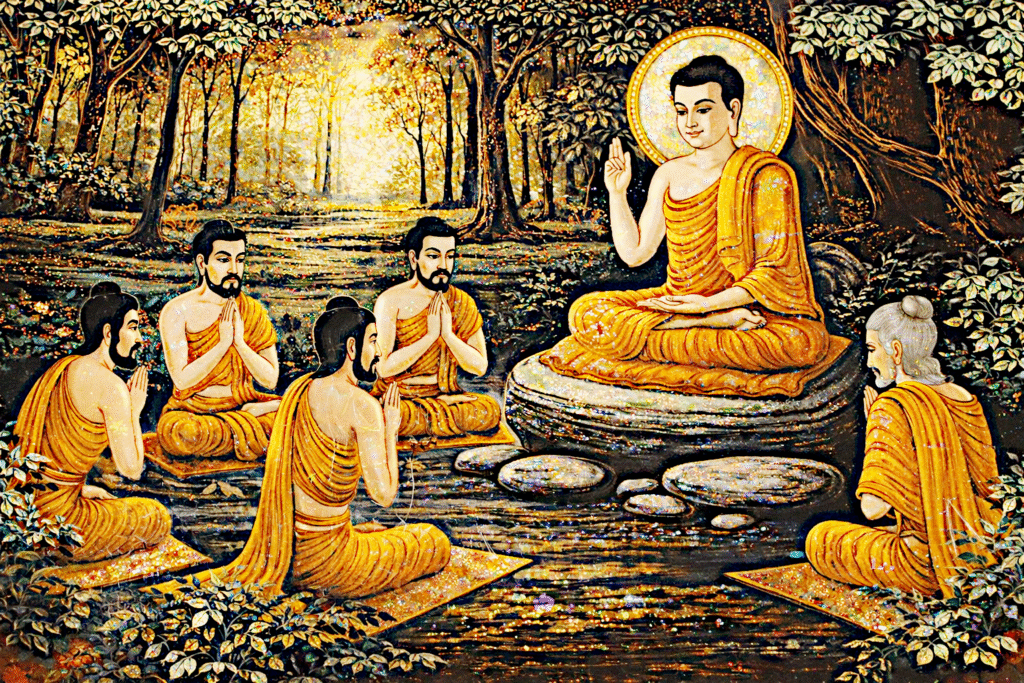
The Buddha teaching the early Sangha in the forest – a visual evocation of oral transmission before written scriptures.
I – Before the Text: A World of Voices
As dusk settles over the forests of ancient India, a small group of mendicants gathers quietly in a clearing. Around them there are no palm-leaf manuscripts etched with letters, no ink or brushes, no shelves lined with texts to preserve the teaching. There are only human voices.
One low voice rises, slow and steady, and others gradually join in. Verse after verse is passed along—not from page to page, but from memory to memory, from breath to breath. In the beginning, the Dharma existed in this way: not as a text to be read, but as a sound to be lived with.
Long before Buddhism became a tradition of scriptures and written canons, it was a culture of voice—of listening, of remembering, and of shared recitation within a living community.
II – India as an Oral Civilization
If we look back at the cultural landscape of ancient India, we see that the emergence of the Buddha did not take place within a civilization of books, but within a world shaped by memory and speech.
For many centuries prior, the great spiritual traditions of the subcontinent—from Vedic chants to sacrificial rites—had been preserved primarily through oral transmission. Knowledge did not reside in written materials but in human beings themselves. Students did not “read” scriptures; they memorized them, recited them, and lived with them as part of their daily existence.
As scholars of early Buddhism such as Richard Gombrich and Gregory Schopen have observed, religious culture in ancient India relied far more on collective memory than on fixed texts. Teachings were sustained through communal chanting, mutual cross-checking among monastic groups, and a rigorous discipline of memorization. Accuracy was not guaranteed by manuscripts, but by the living presence of a trained community.
Memory, therefore, was not merely an individual faculty; it functioned as a cultural institution. The preservation of the teaching was a shared responsibility: teachers recited, students repeated, and each generation handed the words down to the next. This collective structure effectively formed a kind of “living library,” in which texts were not stored on shelves but maintained in breath, rhythm, and embodied presence.
Early Buddhism arose within precisely such an environment. Long before palm-leaf manuscripts or written canons came into existence—as recent studies by Alexander Wynne on the origins of Buddhist meditation also suggest—the Dharma existed first and foremost as sound: something to be heard, remembered, and practiced.
This oral mode of transmission did not operate only during the Buddha’s lifetime. It continued for generations after his passing, extending even through the earliest councils, when the Sangha still relied primarily on collective memory and communal recitation to safeguard the teaching. Only much later did the Dharma gradually become fixed in written form.
In other words, at the dawn of Buddhism, the Dharma was not something stored in books. It was something carried within people—spoken, heard, and lived with each day.
III – The Sangha as a Living Archive
However, to say that early Buddhism existed within an oral culture is still not enough. More crucially, the Dharma was not merely “transmitted by word of mouth”; it was sustained by a distinctive social structure—the monastic community of the Sangha itself.
If other civilizations relied on libraries to store knowledge, the Sangha effectively fulfilled that role. Each monk was not simply a practitioner but also a living repository of the teaching. The discourses were committed to memory in the body, the discipline was maintained through conduct, and the Dharma was preserved through the steady rhythm of daily recitation.
Learning, therefore, did not unfold in the silence of private reading, but in the shared sound of repetition. One group chanted while another listened; one generation memorized while the next verified. Memory was not an isolated effort of individuals but a collective responsibility. This continuous process of mutual correction minimized distortion and maintained the coherence of the teaching over time.
From this perspective, the Sangha can be understood as a kind of “living text.” Rather than being fixed on palm leaves or carved in stone, the Dharma was inscribed within collective memory and embodied practice. What was preserved was not only wording, but a way of living—a mode of conduct, discipline, and presence through which the teaching was enacted in everyday gestures.
For this reason, in the early period of Buddhism, the boundary between “learning” and “living” was almost nonexistent. To memorize was already to practice. To chant was already a form of meditation. The teaching did not stand outside life to be studied; it permeated life to be experienced.
Each member of the Sangha thus safeguarded the Dharma not only through memory but through embodiment. The teaching manifested itself in behavior, in manners, and in the smallest daily actions—what later Buddhist traditions would describe as teaching through one’s very presence. The Dharma, therefore, did not exist primarily as a theoretical system to be analyzed, but as a way of life to be practiced and realized.
It was perhaps precisely this embodied quality that allowed the teaching to endure for centuries before being committed to writing. What sustained it was neither ink nor material support, but human beings themselves—individuals who carried the Dharma in their memory, in their conduct, and within the living community they formed together.
IV – What Difference Does It Make When There Are No Scriptures?
If the early Dharma did not exist in the form of written scriptures, then the natural question is no longer simply how it functioned, but rather: what difference did it make when there was no text to rely upon?
In most later religious traditions, authority tends to be closely tied to writing. Scripture becomes the ultimate point of reference: what is recorded is regarded as orthodox, while what falls outside the text is easily viewed with suspicion. In this sense, the written word functions as a fixed standard, an anchor that secures truth.
Yet in the context of early Buddhism, when scriptures had not yet appeared as material objects, authority could not reside in books. It resided in people—in the collective memory of the Sangha, in the consistency of practice, and in the direct experience of lived cultivation. The authenticity of the teaching was guaranteed not because it had been written down, but because it had been lived through.
This difference produced an important shift. The Dharma was no longer understood primarily as a system of information to be received, but as a path of transformation to be realized. Without texts to consult, learning could not stop at comprehension alone; it had to become action. To remember was to practice. To chant was to embody.
What is striking is that, despite the absence of any fixed scriptural system, early Buddhism appears to have sustained an intensely vital spiritual life. Various historical sources suggest that the early Sangha achieved a profound and widespread degree of inner transformation—what later Buddhist traditions would call the period of the “True Dharma,” a time when the teaching was practiced in its most direct and living form.
In other words, in a world without books, truth was not something to be read, but something to be become.
Writing may preserve words. Only practice preserves meaning. Texts may fix the form of a teaching; life alone keeps it alive. Perhaps this is why early Buddhism existed not as a “religion of books,” but as a culture of practice—one in which the Dharma was not stored outside the human being, but carried within each step and each breath.
Yet to understand how such a textless tradition could endure with such resilience, we must look more deeply into the very mechanism of memory itself—not merely as a means of storage, but as a form of practice.
V – Memory as a Spiritual Technology
If we regard oral transmission merely as a practical solution to the lack of writing materials, we risk reducing early Buddhist history to a technical problem: there were no texts, therefore everything had to be memorized. Yet the reality runs much deeper. In that context, memory was not simply a means of storing the teaching; it was itself a form of cultivation—a spiritual “technology” in the oldest sense of the word: an art of training body and mind so that the Dharma could become woven into the fabric of daily life.
In the modern world, we tend to think of memory as an intellectual operation: accumulating information, keeping data in the mind, and retrieving it when needed. But the traditions of chanting and memorization in early Buddhism seem to have followed a very different logic. Memory was less like a container and more like a regulated flow. The teaching was not inserted into the mind as an object; it was integrated into one’s rhythm of living—through sound, breath, cadence, and steady repetition. To “remember” was not merely to recall; it was to return—to return again and again to a particular orientation of mind.
For this reason, memorizing the scriptures was not only a way of preserving words. It created a distinctive form of inscription: the Dharma entered the body itself. When a verse is repeated day after day, month after month, it begins to take on a life of its own. It echoes while one walks, while one sits in stillness, while facing temptation or fatigue. At that point, the teaching no longer stands outside as something to be observed; it moves inward as something to live with. Such internalization cannot be achieved through quick reading or casual reference.
Sound plays a decisive role here. In an oral culture, the teaching does not exist as silent letters on a page but as voiced rhythm. That rhythm disciplines the mind. Even the simplest act of chanting requires the practitioner to synchronize multiple dimensions at once: voice, breath, attention, and communal harmony. A chant kept in proper cadence leaves little room for distraction. When one’s voice falters, others notice; when the breath grows uneven, one becomes aware of one’s own instability. Memory, in this sense, is not an isolated personal faculty but a capacity trained and sustained by the community.
Seen from this perspective, the “technology” of memory possesses two essential qualities: rhythm and embodiment. Rhythm allows the teaching to reappear in the mind almost effortlessly, like a melody that returns without deliberate effort. Embodiment ensures that the teaching resides not only in meaning but in conduct. A community that chants together transmits not just doctrine but a posture of living—slowness, restraint, attentiveness, and responsibility for every word spoken.
In a culture of texts, the authority of the Dharma is often placed in the precision of wording. In a culture of orality, however, authority lies closer to the precision of life. The most serious deviation is not a misplaced syllable but a misdirected mind. Thus memory as a spiritual technology is not aimed at displaying erudition, but at something quieter and more fundamental: transforming the teaching into ethical reflex and mindful reflex. When suffering arises, the mind knows how to return. When anger appears, it knows how to pause. When confusion emerges, it knows how to look inward.
It may be precisely this embodied discipline that explains how early Buddhism endured for centuries before being written down. Its resilience did not depend on intellectual brilliance or feats of memorization alone, but on a mode of training that anchored the Dharma directly in lived experience. Memory became a structure of practice, not merely an instrument of preservation.
From this, a lesson for the present gradually becomes clear. The challenge of the textual age is not that we possess too few scriptures, but that we easily turn them into a warehouse of information. We know more, yet little truly settles within us. We can cite correctly, yet when suffering arrives the mind remains as unsettled as before. What may need recovering—not to replace texts, but to rebalance them—is the spirit of orality as an art of internalization: reading less but more deeply, quoting less but living more fully, accumulating less but practicing more consistently.
Before the Dharma was a book, it was a breath carefully sustained. And if memory once functioned as a spiritual technology, then perhaps our task today—amid an ocean of words—is not to possess more information, but to relearn how the teaching might become part of our breathing itself: appearing at the right moment, steadying the mind at the right moment, and falling silent at the right moment.
From such a “technology of memory,” we may begin to look again at our own time—an age in which the Dharma is everywhere available as text, yet sometimes strangely absent from life.
VI – From Orality to the Age of Text: Contemporary Relevance
Looking back at this history, we may begin to ask: if the Dharma once existed and flourished in a world with almost no scriptures, what does that tell us about how we approach Buddhism today?
Never before in history have the scriptures been so accessible. With a small device in hand, one can download thousands of PDFs, consult countless translations, and read the entire canon with just a few taps on a screen. In one sense, Buddhism has become more textual than ever—a tradition mediated by documents, archives, and digital libraries.
Yet an abundance of words does not necessarily translate into depth of transformation. Knowing more does not automatically mean living more deeply. One may read extensively about mindfulness without ever sitting still for a single morning; one may recite the doctrine of non-self by heart and still suffer as before.
This contrast reveals a paradox worth considering. In the earliest period of Buddhism, when scriptures were largely absent, the life of practice seems to have been intensely vital. Today, when texts are everywhere, the teaching sometimes remains confined to the level of information.
The lesson suggested by the oral past, however, is not that we should turn away from texts altogether. Rather, it invites us to remember their original place. Scriptures were never meant to be the destination; they were only means. Words cannot substitute for practice, just as a map cannot replace the journey itself.
In an old parable frequently cited in Buddhist studies, the Dharma is compared to a raft used to cross a river: necessary for the crossing, yet not something to be carried forever on one’s back. The value of the raft lies in helping us reach the other shore, not in clinging to it. Scriptures function in the same way—they open the path to transformation, but they cannot replace lived experience.
This spirit is also echoed in later Zen stories, where awakening is attained not through books but through life alongside a teacher. One tale tells of a young seeker who enters the mountains to study the Way and spends years doing nothing but carrying water, chopping wood, and sweeping the grounds, receiving no formal doctrinal instruction. Then one day, through a simple gesture—a handful of flowers scattering in the wind—he suddenly understands what he had been searching for. Symbolic as such stories may be, they remind us that the Dharma is sometimes transmitted not through texts, but through the living presence of practice itself.
In this sense, the most important legacy of the pre-scriptural era may be disarmingly simple: the teaching truly lives only when it is embodied. Not when it is collected, categorized, or quoted, but when it permeates the way we walk, speak, and face our own suffering.
Before it was a body of books, Buddhism was a way of life. And perhaps, in today’s world saturated with texts, that memory is precisely what deserves to be recalled.
VII – Returning to the Voice
Perhaps, when we look back over this entire journey, we begin to see that the question of scripture is ultimately not only a question of writing. It is a question of how truth makes itself present in human life.
Before being bound into volumes, before being arranged into systems, the Dharma once existed in a far simpler way: as a voice in the twilight forest, a verse repeated in memory, a slow step along the alms path.
It did not rest on shelves.
It did not reside in libraries.
It lived in the breath of those who practiced.
And perhaps for that very reason, though never written down, it was able to pass through generations without losing its vitality.
As dusk falls, we might imagine once more that early scene: a few brown-robed figures gathered at the edge of the woods, no books, no manuscripts—only the steady cadence of chanting blending into the stillness of the air. The teaching moves from one person to another, from memory to memory, slow and persistent, as natural as breathing itself.
Before it was scripture, the Dharma was simply sound.
Before it was text, it was simply life.
And perhaps, in today’s world overflowing with words, what we most need to recover is not another book, but the capacity to listen—and to live—long enough for those simple truths to speak for themselves.
Suggested Readings
- Richard Gombrich
- Gregory Schopen
- Alexander Wynne