
Le Hoang Da
Buddhist Scholar
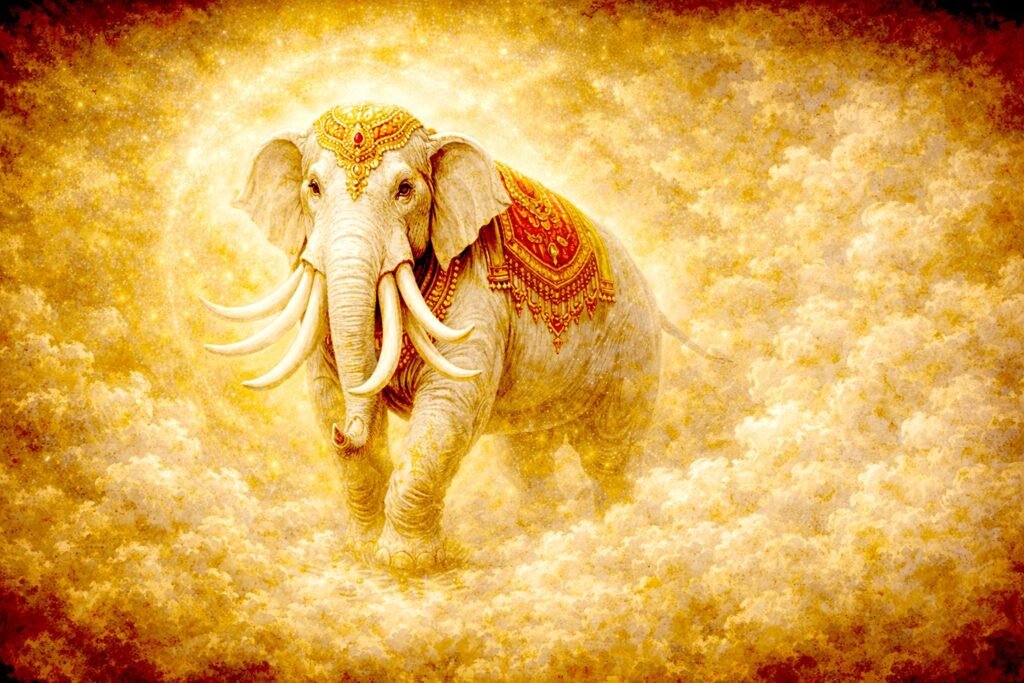
Figure 1: The six-tusked white elephant descending from the heavens — a symbolic image associated with Queen Māyā’s dream announcing the birth of the Bodhisattva in later Buddhist narrative traditions.
I. Introduction: The Dream of the White Elephant in Buddhist Tradition
In many Buddhist traditions, the story of the Buddha’s birth is closely associated with a remarkable dream experienced by Queen Māyā, the mother of Prince Siddhārtha. According to well-known Buddhist biographies, on a serene night the queen dreamed of a white elephant with six tusks descending from the heavens and entering her right side. Court Brahmins and ascetics later interpreted this dream as an extraordinarily auspicious omen, foretelling the appearance of a Great Being in the world.
Over time, the image of the six-tusked white elephant became a familiar symbol in Buddhist literature and art. On ancient reliefs at Gandhāra and in various Buddhist narrative texts transmitted throughout India and East Asia, this dream is often presented as the first sign announcing the future birth of the Buddha. For many Buddhists, it represents a sacred story expressing deep reverence for the appearance of an Awakened One in the human world.
However, when one turns to the earliest strata of Buddhist scripture, an intriguing detail emerges. In the Acchariya-abbhūta-dhamma Sutta, commonly known as the “Discourse on Wonderful and Marvellous Qualities,” the account of the Bodhisattva’s descent into the world is described through numerous extraordinary and solemn signs, yet the dream of the white elephant is not mentioned at all. Instead, the discourse emphasizes cosmic phenomena, such as the great radiance that illuminates the entire world when the Bodhisattva enters the womb, as well as the exceptional purity of Queen Māyā during the period of pregnancy.
This difference raises an interesting question for the study of Buddhist scriptures. If the dream of the white elephant is such a familiar motif in many Buddhist biographies, why does it not appear in a discourse belonging to the Majjhima Nikāya, one of the earliest collections of Buddhist teachings?
To understand this issue more clearly, it is necessary to place the different textual traditions side by side and read them within the broader historical context of Buddhist literature. When comparing MN 123 with later biographical works such as the Mahāvastu, the Lalitavistara Sūtra, and the Abhiniṣkramaṇa Sūtra (Phật Bản Hạnh Tập Kinh), we can observe how the image of the six-tusked white elephant gradually emerges and becomes an important motif in later Buddhist narrative traditions.
Recognizing the differences between these texts does not diminish the reverence accorded to the Buddha. On the contrary, it allows us to understand more clearly how generations of Buddhists, in diverse cultural settings, sought the most beautiful and dignified symbols to express the appearance of an Awakened One in the world. From the relatively simple accounts preserved in the Nikāya texts to the richly symbolic narratives of later Buddhist biographies, all of them reflect the same profound reverence for the Buddha and his teaching.
In this article, we will examine four important textual sources — MN 123, the Mahāvastu, the Lalitavistara, and the Abhiniṣkramaṇa Sūtra — in order to explore how the story of the Buddha’s birth was narrated and gradually developed across different Buddhist traditions.
II. MN 123: The Account of the Bodhisattva’s Birth without the White Elephant
Among the early Buddhist canonical sources, the Acchariya-abbhūta-dhamma Sutta occupies a distinctive place in describing the Bodhisattva’s descent into the world. The title of the discourse may be translated into English as “The Discourse on Wonderful and Marvellous Qualities.” The text is presented in the form of a teaching delivered by the Venerable Ānanda, in which he recounts to the monks a series of “marvellous and extraordinary” signs associated with the appearance of the Blessed One.
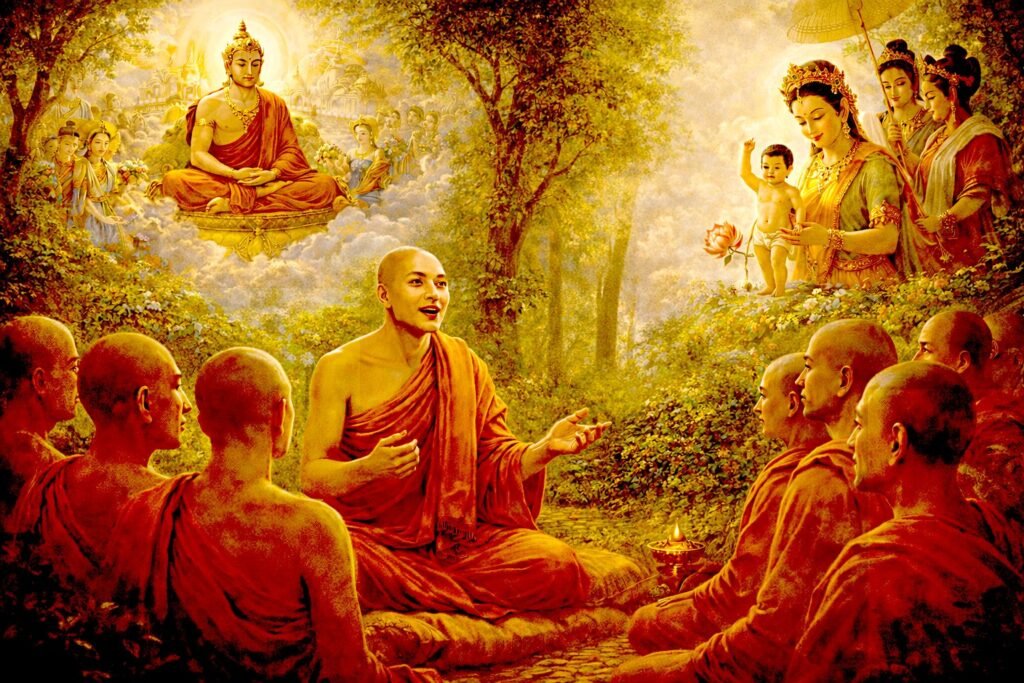
Figure 2: Venerable Ānanda recounting the marvellous events surrounding the Bodhisattva’s descent and birth, as described in the Acchariya-abbhūta-dhamma Sutta (MN 123).
From the very beginning of the discourse, Ānanda emphasizes that the events he describes are not ordinary phenomena, but special signs accompanying the appearance of a Great Being in the world. According to the narrative of the text, when the Bodhisattva decided to descend from the Tuṣita heaven into the human world, the event occurred in a state of complete mindfulness and awareness. This detail is significant within the Nikāya tradition, as it emphasizes that even before birth the Bodhisattva is portrayed as a being endowed with exceptional wisdom and consciousness.
One of the extraordinary signs mentioned in the discourse is the appearance of a great light that illuminates the entire world when the Bodhisattva enters the womb. The text describes how, at that moment, a radiant light spreads throughout the realms of the gods and the human world, even illuminating the deep spaces between worlds where the light of the sun and the moon cannot reach. This radiance is interpreted as a cosmic sign indicating that an event of profound significance is taking place: the appearance of an Awakened One in the world.
Alongside this phenomenon of light, the discourse also highlights the remarkable purity of Queen Māyā during the period of pregnancy. According to Ānanda’s account, from the moment the Bodhisattva entered the womb, the queen lived in an unusually serene and purified state. She no longer experienced ordinary sensual desires, and her mind remained calm and composed. Such descriptions not only serve to honor the extraordinary nature of the being she carried, but also reflect a widespread idea within Buddhist traditions regarding the special purity of the mother of a Great Being.
Another striking image in the discourse is the description of how the Bodhisattva could be seen within Queen Māyā’s womb. The text compares this image to a precious jewel placed within a transparent cloth: although covered, it can still be seen clearly. This comparison is both poetic and symbolic, emphasizing the purity and extraordinary nature of the pregnancy.
When the moment of birth arrives, the discourse continues to describe further marvellous signs. The Bodhisattva is born in a state of complete purity, untouched by the impurities normally associated with human birth. Immediately after being born, he stands firmly, takes seven steps, and declares that this will be his final birth in the cycle of existence. These elements later became familiar features in many Buddhist narratives describing the birth of the Buddha.
What is particularly noteworthy, however, is that throughout the entire account of the discourse there is no mention of any dream involving a white elephant, nor any detail about an elephant descending from heaven and entering the side of Queen Māyā. Instead, the discourse focuses on cosmic and ethical signs, such as the great radiance illuminating the world, the purity of the queen, and the exceptional awareness of the Bodhisattva.
The absence of the white-elephant motif in this discourse is an important detail. It suggests that in certain early layers of Buddhist scripture, the story of the Buddha’s birth was narrated in a relatively simple manner, emphasizing the spiritual and cosmic significance of the event rather than elaborate mythological symbolism.
From this starting point, when we compare these early accounts with later Buddhist narrative traditions, we can observe how the story of the Buddha’s birth gradually came to incorporate richer symbolic elements. In texts such as the Mahāvastu, the Lalitavistara, and the Abhiniṣkramaṇa Sūtra, the image of the six-tusked white elephant appearing in Queen Māyā’s dream becomes a prominent feature of the narrative.
This difference will serve as the point of departure for the next part of our analysis, in which we will examine how the motif of the six-tusked white elephant emerged and developed within different Buddhist biographical traditions.
III. Lalitavistara: The Selection of the Six-Tusked White Elephant Form
If in the Acchariya-abbhūta-dhamma Sutta the story of the Bodhisattva’s descent into the world is narrated in a relatively simple and solemn manner, the Lalitavistara Sūtra presents the episode with a richer array of symbolic and mythological elements. One of the most notable features is the appearance of the motif of the six-tusked white elephant. Yet the way this motif is introduced into the narrative is quite distinctive.
According to the account preserved in the Lalitavistara, before descending into the human world the Bodhisattva resides in the Tuṣita heaven, where he teaches the Dharma to the celestial beings. After delivering his teaching and benefiting the gods, the Bodhisattva raises an important question: in what form should he appear when descending into his mother’s womb in the human realm? This question leads to a discussion among the celestial beings concerning the most appropriate form for the descent of a Bodhisattva.
During this discussion, various proposals are presented. Some suggest that the Bodhisattva should manifest in the form of a young Brahmin, while others propose that he should appear as one of the great heavenly kings or as powerful divine beings such as Asuras, Gandharvas, Garuḍas, or other exalted figures. These suggestions reflect a common idea in ancient Indian religious literature, where divine and supernatural forms were often regarded as symbols of power and authority.
Among these proposals, however, a Brahmā deity named Qiangwei offers a different suggestion. According to this Brahmā, ancient Brahmanical scriptures praise the form of the six-tusked white elephant as the most auspicious manifestation for the descent of a Great Being into the world. The white elephant, in this context, is regarded as the noblest and most auspicious of creatures.
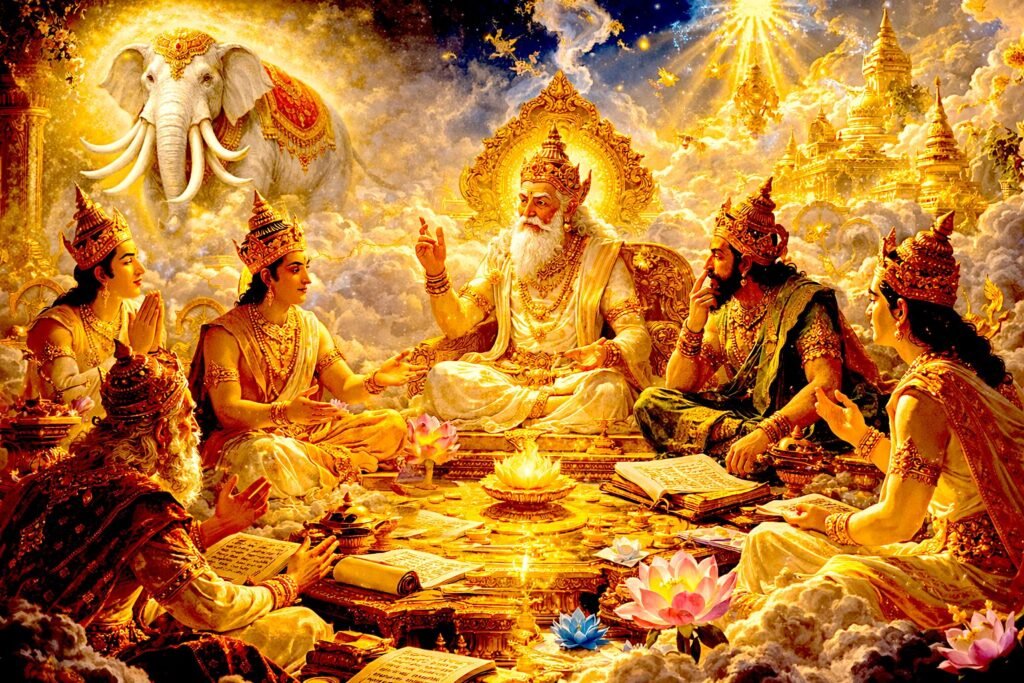
Figure 3: Brahmā devas discussing the appropriate form for the Bodhisattva’s descent from Tuṣita heaven, with the six-tusked white elephant proposed as the most auspicious manifestation in the Lalitavistara Sūtra.
To explain this proposal, the Lalitavistara presents a symbolic comparison. In the world there are three animals capable of crossing water: the hare, the horse, and the elephant. The hare can only cross shallow water by itself; the horse, though strong, cannot fully discern the depth of the river. Only the elephant can step into deep water and understand its full depth. From this image the text draws a doctrinal analogy: the Śrāvakas and Pratyekabuddhas are like the hare and the horse, able to cross saṃsāra but not yet reaching the ultimate depth of truth. The Bodhisattva, by contrast, is like the white elephant, capable of penetrating the profound nature of all phenomena and guiding all beings toward liberation.
In this context, the image of the six-tusked white elephant is not merely an auspicious symbol. It also carries a deeper doctrinal meaning within Mahāyāna literature. The elephant represents the wisdom and strength of the Bodhisattva, while the six tusks are often interpreted as symbolizing the six pāramitās—the perfections cultivated by a Bodhisattva on the path to awakening.
After the celestial beings discuss these symbolic reasons, the narrative continues with the Bodhisattva surveying the human world from the Tuṣita heaven and deciding to be born into the royal family of King Śuddhodana. In the subsequent parts of the story, the image of the six-tusked white elephant becomes the sign announcing the conception of Queen Māyā.
It is noteworthy that in the Lalitavistara the image of the elephant is emphasized primarily as a form symbolically chosen before the Bodhisattva’s descent, rather than being described with the rich narrative details found in some later Buddhist biographies. For example, the text does not yet include elements such as the red-colored head of the elephant—details that appear more clearly in certain later narrative traditions.
For this reason, the Lalitavistara may be regarded as an intermediate stage in the development of the white-elephant motif in Buddhist literature. While the image is entirely absent in MN 123, in the Lalitavistara it appears as an important symbolic representation, though it has not yet developed into the richly detailed imagery found in later Buddhist biographical texts.
As we continue to examine other works within the Buddhist tradition, we will see that this motif becomes further elaborated with additional narrative elements. A notable example is the Mahāvastu, where the image of the six-tusked white elephant is described with more specific features—including the detail of a red-colored head—making the story of Queen Māyā’s dream even more vivid and elaborate.
IV. Mahāvastu: The Development of the Six-Tusked White Elephant Motif
If the Lalitavistara Sūtra marks the emergence of the image of the six-tusked white elephant in the narrative of the Bodhisattva’s birth, the Mahāvastu develops this motif further with richer and more vivid details.
The Mahāvastu is an important Buddhist biographical work associated with the Lokottaravāda tradition, a branch of the Mahāsāṃghika school. The text appears to have taken shape through a long process of compilation, likely spanning from around the second century BCE to the early centuries of the Common Era. Its contents combine various elements, including legends of the Buddha’s previous lives, mythologically colored narratives, and detailed accounts of the Bodhisattva’s life before attaining awakening.
In the Mahāvastu, the story of the Bodhisattva’s descent into the world is narrated in a richly imaginative literary style. When Queen Māyā conceives the Bodhisattva, the event is foretold through a remarkable dream in which she sees a white elephant with six tusks descending from the sky. This image carries both symbolic and miraculous connotations, reflecting the profound reverence of the Buddhist tradition for the appearance of the Buddha in the world.
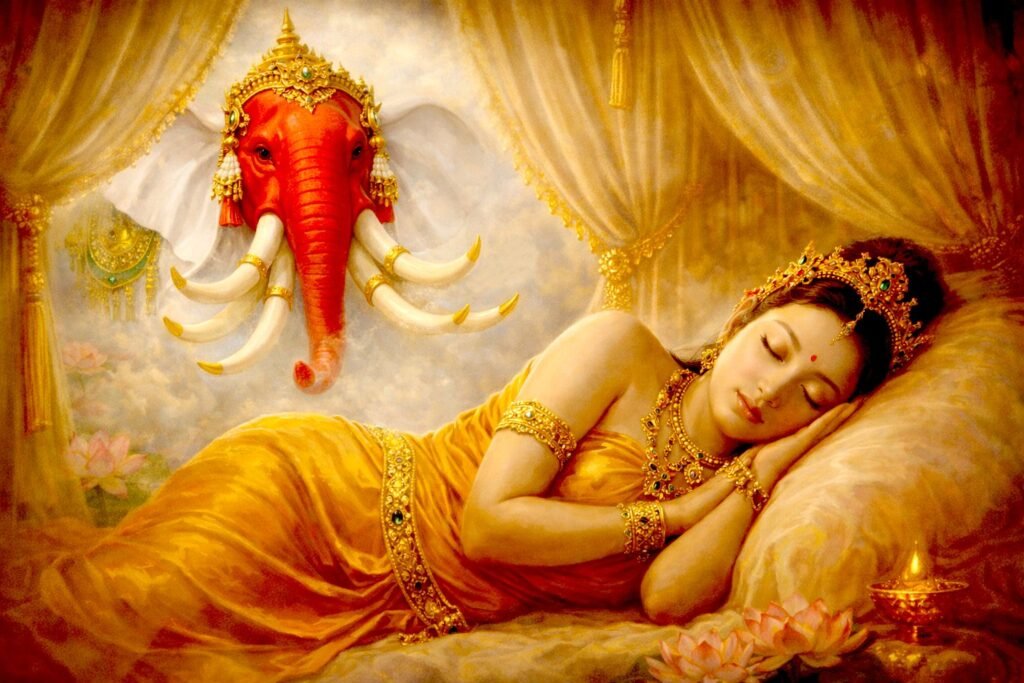
Figure 4: Queen Māyā dreaming of the six-tusked white elephant descending from the heavens, a motif elaborated in the Mahāvastu as a sign announcing the Bodhisattva’s conception.
Compared with the Lalitavistara, the account in the Mahāvastu introduces an additional noteworthy detail: the elephant is described as having a red-colored head. This element makes the image of the elephant more vivid and distinctive. In ancient Indian literature, the color red is often associated with auspiciousness, power, and sacredness. The depiction of the elephant with a red head may therefore be understood as emphasizing even further the dignity and majesty of the symbol.
Beyond the element of color, the Mahāvastu also highlights the beauty and grandeur of the white elephant. The animal is not presented as an ordinary creature, but as a noble and exalted being, symbolizing the strength, wisdom, and virtues of the Bodhisattva. The six tusks of the elephant continue to be interpreted as representing the perfect qualities cultivated by the Bodhisattva through countless lifetimes of practice.
When compared with earlier sources, the Mahāvastu presents the narrative of the Bodhisattva’s birth with a greater degree of detail. Whereas the white-elephant motif is entirely absent in MN 123, and in the Lalitavistara the image appears mainly as a symbolic representation, in the Mahāvastu the story develops into a concrete dream experienced by Queen Māyā, accompanied by clearer descriptive elements.
This development reflects a broader tendency within Buddhist literature. Over time, narratives concerning the life of the Buddha often came to incorporate increasingly rich symbolic elements. Details such as colors, forms, and miraculous phenomena not only make the story more vivid, but also serve to express the deep reverence felt by Buddhist communities toward the appearance of an Awakened One in the world.
Yet even in these more elaborate accounts, the purpose of such narratives is not merely to create mythological embellishment. Behind these symbolic images lies a profound doctrinal meaning: the appearance of the Buddha is understood as a cosmic event, bringing the light of wisdom and the path to liberation to all beings.
Thus, when comparing texts such as MN 123, the Lalitavistara, and the Mahāvastu, we observe not merely differences in narrative detail. More importantly, we can see how different Buddhist traditions expressed the same reverence for the Buddha through a variety of symbolic images.
In later Buddhist biographical texts, the motif of the six-tusked white elephant continues to develop with even richer narrative elements. A notable example is the Abhiniṣkramaṇa Sūtra (Phật Bản Hạnh Tập Kinh), where Queen Māyā’s dream is described with vivid details, including the image of the elephant kneeling before entering her right side.
V. The Abhiniṣkramaṇa Sūtra: A Rich Narrative of the Dream of the White Elephant
After examining the accounts found in the Acchariya-abbhūta-dhamma Sutta, the Lalitavistara Sūtra, and the Mahāvastu, we may observe that the motif of the six-tusked white elephant gradually became a familiar element in narratives describing the Buddha’s birth. However, in some Buddhist biographical texts transmitted to East Asia, the story continued to develop with even richer and more vivid details.
A notable example is the Abhiniṣkramaṇa Sūtra, an important Buddhist biographical work preserved in the Chinese canon and translated into Chinese during the sixth century. This text brings together various narrative traditions and presents the life of the Buddha in a richly descriptive storytelling style.
In the account preserved in this scripture, the Bodhisattva’s descent into the womb is announced through a remarkable dream experienced by Queen Māyā. During the night, while she is asleep, she sees a white elephant with six tusks descending from the sky. The elephant is described as possessing extraordinary beauty and majesty, symbolizing the nobility of the Bodhisattva.
One particularly striking detail in this text is the description of the elephant’s head as being red in color, while its six tusks are compared to pure gold. This imagery makes the symbol of the white elephant appear even more radiant and vivid than in earlier accounts. The elephant is thus not merely an auspicious sign but is portrayed as a majestic and sacred form imbued with extraordinary beauty.
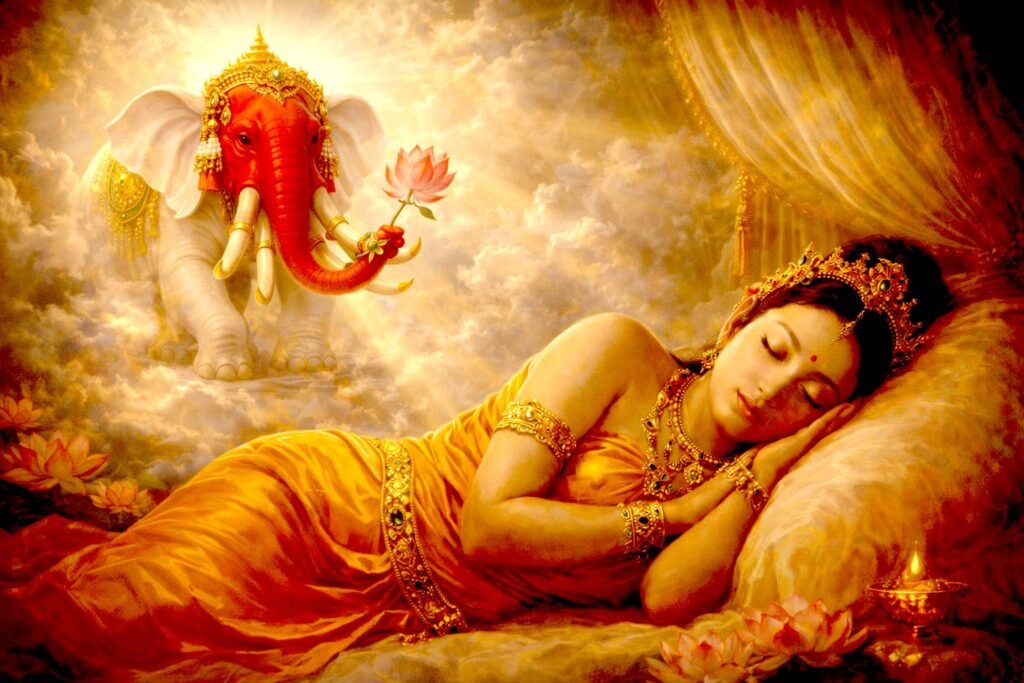
Figure 5: Queen Māyā dreaming of the six-tusked white elephant descending from the heavens, a richly elaborated motif in the Abhiniṣkramaṇa Sūtra (Phật Bản Hạnh Tập Kinh) announcing the Bodhisattva’s conception.
After descending from the sky, the white elephant approaches Queen Māyā and kneels before her with seven limbs touching the ground, a gesture expressing deep reverence. It then moves toward the queen and enters her right side, indicating that she has conceived a Great Being.
The narrative continues by recounting that when the queen awakens the following morning, she experiences a profound joy unlike anything she had previously felt. From that moment onward, she no longer experiences ordinary sensual desires. These details serve to emphasize both the exceptional purity of the pregnancy and the exalted nature of the being she carries.
Compared with earlier sources, the account in the Abhiniṣkramaṇa Sūtra may be regarded as a more elaborate and fully developed version of the six-tusked white-elephant motif. In the Lalitavistara, the elephant appears primarily as a chosen symbolic representation, while in the Mahāvastu the motif has developed into a dream accompanied by several descriptive elements. In the Abhiniṣkramaṇa Sūtra, however, the entire episode is presented with a clear narrative structure and rich visual imagery.
This development reflects the way Buddhist traditions in different cultural regions received and retold the story of the Buddha’s birth. As the narrative spread to Central Asia and East Asia, symbolic motifs within Buddhist biography were often elaborated with greater narrative detail in order to emphasize the sacred significance of the event.
Nevertheless, despite the variations in narrative detail, the underlying purpose of these accounts remains the same: to express the profound reverence of the Buddhist tradition for the appearance of the Buddha in the world. The image of the six-tusked white elephant thus became a familiar symbol in many Buddhist traditions, evoking the nobility, wisdom, and spiritual power of the Bodhisattva before his awakening.
When these texts are placed side by side—from MN 123 to the Lalitavistara, the Mahāvastu, and the Abhiniṣkramaṇa Sūtra—we can observe a fascinating process of development within Buddhist literature. A motif that does not appear in the earliest scriptures gradually becomes a familiar and meaningful symbol in later Buddhist narrative traditions.
From this point, we may turn to the next important question: what symbolic meanings does the white elephant hold within Indian culture and Buddhist thought, and why was this image chosen to express the birth of an Awakened One?
VI. The Symbolism of the White Elephant in Indian Culture and Buddhist Thought
After examining the accounts preserved in the Acchariya-abbhūta-dhamma Sutta, the Lalitavistara Sūtra, the Mahāvastu, and the Abhiniṣkramaṇa Sūtra, it becomes clear that the motif of the six-tusked white elephant gradually developed into a prominent element in narratives concerning the birth of the Buddha. To fully understand the meaning of this image, however, it must be considered within the broader context of ancient Indian culture and symbolism.
In ancient Indian culture, the elephant had long been regarded as a symbol of power, wisdom, and nobility. Kings frequently employed elephants in warfare and royal ceremonies, and the image of the elephant became closely associated with the strength and majesty of royal authority. In Indian mythology, the white elephant in particular was linked to auspicious symbolism. One well-known example is Airāvata, the divine elephant of Indra, described as a magnificent white elephant that emerged from the churning of the cosmic ocean in Indian mythological tradition.
Within this symbolic context, the appearance of the white elephant in Buddhist narratives becomes easier to understand. When Buddhist traditions depict the Bodhisattva descending in the form of a white elephant, they are not merely recounting a miraculous story. Rather, they are drawing upon a familiar cultural symbol within Indian society to express the nobility and majesty of a Great Being about to appear in the world.
Beyond the general symbolism of the elephant itself, the detail of the animal’s six tusks also carries multiple layers of meaning within Buddhist interpretation. In many later explanations, the six tusks are understood as representing the six pāramitās—the perfections cultivated by a Bodhisattva on the path to awakening: generosity, moral discipline, patience, diligence, meditation, and wisdom. Although such interpretations may belong to later developments in Buddhist thought, they illustrate how Buddhist communities interpreted this image in doctrinal terms.
The white color of the elephant also possesses important symbolic significance. In many Indian religious traditions, the color white is associated with purity, clarity, and nobility. The image of a white elephant descending from the heavens may therefore be understood as symbolizing the perfect purity and exalted virtue of the Bodhisattva prior to becoming the Buddha.
Another interesting detail found in some narrative traditions is the description of the elephant’s head as red in color. In ancient Indian culture, red is often associated with vitality, energy, and auspiciousness. When combined with the image of the white elephant, this feature further emphasizes the extraordinary character of the symbol: a being that embodies both purity and sacred power.
It is important to recognize, however, that these symbolic images are not intended to describe a historical event in a literal sense. Rather, they function as symbolic expressions within religious tradition, used to convey the deeper significance of the Buddha’s appearance in the world. In this context, the image of the six-tusked white elephant should not be understood merely as a mythical detail, but as a cultural and religious symbol with multiple layers of meaning.
When we place this motif within the broader process of development observed in the texts examined above, an interesting picture emerges. In early scriptures such as MN 123, the story of the Buddha’s birth is narrated in a relatively simple and solemn manner. In Sanskrit Buddhist biographies such as the Lalitavistara and the Mahāvastu, the motif of the white elephant begins to appear and gradually develops with richer symbolic elements. By the time of Chinese Buddhist biographies such as the Abhiniṣkramaṇa Sūtra, the narrative has evolved into a richly elaborated story filled with vivid imagery.
The image of the six-tusked white elephant may therefore be understood as a religious symbol that gradually developed within Buddhist tradition. It reflects not only the imaginative richness of Buddhist narrative literature, but also the ways in which Buddhist communities over many centuries employed familiar cultural symbols from Indian tradition in order to express their reverence for the Buddha.
For this reason, the motif does not exist solely within textual traditions. It also appears widely in ancient Buddhist art, where artisans depicted Queen Māyā’s dream in reliefs and murals as one of the key scenes in the sequence of events leading to the Buddha’s birth.
VII. The Dream of the White Elephant in Early Buddhist Art
The image of the six-tusked white elephant does not appear only in Buddhist narrative texts. From an early period, it also became a familiar motif in Buddhist art. When Buddhist artists began depicting episodes from the life of the Buddha in reliefs and murals, Queen Māyā’s dream was often chosen as one of the opening scenes in the sequence of events leading to his birth.
Some of the earliest visual representations of this motif can be found in Buddhist artistic monuments in India dating from the centuries before and after the beginning of the Common Era. On the stone railings of ancient Buddhist stupas such as the Bharhut Stupa and the Sanchi Stupa, artisans carved numerous scenes from the life of the Buddha, including the dream of Queen Māyā.
In these reliefs, the scene is usually presented according to a characteristic composition. Queen Māyā is depicted reclining on a royal bed, while a white elephant descends from the sky toward her. In some representations, the elephant is shown entering the queen’s right side, symbolizing the conception of the Bodhisattva. It is noteworthy that in these early works of art the Buddha himself is often not represented directly, but rather indicated through symbolic imagery—a common feature of early Buddhist artistic tradition.
As Buddhist art spread to other regions of India and Central Asia, the motif continued to appear in a variety of forms. In the art of Gandhāra, which was influenced by Greco-Roman artistic styles, the dream of Queen Māyā was frequently depicted in narrative relief panels. In these works, the white elephant is often carved with greater clarity and naturalism, reflecting the fusion of Buddhist themes with the classical artistic traditions of northwestern India.
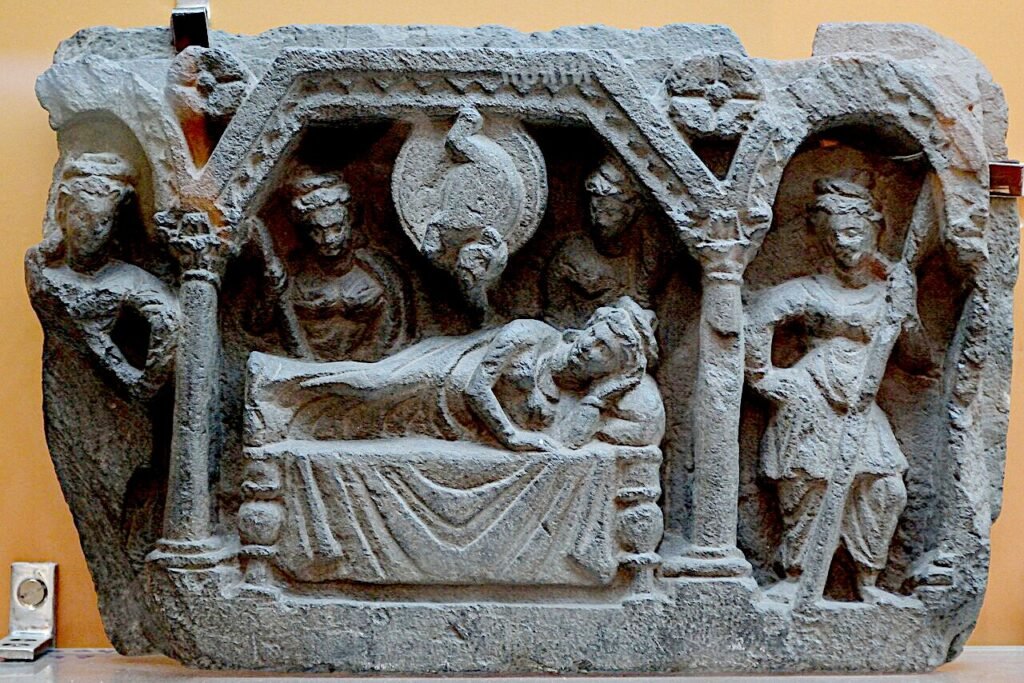
Figure 6: Relief from Gandhāra depicting the Dream of Queen Māyā, in which a white elephant descends from the heavens as a sign of the Bodhisattva’s conception. Schist sculpture, ca. 2nd century CE, from Mardan (ancient Gandhāra), now preserved in the Indian Museum, Kolkata. Source: Wikimedia Commons
This motif also appears in Buddhist mural painting. In the murals of the Ajanta Caves, artists portrayed many scenes from the life of the Buddha, including the dream of Queen Māyā. These paintings typically present the scene with rich colors and dynamic compositions, allowing viewers to recognize easily the symbolic meaning of the event.
The widespread presence of the white-elephant dream in Buddhist art demonstrates that this story became an important element in the narrative tradition concerning the Buddha’s birth. When translated from text into visual form, the story was not merely told through words but transformed into a visual symbol that helped devotees recognize and remember significant events in the life of the Buddha.
Moreover, these reliefs and murals reveal how Buddhist art functioned as a medium for transmitting religious teachings. In periods when much of the population could not read the canonical texts, the narrative images carved on stupas and painted in cave temples served as a kind of “visual language” through which sacred stories of the Buddhist tradition could be communicated.
For this reason, the motif of the six-tusked white elephant does not exist only within literary traditions. It is also preserved in the stone and colors of ancient Buddhist art, becoming a familiar symbol within the religious imagination of many generations of Buddhists.
When we place textual sources and artistic representations side by side, it becomes clear that the dream of the white elephant developed into one of the most significant images in the story of the Buddha’s birth. From the relatively simple narratives preserved in early scriptures to the rich descriptions found in later Buddhist biographies and works of art, this motif reflects the ways in which Buddhist tradition employed both textual and visual languages to express reverence for the appearance of the Buddha in the world.
Bibliography
Abhiniṣkramaṇa Sūtra (佛本行集經). Translated by Jñānagupta (闍那崛多). In The Taishō Shinshū Daizōkyō, no. 190, vol. 3. Tokyo: Taishō Issaikyō Kankōkai, 1924–1934.
Acchariya-abbhūta-dhamma Sutta (MN 123). In The Middle Length Discourses of the Buddha: A Translation of the Majjhima Nikāya. Translated by Bhikkhu Bodhi. Boston: Wisdom Publications, 1995.
Gethin, Rupert. The Foundations of Buddhism. Oxford: Oxford University Press, 1998.
Jones, J. J., trans. The Mahāvastu. 3 vols. London: Pali Text Society, 1949–1956.
Lalitavistara Sūtra. Translated by Gwendolyn Bays. Berkeley: Dharma Publishing, 1983.
Strong, John S. The Buddha: A Short Biography. Oxford: Oneworld Publications, 2001.