
Le Hoang Da
Independent Philosopher & Buddhist Scholar
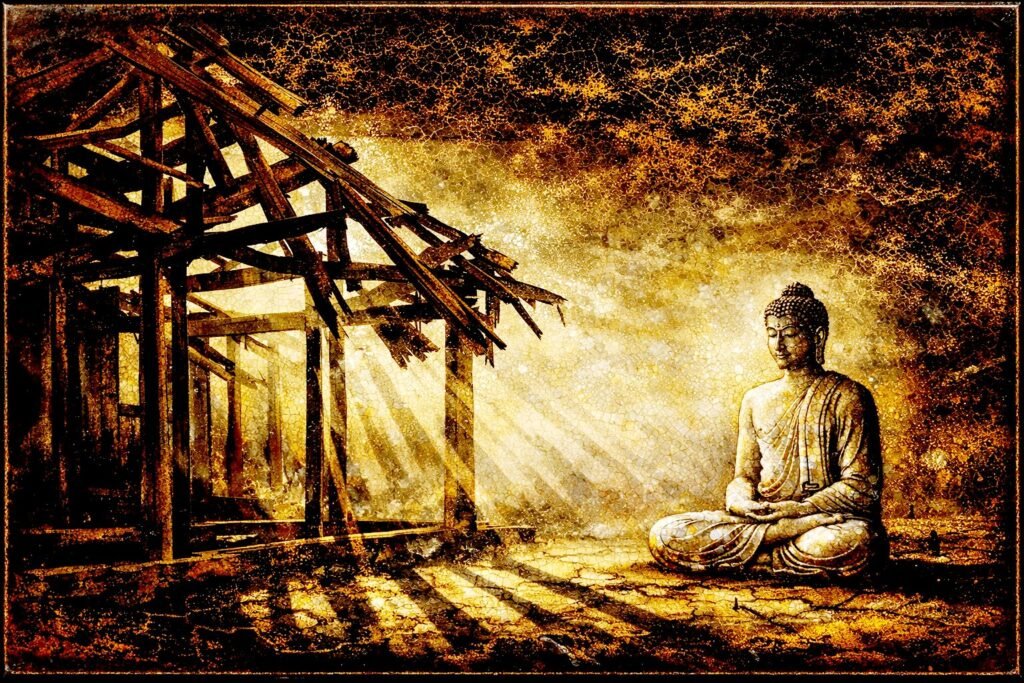
The broken frame of a house beneath an open sky, with the Buddha in meditation—an architectural metaphor for constructed existence and its cessation.
I. The Hermeneutical Question of the “House-Builder” Image
Among the most frequently cited verses of the Dhammapada, stanzas 153–154 stand out for a densely symbolic image: the “house-builder.” Here the Buddha recounts his wandering through immeasurable cycles of saṃsāra in search of the one who “builds the house.” Upon finally recognizing that builder, he declares that the house will no longer be constructed. In only a few brief lines, the verse sketches the entire passage from wandering to liberation, from continual fabrication to definitive cessation.
In the commentarial tradition, the “house-builder” is commonly taken as a figure for ignorance and craving—fundamental causes that sustain rebirth. This interpretation has become so familiar that it is seldom questioned. Yet if we read more slowly, attending to the inner logic of the “building a house” metaphor itself, a further question arises: do psychological states such as ignorance or craving truly correspond to the role of a “builder,” that is, an agent that constructs and operates? Or might the image be pointing to another layer of meaning, less visible within the standard reading?
This essay, therefore, does not seek to overturn the commentarial heritage. Rather, it returns to the wording of the text, examines the internal logic of the metaphor, and proposes a more cautious approach to the meaning of the “house-builder.” Through close reading and the careful analysis of its details, the study aims to illuminate further the philosophical depth contained in one of the most compressed and evocative passages of the Buddhist canon.
Section II — The Commentarial Tradition and the Conventional Understanding of the “House-Builder”
In the history of interpreting the Dhammapada, the image of the “house-builder” has rarely been regarded as an obscure metaphor. On the contrary, most commentarial traditions offer a fairly direct identification: the “builder” is understood as the psychological roots that bind beings to the cycle of rebirth, especially ignorance (avijjā) and craving (taṇhā).
Within the Theravāda exegetical system, this interpretation appears to have taken shape relatively early. The Dhammapada Aṭṭhakathā (Commentary on the Dhammapada), traditionally attributed to Buddhaghosa, when explaining verses 153–154, frequently associates the “house-builder” specifically with craving—the factor considered the primary driving force behind rebirth. According to this reading, craving “builds the house” by continually providing the conditions for the re-arising of name-and-form and the five aggregates, so that the house of existence is reconstructed life after life.
In other contexts, ignorance is placed alongside craving as its accomplice in this process. Ignorance obscures right understanding of reality, while craving propels the desire for continued existence; together they sustain the ongoing current of saṃsāra. From the broader doctrinal perspective of the Four Noble Truths and dependent origination, such an identification seems entirely reasonable: as long as ignorance and craving remain, rebirth continues; when they are eradicated, the cycle of birth and death comes to an end.
Precisely because of this apparent plausibility, the interpretation “house-builder = ignorance and craving” gradually became a commentarial default. In many modern translations and expositions, the equation is often accepted with little further justification, as though the meaning of the metaphor were already self-evident.
Yet familiarity can sometimes obscure questions that still deserve to be asked. The fact that an image has been explained in a particular way within the tradition does not necessarily mean that all alternative possibilities have been fully explored. Especially in concise and highly symbolic verses such as those of the Dhammapada, the distance between commentary and the wording of the text itself may be more subtle than it first appears.
For this reason, rather than treating the traditional interpretation as the endpoint of inquiry, it may be more fruitful to regard it as a point of departure—a foundation to be respected, yet also reexamined in light of the language of the text itself. From this perspective, returning to a close reading of each Pāli term becomes necessary, not in order to reject the tradition, but to ask whether the internal structure of the metaphor truly coincides with the familiar identification that has long been taken for granted.
III. Returning to the Text: A Close Reading of the Language of the Verses
Before advancing any interpretation, it is necessary to return to the text itself—specifically to verses 153–154 of the Dhammapada in the original Pāli. Traditionally, these lines are understood as the Buddha’s own autobiographical reflection on the moment of awakening, when he directly confronted the roots of birth and death and declared the end of the cycle of rebirth. Precisely because of this confessional and experiential character, each lexical choice in the verses invites slow and careful attention:
Pāli (Dhp 153–154)
153
Anekajātisaṃsāraṃ sandhāvissaṃ anibbisaṃ,
gahakārakaṃ gavesanto, dukkhā jāti punappunaṃ.
154
Gahakārakadiṭṭhosi, puna gehaṃ na kāhasi;
sabbā te phāsukā bhaggā, gahakūṭaṃ visaṅkhitaṃ;
visaṅkhāragataṃ cittaṃ taṇhānaṃ khayaṃ ajjhagā.
A standard English translation by Acharya Buddharakkhita reads:
153
Through many a birth in saṃsāra
have I wandered in vain,
seeking the builder of this house (of life).
Repeated birth is indeed suffering.
154
O house-builder, you are seen!
You will not build this house again.
For your rafters are broken
and your ridgepole shattered.
My mind has reached the Unconditioned;
I have attained the destruction of craving.
In common translations, the Buddha recounts having wandered through many lives in search of the “house-builder,” and, upon finally seeing that builder, proclaims that the house will no longer be constructed. The rafters are broken, the ridgepole shattered, and craving brought to its exhaustion. In only a few brief lines, the language of the verses condenses the entire trajectory of liberation.
Yet when we attend closely to the individual Pāli terms, several noteworthy semantic details begin to emerge.
First, the term gahakāraka—usually rendered as “house-builder”—is a compound of gaha (house) and kāraka (maker, doer, agent). In Pāli, kāraka implies not merely a quality but an operative agent, something that performs an action or brings about a result. Grammatically, it denotes not a static state but the subject of the act of “doing” (karoti). Even at the level of etymology, kāraka suggests constructive efficacy rather than a mere psychological disposition.
Second, the line gahakāraka diṭṭhosi—“house-builder, you are seen”—employs the verb diṭṭhosi (“have been seen”). Here the “builder” appears as something recognized, an object of direct cognition. Immediately afterward, however, the verses shift to a series of verbs with destructive connotations: bhaggā (“broken”), visaṅkhataṃ (“dismantled, deconstructed”), and finally taṇhānaṃ khayaṃ ajjhagā—“craving has reached its exhaustion.” Notably, it is craving that becomes the object of cessation (khaya), not the “house-builder” itself.
This grammatical distinction between what is “seen” and what is “brought to an end,” though subtle, may carry interpretive significance. In the Buddha’s self-description, two different dimensions seem to be present: on the one hand, the recognition of the “house-builder”; on the other, the cessation of craving as a condition sustaining saṃsāra. The fact that these elements do not coincide perfectly at the linguistic level opens the possibility that they are not necessarily identical at the conceptual level.
For this reason, rather than hastily assigning a fixed content to the “house-builder” from the outset, it may be more prudent to linger over the linguistic structure through which the Buddha articulated his experience of liberation. In compact texts such as the Dhammapada, each lexical choice often carries a subtle philosophical intention. Only from such a point of departure can the question of what the “house-builder” truly signifies be raised with due caution and textual grounding.
IV . Testing the Internal Logic of the “House-Building” Metaphor: Who Is the Builder, Really?
If the traditional interpretation—identifying the “house-builder” with ignorance and craving—offers a plausible explanation at the doctrinal level, then the next question no longer belongs primarily to the history of commentary, but to the internal logic of the metaphor itself. In other words, before determining what the “builder” signifies, we must first ask: structurally speaking, what characteristics must a “house-builder” possess?
At the most ordinary level, the act of building a house minimally implies three elements: materials, an operative agent, and a process that connects the two. Bricks, wood, or stone do not become a house by themselves without some constructive mechanism; likewise, intentions or psychological tendencies, unless enacted through a concrete process, cannot by themselves assemble a structure. The very verbs “to make” or “to build” therefore imply movement, operation, and procedural activity.
When ignorance (avijjā) and craving (taṇhā) are placed within this logical framework, a certain mismatch begins to appear. By nature, both are described in the canonical texts as psychological states or dispositions: ignorance as a failure to see reality correctly, and craving as attachment and thirst. They function as conditions rather than as operative agents in a mechanical sense. A cognitive error, however mistaken, does not itself “build” anything; a desire or emotional impulse, unless translated into an ongoing process of action, cannot directly construct a concrete configuration such as the five aggregates.
Put differently, there is an important ontological distinction between a quality and a mechanism. A quality may explain why a process occurs, but it does not necessarily explain how that process operates. If we take the metaphor literally, the “house-builder” would seem to correspond not merely to a psychological motivation but to an operative principle—something that genuinely participates in the work of construction itself.
The grammar of the verses further reinforces this suspicion. The Buddha declares, “house-builder, you are seen” (diṭṭhosi), yet it is craving that is said to “reach destruction” (khayaṃ ajjhagā). If the builder were entirely identical with craving, this difference in verbal forms becomes difficult to account for. Why does the text not say that the builder has been destroyed, but only that craving has come to an end? This linguistic separation suggests that the two may not coincide as neatly as the conventional interpretation assumes.
From this perspective, the metaphor of “building a house” appears to demand another layer of explanation. Between ignorance and craving as conditions on the one hand, and the house of the five aggregates as the resulting structure on the other, there may exist an intermediate mechanism—a process that actually “does” the building. Without identifying such a process, the image of a “builder” remains only partially explained.
For this reason, rather than hastily assigning a familiar label to the “house-builder,” it may be necessary to suspend inherited identifications and continue the inquiry. Within the framework of dependent origination, which factor truly performs the work of construction—what element genuinely deserves to be called a “builder” in the strict sense of the term?
V. A Process-Oriented Reading: The “Builder” as the Stream of Karmic Activity
If a close examination of the text suggests that the “house-builder” can hardly be understood merely as a psychological state, and if the logic of the metaphor requires a genuinely constructive agent, then the remaining question becomes clear: within the conceptual framework of early Buddhism, which element performs the function of such a “building” mechanism?
To address this question, it may be necessary to move beyond isolated qualities such as ignorance or craving and shift instead to the level of process. For the doctrine of dependent origination (paṭiccasamuppāda) does not operate as a collection of static entities, but as a sequence of dynamic events: this arising because that arises, and from this interplay a stream of existence takes shape. Within such a structure, what truly “produces” is not a single factor taken in isolation, but the ongoing operation of formations (saṅkhāra) and karma (kamma).
Unlike ignorance or craving—which are described primarily as psychological conditions—karma has the character of an active, constructive process. Each intentional action leaves behind a tendency; each tendency continues to shape perception and behavior; and it is precisely this cumulative momentum that gives rise to renewed birth and the reconfiguration of the five aggregates. In this sense, karma is neither a “thing” nor a hidden self, but a movement—a continuous mechanism that links conditions to results, like an invisible hand constantly assembling the components of existence.
When this model is placed within the metaphor of “building a house,” the structure becomes more coherent. Ignorance and craving may be understood as fuel or materials: they provide motivation and conditions for the process. Yet it is the stream of karmic activity—the ceaseless chain of formations that generate and regenerate experience—that actually performs the work of construction, that truly assumes the role of assembling the house of name-and-form and the five aggregates. If craving is comparable to wood and bricks, karma is the builder who puts them together into a concrete structure.
This reading also offers a more satisfactory account of the grammatical details of the verses. When the Buddha declares, “house-builder, you are seen,” the act of “seeing” may be understood as the direct recognition of the operative mechanism of saṃsāra—a clear insight into the functioning of karmic processes themselves. And when “craving has reached destruction,” what ceases is the fuel that sustains that process. Once the fuel is exhausted, the constructive activity naturally comes to a halt. The house is no longer built, not because a “builder” has been annihilated, but because the entire set of supporting conditions has dissolved.
Here, the “builder” is not an entity to be destroyed, but a mechanism to be understood. Once this mechanism is seen in its impersonal and dependently arisen nature, the mistaken identification with a fixed “self” collapses, and the cycle of rebirth loses its basis for continuation. In this sense, the Buddha’s declaration is not a victory over an adversary, but the complete deconstruction of the process that had been constructing existence all along.
Thus, reading the “house-builder” as the stream of karmic activity does not deny the roles of ignorance and craving. Rather, it places them in their proper position: as conditions and materials, not as the operative agent itself. Such an interpretation, instead of replacing the tradition, may help clarify the very mechanism that the metaphor of “building a house” seems to have implied from the beginning.
VI. Philosophical Implications: From Psychological Explanation to a Process Ontology
If the “house-builder” is read as the stream of karmic activity—that is, as an impersonal and selfless constructive process—then the implications of this interpretation extend beyond the explanation of a single metaphor. They touch upon the very way we understand the overall structure of saṃsāra and liberation in early Buddhism.
First, such a reading shifts the focus away from a merely psychological level. When the “builder” is identified directly with ignorance or craving, the emphasis tends to fall on moral and emotional content: eliminating desire, ending attachment, dispelling illusion. Yet if the “builder” is understood as a karmic process, attention moves instead to the structural dynamics of existence itself. The issue is no longer simply whether craving is present or absent, but how a continuous chain of conditions constructs what is conventionally called the “self.”
From this perspective, saṃsāra is no longer the effect of an inner, personified adversary, but the outcome of an impersonal mechanism of operation. This view aligns more closely with the spirit of dependent origination: there is no central subject directing the process, only the mutual conditioning of formations. The “builder,” therefore, is not a hidden ego, but the apparent continuity of a process that in fact possesses no fixed substance.
Second, this interpretation highlights a dimension of process ontology that has long been implicit within Buddhist thought. Existence is not understood as a collection of static entities, but as a continuous stream of construction. The “house” of the five aggregates is not a structure erected once and then preserved unchanged; rather, it is a project that is being rebuilt at every moment. It is precisely the continuity of karmic activity that gives this structure the appearance of stability and ownership.
When the Buddha declares, “house-builder, you are seen,” this may be understood as an insight into the very nature of this process: the recognition that what is called “I” is merely the effect of an ongoing chain of fabrications. And when “craving has reached destruction,” the fuel sustaining that process is exhausted, causing the entire structure to lose its foundation. Liberation, accordingly, is not the annihilation of an entity, but the dissolution of a constructive mechanism that had operated only through conditions.
Finally, this reading carries methodological implications as well. Rather than approaching the scriptures by rapidly equating symbols with familiar concepts, a process-oriented interpretation calls for greater patience: reading slowly, examining the internal structure of metaphors, and carefully distinguishing between conditions, mechanisms, and results. This approach applies not only to the image of the “house-builder,” but also to many other symbolic expressions in the canon that are often reduced to simplified moral slogans.
In this way, rereading the “house-builder” does more than offer an alternative interpretation of a particular verse. It suggests a broader hermeneutical orientation toward Buddhist thought itself: to see existence as an impersonal process of construction, and liberation as the cessation of that very process when its conditions are no longer present.
VII. Reading Again in Stillness
For a long time, the two verses on the “house-builder” have often been read as a declaration of victory: a triumph over ignorance, over craving, over the cycle of birth and death. Yet when we return to the language of the text itself and follow the inner structure of its metaphor more slowly, what emerges does not seem to be a confrontation so much as an insight.
The Buddha does not portray himself as one who has destroyed an enemy, but as one who has “seen.” What is seen is not a hidden entity lurking behind existence, but the very mechanism by which existence operates: an impersonal yet continuous process of construction through which the house of the five aggregates is built again and again. Once this process is recognized in its dependently arisen nature, the illusion of a “master” or owner naturally dissolves. And when the fuel of craving is exhausted, the work of building simply comes to a stop.
In this sense, the verses speak not only of cessation, but of a particular mode of knowing—a way of seeing things as they are. The “house-builder” is therefore no longer an image to be hunted down or resisted, but a key that helps us understand more deeply how saṃsāra is constructed moment by moment.
Yet perhaps the greater value of this rereading lies not merely in proposing a new interpretation of an ancient metaphor. It also suggests an attitude toward the very act of reading the scriptures. Verses that appear familiar, when confined within inherited explanations, easily become slogans repeated without reflection. Only when we slow down, suspend premature identifications, and listen patiently to each word and each structural nuance does the thought of the text gradually unfold on its own. Hermeneutics, in this sense, is not the imposition of meaning, but the creation of conditions in which meaning may disclose itself.
On an existential level, the image of the “house-builder” thus belongs not only to the Buddha’s distant past, but also to the present experience of every reader. At each moment, a “house” of selfhood continues to be assembled—from memories, desires, and countless small actions of everyday life. Simply seeing this process at work may already mark the beginning of freedom—not by destroying anything, but by no longer mistaking it for a fixed and enduring self.
And perhaps, in the final stillness of these two verses, what remains is not the image of a battle won, but the quiet openness of a construction that has ceased. The house is no longer built. Only the open sky remains.
Bibliography
Buddharakkhita, Acharya, trans. The Dhammapada: The Buddha’s Path of Wisdom. Kandy: Buddhist Publication Society, 1985.
Burlingame, Eugene Watson, trans. Buddhist Legends (Dhammapada Commentary). 3 vols. Cambridge, MA: Harvard University Press, 1921.
Fausboll, V., ed. The Dhammapada. London: Pali Text Society, 1881.