
Le Hoang Da
Independent Philosopher & Buddhist Scholar
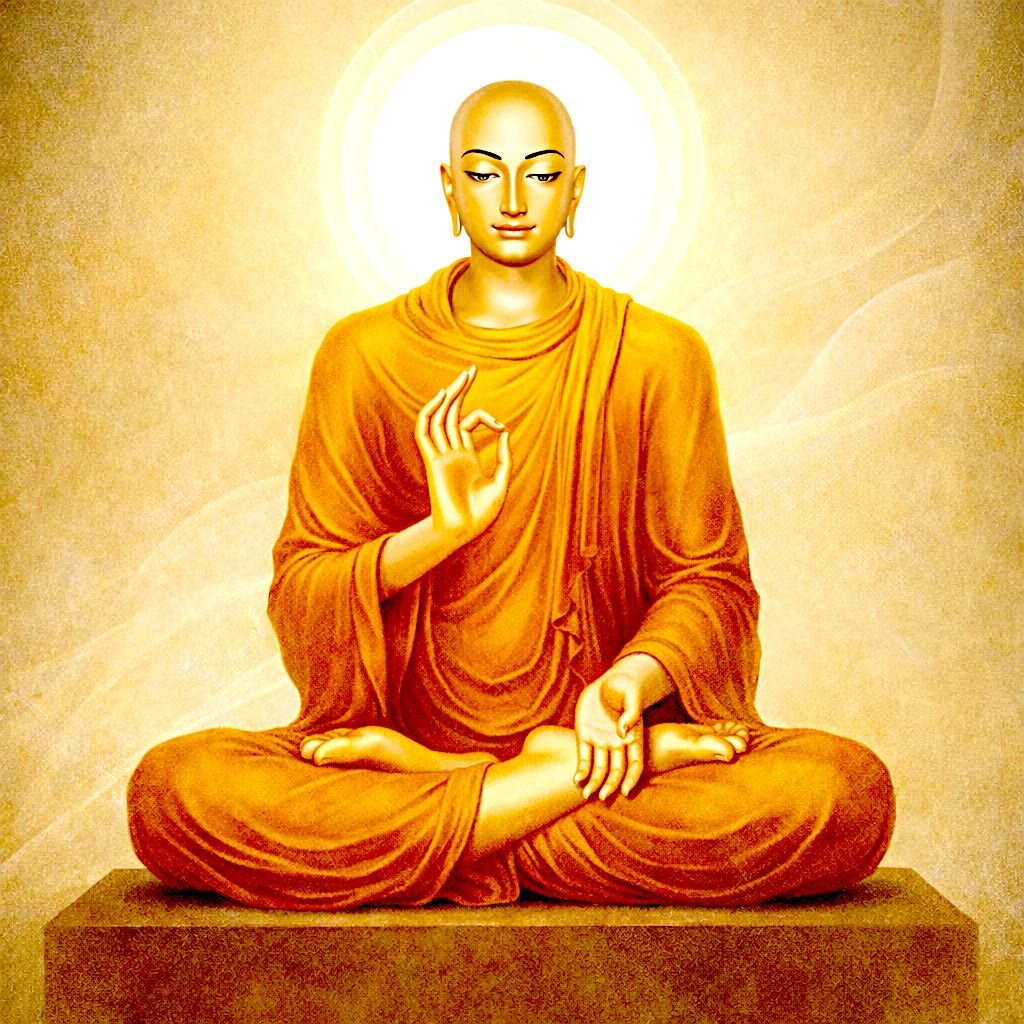
Arahant – the complete eradication of the fetters within the structure of the Four Fruits.
I. The Four Noble Fruits between Destiny and Spiritual Structure
Within the Nikāya tradition, the Four Noble Fruits—sotāpanna (stream-enterer), sakadāgāmin (once-returner), anāgāmin (non-returner), and arahant—are commonly understood as clearly demarcated stages on the path to liberation. Yet in the history of Buddhist studies, the structural interpretation of these four attainments has not always been uniform. Some readings emphasize their post-mortem dimension: each fruit appears to be associated with a specific rebirth destiny, accompanied by distinct cosmological consequences after the dissolution of the body. From this perspective, the system of the Four Noble Fruits can easily be envisioned as a stratified scheme of “destinations,” in which each level corresponds to a particular position within the cycle of rebirth.
Alongside this view, however, there exists the argument that the structure of the four fruits was not originally fixed and fully systematized from the outset, but gradually developed and crystallized over the course of the tradition’s evolution. According to this approach, internal tensions may exist among different descriptions of the “path” (magga), the “fruit” (phala), and the state of realization “here and now” (diṭṭhe va dhamme) in contrast to post-mortem consequences. In particular, the status of the anāgāmin—the “non-returner”—is often examined in relation to the arahant: if the arahant represents complete cessation and is emphasized as an attainment realized in this very life, how should the position of the non-returner be understood within that structure? Does this suggest an inconsistency, or at least a shift, in the understanding of liberation?
These questions indicate that the issue is not merely doctrinal, but methodological. Should the Four Noble Fruits primarily be read as positions within a stratified cosmology, where each level implies a distinct realm of rebirth? Or should they instead be understood as degrees of inner purification, measured by the extent to which fetters (saṃyojana) and taints (āsava) have been eradicated, within a single process of liberation? In other words, is the structure of the Four Noble Fruits fundamentally “geographical,” or fundamentally “spiritual–ethical”? And if cosmological language appears in the Nikāyas, does it function as the classificatory foundation of the system, or merely as the consequence of transformations in the structure of consciousness?
This article proposes that the second reading allows for a clearer recognition of the Nikāyas’ internal coherence. A close examination of the relevant passages reveals that the decisive criterion is not the place of rebirth, but the degree of eradication of fetters. The sotāpanna is defined by the elimination of the first three lower fetters; the anāgāmin by the elimination of the five lower fetters; the arahant by the complete destruction of all taints. References to rebirth, heavenly realms, or “not returning to this world” appear only as necessary consequences of this structural transformation: when the conditions for a particular mode of existence (bhava) no longer obtain, the corresponding rebirth likewise ceases. Thus, post-mortem classifications do not constitute the foundation of the system; rather, they express the principle of dependent origination at the cosmological level.
From this perspective, the four “paths” are not four distinct trajectories, but four degrees of progress within a single Way. The imagery of the “stream” (sota) evokes a continuous process, in which purification unfolds step by step, rather than through abrupt leaps into different realms of existence. “Non-return” need not be understood as spatial relocation, but as the absence of conditions for rebirth in a given mode of existence. Likewise, “here and now” does not deny post-mortem consequences; it emphasizes the experiential immediacy of liberation within the present structure of consciousness.
Accordingly, the aim of this article is neither to deny the cosmological dimension of the Nikāyas nor to reduce the teaching to a modern psychological framework. Rather, it seeks to reposition the relationship between spiritual structure and cosmological language: cosmology functions as a moral–spiritual cartography, not as an independent spatial taxonomy detached from the inner process of transformation. When the Four Noble Fruits are read in light of the eradication of fetters and the principle of dependent origination, the system reveals no inherent tension requiring explanation through evolutionary hypotheses. Instead, it displays its own internal logic, grounded in the conditional structure of the mind.
With this orientation in place, the following section will examine more closely the criteria by which the four fruits are distinguished in the Nikāyas, before turning to an analysis of the concept of “path” (magga), the meaning of “non-return,” and the role of cosmology within the overall structure of liberation.
II. The Criterion of Distinction: The Eradication of Fetters as the Measure of Liberation
If one wishes to understand correctly the structure of the Four Noble Fruits in the Nikāyas, it is first necessary to clarify the criterion by which these attainments are distinguished. A direct examination of passages in the Saṃyutta Nikāya, the Aṅguttara Nikāya, and related texts reveals a consistent point: the difference between sotāpanna, sakadāgāmin, anāgāmin, and arahant is not defined by place of rebirth, but by the degree to which fetters (saṃyojana) and taints (āsava) have been eradicated.
In many discourses, the sotāpanna is described as one who has eliminated the three lower fetters: identity view (sakkāya-diṭṭhi), doubt (vicikicchā), and attachment to rites and rituals (sīlabbata-parāmāsa). No spatial or cosmological criterion is presented as a prerequisite. Statements such as “no longer subject to rebirth in the lower realms” or “destined to attain full awakening within at most seven lives” appear only as necessary consequences of this eradication. What is primary is the structure of the mind: three fundamental bonds rooted in distorted understanding have been broken.
Similarly, the anāgāmin is defined as one who has eradicated the five lower fetters—including sensual desire (kāma-rāga) and ill will (paṭigha). The commonly mentioned result is “not returning to this world” and “being reborn in the Pure Abodes.” Yet a careful reading shows that the decisive factor is precisely the elimination of sensual desire and ill will. Once sensual desire has been extinguished, the condition for rebirth in the sensual realm no longer exists. “Non-return,” therefore, is not a geographical decision but the necessary consequence of a transformed mental structure.
This point becomes clearer when situated within the framework of dependent origination. According to paṭicca-samuppāda, birth (jāti) arises from becoming (bhava), becoming arises from clinging (upādāna), and clinging arises from craving (taṇhā). When sensual craving has been eradicated, a particular mode of becoming can no longer continue. Thus, cosmological consequences—where one is reborn, whether one returns—depend entirely on the conditioned structure of the mind. For this reason, the criterion of distinction cannot lie in post-mortem outcomes, but in the degree to which the conditions for rebirth have been eliminated.
In the case of the arahant, the criterion becomes even more explicit. The arahant is described as one who has eradicated all ten fetters and destroyed the taints completely. The phrase “here and now” (diṭṭhe va dhamme) does not signify a rejection of any post-mortem dimension; rather, it emphasizes that the eradication has been completed in this present life. No conditions remain for further becoming; therefore, when the body breaks up, there is no further rebirth. Yet the foundation of this cessation lies in the total destruction of fetters—not in the attainment of a particular “realm of existence.”
It is noteworthy that in passages classifying the four fruits, the element of “eradication” consistently appears first, while references to rebirth often function as secondary elaborations. This reveals the logical order of the teaching: mental structure is the cause; cosmological consequence is the effect. If this order is reversed—if place of rebirth is taken as the criterion of distinction—the causal foundation of the entire system is obscured.
Another important point to emphasize is the continuity of the process of eradication. Fetters are not destroyed through mechanical “leaps across space,” but are gradually dismantled in degrees. A sotāpanna does not move to a new “realm” in order to become a sakadāgāmin; rather, the residual traces of greed, hatred, and delusion are further attenuated. The anāgāmin does not enter a fundamentally different trajectory; he or she simply continues the process of purification until all fetters are eradicated. Thus, no rigid ontological boundaries separate the fruits—only differences in the degree of purification.
This clarification illuminates the relationship between “path” (magga) and “fruit” (phala). Magga is not a geographical route from point A to point B, but the process of eradicating fetters. Phala is not a destination reached, but the state of mind that obtains once a given level of eradication has been completed. The four fruits can therefore be understood as four degrees within a single process of purification, rather than as four distinct destinies.
From this, a preliminary conclusion may be drawn: the structure of the Four Noble Fruits in the Nikāyas is spiritual–ethical before it is cosmological. Cosmology is not denied, but it functions as the language through which the consequences of mental transformation are expressed. When fetters remain, corresponding conditions for rebirth remain; when fetters are eradicated, those conditions cease. The entire system is thus grounded in the logic of dependent origination, rather than in a logic of spatial stratification.
At precisely this point, reading the Four Noble Fruits as a scheme of “destinations” may generate artificial tensions. If the non-returner and the arahant are treated as two distinct positions on a cosmological map, one may easily question the compatibility between “not returning” and “here and now.” But if they are understood as two degrees of eradication within a single conditioned structure, the difference is one of degree, not of realm.
By placing the eradication of fetters at the center, the structure of the Four Noble Fruits emerges as coherent and internally consistent. Descriptions of rebirth, realms, and “non-return” no longer function as foundational classifications, but as necessary consequences of the ongoing purification of the mind. From here, we may proceed to examine the concept of magga as a single Way, in which the four fruits represent successive degrees within one continuous transformation.
III. One Way (Magga) and the Imagery of the Stream
Having established that the criterion distinguishing the Four Noble Fruits lies in the degree of eradication of fetters, the next question to be clarified is whether there truly exist four independent “paths” corresponding to the four attainments. In many modern translations, one frequently encounters the phrase “four paths and four fruits,” as though each fruit were associated with a distinct path of its own. Yet when we return to the Pāli texts and the usage of the early tradition, the picture proves to be more nuanced.
First, the term magga in the Nikāyas is predominantly used in the singular: ayaṃ maggo, “this path,” or ariyo aṭṭhaṅgiko maggo, “the Noble Eightfold Path.” The Noble Eightfold Path is not divided into four different versions corresponding to four stages of liberation. It is a single Way, in which right view, right intention, right speech, right action, right livelihood, right effort, right mindfulness, and right concentration function as integral factors. When the tradition speaks of the “path of the stream-enterer” or the “path of the non-returner,” it does not imply the existence of essentially distinct routes; rather, it refers to the stage at which a particular degree of eradication has been completed.
This becomes even clearer when we consider the imagery of the “stream” (sota)—one of the central metaphors in the Nikāyas. Sotāpanna means “one who has entered the stream.” The stream here is not a new route branching off from the Noble Eightfold Path; it is the very current of that path itself. When a person “enters the stream,” this does not signify a transition into another world. It signifies entry into the dynamic flow of the liberative process—a current directed toward nibbāna. The image of the stream conveys continuity and dynamism: water does not leap mechanically from one tier to another, but moves according to its intrinsic momentum.
For this reason, speaking of “four ways” may easily create the impression of four separate trajectories. In reality, however, these are four degrees of attainment within the same Way. A sotāpanna does not abandon one path in order to embark upon a “second magga”; he or she continues along the same path until the remaining fetters are weakened and ultimately eradicated. The sakadāgāmin and anāgāmin are not “switching tracks,” but advancing further along the same current.
At this point, the distinction between magga and phala also requires clarification. Magga may be understood as the moment of eradication—the critical breakthrough at which a group of fetters is severed. Phala is the state of mind that follows, once that eradication has been accomplished. Yet neither magga nor phala refers to a location or spatial tier; both designate transformations within the structure of consciousness. When the tradition speaks of sotāpatti-magga and sotāpatti-phala, it does not posit a separate road leading to a separate realm; rather, it analyzes the inner process at a more refined level.
This perspective helps us avoid an important misunderstanding: namely, that rigid ontological boundaries exist between the fruits. If there is only one Way, then the difference between a sotāpanna and an arahant is not a difference of “realm,” but a difference in the degree of purification within the same ongoing process. A sotāpanna has broken the first three fetters; an arahant has broken them all. Yet both remain on the same path, within the same current moving toward the cessation of suffering.
The imagery of the stream also carries another crucial implication: irreversibility. Once one has entered the stream, one is “certain” to attain final liberation. However, this certainty is not a destiny imposed from outside; it is the internal consequence of a transformed structure. When the three fundamental fetters have been broken, a return to the former distorted views becomes impossible. The current is now flowing toward the ocean; it no longer turns back toward its source. Here, the necessity of liberation is grounded in the structure of the mind itself, not in the arrangement of a cosmological map.
Viewed in this way, the notion of “four Ways” dissolves into four degrees within a single dynamic of purification. This insight softens many of the tensions that arise when the system is read in terms of spatial stratification. The non-returner is not someone standing on a “third path” leading to a separate domain; he or she has simply advanced further along the same Way, to the point where sensual desire and ill will have been eradicated. The arahant does not shift onto a new trajectory, but completes the same process by eliminating all remaining taints.
Thus, the structure of the Four Noble Fruits is not a branching system, but a system of growth. The fruits do not exist side by side as competing destinations; they succeed one another as successive degrees of purification within a single transformative flow. For this reason, when magga is placed at the center, the entire system reveals itself as governed by the logic of process rather than the logic of position.
This recognition will prove decisive when we turn to the issues of “non-return” and “here and now.” If there is only one Way and the fruits represent degrees within a single current, then the anāgāmin and the arahant cannot be treated as two essentially separate entities. Their difference lies in the degree of eradication, not in belonging to two distinct “realms of existence.” From this foundation, we may proceed to examine more closely the meaning of non-return and the significance of attainment “in this very life,” in order to clarify further the internal structure of liberation in the Nikāyas.
IV. Non-Return and “Here and Now”: Clarifying an Interpretive Tension
Within the structure of the Four Noble Fruits, the anāgāmin—the “non-returner”—is commonly described as one who “does not return to this world,” but is reborn in the Pure Abodes (Suddhāvāsa) and there attains nibbāna. By contrast, the arahant is emphasized as one who has “destroyed the taints in this very life,” attaining liberation “here and now” (diṭṭhe va dhamme). If read in terms of spatial stratification, these descriptions may give the impression of a division: on the one hand, liberation completed in another realm after death; on the other, liberation completed in the present life. The question thus arises: is there a tension between “non-return” and “here and now”?
Yet when we return to the criterion already established—namely, the degree of eradication of fetters—it becomes clear that this tension largely arises from a reading that prioritizes post-mortem consequences over internal structure. The anāgāmin is defined as one who has eradicated the five lower fetters, including sensual desire (kāma-rāga) and ill will (paṭigha). When sensual desire is eliminated, the condition for rebirth in the sensual realm no longer exists. “Not returning to this world” is therefore not a spatial determination, but the necessary consequence of the eradication of sensual craving.
This point can be further illuminated through the principle of dependent origination. According to paṭicca-samuppāda, birth (jāti) arises from becoming (bhava), and becoming arises from clinging (upādāna), which in turn originates from craving (taṇhā). When sensual craving has been completely eradicated, a particular form of becoming—namely, becoming within the sensual realm—can no longer continue. “Non-return,” in this sense, is simply the absence of the conditions for a specific type of rebirth. It signifies the cessation of a cause, not relocation to a new coordinate within cosmic space.
Similarly, “here and now” in the case of the arahant does not deny any post-mortem dimension. Rather, it emphasizes that the destruction of the taints has been completed in this present life. Once the ten fetters have been eradicated, no condition remains for any form of becoming to persist. Liberation is not postponed to another realm; it is verified within the present structure of consciousness. When the body breaks up, there is no further rebirth—but the basis of this cessation lies in the destruction of conditions, not in the attainment of a place.
From this perspective, the anāgāmin and the arahant do not represent two fundamentally distinct realms of existence. Their difference lies in the degree of eradication: the non-returner has eliminated the five lower fetters, while the higher fetters remain; the arahant has eradicated them all. “Non-return” and “here and now,” therefore, are not opposing states, but expressions of different degrees within the same process of purification.
Read in this way, the system contains no ontological boundary between “the present” and “the post-mortem.” Post-mortem language simply expresses the consequences of a transformed mental structure. When conditions remain, continuation remains; when conditions cease, continuation ceases. This entire logic accords fully with dependent origination and does not require positing a doctrinal evolution from “becoming” to “cessation.”
Another important factor is the experiential verifiability of liberation. In the Nikāyas, numerous passages emphasize that one who has attained a fruit can know and confirm that state directly. This is not knowledge of a future destination, but knowledge of an eradication that has already occurred. When one knows that the fetters have been broken, one knows that the corresponding consequences can no longer arise. The certainty of “non-return,” therefore, rests not on metaphysical belief about the future, but on direct insight into the structure of causality.
The so-called “tension” between the non-returner and the arahant thus largely stems from reversing the order of causality: instead of taking eradication as the foundation and post-mortem consequences as its expression, one takes post-mortem consequences as the classificatory criterion. Once the order is restored—mental structure first, consequence second—the system becomes coherent and self-explanatory.
From this, an important conclusion follows: in the Nikāyas, language concerning rebirth and realms is not the central principle for classifying liberation, but the expression of the consequences of inner transformation. “Non-return” is not a coordinate; it is the absence of conditions. “Here and now” is not the negation of a post-mortem dimension; it is the present verification of cessation. When read within this structure, the anāgāmin and the arahant no longer stand as opposing poles, but as two degrees within a single process of liberation.
On this basis, we may proceed to examine more broadly the role of cosmology in the Nikāyas. If rebirth and realms function only as consequences of mental structure, then cosmology as a whole may be understood as a moral–spiritual cartography rather than as an independent spatial taxonomy. The following section will explore more deeply the relationship between cosmology and the structure of consciousness, in order to complete the picture of the Four Noble Fruits as a dynamic of purification rather than a scheme of positional hierarchy.
V. Cosmology as Moral–Spiritual Language
Having examined the structure of the Four Noble Fruits through the criterion of the eradication of fetters and the dynamics of a single Way, we may observe that descriptions of rebirth and realms do not function as the foundational principle of classification. Yet this does not mean that cosmology in the Nikāyas is secondary or reducible to mere metaphor. The issue is not to deny cosmology, but to determine its proper place and function within the overall system.
In the Nikāyas, the various realms—sensual, form, and formless; the heavenly worlds, the Brahmā realms, and the Pure Abodes (Suddhāvāsa)—are often described in detail and with clear structural articulation. At one level, these depictions reflect the ancient Indian worldview, in which the cosmos is envisioned as a stratified system ordered by degrees of subtlety. Yet when these descriptions are read alongside the criterion of fetter-eradication, a striking correspondence emerges: each cosmological tier tends to correlate with a particular degree of mental purification.
The sensual realm corresponds to a mind still governed by sensual craving; the form realm corresponds to meditative states that transcend sensuality; the formless realm to even more refined absorptions. Similarly, rebirth in the Pure Abodes is linked to the eradication of the five lower fetters—that is, to a mental structure that has moved beyond sensual desire. Cosmology here does not operate as an independent spatial taxonomy detached from the inner life; it functions as a language for articulating degrees of purification within consciousness.
This point becomes especially clear when we consider the relationship among craving (taṇhā), clinging (upādāna), and becoming (bhava). According to dependent origination, becoming arises from clinging, and clinging arises from craving. When craving persists, becoming persists; when craving ceases, becoming ceases. In this sense, the realms are not arbitrary “destinations,” but manifestations of particular modes of becoming conditioned by the structure of the mind. Sensual craving gives rise to becoming within the sensual realm; craving for form and formlessness gives rise to more subtle forms of becoming. Cosmology thus reflects the causal logic of the mind rather than imposing an external schema upon it.
This allows us to understand cosmology as a kind of moral–spiritual cartography. It does not merely describe places; it describes possibilities of existence shaped by degrees of purification or defilement. When someone is described as “not returning to this world,” the statement does not simply refer to the absence of a physical journey; it refers to the absence of the conditions for a particular mode of becoming. When someone is said to be “reborn in the Pure Abodes,” this reflects a mental structure that has transcended sensual craving.
At the same time, it is important not to reduce the entirety of cosmology to modern psychological metaphor. In its ancient context, the realms were understood as genuine modes of existence. Yet “genuine” does not mean “independent of mind.” In early Buddhism, reality is always understood in relation to dependent origination. Realms exist as consequences of karma and mind; they are not self-subsisting entities. To read cosmology as expressive of mental structure is therefore not to impose a modern reinterpretation, but to return to the fundamental principle of the teaching: all phenomena arise dependently.
From this standpoint, cosmology in the Nikāyas is not the center of the classification of liberation. The center remains the eradication of fetters and taints. Cosmology articulates the existential consequences of that eradication. When conditions remain, becoming remains; when conditions are dismantled, becoming ceases. The system does not require positing a doctrinal shift from “becoming” to “cessation”; the logic of cessation is already embedded within the very structure of dependent origination.
This perspective also clarifies the relationship between liberation and present experience. When liberation is described as “here and now,” this does not negate cosmological dimensions; it places emphasis on the transformation of the mind in the present. Cosmology, if invoked, merely expresses the necessary consequences of that transformation. When the mind no longer provides conditions for becoming, all corresponding possibilities of rebirth fall away. Liberation thus depends not on reaching another space, but on dismantling the conditioned structure of the mind itself.
From this vantage point, we may conclude that cosmology in the Nikāyas operates as moral–spiritual language: it describes levels of existence in accordance with degrees of purification or defilement of mind. The realms do not constitute the foundational taxonomy of liberation; they are consequences of transformed mental structure. Read in this way, one can preserve the integrity of cosmological discourse without falling into mechanical literalism, while also avoiding its reduction to mere metaphor.
With this positioning, the structure of the Four Noble Fruits appears as a dynamic of purification: one single Way, four degrees of eradication, and a cosmology that functions as the expression of conditioned structure. The final section will synthesize the argument, reaffirming the Four Noble Fruits as four degrees in the dismantling of the conditions for rebirth within a coherent and unified process of liberation.
VI. Rereading the Four Noble Fruits: A Coherent Structure of Liberation
Having examined the criterion of fetter-eradication, clarified the unity of the “path” (magga), analyzed the meaning of “non-return,” and repositioned the role of cosmology, we may now return to the fundamental question: how should the Four Noble Fruits be understood within the overall structure of the Nikāyas?
First, it must be emphasized that the four fruits are not four parallel “destinations,” but four degrees of purification within a single process. The sotāpanna does not enter a new realm of existence, but breaks the three fundamental fetters rooted in distorted perception. The sakadāgāmin does not shift to another path, but further attenuates the remaining defilements. The anāgāmin does not attain a separate metaphysical coordinate, but eradicates sensual desire and ill will, thereby removing the conditions for rebirth in the sensual realm. The arahant does not ascend into a higher world, but completes the process by destroying all taints.
This indicates that the difference among the four fruits is a difference of degree, not of essence. In dynamic terms, they may be described as “thresholds of eradication” within a single current of transformation. Each threshold marks the dismantling of a group of conditions that bind consciousness. Yet the entire process operates according to the same causal logic: when a condition is removed, its corresponding effect can no longer arise.
From this perspective, the system of the Four Noble Fruits contains its own internal coherence. There is no need to posit a historical development from a doctrine centered on “becoming” to one centered on “cessation” in order to account for variations in description. Within the structure of dependent origination itself, both continuation and cessation are simultaneously present. When craving remains, becoming remains; when craving ceases, becoming ceases. The fruits merely indicate the degree to which the conditioned structure has been dismantled.
This coherence is further reinforced by the experiential verifiability of liberation in the Nikāyas. One who attains a fruit does not await post-mortem confirmation to know his or her status; it is known directly through the eradication of fetters. This direct knowledge forms the basis for any affirmation of future consequence. If the condition has ceased, the effect cannot arise. The certainty of “non-return” or “no further rebirth” is therefore not a metaphysical belief about the future, but an inference grounded in directly realized causality.
On this basis, a synthetic reading may be proposed: the Four Noble Fruits constitute a stratified structure of dismantling the conditions for rebirth within a single Way. Cosmology, with its descriptions of realms and rebirth, functions as the language expressing the consequences of that structure. When read in this manner, descriptions of the “Pure Abodes,” “non-return,” or “liberation here and now” no longer stand in tension with one another; they reflect different degrees within the same process of purification.
This approach also allows us to avoid two extremes. On the one hand, it does not reduce the entire system to modern psychological metaphor, thereby denying its cosmological dimension. On the other hand, it does not interpret the system as a purely spatial stratification, in which each fruit corresponds to an independent location. Instead, both dimensions can be held within a unified structure: mental structure is the cause, cosmology the consequence; process is central, while position is expressive.
Rereading the Four Noble Fruits in this way does not diminish the force of the teaching; rather, it highlights the internal coherence of the Nikāyas. It reveals that the entire soteriological system is grounded in dependent origination and the eradication of fetters, not in the spatial division of realms. When the order of causality is restored to its proper place, interpretive tensions naturally subside without recourse to complex developmental hypotheses.
Under this reading, the Four Noble Fruits are not merely four designations, but four degrees in the dismantling of the conditions that bind consciousness within an ongoing process of liberation. It is this process—rather than any cosmological map—that stands at the center of the Nikāyas.
VII. The Four Noble Fruits as the Dynamics of Cessation
Through an examination of the criterion of fetter-eradication, a clarification of the unity of the path (magga), an analysis of the meaning of “non-return,” and a repositioning of the role of cosmology, this article has proposed a reading of the Four Noble Fruits grounded in the internal structure of liberation within the Nikāyas. Rather than viewing the four attainments as post-mortem positions within a stratified cosmological scheme, they may be understood as four degrees in the dismantling of the conditions for rebirth within a continuous process of purification.
The criterion distinguishing the sotāpanna, sakadāgāmin, anāgāmin, and arahant is not the place of rebirth, but the degree to which fetters and taints have been eradicated. When the first three fetters are broken, the basic structure of distorted perception is fundamentally shaken; when the five lower fetters are eliminated, the conditions for rebirth in the sensual realm cease; when all fetters and taints are destroyed, becoming comes to an end entirely. Every description of rebirth or “non-return” arises as the consequence of this transformation in structure.
At the same time, recognizing that there is only a single Way reveals that the four fruits are not four parallel routes, but four degrees within one current of transformation. The imagery of “stream-entry” suggests dynamism rather than positionality: one who has entered the stream has entered the flow of liberation, and subsequent stages of eradication unfold as the natural continuation of that movement. The difference between the anāgāmin and the arahant, therefore, lies in degree of purification, not in belonging to different realms of existence.
On this foundation, cosmology in the Nikāyas may be understood as moral–spiritual language. The realms are not the central classificatory principle of liberation, but expressions of the conditioned structure of mind. When craving and clinging persist, becoming persists; when craving ceases, becoming ceases. Cosmology thus reflects the logic of dependent origination within the mind, rather than establishing an independent spatial taxonomy detached from inner transformation.
This reading neither denies cosmological descriptions in the canonical texts nor reduces them to mere metaphor. Instead, it restores the proper order of causality: mental structure is the cause, cosmology the consequence. Once this order is clearly recognized, the system of the Four Noble Fruits emerges as internally coherent, without requiring complex developmental hypotheses to explain variations in description.
The Four Noble Fruits may therefore be understood as the dynamics of cessation: four degrees in dismantling the conditions that bind consciousness within a single Way. Liberation does not consist in reaching another space, but in removing the conditions that sustain the cycle of becoming. When the condition ceases, continuation ceases. It is within this simple yet profound structure that the Nikāyas reveal their coherence—a coherence grounded in dependent origination and eradication rather than in the stratification of realms.
Bibliography
Bodhi, Bhikkhu, trans. The Connected Discourses of the Buddha: A Translation of the Saṃyutta Nikāya. Boston: Wisdom Publications, 2000.
Bodhi, Bhikkhu, trans. The Numerical Discourses of the Buddha: A Translation of the Aṅguttara Nikāya. Boston: Wisdom Publications, 2012.
Gethin, Rupert. The Foundations of Buddhism. Oxford: Oxford University Press, 1998.
Harvey, Peter. An Introduction to Buddhism: Teachings, History and Practices. 2nd ed. Cambridge: Cambridge University Press, 2013.
Horner, I. B. “The Four Ways and the Four Fruits in Pāli Buddhism.” The Indian Historical Quarterly 10 (1934): 785–796.
Ñāṇamoli, Bhikkhu, and Bhikkhu Bodhi, trans. The Middle Length Discourses of the Buddha: A Translation of the Majjhima Nikāya. Boston: Wisdom Publications, 1995.
Vetter, Tilmann. The Ideas and Meditative Practices of Early Buddhism. Leiden: Brill, 1988.
Wynne, Alexander. The Origin of Buddhist Meditation. London: Routledge, 2007.