
Le Hoang Da
Buddhist Scholar
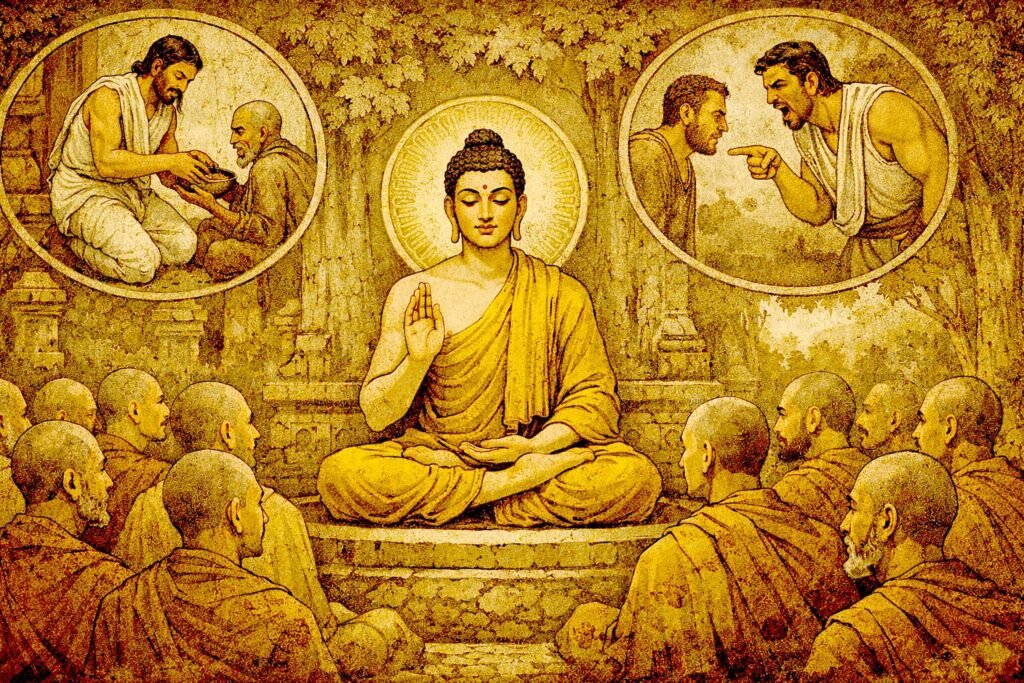
The Buddha teaching the distinction between the true person (sappurisa) and the false person (asappurisa) in the Cūḷapuṇṇama Sutta (MN 110).
I. Introduction: The Problem of Recognizing the “True Person”
In social life, people often evaluate one another through external signs such as social status, reputation, education, or success in religious activities. A person may be regarded as respectable because they occupy a prominent role in the community, because they speak eloquently about religious teachings, or because they are widely admired by others. Yet such criteria raise a fundamental question: do these outward signs truly reflect the inner qualities of a person? In other words, how can we recognize someone who genuinely possesses moral and spiritual integrity?
This issue is not merely a sociological or ethical question in the ordinary sense; it is also a profound epistemic problem. If external appearances can be misleading, then distinguishing between a genuine person and a false one becomes a difficult task. In many cases, individuals lacking moral integrity may still succeed in presenting themselves as worthy of respect in the eyes of the public, while those with a deep inner life do not necessarily display their qualities through easily recognizable forms. For this reason, determining what constitutes a “true person” cannot rely solely on superficial criteria, but requires a deeper understanding of the moral and psychological structure of human life.
The Cūḷapuṇṇama Sutta of the Majjhima Nikāya offers one of the clearest and most systematic discussions of this issue in the early Buddhist canon. In this discourse, the Buddha draws a fundamental distinction between two types of persons: asappurisa (the ignoble or false person) and sappurisa (the noble or true person). This distinction is not based on social status, intellectual learning, or the outward forms of religious practice, but rather on a series of interconnected moral and psychological qualities.
What is particularly striking about the discourse is the way it presents the contrast between these two types of persons through a symmetrical and systematic structure. The false person is described as someone lacking the fundamental qualities of moral life: they lack faith, lack moral shame and moral dread, are not inclined to learning, are negligent in practice, and are deficient in mindfulness and wisdom. Moreover, these characteristics shape their entire way of living. They associate with people of similar disposition, think along misguided lines, speak and act under the influence of unwholesome motivations, and eventually develop distorted views about the world and the path to liberation. In contrast, the true person is portrayed as someone who has developed a completely different structure of character: they possess faith, moral shame and moral dread, a desire to learn, diligence in practice, mindfulness, and wisdom. As a result, their entire life—from social relationships to speech, action, and understanding—is oriented toward wholesome conduct and the pursuit of liberation.
Through this presentation, the discourse shows that the difference between the false person and the true person does not lie in a few isolated actions, but in the overall structure of moral and psychological life. In other words, early Buddhism does not understand the “true person” as a social title or role, but as the outcome of an inner process of transformation in which ethical qualities, cognitive understanding, and spiritual practice mutually support and reinforce one another.
For this reason, the Cūḷapuṇṇama Sutta can be understood not merely as a sermon on morality, but as a reflection on the nature of spiritual authenticity in early Buddhism. By contrasting the false person (asappurisa) with the true person (sappurisa), the discourse offers a criterion for recognizing the genuine qualities of a human being—a criterion that does not rely on appearance or reputation, but on the consistency between mind, speech, action, and understanding.
This article analyzes the Cūḷapuṇṇama Sutta from philosophical and ethical perspectives in order to clarify how the discourse constructs the idea of the “true person.” First, it examines the way the sutta describes the false person and the limitations in their capacity for moral understanding. It then analyzes the figure of the true person as an integrated ethical ideal in early Buddhism. From there, the article discusses the broader implications of the discourse for understanding spiritual authenticity, moral discernment, and the structure of human character within the Buddhist tradition.
II. The False Person and the Limits of Moral Perception
One of the distinctive features of the Cūḷapuṇṇama Sutta is that the discourse does not merely describe the qualities of the false person (asappurisa), but also points to the limits of their capacity for moral perception. At the very beginning of the discourse, the Buddha makes an important observation: the false person cannot recognize who is a false person and who is a true person. In other words, moral deficiency does not only affect an individual’s behavior; it also weakens their ability to judge other people and the world around them.
According to the presentation of the discourse, the false person is first characterized by the absence of the fundamental qualities of moral life. They lack faith, lack moral shame and moral dread, show little inclination toward learning, are negligent in practice, and are deficient in mindfulness and wisdom. These characteristics do not exist as isolated traits; rather, they form a psychological structure in which each element reinforces and sustains the others. When a person lacks confidence in the value of the moral path, they have little motivation to learn or to cultivate themselves. When learning and mindfulness are absent, the capacity to recognize one’s own mistakes becomes weak. And when wisdom is not developed, unwholesome tendencies more easily dominate one’s life.
An important consequence of this structure is the formation of a corresponding social environment. The discourse indicates that false persons tend to associate with individuals who share similar qualities. They seek out those who also lack faith, lack moral shame and moral dread, show little interest in learning, and have little concern for inner cultivation. In such an environment, misguided actions and views are not only tolerated but may also be mutually reinforced. The interaction among individuals who share similar unwholesome tendencies creates a cycle in which moral and cognitive errors continue to be repeated and sustained.
From this psychological and social foundation, the intellectual life of the false person also exhibits similar characteristics. The discourse explains that they think and reflect along misguided lines, and consequently their speech and actions are shaped by unwholesome motivations. Moreover, the views they develop about the world and about the path to liberation also tend to become distorted. Thus, in the perspective of the discourse, moral error is not merely a matter of outward behavior, but also a matter of cognition and worldview.
Another noteworthy detail in the discourse is the way this analysis extends even to the domain of generosity. Even when the false person performs actions that appear wholesome—such as giving gifts—these actions may still be influenced by misguided intentions or by a lack of understanding. This suggests that in early Buddhist thought the ethical value of an action does not lie solely in its outward form, but also depends on the mental state and understanding of the person who performs it.
Through this entire description, the Cūḷapuṇṇama Sutta shows that the false person is not simply someone who performs wrong actions. Rather, they are individuals who live within a distorted moral and cognitive structure in which factors such as psychology, social environment, patterns of thought, and patterns of behavior interact to sustain unwholesome tendencies. For this reason, the difference between the false person and the true person cannot be understood merely as the difference between particular actions, but must instead be understood as the difference between two fundamentally different structures of character.
From this perspective, the discourse’s description of the false person is not intended merely as a criticism of moral wrongdoing. Rather, it aims to clarify the conditions under which human beings become morally confused. When qualities such as faith, moral shame and moral dread, mindfulness, and wisdom are absent, individuals not only become more prone to unwholesome actions but also lose the ability to recognize their own errors. And when moral perception becomes weakened in this way, distinguishing between the path that leads to suffering and the path that leads to liberation becomes extremely difficult.
III. The True Person as an Integrated Ethical Ideal
If the previous section of the discourse describes the false person (asappurisa) as an individual living within a distorted moral and cognitive structure, the Cūḷapuṇṇama Sutta proceeds to present the symmetrical image of the true person (sappurisa). What is noteworthy, however, is that the discourse does not merely list positive qualities in opposition to the deficiencies of the false person. Rather, it portrays the true person as a moral character formed through the harmonious integration of multiple elements, in which psychological, cognitive, and behavioral qualities support one another to create a stable inner life.
First, the true person is characterized by the presence of the fundamental qualities of moral life. They possess faith, moral shame and moral dread, a love of learning, diligence in practice, mindfulness, and wisdom. These qualities form the foundation of their entire spiritual life. Faith is not merely the acceptance of doctrine, but a trust in the value of the path of cultivation. Moral shame and moral dread enable them to recognize and refrain from unwholesome actions. A love of learning opens the possibility of receiving and understanding the teachings. Diligence encourages perseverance in practice. Mindfulness sustains awareness of body and mind. Wisdom allows them to understand the true nature of phenomena.
An important feature of the discourse’s description is the interconnection among these qualities. The true person is not someone who merely possesses a few isolated virtues; rather, they have developed a structure of character in which ethical and cognitive elements mutually reinforce one another. Faith encourages learning; learning nurtures wisdom; wisdom strengthens mindfulness; and mindfulness sustains awareness in speech and action. Through this interdependence, their life becomes more coherent and stable, no longer dominated by unwholesome tendencies.
The discourse also emphasizes that the social life of the true person reflects these inner qualities. They associate with individuals who share similar aspirations—people who possess faith, moral shame and moral dread, a love of learning, and diligence in practice. Such association carries not only social significance but also ethical and spiritual significance. It creates an environment in which wholesome qualities are cultivated and reinforced. Living within a community oriented toward inner cultivation provides each individual with the conditions necessary to develop and sustain their moral qualities.
From this psychological and social foundation, the intellectual and practical life of the true person exhibits corresponding characteristics. The discourse explains that they think and reflect along proper lines, and consequently their speech and actions express wholesome motivations. The views they develop about the world and about the path of practice are likewise grounded in correct understanding, enabling them to discern what leads to suffering and what leads to liberation.
A noteworthy detail is that the discourse also addresses the act of giving performed by the true person. When they practice generosity, the act is not merely an outward gesture, but one carried out with a pure intention and right understanding. This suggests that, in early Buddhist thought, the value of a wholesome action does not lie solely in its outward form but also depends on the mental state and wisdom of the person who performs it.
Through this presentation, the Cūḷapuṇṇama Sutta shows that the true person is not simply someone who refrains from wrongdoing. Rather, they are someone who has cultivated a harmonious inner life in which ethical qualities, understanding, and practice mutually support one another. It is precisely this harmony that creates coherence throughout their life—from the way they think and communicate to the way they act and understand the world.
For this reason, the figure of the true person in the discourse may be understood as an integrated ethical ideal within early Buddhism. It is not a formal title or social designation, but the result of a process of cultivation in which a person gradually develops faith, mindfulness, wisdom, and other moral qualities. As these elements are nurtured and strengthened over time, they form a stable structure of character that enables the individual not only to live ethically but also to move closer to the goal of liberation.
IV. Spiritual Authenticity and the Foundation of Right View
The contrast between the false person (asappurisa) and the true person (sappurisa) in the Cūḷapuṇṇama Sutta is not merely a moral classification. When read within the broader structure of the discourse, it becomes clear that early Buddhism understands spiritual authenticity not as an outward characteristic or a social designation, but as an inner coherence among different dimensions of human life. Such authenticity does not lie in the formal signs of religious life, but in the harmony between intention, speech, action, and understanding.
One notable feature of the discourse is the way it extends its analysis across multiple domains of life. The difference between the false person and the true person is presented through a sequence of closely interconnected elements: inner qualities, social associations, patterns of thought, speech, action, views, and even the practice of giving. This mode of presentation suggests that the ethical and spiritual life of a person is not a collection of isolated actions, but a comprehensive structure in which different elements interact and reinforce one another.
Within such a structure, spiritual authenticity cannot be understood as a single attribute. A person cannot be regarded as truly noble merely because they perform certain good actions while their patterns of thought, social relationships, or views remain shaped by misguided tendencies. In contrast, the true person is described as someone whose entire life—from the way they think to the way they speak and act—is directed toward the same ethical orientation. It is precisely this coherence that constitutes the authenticity of their spiritual life.
When placed within the broader framework of early Buddhist thought, the ethical structure described in the discourse can be understood as reflecting the same logic found in the Noble Eightfold Path. In the Buddhist tradition, this path begins with right view, the correct understanding of the nature of suffering and the path leading to its cessation. From this cognitive foundation arises right intention, the orientation of the mind toward renunciation, non-ill will, and non-harming. Together, these two elements establish the fundamental direction of a person’s moral life.
From this perspective, the qualities attributed to the true person in the discourse—such as faith, learning, mindfulness, and wisdom—can be understood as conditions that support the emergence and stabilization of right view. When an individual has confidence in the value of the path and actively engages in learning the teachings, they develop the conditions necessary for correct understanding of the nature of life. When this understanding is sustained through mindfulness and deepened through wisdom, it becomes the foundation for the way they think, speak, and act.
From the foundation of right view and right intention, the remaining elements of moral life gradually take shape. The speech of the true person reflects honesty and goodwill; their actions aim to avoid harm to themselves and others; and the views they develop about the world are grounded in a correct understanding of causality and the path to liberation. Even acts such as generosity are performed within a context of ethical awareness and right understanding, thereby becoming part of a comprehensive process of self-cultivation.
From a philosophical perspective, this suggests that the Cūḷapuṇṇama Sutta does more than simply present a list of moral qualities. Rather, it hints at a model of character formation within early Buddhism. According to this model, transformation does not begin with outward behavior, but with the reorientation of cognition and intention. Once right view and right intention are established, the entire life of the individual—from social relationships to speech and action—gradually becomes aligned with the ethical path they pursue.
Thus, spiritual authenticity in the discourse does not lie in the formal signs of religious life, but in the harmony among the different dimensions of human existence. When intention, speech, action, and understanding are all guided by right view and wisdom, the life of an individual becomes an integrated whole. It is precisely this coherence that serves as the most reliable sign of a true person in the perspective of early Buddhism.
V. Moral Discernment and Knowledge of Character
One of the most striking statements in the Cūḷapuṇṇama Sutta is the claim that the false person cannot recognize who is false and who is true. By contrast, only the true person is capable of recognizing both the true person and the false one. At first glance, this observation may appear to be a conventional moral judgment. Yet when examined more closely, it reveals a deeper philosophical issue: the ability to recognize the moral qualities of a person depends not only on outward observation, but also on the inner structure of the one who is doing the observing.
In many ethical traditions, evaluating a person is often understood as a process of inference based on observable behavior. However, the discourse shows that such an approach has clear limitations. Outward actions can be concealed, misinterpreted, or misunderstood. A person may perform actions that appear wholesome for a variety of motives, while the deeper qualities of character are not easily revealed through temporary or superficial expressions. For this reason, the ability to recognize the moral qualities of an individual cannot rely solely on surface observation.
According to the perspective of the discourse, recognizing the true person requires a certain inner correspondence between the observer and the one being observed. The false person, lacking qualities such as faith, moral shame and moral dread, mindfulness, and wisdom, does not possess the inner foundation necessary to understand and properly evaluate the moral life of others. When these qualities are absent, their standards of judgment become distorted, and they tend to view the world through the lens of their own unwholesome tendencies. As a result, they may confuse what is wholesome with what is unwholesome, or fail to perceive the difference between a genuine person and a false one.
In contrast, the true person is described as someone who has developed the qualities necessary to recognize this difference. Through faith, mindfulness, and wisdom, they are able to perceive more clearly the motivations and tendencies underlying outward actions. This does not imply that they possess a supernatural ability to read the minds of others. Rather, they possess a moral and cognitive foundation that allows them to understand more deeply the structure of ethical life. Because they have experienced and cultivated wholesome qualities within their own lives, they are capable of recognizing similar qualities in others.
From a philosophical perspective, this suggests a distinctive understanding of moral knowledge within early Buddhism. Knowledge of character is not a form of entirely objective knowledge that stands apart from the observer; rather, it is a form of knowledge intimately connected with the cultivation of the subject who knows. In other words, the ability to understand the moral qualities of human beings depends not only on what we observe, but also on who we are and which qualities we have developed within our own lives.
This perspective has broader implications for the early Buddhist understanding of the development of wisdom. Within the context of the path of practice, wisdom is not merely the accumulation of theoretical knowledge but the transformation of the entire inner life. As mindfulness, diligence, and wisdom are cultivated, individuals not only gain a clearer understanding of the nature of suffering and the path to liberation, but also become more sensitive to the ethical qualities present in themselves and in others.
Thus, the Cūḷapuṇṇama Sutta suggests that the ability to discern moral character is itself part of the process of spiritual transformation. The true person does not merely live ethically; they also develop a form of practical wisdom that allows them to recognize ethical structures within human life. This capacity enables them to avoid misleading influences and to orient themselves toward relationships and environments that support the path of cultivation.
In this sense, the statement that only the true person can recognize the true person should not be understood as an authoritarian claim. Rather, it is an observation about the relationship between morality and cognition. From the perspective of the discourse, correct understanding of human beings cannot be separated from the ethical cultivation of the one who seeks to understand them. When the inner life is transformed, moral perception expands, and individuals become able to see more clearly the genuine qualities both within themselves and in others.
VI. Character and the Process of Transformation in Early Buddhism
The analyses presented in the preceding sections suggest that the Cūḷapuṇṇama Sutta does more than simply articulate a moral distinction between the false person (asappurisa) and the true person (sappurisa). Rather, it also hints at a deeper understanding of the nature of character within early Buddhist thought. When read within the broader context of the Nikāya discourses, this opposition should not be interpreted as a classification of two types of people possessing fixed essences, but as a description of two different states within an ongoing process of ethical and spiritual transformation.
In many philosophical and religious traditions, character is often understood as a stable essence attached to the individual. A person may be regarded as good or bad as if these were innate traits or fixed aspects of human nature. However, the presentation of the discourse suggests that early Buddhism approaches the issue of character in a different way. The qualities attributed to the false person and the true person—such as faith, moral shame and moral dread, mindfulness, wisdom, learning, and diligence—are not presented as immutable characteristics, but as factors that may develop or decline depending on how individuals live and cultivate themselves.
From this perspective, the distinction between the false person and the true person can be understood as the difference between two structures of character formed under different conditions. The false person lives within a network of tendencies and conditions that nurture unwholesome qualities: they associate with people who share similar inclinations, think according to misguided patterns of thought, and gradually develop views that are incompatible with the path to liberation. In contrast, the true person lives within a different ethical environment: they seek out companions who share similar aspirations, learn the teachings, maintain mindfulness, and cultivate wisdom. These conditions mutually reinforce one another, forming a structure of character oriented toward awakening and liberation.
This interpretation reflects an important feature of early Buddhist thought: the human being is not a static entity defined by fixed essences, but a process in continual formation. The character of an individual is shaped through habits, relationships, and patterns of thought repeatedly enacted in daily life. When unwholesome tendencies are nurtured, they reinforce one another and form a structure of character that leads to suffering. Yet when wholesome qualities are cultivated—through learning, mindfulness, and wisdom—they can gradually reshape the entire orientation of a person’s life.
From this perspective, Buddhist practice is not merely concerned with correcting a few isolated actions. Rather, it aims at the restructuring of the whole of one’s life. Transformation occurs not only at the level of behavior, but also at the level of cognition, motivation, and social environment. As these elements gradually change, the character of the individual is likewise reshaped in a new direction.
In this sense, the image of the true person in the Cūḷapuṇṇama Sutta should not be understood as a social title or designation, but as a sign of an ongoing process of transformation. The true person is someone who has begun to restructure their life according to the ethical and cognitive principles of the Buddhist path. Qualities such as faith, mindfulness, and wisdom are not merely isolated virtues, but elements that together constitute a character gradually being shaped in the direction of liberation.
Thus, the discourse does not merely offer a standard for judging human beings; it also suggests a broader understanding of the goal of ethical life in early Buddhism. That goal is not the attainment of a religious title or social position, but the continuous transformation of body, speech, and mind. As this process of transformation is sustained and deepened, individuals gradually move away from the structures of character that lead to suffering and draw closer to the path of liberation.
VII. From Recognition to Transformation: The Pedagogical Significance of the Teaching in the Cūḷapuṇṇama Sutta
When read carefully, the Cūḷapuṇṇama Sutta is not merely a list of moral qualities but also a discourse structured with remarkable pedagogical precision. The way the Buddha presents the distinction between the false person (asappurisa) and the true person (sappurisa) suggests that the purpose of the teaching is not simply to describe two types of character, but also to guide the listener toward a process of self-recognition and self-transformation.
One of the first noteworthy features is the way the discourse begins with the issue of recognition. The Buddha does not open the teaching with metaphysical problems or abstract doctrines, but with a very practical question: who is capable of recognizing the false person and the true person? This question places the listener in a position of direct reflection, since it relates to the way individuals evaluate themselves and others in everyday life. By framing the issue in this way, the discourse shifts the focus of discussion from theoretical debate to the capacity for moral perception in lived experience.
After introducing the problem of recognition, the discourse unfolds its teaching through a sequential and comprehensive structure. Rather than presenting only a few exemplary moral actions, the Buddha leads the listener through several layers of human life. The distinction between the false person and the true person is explained through elements such as inner qualities, social associations, patterns of thought, modes of reflection, speech, action, views, and even the practice of giving. This method of presentation shows that, from the perspective of early Buddhism, moral life cannot be understood as a collection of isolated behaviors but must be seen as an integrated structure composed of many interconnected factors.
It is precisely this comprehensive structure that gives the discourse its deep pedagogical significance. By placing the two contrasting figures—the false person and the true person—side by side, the Buddha creates a mode of instruction based on clear comparison. The listener does not simply receive a list of virtues to cultivate; rather, they are invited to situate themselves between these two images. Each characteristic described in the discourse functions as a mirror through which the listener may ask themselves toward which of these two structures of character their own life inclines.
From this perspective, the aim of the teaching is not to classify people in a rigid manner but to awaken the capacity for self-reflection. When listeners recognize the traits of the false person within their own lives, they simultaneously become aware of the path of transformation represented by the qualities of the true person. Thus, the opposition between asappurisa and sappurisa is not intended to establish a fixed boundary between two categories of people, but to indicate two different directions in the development of moral life.
In this sense, the instructional structure of the discourse carries a clear transformative orientation. The recognition of unwholesome tendencies is not the final goal of the teaching but only the first step in a process of change. When individuals become aware of the conditions that nurture unwholesome tendencies—such as unhealthy social environments, a lack of mindfulness, or misguided views—they may also begin to alter these conditions by seeking the company of virtuous individuals, studying the teachings, and cultivating wisdom.
Thus, the discourse does more than provide a standard for evaluating human beings; it also presents a method of moral education. Through its analysis of the elements that constitute character, the Buddha demonstrates that human transformation is not a sudden or abrupt change but the result of gradually adjusting various aspects of one’s life. As patterns of thought, speech, action, and views become oriented by right understanding and wisdom, the entire structure of a person’s life is reshaped in a new direction.
For this reason, the deeper significance of the Cūḷapuṇṇama Sutta lies not in determining who is false and who is true, but in revealing the path that leads from one state to the other. By guiding listeners toward self-recognition and self-transformation, the Buddha’s teaching in this discourse presents moral life as a continuous process in which human beings are capable of change, growth, and gradual movement toward the path of liberation.
VIII. Conclusion: The True Person and the Meaning of Moral Transformation
The analyses presented in the preceding sections suggest that the Cūḷapuṇṇama Sutta is not merely a discourse on morality in the conventional sense. When read within the context of its overall structure, the sutta can be understood as a profound reflection on how early Buddhism conceives human character and the transformative process of ethical life. Through the contrast between the false person (asappurisa) and the true person (sappurisa), the discourse not only describes two different states of moral existence but also clarifies the conditions that lead individuals either closer to, or further away from, the path of liberation.
First, the discourse shows that the difference between the false person and the true person does not lie in outward appearances or social position, but in the overall structure of inner life. Qualities such as faith, moral shame and moral dread, learning, diligence, mindfulness, and wisdom are not isolated virtues, but interconnected elements that together form a structure of character. When these elements are absent, individuals easily fall into misguided patterns of thought, speech, and action. Yet when they are cultivated and sustained, a person’s life gradually becomes aligned with the ethical path proposed in Buddhist teaching.
The discourse also demonstrates that the capacity for moral discernment cannot be separated from inner cultivation. The false person not only lives within a distorted structure of character but also lacks the ability to recognize this distortion in themselves or in others. By contrast, the true person, through mindfulness and wisdom, is able to perceive more clearly the motivations and tendencies underlying outward behavior. This suggests that, within early Buddhist thought, moral knowledge is not a form of entirely objective knowledge detached from the observer, but rather a form of understanding intimately connected with the transformation of one’s inner life.
From the broader perspective of Buddhist philosophy, this interpretation reflects the same logic that underlies the Noble Eightfold Path. The path begins with the correction of cognition and intention, which then gradually shape speech, action, and the whole orientation of life. In this sense, becoming a true person is not a matter of attaining a religious title or status, but the result of a process of transformation in which ethical and cognitive factors work together to restructure an individual’s life.
Ultimately, the deeper significance of the Cūḷapuṇṇama Sutta lies in its demonstration that moral life in Buddhism is not a system of rules imposed from outside, but a process of inner development. By describing two contrasting structures of character, the discourse encourages individuals to examine their own lives and recognize the conditions shaping the way they think, speak, and act. This act of self-recognition opens the possibility for transformation.
Thus, the central message of the discourse is not the classification of people into two fixed groups, but the revelation of a path through which individuals may move from the state of the false person to that of the true person. As qualities such as faith, mindfulness, and wisdom are cultivated, the entire structure of human life can be reshaped in a new direction—one that leads toward clarity, awakening, and ultimately the path to liberation.
Related Studies:
Bibliography
Anālayo, Bhikkhu. A Comparative Study of the Majjhima-nikāya. Taipei: Dharma Drum Publishing, 2011.
Bodhi, Bhikkhu. The Noble Eightfold Path: Way to the End of Suffering. Kandy: Buddhist Publication Society, 1994.
Bodhi, Bhikkhu, trans. The Middle Length Discourses of the Buddha: A Translation of the Majjhima Nikāya. Boston: Wisdom Publications, 1995.
Gethin, Rupert. The Foundations of Buddhism. Oxford: Oxford University Press, 1998.
Harvey, Peter. An Introduction to Buddhism: Teachings, History and Practices. 2nd ed. Cambridge: Cambridge University Press, 2013.
Ñāṇamoli, Bhikkhu, and Bhikkhu Bodhi, trans. The Middle Length Discourses of the Buddha. Boston: Wisdom Publications, 2005.
Rahula, Walpola. What the Buddha Taught. New York: Grove Press, 1974.
Wynne, Alexander. The Origin of Buddhist Meditation. London: Routledge, 2007.