
Le Hoang Da
Independent Philosopher & Buddhist Scholar
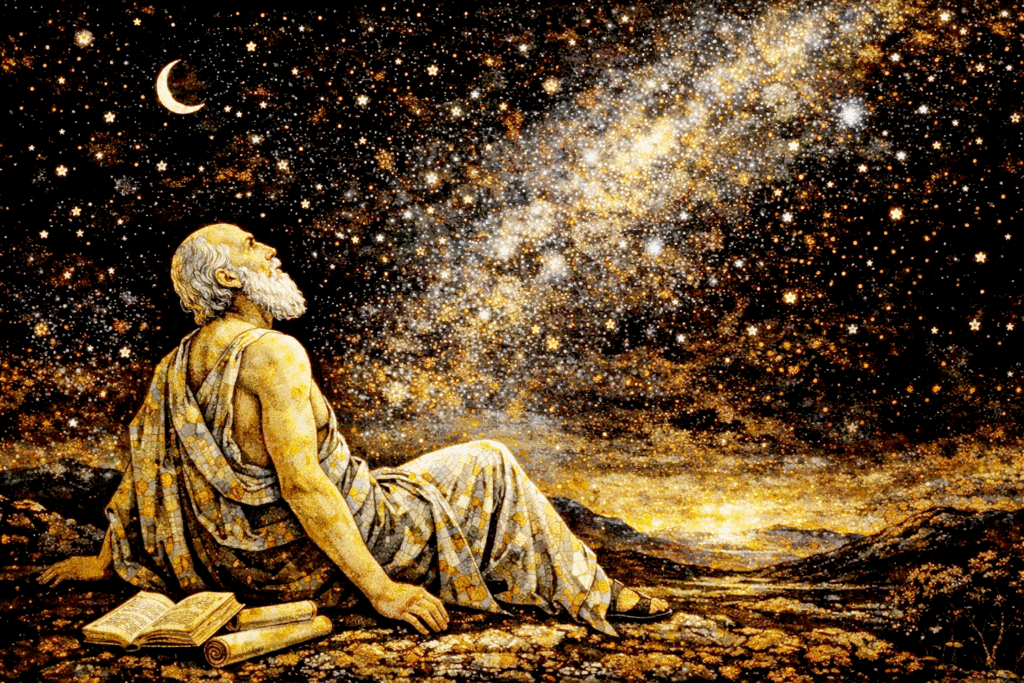
The universe thinking through a human form
The Illusion of the Independent Thinker
Modern life rests upon a metaphysical assumption so familiar that it rarely attracts attention. We speak casually of my idea, my discovery, my creation, as though thought were a private possession generated within the interior of an individual mind. Universities reward “original contributions,” corporations celebrate “innovation,” and education encourages children to become “independent thinkers.” In each case, the same picture is silently presupposed: cognition begins inside a self, and from that self new realities emerge.
This assumption does not appear merely in language; it structures institutions. Intellectual property laws, academic authorship, professional credit, and even everyday praise all reinforce the intuition that thinking originates from discrete individuals. We distribute recognition, responsibility, and reward according to this model, as though ideas could be traced back to a single interior source. The image of the mind as a kind of private workshop—sealed off from the world and producing thoughts from within—has become so pervasive that it feels less like a theory than like common sense itself.
Yet what appears obvious often conceals the deepest philosophical commitments. The belief that there must be a thinker behind every thought, an author behind every idea, a subject standing at the origin of creation, carries with it an entire metaphysics of selfhood. To assume that thought belongs to an independent self is not a neutral description of experience; it already presupposes a particular account of mind, knowledge, and reality. It assumes that cognition has an internal origin, that agency is fundamentally solitary, and that the world is something secondary upon which the mind subsequently acts. Like all metaphysical pictures, this one shapes not only how we speak but how we live.
For this reason, the question of whether thinking is truly independent is not a minor technical issue in philosophy of mind. It bears directly upon how we understand creativity, responsibility, education, and even freedom itself. If thought genuinely begins within an isolated subject, then individuality stands at the center of human existence. But if this assumption proves mistaken, the consequences extend far beyond epistemology. Our most basic categories—self, agency, authorship, originality—would require re-examination.
When we pause and look more carefully, however, the solidity of this “independent thinker” begins to waver. Where does language come from? Where do concepts arise? How do memory, perception, and imagination become possible? Can a mind truly think in isolation from the world that sustains it? Remove culture and meaning evaporates; remove sensation and thought loses content; remove the world altogether and the very possibility of cognition collapses. What initially appeared self-grounded reveals itself to be deeply dependent.
Seen from this angle, the supposedly autonomous thinker begins to resemble less a foundation than a fragile abstraction—an explanatory shortcut that conceals the complex web of conditions from which thought actually arises. The more closely we examine the event of thinking, the harder it becomes to locate a clear boundary between inner and outer, between self and world. The mind no longer appears as a sovereign origin but as something embedded, conditioned, and relational.
The aim of the present essay is to take this unease seriously. Rather than assuming the independence of thought, it asks whether cognition might be better understood as an emergent process arising from networks of biological, linguistic, cultural, and environmental conditions. By tracing the historical construction of the autonomous subject, observing the phenomenology of thinking, and drawing upon both contemplative philosophy and contemporary science, the discussion that follows seeks to replace the image of the solitary thinker with a more relational account of mind. What emerges is not the disappearance of the self, but a different understanding of it: not as an origin, but as a node within a larger field of interdependence.
The Historical Construction of the Autonomous Subject
The belief in independent thought has a recognizable genealogy. It did not arise spontaneously from immediate experience, nor does it represent a timeless truth about the mind. Rather, it emerged gradually within specific historical and philosophical contexts. What today appears as common sense—that thinking originates within an isolated individual—was in fact shaped by centuries of intellectual development. To understand the apparent naturalness of the “independent thinker,” we must first see it as a historical construction rather than an obvious fact.
In early modern Europe, philosophy confronted a profound crisis of certainty. Religious authority had fractured, inherited cosmologies were collapsing, and new scientific discoveries challenged traditional worldviews. In this unsettled landscape, thinkers sought an indubitable foundation upon which knowledge could securely rest. It was within this search for certainty that the figure of the subject acquired unprecedented importance. Rather than beginning from the world, philosophers increasingly began from the self.
Descartes’ celebrated formula—cogito, ergo sum—expressed this shift with striking clarity. By doubting everything that could be doubted, Descartes arrived at the act of thinking itself as the one undeniable fact. Even if the world were illusory, the thinking subject could not be denied. Truth was thus relocated inward. From this point forward, the “I” became the anchor of knowledge, the secure center from which the world could be reconstructed. Consciousness appeared as a self-grounding origin, and cognition seemed to proceed outward from an interior core.
This move proved historically fruitful. By granting epistemic priority to the subject, early modern philosophy strengthened rational inquiry and fostered scientific clarity. The image of the autonomous individual also helped articulate emerging political ideals of freedom, rights, and personal responsibility. Modern legal systems, democratic institutions, and educational practices all presupposed agents capable of independent thought and self-determination. In this sense, the rise of the autonomous subject was not merely a theoretical shift; it became embedded in the social and political fabric of modernity itself.
Yet the success of this model concealed its limitations. By treating the subject as primary, it encouraged a picture of thinking as an internal production, as though ideas were generated inside the mind independently of the world. The countless conditions that make thought possible were pushed into the background. Language, culture, embodiment, and environment were treated as secondary influences rather than constitutive elements. The self was enthroned as origin, while the network of dependencies that sustained it faded from view.
Not all philosophers were convinced by this inward turn. David Hume, for instance, famously searched within experience for the supposed self and found only a “bundle” of fleeting perceptions. No stable thinker could be located behind thoughts themselves. Later phenomenologists would reach similar conclusions from a different direction. Rather than beginning with an isolated consciousness, they emphasized that experience is always already situated in a world. Perception is embodied, intentional, and relational. The mind is not sealed off from reality but fundamentally intertwined with it.
From this perspective, the modern subject begins to appear less like a metaphysical foundation and more like an abstraction—a conceptual simplification useful for certain purposes but misleading when taken as ultimate. What modernity treated as the starting point may in fact be a product of deeper processes. The “I” may not precede thinking but crystallize out of it, emerging only within pre-existing fields of language, history, and bodily life.
Seen historically, then, the autonomous subject loses its air of inevitability. It becomes one possible interpretation among others, shaped by particular cultural and intellectual circumstances. Once this contingency is recognized, the question naturally arises: if the independent thinker is not a timeless given but a constructed image, how does thinking actually occur? What do we find when we examine the event of thought itself rather than the theories that surround it?
These questions lead us away from historical reconstruction and toward direct observation—away from genealogy and toward phenomenology. By attending carefully to the lived process of thinking, we may discover that cognition unfolds not from an isolated center but from a field of relations far more complex than the modern picture suggests.
Observing the Event of Thinking
This dependence becomes visible when we turn away from abstract theories and attend closely to experience itself. Instead of asking what thought ought to be in principle, we may simply observe how it actually unfolds in the texture of everyday life. When examined in this way, thinking appears far less deliberate and self-contained than the modern image of the autonomous subject would suggest.
Thoughts rarely feel manufactured step by step, as though assembled by an inner engineer. Insights surface unexpectedly while walking down a quiet street. Solutions emerge in moments of relaxation when effort has ceased. Memories return without deliberate searching. Words arrange themselves in speech before we have consciously selected them. A phrase is spoken, and only afterward do we recognize what we have said. In countless ordinary situations, thinking seems less like an act we perform and more like an event that happens through us.
Such observations are not exceptional or mystical; they belong to the most mundane structure of experience. The writer waiting for inspiration, the scientist struck by a sudden hypothesis, the student recalling an answer during an examination—all encounter the same phenomenon. Cognition often arrives unbidden. It presents itself prior to intention. Rather than the mind producing thought as a craftsman produces an object, thought frequently appears as something that arises on its own terms.
Closer attention reveals an intriguing temporal sequence. First the thought appears; only afterward does the sense of “I thought this” arise. Ownership, in other words, is often retrospective. The feeling of authorship attaches itself to a process already underway. What we take to be agency may in fact be a narrative reconstruction—a story the mind tells to integrate events that have already occurred. The self claims authorship not at the beginning of thinking, but after the fact.
From a phenomenological perspective, this suggests that the “thinker” may not be the origin of thought but one of its by-products. The sense of self emerges alongside cognition as a kind of organizing interpretation. It functions less as a hidden commander directing mental life than as a narrator weaving coherence from processes too complex to grasp directly. The narrative of authorship follows the event of thinking rather than causing it.
Seen in this light, the self begins to resemble a pattern within a larger flow rather than an independent substance. It is a temporary stabilization within a continuous process, a form that persists only through ongoing change. Like a whirlpool in a river, it has recognizable shape and continuity, yet it never exists apart from the current that sustains it. Remove the flow, and the whirlpool disappears; remove the conditions of cognition, and the thinker dissolves as well.
If this description is even approximately accurate, the familiar picture of an isolated subject generating thoughts from within becomes difficult to maintain. Thinking no longer appears as a private production but as a dynamic occurrence unfolding within a field of relations—bodily, linguistic, environmental, and social. What we call “my thought” may therefore be less a possession than a momentary crystallization within this broader field.
To observe the event of thinking carefully is thus already to loosen the metaphysical certainty of the independent self. Experience itself begins to testify that cognition is not self-sufficient. Something more fundamental—some network of conditions—must already be at work for thought to arise at all. The next step, then, is to articulate this dependency more explicitly: not merely to note that thinking happens through us, but to ask through what conditions it becomes possible in the first place.
Dependent Origination of Thought
These observations suggest the need for a different philosophical framework—one that moves beyond the image of an isolated subject producing ideas from within. If the self does not transparently author its thoughts, and if cognition repeatedly reveals its dependence upon bodily, linguistic, and environmental factors, then the assumption of independence becomes increasingly difficult to sustain. What is required is not merely a critique of the autonomous thinker, but an alternative account capable of explaining how thought actually comes into being. Such an account may be described as the dependent origination of thought.
Instead of assuming that cognition begins inside a self-contained mind, this view holds that thinking arises only through conditions. Thought is not a starting point but an event. It does not precede its circumstances but emerges from them. In this sense, cognition resembles neither a private production nor an internal substance; it resembles a process—a dynamic convergence of multiple factors that must already be in place for thinking to occur at all.
Consider how many conditions are silently presupposed in even the simplest act of thought. Language conditions meaning, for without shared symbols there can be no concepts to manipulate. Culture conditions interpretation, shaping what counts as relevant, valuable, or intelligible. Memory conditions imagination, providing the materials from which new combinations are formed. Biology conditions perception, for the structure of the nervous system determines what can be sensed or processed. Environment conditions survival, sustaining the bodily life upon which all cognition depends. History conditions possibility, delimiting what questions may even be asked at a given moment in time. Remove any of these layers and thought immediately contracts or disappears.
Seen from this angle, every thought is the convergence of innumerable factors. What appears as a single, self-contained mental event is in fact the meeting point of vast networks of relations extending far beyond the individual. The idea I call “mine” carries within it the traces of teachers, languages, technologies, ancestors, and environments. It is less an isolated creation than a temporary crystallization within an ongoing process. Thought, therefore, is not the product of a solitary origin but the outcome of relational conditions continuously interacting with one another.
This relational picture resonates strongly with the Buddhist principle of dependent origination (paṭiccasamuppāda), according to which phenomena arise only through interdependent causes and lack any independent or self-sufficient essence. Nothing exists in isolation; everything comes to be through mutual conditioning. Applied to cognition, the implication is straightforward yet profound: thought itself is not self-grounding. It does not arise from an inner core but from a web of dependencies that precede and exceed the individual.
Importantly, this principle need not be interpreted as a religious doctrine. It may instead be understood philosophically as a general ontology of relations. To say that phenomena are dependently arisen is simply to say that they are processes rather than substances, events rather than origins. Cognition, viewed in this way, is neither mysterious nor miraculous. It is one more natural occurrence within a broader ecology of causes and conditions.
Thinking, then, is not something an isolated mind does. It is something that happens when conditions align. Just as a flame appears only when fuel, oxygen, and heat coincide, thought appears only when biological life, language, memory, environment, and history converge in a particular configuration. The “self” is not the fire’s source but one of the temporary patterns formed within its light.
Once this framework is adopted, the independent thinker ceases to be a foundational assumption and becomes instead a convenient shorthand—a practical fiction that obscures the deeper relational reality of cognition. The task of philosophy shifts accordingly: from locating an inner origin to mapping the conditions that make thinking possible in the first place. Rather than asking “Who thinks?”, we begin to ask “Through what network of relations does thinking arise?”
This shift in perspective prepares the ground for rethinking creativity, intelligence, and agency more broadly. For if thought itself is dependently originated, then everything built upon thought must share the same relational structure. What we call invention, innovation, or authorship will likewise turn out to be expressions of conditions rather than acts of absolute independence.
Rethinking Creativity
The implications of this shift become especially evident in the domain of creativity. Few areas of human life appear to testify more strongly to the independence of the self than the act of creation. Modern culture frequently treats creativity as a near-miraculous power, attributing novelty to the inner resources of a solitary genius. The artist is imagined as producing something wholly unprecedented, the scientist as discovering truths through sheer intellectual force, the entrepreneur as inventing new realities through individual vision alone. In each case, originality is framed as evidence of autonomy.
This image, however, owes more to romantic mythology than to careful observation. The figure of the isolated creator—working alone, generating ideas ex nihilo—has become a powerful cultural ideal, but it obscures the complex web of dependencies that underlie every creative act. Once we examine creativity closely, the narrative of independence begins to unravel.
Every act of creation reveals deep and pervasive reliance upon prior conditions. The scientist depends on centuries of accumulated knowledge, inherited methods, and shared instruments. No experiment begins from nothing; each one stands upon an already established body of concepts and techniques. The composer relies upon tonal systems, scales, and musical traditions transmitted across generations. Even the most experimental piece remains legible only within a historical horizon of listening. The writer depends upon a language shaped by countless predecessors—grammars, metaphors, and idioms sedimented through collective use. Without these inheritances, expression itself would be impossible.
Even imagination, often regarded as the freest faculty of the mind, proves to be constrained by experience. We cannot imagine a color we have never perceived or conceive a form entirely outside the structures of our world. The so-called “new” arises not from nothing but from recombination. Memory provides the materials; imagination rearranges them. Creativity, in this sense, is less invention than transformation.
Seen more carefully, novelty appears not as absolute rupture but as reconfiguration. What changes is not the emergence of something independent of conditions, but the emergence of new patterns within them. Innovation consists in the unexpected alignment of existing elements rather than the creation of entirely separate realities. The creative act is therefore relational at its core: it depends upon what has already been given.
This relational character suggests a quieter and more modest understanding of authorship. The creator does not stand outside history as a sovereign origin but participates within an ongoing process. One does not create alone; one works within languages, traditions, tools, and communities that make creation possible in the first place. The individual becomes less an originator and more a site where multiple influences intersect and take temporary form.
From this perspective, creativity begins to resemble an ecological phenomenon. Just as life emerges within ecosystems rather than in isolation, ideas emerge within networks of conditions. Cultural memory, social exchange, technological infrastructure, and material environment all contribute to what appears as a single act of invention. The “genius” is not a miracle of independence but a particularly sensitive node within this larger field.
The romantic imagethus collapses into something both humbler and more realistic: participation. To create is not to produce something from nothing, but to take part in an ongoing flow of transformations. It is to receive, recombine, and transmit rather than to originate absolutely. What we celebrate as originality may therefore be better understood as a moment of reorganization within a vast web of relations.
Once creativity is seen in this way, it no longer serves as evidence for the independence of the self. On the contrary, it becomes one of the clearest demonstrations of our interdependence. The very achievements we take as proof of individuality turn out to be expressions of shared conditions. Creation itself testifies that thought is never solitary.
Contemporary Echoes in Science and Technology
If the relational account of thought developed thus far risks appearing merely philosophical or speculative, contemporary science offers strikingly convergent evidence. Over the past several decades, research in neuroscience, cognitive science, and artificial intelligence has increasingly challenged the classical image of the mind as a self-contained inner domain. Far from confirming the picture of an autonomous thinker directing cognition from within, these fields instead reveal intelligence to be distributed, embodied, and environmentally entangled.
Neuroscience, for example, no longer portrays the brain as governed by a single inner commander or centralized executive. Cognitive processes are not orchestrated by a solitary “homunculus” hidden within the skull. Rather, perception, memory, and reasoning arise from the cooperation of vast networks of neural activity. Multiple subsystems interact dynamically, often in parallel, with no single locus of absolute control. What we experience as a unified “self” emerges from these distributed processes rather than directing them. The brain resembles less a monarch issuing commands and more an ecosystem of interacting elements whose coordination gives rise to coherent behavior.
Cognitive science has extended this insight even further. Increasingly, researchers argue that thinking does not stop at the boundary of the skull. The tools we use—language, writing, diagrams, notebooks, calculators, and digital devices—do not merely assist cognition; they actively constitute it. When we jot down notes to remember something, sketch a diagram to solve a problem, or rely on a smartphone to navigate space, the cognitive process is already distributed across brain, body, and environment. Mind is not housed exclusively within the head but embedded in material and social contexts.
In this sense, cognition appears less like an inner substance and more like a system of relations. Writing stabilizes memory. Symbols scaffold reasoning. Conversation shapes understanding. Social interaction distributes knowledge across communities rather than concentrating it within individuals. The so-called “individual thinker” is therefore always supported by a background of collective and technological structures. What we casually attribute to personal intelligence often depends upon infrastructures that remain invisible precisely because they function so seamlessly.
Artificial intelligence provides an even clearer and more contemporary illustration of this principle. AI systems do not originate intelligence independently or spontaneously. They learn from vast datasets—texts, images, sounds, and behaviors accumulated through collective human history. Their capacities reflect patterns extracted from this shared material. What appears as “machine creativity” is, upon inspection, the recombination of elements already present in the data on which they were trained. Without such prior conditions, no intelligence would emerge at all.
Indeed, the dependence of AI is so explicit that it becomes difficult to ignore. Remove the data and the system collapses. Alter the training environment and its behavior changes. Intelligence here is visibly conditioned rather than autonomous. Far from demonstrating the possibility of independent cognition, artificial systems highlight how deeply intelligence relies on networks of support.
Seen together, these developments in neuroscience, cognitive science, and AI converge upon the same conclusion: intelligence is ecological rather than isolated. It arises through interactions among brain, body, tools, and world. The boundaries of mind blur into the environments that sustain it. Thought is not something sealed inside an individual but something enacted across systems.
From this perspective, modern science does not contradict the relational account of cognition; it increasingly confirms it. What philosophy and contemplative traditions intuited through reflection and observation, empirical research now approaches through measurement and experiment. The autonomous thinker, once treated as self-evident, begins to look less like a scientific fact and more like a convenient fiction.
From Epistemology to Ethics
Once thought is understood as interdependent rather than self-originating, the implications extend far beyond the domain of epistemology. The question is no longer merely how cognition functions, but how we ought to live in light of that understanding. For if thinking itself arises only through conditions—biological, social, linguistic, and environmental—then the preservation of those conditions becomes inseparable from the preservation of mind. Ontology quietly turns into ethics.
In the modern imagination, ethics is often conceived as a set of external rules imposed upon otherwise autonomous individuals. Moral obligations appear as constraints placed upon personal freedom, as though the self were complete in isolation and only subsequently required to consider others. Yet if the self is not independent to begin with, this picture becomes difficult to sustain. Responsibility no longer appears as an external demand but as a structural feature of existence itself.
If cognition depends upon environmental and social conditions, then damaging those conditions undermines the very ground of thought. Destroy forests and the biological systems that sustain life weaken. Pollute air and water and the physiological preconditions of consciousness erode. Fragment communities and the linguistic, emotional, and educational networks that nurture intelligence begin to collapse. What is harmed is not merely the world “out there,” but the matrix that makes experience possible at all. The injury is ultimately cognitive as well as ecological.
This interdependence becomes visible not only at the level of nature but also at the level of culture. Knowledge depends upon institutions of learning, shared trust, and reliable communication. When misinformation spreads unchecked, when social bonds fracture, or when technological systems exploit attention rather than cultivate understanding, the very conditions for clear thinking deteriorate. In such cases, ethical failure becomes epistemic failure. A damaged world produces damaged cognition.
From this perspective, ethics ceases to be an abstract moral code and becomes instead a form of practical realism. To act responsibly is simply to recognize the web of conditions that sustain one’s own existence. Care for the environment, for communities, and for shared knowledge is not altruistic heroism but rational self-understanding. We protect these conditions not because morality demands sacrifice, but because without them we ourselves cannot flourish or even think coherently.
Compassion therefore emerges in a new light. It is not merely a noble sentiment or an exceptional virtue. It is the natural expression of insight into interdependence. To care for others is to care for the field within which one’s own life unfolds. The boundary between self-interest and concern for others grows porous. What benefits the network benefits the node within it.
Such an understanding generates humility. If our thoughts, abilities, and achievements depend upon countless visible and invisible supports, then the image of the self-sufficient individual becomes untenable. We are not masters standing above the world but participants within processes larger than ourselves. Gratitude replaces pride; cooperation replaces domination. Ethics, in this sense, is simply the acknowledgment that nothing stands alone.
The movement from epistemology to ethics is therefore not an additional step but a logical continuation. Once we see that thought is relational, we must also see that responsibility is relational. How we treat the world directly shapes the conditions of our own minds. To safeguard those conditions is already an ethical act.
A Relational Image of the Human
Taken together, the preceding reflections invite not merely a revision of cognitive theory but a reorientation of how we understand the human condition itself. If thought arises dependently rather than independently, then the figure of the human being as a sovereign creator standing above nature becomes increasingly difficult to sustain. The familiar image of the self as an isolated origin—an inner source from which ideas, intentions, and actions radiate outward—slowly dissolves under closer examination. What replaces it is not a diminished humanity, but a more situated one.
The human being appears less as a commander of reality and more as a participant within it. Intelligence is no longer an exception to nature but one of its expressions. Our capacity to think does not lift us outside the world as detached observers; it binds us more intimately to the processes that sustain life. Language, memory, culture, tools, and environment are not external accessories to an already complete mind; they are the very conditions through which mind comes into existence at all. To think is therefore not to escape the world but to embody one of its ongoing activities.
The boundary between mind and world correspondingly grows porous. Perception is not the inspection of an external scene from a hidden interior chamber; it is an encounter between organism and environment. Meaning is not manufactured inside the head and projected outward; it emerges within shared histories and collective practices. The self itself begins to look less like a substance and more like a pattern—a temporary stabilization within a larger field of relations. Subject and object, inner and outer, self and world become provisional distinctions rather than absolute separations.
From this perspective, the universe is not merely something we observe. It is something that, in a profound sense, becomes conscious through us. Each perception is a meeting of body and world; each idea a convergence of history, language, and matter; each creative act a rearrangement of conditions that were never solely our own. We do not stand outside reality as its authors. We are among the places where reality reflects upon itself.
Such an image carries an unexpected ethical and existential consequence. It tempers pride without diminishing dignity. If our achievements depend upon countless visible and invisible supports, then humility becomes a form of accuracy rather than self-denial. Gratitude replaces the illusion of self-sufficiency. Cooperation appears more rational than competition. The human being is neither a detached spectator nor an absolute master, but a node within an immense web of participation. To recognize this is not to lose significance, but to understand it in proportion.
Philosophy and the Quiet of Participation
At its deepest level, this recognition carries a contemplative resonance. If thoughts are not possessions and the self is not an absolute center, the constant effort to defend authorship gradually relaxes. We no longer need to cling to every idea as “mine,” nor to secure identity through the claim of originality. Thinking continues, yet the burden of ownership lightens.
What emerges is not passivity but clarity. Ideas arise, unfold, and dissolve within conditions that are never entirely personal. The mind becomes less a battlefield of control and more an open field of participation. Rather than striving to force thought into existence, one learns to attend to the processes already unfolding. Cognition reveals itself as something we inhabit rather than something we command.
In this way, philosophy—pursued patiently and consistently—tends toward a certain quiet. Not the quiet of withdrawal, and not the silence of ignorance, but the quiet that follows understanding. When the illusion of separateness loosens, the restless need to assert a central self diminishes. Thinking becomes lighter, more transparent, less burdened by the fiction of solitary origin. There is thought, but no isolated thinker behind it; there is creativity, but no absolute creator apart from conditions.
Perhaps the simplest formulation is also the most direct: we do not think alone. The universe thinks through us. Like waves rising and falling upon the surface of the sea, like music passing through a flute, what appears as “our” thought is a movement within a larger flow. The flute does not own the melody; it allows the breath to sound. Likewise, the mind may be understood as a brief opening through which the vast web of existence becomes momentarily aware of itself.
Thought continues. The sense of self appears and recedes. Conditions gather and disperse. And quietly, without spectacle, the larger process goes on—expressing, transforming, and knowing itself through countless forms, of which we are only one. To see this clearly is already to participate in it.