
Le Hoang Da
Buddhist Scholar
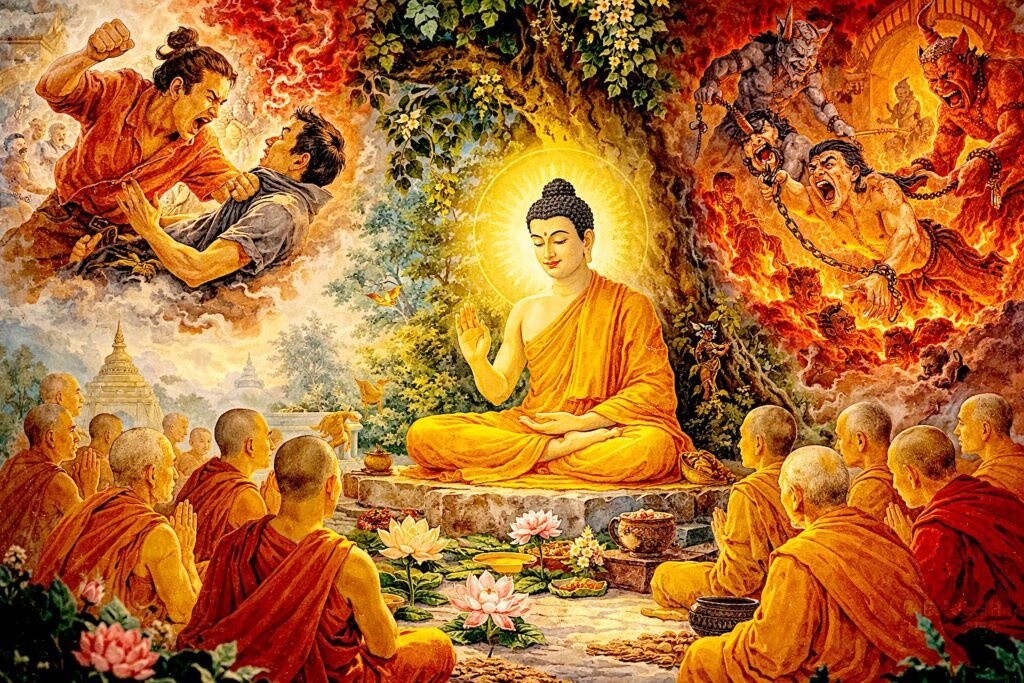
Figure 1: The Buddha teaching the monks, illustrating the moral law of karma: anger and violence lead to suffering, while the Dharma guides beings toward ethical conduct and liberation.
I. Introduction: Two Scriptures, One Ethical Foundation
Within the vast corpus of Buddhist scriptures, texts bearing the same title sometimes appear in very different historical and literary contexts. A particularly interesting example is found in two scriptures that share the title “The Wise and the Foolish.” One belongs to the early Buddhist tradition and appears in the Majjhima Nikāya as the Bālapaṇḍita Sutta (MN 129), while the other is the Xianyu Yinyuan Jing (賢愚因緣經, The Sutra of the Wise and the Foolish), a Mahāyāna text widely transmitted in the Buddhist literary traditions of Central and East Asia.
Although both texts employ the pair of categories “wise” and “foolish” to classify human conduct, they belong to very different literary environments and pedagogical approaches. In the Nikāya discourse, the Buddha presents a direct and analytical explanation of the distinction between the fool (bāla) and the wise person (paṇḍita) through the ethical dimensions of bodily actions, speech, and mental intentions, together with the moral consequences arising from them. The discourse develops a form of ethical and psychological analysis, emphasizing that unwholesome actions lead not only to suffering in future lives but also to distress within one’s present existence.
By contrast, the Xianyu Yinyuan Jing of the Mahāyāna tradition is composed of a collection of karmic narratives (avadāna), in which the wholesome and unwholesome deeds of various characters are illustrated through vivid stories of cause and effect across multiple lifetimes. Rather than presenting a direct analytical exposition of ethical principles, the scripture employs storytelling to portray exemplary figures of the wise and the foolish, thereby transmitting moral instruction to a broad audience.
This contrast reflects two characteristic pedagogical approaches in the history of Buddhism. On the one hand is a method of philosophical exposition, in which doctrine is presented through analysis and argumentation. On the other hand is a narrative method, in which ethical teachings are conveyed through stories of karma that are accessible, memorable, and symbolically rich. Despite their differences in form and literary style, both approaches ultimately serve the same fundamental purpose: guiding human beings to recognize the consequences of moral actions and encouraging them to abandon evil while cultivating wholesome conduct.
From this perspective, placing the two “Wise and Foolish” scriptures side by side is not merely an exercise in textual comparison. It also opens a broader view of two languages of Buddhist instruction: the language of philosophical analysis and the language of narrative storytelling. In the Nikāya discourse, the distinction between the wise and the foolish is articulated through an analysis of karma and the psychological states arising from unwholesome conduct. In the Xianyu Yinyuan Jing, similar ethical principles are illustrated through narratives of karmic causation extending across multiple lifetimes, in which the actions of characters inevitably lead to corresponding results.
For this reason, although the two texts belong to different scriptural traditions and employ distinct pedagogical methods, they ultimately converge on the same core ethical foundation of Buddhism: the avoidance of unwholesome actions and the cultivation of wholesome ones. This principle is succinctly expressed in a well-known verse from the Dhammapada:
“To refrain from all evil,
to cultivate what is wholesome,
and to purify one’s mind —
this is the teaching of the Buddhas.”
This article examines the two “Wise and Foolish” scriptures from a comparative perspective in order to clarify how different Buddhist traditions articulated the same shared ethical foundation. First, it analyzes the concept of the “wise person” and the “fool” in the Bālapaṇḍita Sutta of the Majjhima Nikāya, with particular attention to the moral psychology presented in the discourse. It then turns to the structure and content of the Xianyu Yinyuan Jing within the Mahāyāna tradition, focusing especially on the role of narrative storytelling as a vehicle for ethical instruction. Finally, through a comparison of these two texts, the article argues that despite their different literary forms, both reflect the same fundamental moral ideal of Buddhism: the abandonment of evil and the cultivation of wholesome qualities in human life.
II. The Wise and the Foolish in Early Buddhist Thought
An Analysis of the Bālapaṇḍita Sutta
In the early Buddhist tradition, the distinction between the “wise” and the “foolish” is not based on social status, worldly learning, or intellectual ability in the conventional sense. Rather, the criterion of distinction rests upon ethical conduct and the karmic consequences of action. One of the texts that most clearly presents this classification is the Bālapaṇḍita Sutta (MN 129) in the Majjhima Nikāya.
In this discourse, the Buddha does not merely provide conceptual definitions of the fool (bāla) and the wise person (paṇḍita); he also describes in detail their ethical characteristics and the psychological consequences arising from their actions. This approach reveals an important feature of early Buddhist thought: the evaluation of a person is not grounded in a fixed essence but in concrete moral actions and the consequences that follow from them.
1. The Fool and the Three Types of Unwholesome Conduct
According to the Bālapaṇḍita Sutta, the fool is first recognized through three kinds of unwholesome conduct. These correspond to the three fundamental forms of karma in Buddhist doctrine:
- actions of the body
- speech of the mouth
- intentions of the mind.
The fool habitually entertains unwholesome thoughts, speaks harmful words, and performs actions that violate ethical principles. Importantly, in the presentation of the discourse these three forms of conduct are not merely isolated behaviors. They reflect a comprehensive moral structure in which thought, speech, and action form a continuous chain of cause and effect.
For this reason, the fool is not someone lacking intelligence in an intellectual sense, but rather someone who fails to recognize—or fails to care about—the moral consequences of the actions they perform.
2. The Wise Person and the Cultivation of Wholesome Qualities
In contrast to the fool, the wise person in the discourse is described as one who avoids unwholesome actions and cultivates wholesome qualities in daily life. The wise think wholesome thoughts, speak truthful words, and act in accordance with ethical principles.
However, the significance of the discourse does not lie merely in listing good and bad actions. Its deeper point is to show the connection between ethical conduct and the psychological condition of the individual. The wise do not avoid evil simply out of fear of punishment or in expectation of future reward. Rather, they understand that wholesome actions form the foundation for peace of mind and for harmonious relationships with others.
At this point, the Bālapaṇḍita Sutta reveals a distinctive feature of Buddhist ethics: morality is not a system of commands imposed from outside, but a path leading to the purification of the mind and to well-being in human life.
3. Ethical Conduct as the Criterion for Distinguishing Persons
One of the most striking aspects of the Bālapaṇḍita Sutta is its emphasis that ethical conduct itself constitutes the criterion for distinguishing between individuals. The fool and the wise are not defined by titles, beliefs, or self-identification, but by the actions they perform.
This perspective reflects a fundamental principle of early Buddhist thought: a person is shaped by their karma. Actions do not merely produce consequences in the future; they also shape the moral identity of the individual in the present. Thus, the distinction between the fool and the wise ultimately represents a distinction between two patterns of behavior and two different moral trajectories within human life.
4. Ethics and the Law of Karma
The analysis presented in the Bālapaṇḍita Sutta shows that ethical conduct does not exist independently but is inseparably linked with the principle of karma. Unwholesome actions lead to suffering, while wholesome actions lead to beneficial outcomes.
Yet the discourse introduces an important nuance: the consequences of action are not limited to future rebirths but are already manifested in the present life of the individual. One who performs evil deeds lives in states of anxiety, fear, and remorse, while one who cultivates wholesome actions experiences a mind that is peaceful and at ease.
Through this presentation, the Bālapaṇḍita Sutta is not merely a discourse on karmic retribution but also a profound analysis of moral psychology. Ethical conduct and psychological states are closely interconnected, forming a causal structure within the inner life of human beings.
5. The Ethical Foundation of the Teaching
From the foregoing analysis, it becomes clear that the Bālapaṇḍita Sutta in the Majjhima Nikāya does more than simply classify people into two groups, the wise and the foolish. Rather, it seeks to illuminate a fundamental ethical principle of Buddhism: human actions determine the direction of one’s life.
For this reason, the discourse may be regarded as a concise presentation of the ethical foundation of the Buddhist teaching. The avoidance of unwholesome actions and the cultivation of wholesome qualities are not merely moral recommendations; they constitute the necessary conditions for liberation from suffering and for the attainment of a life characterized by peace and well-being.
In this context, the distinction between the wise and the foolish in the Bālapaṇḍita Sutta is not simply a moral classification but also an indication of two different paths that human beings may choose to follow in their lives.
III. Moral Psychology and the Consequences of Karma
Suffering in the Present Life, at the Moment of Death, and After Death
While the earlier sections of the Bālapaṇḍita Sutta in the Majjhima Nikāya present the distinction between the wise and the foolish primarily in terms of ethical conduct, the subsequent passages of the discourse vividly describe the consequences that those who perform evil actions must endure. What is particularly noteworthy is that these consequences are not understood solely in terms of future rebirth but are portrayed as a multi-layered process unfolding within human life.
In the structure of the discourse, the suffering of the fool appears on three different levels: within present life, at the moment of death, and in the existence that follows death. Through this presentation, the discourse demonstrates that karma is not a distant or abstract principle but a process that can be observed throughout the entire flow of human existence.
1. Suffering in the Present Life
First, the discourse describes the psychological states experienced by those who commit evil deeds in their present life. After performing unwholesome actions, the fool often lives in a condition of fear and unease. When sitting among others in public gatherings, such a person may imagine that the words spoken by others are indirectly referring to their own wrongdoing.
This fear does not arise solely from the possibility of being discovered. It also stems from the individual’s own awareness of moral fault. Those who commit evil deeds know that their actions are wrong, and this awareness itself becomes the source of anxiety within the mind.
In addition, the discourse describes the fear that wrongdoers feel toward social punishment. In the context of ancient societies, criminals could face severe penalties. When contemplating the possibility of punishment, those who have committed evil acts often live in a prolonged state of worry and tension.
Through these descriptions, the discourse shows that unwholesome conduct harms not only others but also undermines the inner peace of the one who performs it. Suffering therefore emerges already within the present life of the wrongdoer.
2. Suffering at the Moment of Death
After describing suffering in present life, the discourse turns to another stage in the process of karma: the moment of death.
According to the discourse, when death approaches, the fool may recall the unwholesome actions committed during life. These memories arise in the mind like heavy and disturbing images, causing the mind to become agitated and fearful.
This condition reflects an important idea in Buddhist thought: the mental state at the final moment of life is closely connected with the actions previously performed. Unwholesome actions not only leave consequences for future rebirth but also directly influence the psychological state of a person when facing death.
Thus, in the discourse the moment of death is not merely a biological event but also a moral moment, in which the entire history of one’s conduct is reflected within consciousness.
3. Retribution in Hell
After describing suffering in present life and at the moment of death, the discourse continues by presenting the consequences of unwholesome actions in the existence that follows death. The fool, after death, is described as being reborn in states of suffering, particularly in hell.
The depictions of hell in the discourse possess strong symbolic force. Beings reborn in hell are described as undergoing severe punishments, such as being burned in intense flames or subjected to various forms of torment. These images emphasize that unwholesome conduct leads not only to psychological distress in the present life but also to grave consequences within the cycle of rebirth.
However, these descriptions are not intended merely to evoke fear. Rather, they serve to clarify a fundamental moral principle: human actions produce corresponding consequences within the moral structure of the universe. Hell in the discourse may therefore be understood as the extreme manifestation of the suffering generated by unwholesome deeds.
4. Karma as a Multi-Layered Process
From the overall structure of the discourse, it becomes clear that karma is presented as a multi-layered process within human life. Unwholesome actions first produce anxiety and disturbance within the mind; they then influence the mental state at the moment of death; and finally they lead to consequences in postmortem existence.
This presentation demonstrates that ethics in Buddhist thought concerns not only rules of behavior but the entire process of human existence. Action, psychology, and rebirth are interconnected within a unified causal structure.
It is precisely this multi-layered analysis that makes the Bālapaṇḍita Sutta one of the important texts for understanding the ethical foundations of early Buddhism. The discourse not only emphasizes the distinction between the wise and the foolish but also reveals the far-reaching consequences of moral actions across the whole course of life.
These analyses also prepare the ground for the next section of this article, which turns to the Xianyu Yinyuan Jing of the Mahāyāna tradition—a text that employs narrative storytelling to illustrate similar principles of karma and moral causation in human life.
IV. The Xianyu Yinyuan Jing and the Pedagogical Structure of Karmic Narratives
From Brahmā’s Request for the Teaching to the Pure Abodes
While the Bālapaṇḍita Sutta of the Majjhima Nikāya presents the distinction between the wise and the foolish through a philosophical analysis of karma and the consequences of moral conduct, the Xianyu Yinyuan Jing of the Mahāyāna tradition approaches the same issue through a completely different method: narrative accounts of karmic causation.
This text is not a single philosophical discourse but a collection of stories organized into a relatively coherent structure. In the widely circulated version of the text, the scripture contains forty-six chapters, beginning with the chapter “Brahmā’s Request for the Teaching” and concluding with the chapter “The Pure Abodes.” When viewed as a whole, the arrangement of these chapters does not appear random; rather, they form a clear pedagogical progression.
1. Brahmā’s Request for the Teaching: The Beginning of the Dharma
The opening chapter recounts the well-known episode in which Brahmā requests the Buddha to teach the Dharma to the world. This story appears in many Buddhist traditions and is often understood as a symbolic moment marking the opening of the Buddha’s teaching after his awakening.
According to the narrative, after attaining enlightenment the Buddha reflected that the truth he had realized was profound and difficult for ordinary beings to understand. For this reason, he initially considered refraining from teaching the Dharma to the world. At that moment, however, Brahmā appeared and earnestly implored him to proclaim the truth for the benefit of those beings who still possessed the capacity to understand and practice the teaching.
This motif holds important significance for the entire scripture. It affirms that the Dharma is proclaimed not merely for the benefit of a particular group but for the welfare of all beings in the universe. The opening chapter therefore functions as an introduction to the entire sequence of moral narratives that follow.
2. Forty-Four Chapters of Karmic Narratives
Following the opening chapter, the majority of the Xianyu Yinyuan Jing consists of numerous stories describing wholesome and unwholesome actions performed in past lives. These narratives generally follow a relatively stable structure: an event occurring in the present is introduced, after which the Buddha explains that the event is the result of actions performed in the past.
Through this narrative framework, the scripture vividly illustrates the principle of karmic causation in moral conduct. The characters appearing in these stories represent various strata of Buddhist society. Some narratives focus on the lives of monastics, such as the chapters concerning the monk Jincai, the novice who upholds the precepts, or the merits of renunciation, thereby emphasizing the importance of ethical discipline and spiritual cultivation in monastic life.
At the same time, many other narratives revolve around lay practitioners, such as the story of the self-sacrifice of the monitor lizard (Juda shishen) or accounts in which individuals offer their own bodies as acts of devotion. These stories demonstrate that Buddhist ethics is not confined to the monastic community but is also practiced within the social life of lay followers.
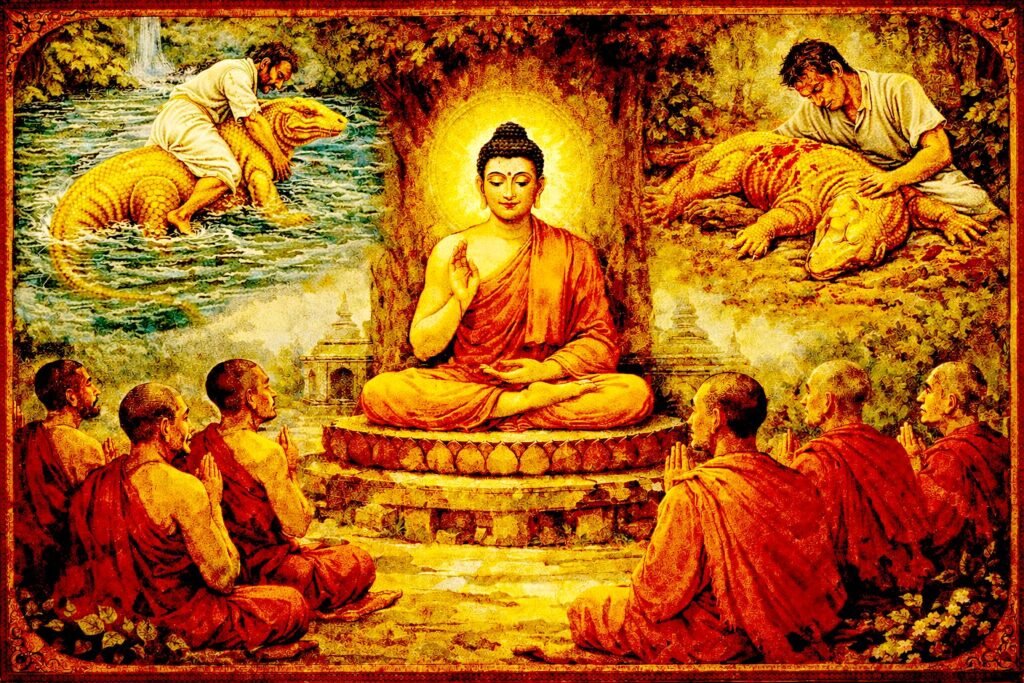
Figure 2: The Buddha teaching the monks, accompanied by the story of the golden monitor lizard who saved a drowning man and sacrificed its own life — an episode from “Juda’s Self-Sacrifice” (鋸陀身施品) in the Sutra of the Wise and the Foolish.
Through dozens of such narratives, the Xianyu Yinyuan Jing presents a rich panorama of the practice of wholesome karma, including generosity, moral discipline, filial devotion, and compassion. These stories do more than explain the principle of karma; they also encourage listeners to emulate the ethical examples portrayed in the scripture.
3. The Pure Abodes: The Fruit of Wholesome Action
The final chapter of the scripture, “The Pure Abodes,” serves as a conclusion to the ethical progression presented throughout the preceding chapters. In this section, the text describes pure heavenly realms in which beings who have practiced wholesome actions are reborn.
The placement of this chapter at the end of the scripture is not accidental. It provides a symbolic conclusion that illustrates the culmination of the moral path depicted in the preceding narratives. Those who cultivate wholesome conduct—whether monastics or lay practitioners—may attain states of happiness and purity.
Thus, the overall structure of the Xianyu Yinyuan Jing may be understood as an ethical journey: the Dharma is first revealed, narratives illustrate the practice of wholesome action, and the final chapter depicts the positive fruits of such conduct.
4. Narrative as a Pedagogical Method
This structure demonstrates that the Xianyu Yinyuan Jing is not merely a loose collection of stories but a religious literary work with a clear pedagogical purpose. Narrative functions within the scripture as a means of conveying the ethical principles of Buddhism to a wide range of audiences.
By following the destinies of the characters in these stories, listeners can easily recognize the connection between moral actions and their consequences. This pedagogical method differs from the analytical exposition found in the Bālapaṇḍita Sutta of the Majjhima Nikāya, yet it ultimately serves the same purpose: helping human beings understand the importance of avoiding evil and cultivating wholesome actions in life.
This difference in pedagogical method will become the central focus of the next section of this article, where we examine the role of narrative in the transmission of Buddhist ethics and compare this approach with the philosophical mode of presentation found in the Nikāya tradition.
V. Narrative Literature and Buddhist Ethics
The Xianyu Yinyuan Jing within the Tradition of Narrative Literature
In order to understand the pedagogical method of the Xianyu Yinyuan Jing, it is necessary to situate this text within the broader context of Buddhist literary traditions. From the earliest stages of Buddhist history, narrative storytelling became an important medium for conveying the Dharma. Alongside discourses characterized by philosophical analysis, many texts employed narrative forms to illustrate moral principles and the workings of karma.
Within this tradition, stories function not merely as illustrative devices but also as an effective form of ethical education. Through narratives about figures from the past, the doctrines of karma and moral retribution are presented in a concrete, vivid, and accessible manner.
1. Jātaka Narratives and the Bodhisattva Ideal
One of the most well-known collections of narrative literature in Buddhism is the Jātaka, the stories of the Buddha’s previous lives before he attained awakening. These narratives portray the Bodhisattva in a variety of past existences, in which he practices virtues such as generosity, compassion, and self-sacrifice for the welfare of other beings.
Through the Jātaka stories, the ethical ideals of Buddhism are presented not as abstract concepts but through the concrete actions of narrative characters. Readers or listeners can follow the Bodhisattva’s moral journey across many lifetimes and thereby gain a deeper understanding of the value of wholesome qualities.
2. Avadāna Literature and Karmic Narratives
Alongside the Jātaka, another important genre of Buddhist narrative literature is the avadāna, stories that explain the connection between actions performed in the past and their consequences in the present. These narratives typically begin with an event occurring in the present, after which the Buddha or one of his enlightened disciples explains that the event is the result of deeds performed in a previous life.
Within this tradition, numerous scriptures were compiled to collect such karmic narratives. A notable example is the Sūtra of the Collection of One Hundred Causes and Conditions (Baijiyuan Jing), in which hundreds of stories are recounted to illustrate the principle of karmic causation. These narratives demonstrate that human actions—whether wholesome or unwholesome—do not disappear once performed but continue to produce corresponding results across different lifetimes.
3. Narrative in Mahāyāna Literature
In Mahāyāna texts as well, narrative storytelling plays an important role in communicating the Dharma. One prominent example is the Lalitavistara, a work that recounts the life of the Buddha from his existence as a Bodhisattva up to the moment of enlightenment. In this text, the life of the Buddha is presented as a sacred narrative in which events carry profound symbolic and ethical significance.
Works such as the Lalitavistara demonstrate that narrative storytelling is used not only to illustrate karmic causation but also to express the religious ideals and moral vision of Buddhism.
4. The Xianyu Yinyuan Jing in the Tradition of Narrative Literature
Within this broader literary context, the Xianyu Yinyuan Jing may be understood as a collection of karmic narratives designed for ethical instruction. The stories contained in the scripture not only recount the virtuous deeds of individuals in past lives but also illustrate how those deeds lead to favorable results in later existences.
Unlike the Jātaka stories, in which the central figure is typically a previous incarnation of the Buddha, the narratives of the Xianyu Yinyuan Jing involve a wide range of characters from Buddhist society. These characters include both monastics and lay practitioners, from monks and novices to lay devotees who practice generosity, filial devotion, and other virtues.
Through these narratives, the scripture presents a rich panorama of the practice of wholesome karma in Buddhist life. Each story illustrates a particular ethical principle, showing that virtuous actions lead to beneficial outcomes, whereas unwholesome actions result in suffering.
5. Narrative and the Shared Ethical Principle
When the Xianyu Yinyuan Jing is situated within the wider tradition of Buddhist narrative literature, it becomes clear that the scripture is not merely a collection of unrelated stories but part of a literary tradition dedicated to conveying ethical teachings through narrative form.
Although the stories differ in characters and circumstances, they all convey the same message: moral actions are inseparably linked to their corresponding consequences. This principle also forms the foundation of many other texts in Buddhist literature, from the Jātaka narratives to the various avadāna collections and Mahāyāna scriptures.
From this perspective, the Xianyu Yinyuan Jing can be understood as part of a broader literary tradition in which storytelling functions as a powerful medium for communicating the fundamental ethical principles of Buddhism.
VI. Two Phases of the Dharma and the Ethical Focus of Buddhism
When the Bālapaṇḍita Sutta in the Majjhima Nikāya is placed alongside the Xianyu Yinyuan Jing, it becomes clear that these two texts differ not only in literary form and pedagogical method but also reflect two different stages in the historical development of Buddhism.
The Bālapaṇḍita Sutta of the Majjhima Nikāya belongs to the early phase of Buddhism, when the Dharma was primarily presented in the form of direct discourses delivered by the Buddha on fundamental issues of ethical and spiritual life. By contrast, the Xianyu Yinyuan Jing emerged within the context of a later stage of Buddhist development, when Buddhism had already spread widely and new literary and religious traditions had begun to take shape. During this period, the Dharma was transmitted through a richer variety of literary forms, including karmic narratives and other narrative compositions.
Despite belonging to different historical stages of Buddhism, both texts share an important characteristic: the central concern of the Dharma remains the ethical foundation of human life.
1. Ethics in the Early Teaching
In the scriptures of the Nikāya tradition, the Dharma is often presented through discussions directly related to the ethical and spiritual life of human beings. Concepts such as karma, good and evil, suffering, and liberation are explained through analyses of actions and their consequences.
The Bālapaṇḍita Sutta provides a clear example of this approach. In this discourse, the Buddha distinguishes between the wise and the foolish on the basis of ethical conduct. The fool is described as one who performs unwholesome actions and consequently experiences suffering in the present life, at the moment of death, and in postmortem existence. In contrast, the wise person avoids unwholesome conduct and cultivates wholesome qualities, thereby attaining peace and well-being in life.
Through this presentation, the discourse demonstrates that ethics is not merely a system of behavioral rules but the foundation of the entire spiritual path. Human actions—whether wholesome or unwholesome—not only affect social life but also determine the trajectory of spiritual development and rebirth.
2. Ethics in the Developed Buddhist Tradition
The Xianyu Yinyuan Jing emerged within a different historical context, when Buddhism had expanded into many regions and encountered diverse cultural environments. During this stage, new literary forms developed within the Buddhist tradition, including collections of karmic narratives and stories recounting the ethical deeds of figures from the past.
Yet although the literary form of the Xianyu Yinyuan Jing differs from that of the Nikāya discourses, the ethical content of the scripture continues to revolve around familiar themes of the Dharma. The stories within the text often recount virtuous actions such as generosity, moral discipline, filial devotion, and compassion. These actions lead to favorable outcomes in future lives, such as rebirth in pleasant or heavenly realms.
This demonstrates that even during the later development of Buddhism, the central focus of the Dharma remained the encouragement of wholesome conduct and the avoidance of unwholesome actions.
3. The Absence of Complex Metaphysical Systems
Another notable feature in comparing the two “Wise and Foolish” scriptures is the absence of the complex metaphysical systems that became prominent in later stages of Buddhist thought. Concepts such as Prajñā, emptiness (śūnyatā), or Buddha-nature (buddha-dhātu), which later assumed central importance in many Mahāyāna texts, are largely absent from these two scriptures.
Instead of focusing on profound metaphysical speculation, both texts concentrate on issues directly related to the ethical life of human beings. This suggests that during the earlier stages of Buddhism—both in the early tradition and in the initial phases of Mahāyāna development—the Dharma maintained a clear emphasis on guiding human beings toward an ethical way of life.
4. Ethics as the Shared Foundation of Buddhist Traditions
From this perspective, the two “Wise and Foolish” scriptures reveal an important continuity within the history of Buddhist thought. Although Buddhism later developed numerous sophisticated philosophical systems, the ethical foundation of the Dharma consistently remained central.
In the Bālapaṇḍita Sutta of the Majjhima Nikāya, ethical principles are presented through analytical discussions of action and its consequences. In the Xianyu Yinyuan Jing, the same principles are illustrated through narrative accounts of karmic causation across multiple lifetimes. Regardless of the literary form employed, however, the ethical message of the Dharma remains the same: human beings should avoid unwholesome actions and cultivate wholesome qualities in their lives.
Through this comparison, the two “Wise and Foolish” scriptures demonstrate that although Buddhism has developed across different historical periods and literary forms, the ethical foundation of the Dharma remains a unifying thread throughout the entire tradition. It is precisely this foundation that creates a point of convergence among diverse Buddhist traditions, from the early Nikāya discourses to the narrative literature of later Buddhist developments.
VII. The Ethical Foundation of the Dharma: Returning to the Spirit of “Avoid All Evil”
The analyses presented in the previous sections demonstrate that the two “Wise and Foolish” scriptures, although belonging to different traditions and employing distinct literary forms, revolve around a common theme: the ethics of human action. In the Bālapaṇḍita Sutta of the Majjhima Nikāya, this principle is articulated through direct analysis of the conduct of the wise and the foolish and the corresponding consequences of their actions. In the Xianyu Yinyuan Jing, the same principle is expressed through a series of karmic narratives that illustrate the relationship between wholesome deeds and favorable results across multiple lifetimes.
Although the two texts differ in their modes of presentation, the ethical message they convey converges upon a fundamental principle of the Dharma. This principle is succinctly expressed in a well-known verse of the Dhammapada:
“To refrain from all evil,
to cultivate what is wholesome,
and to purify one’s mind —
this is the teaching of the Buddhas.”
These four brief lines may be regarded as a concise summary of the entire Buddhist teaching. First, the Dharma encourages human beings to refrain from unwholesome actions. This is not merely intended to maintain moral order within society, but also to prevent the causes that lead to suffering in the spiritual life. Second, the teaching encourages the cultivation of wholesome qualities such as generosity, moral discipline, and compassion toward all beings. Finally, the deeper aim of the path of practice is the purification of the mind, which entails liberation from defilements and attachments.
When the two “Wise and Foolish” scriptures are viewed in light of this principle, it becomes clear that all the narratives and analyses within these texts serve to illustrate these three fundamental elements of the Dharma. The unwholesome actions of the “fool” lead to suffering and rebirth in painful realms, whereas the virtuous actions of the “wise” lead to beneficial outcomes and states of happiness. Through such portrayals, these texts not only explain the principle of karma but also guide human beings toward the cultivation of an ethical life.
However, the significance of the principle “avoid all evil and cultivate what is wholesome” extends beyond the sphere of ordinary morality. In the Buddhist tradition, ethics is inseparable from a deeper vision of the nature of existence. Wholesome and unwholesome actions are not merely social rules; they reflect how human beings understand and live in accordance with the fundamental characteristics of reality. In Buddhist teaching, these characteristics are often expressed through the Three Marks of Existence: suffering (duḥkha), impermanence (anitya), and non-self (anātman).
Understanding suffering allows individuals to recognize that unwholesome actions harm not only others but ultimately lead to suffering for oneself. Understanding impermanence reveals that all phenomena in life are subject to change and cannot serve as a stable basis for selfish attachment. Understanding non-self enables individuals to relinquish attachment to a fixed and enduring “self,” thereby opening the possibility of living with compassion and wisdom.
Seen in this light, the ethical principles of the Dharma are no longer merely moral injunctions but concrete expressions of a profound insight into the nature of existence. From this perspective, the sophisticated philosophical systems that later developed in Buddhist thought—such as the doctrines of Prajñā, emptiness (śūnyatā), and Buddha-nature (buddha-dhātu)—should not be understood as replacing the ethical foundation of the Dharma. Rather, these philosophical ideas can only be properly understood when they are grounded in compassion, virtuous conduct, and insight into the Three Marks of Existence. When separated from these foundations, such philosophical concepts can easily be misinterpreted as abstract speculation or purely theoretical systems of thought.
For this reason, the two “Wise and Foolish” scriptures do more than illustrate a moral principle of the Dharma; they also remind readers of the fundamental foundation of the entire Buddhist tradition. Before entering the deeper realms of philosophy and metaphysics, the Dharma first invites human beings to return to a set of simple yet essential principles: avoiding evil, practicing good, and purifying the mind. It is upon this foundation that every later development of Buddhist thought can preserve the original liberating meaning of the teaching.
Related Studies:
- Kamma Without Fate: Intention and the Architecture of Freedom in Early Buddhism
- The True and the False Person: Spiritual Authenticity in the Cūḷapuṇṇama Sutta
Bibliography
Appleton, Naomi. Jātaka Stories in Theravāda Buddhism: Narrating the Bodhisatta Path. Farnham: Ashgate, 2010.
Cowell, E. B., ed. The Jātaka, or Stories of the Buddha’s Former Births. 6 vols. Cambridge: Cambridge University Press, 1895–1907.
Dhammapada. Translated by Acharya Buddharakkhita. Kandy: Buddhist Publication Society, 1985.
Gethin, Rupert. The Foundations of Buddhism. Oxford: Oxford University Press, 1998.
Lalitavistara Sūtra. Translated by Gwendolyn Bays. Berkeley: Dharma Publishing, 1983.
Ñāṇamoli, Bhikkhu, and Bhikkhu Bodhi, trans. The Middle Length Discourses of the Buddha: A Translation of the Majjhima Nikāya. Boston: Wisdom Publications, 1995.
Speyer, J. S., ed. Avadānaśataka: A Century of Edifying Tales. St. Petersburg: Imperial Academy of Sciences, 1906.
Williams, Paul. Mahāyāna Buddhism: The Doctrinal Foundations. London: Routledge, 2009.
Xianyu Jing (Sutra of the Wise and the Foolish). Taishō Tripiṭaka, T04, no. 202.