
Le Hoang Da
Buddhist Scholar
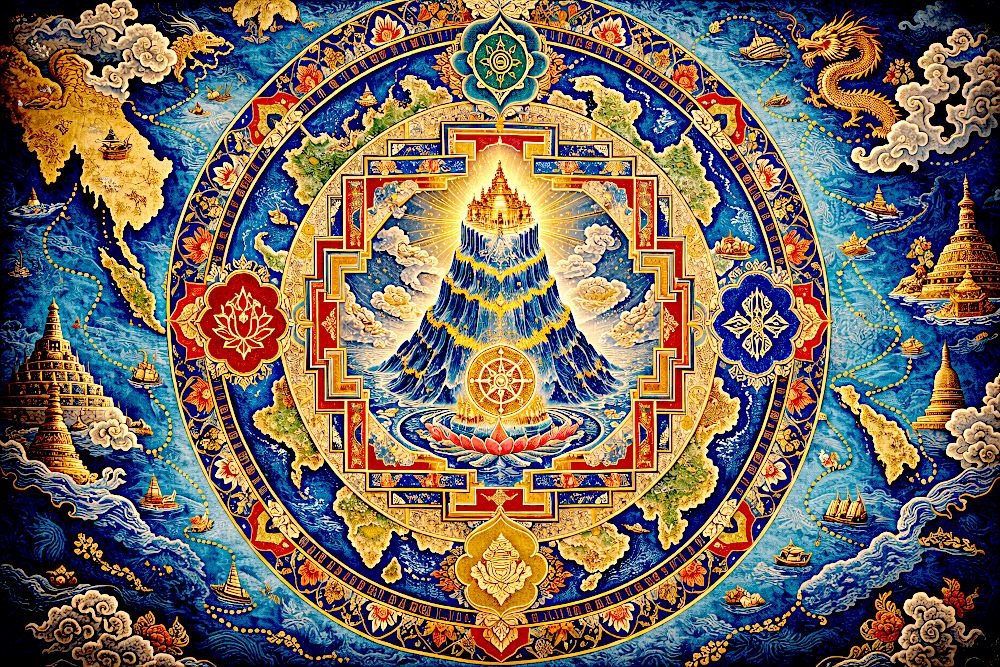
Figure 1: A Tantric cosmological mandala centered on Mount Sumeru. In Vajrayāna traditions, the symbolic structure of the mandala is sometimes projected onto the geographical landscape, allowing sacred sites, stupas, and pilgrimage routes to be understood as elements of a cosmic sacred map.
I. Introduction: Sacred Space in the Late Vajrayāna World
In the Mahāyāna Buddhist tradition—and particularly within Vajrayāna—religious space is rarely understood merely as a neutral geographical setting. Sacred sites—mountains, stūpas, islands, and pilgrimage centers—are often interpreted as visible manifestations of a symbolic cosmic order. For this reason, in many Tantric texts the physical world is not only the stage upon which religious activities take place, but is also conceived as a living mandala, in which the structure of the enlightened universe is reflected through specific geographical coordinates.
Mandala
In Vajrayāna, the mandala is commonly understood as a meditative diagram representing the order of the enlightened universe, where Buddhas and Bodhisattvas are arranged according to specific spatial directions. Yet in many later Tantric traditions of India and Tibet, this structure is not confined to the imaginative space of ritual or meditation. Instead, it is projected onto the physical world itself. Sacred sites, great stūpas, holy mountains, and even distant islands across the Indian Ocean can be interpreted as nodal points within a sacred map of the Vajrayāna cosmos.
One of the rare sources that allows us to observe directly how this Tantric world was conceptualized is the well-known study of the Italian scholar Giuseppe Tucci, in which he analyzes the biography and travels of an Indian Buddhist sādhū named Buddhagupta.
According to accounts preserved in Tibetan traditions, Buddhagupta undertook an extensive series of journeys stretching from India across the Himalayas and Central Asia to the islands of the Indian Ocean and even parts of Southeast Asia. These travels not only reflect the pilgrimage and trade routes of the later Buddhist world, but also provide important clues about how Vajrayāna practitioners understood and experienced religious space.
What is particularly striking in the descriptions of Buddhagupta’s journeys is that sacred locations are frequently associated with the symbolic structure of Tantric mandalas. Certain stūpas, for instance, are described as centers of different mandalas in which cosmic Buddhas occupy the central position of each configuration. In one notable case, three distinct locations are linked with three central Buddhas of Vajrayāna mandalas:
- Vairocana
- Amitābha
- Akṣobhya
These associations suggest that pilgrimage centers were not understood merely as historical or archaeological sites, but as points of convergence within a Tantric cosmic order. In other words, for Vajrayāna practitioners the world was not simply a collection of scattered geographical places, but a sacred space organized according to the structure of a mandala.
From this perspective, the journeys of Buddhagupta may be interpreted in two parallel ways. On the one hand, they reflect the pilgrimage and commercial routes that connected various regions of the Buddhist world—from India to Southeast Asia and beyond. On the other hand, they can also be read as a movement through a symbolic universe in which each sacred location functions as a point within the sacred structure of Vajrayāna cosmology.
It is precisely the intersection between historical geography and Tantric symbolism that makes this journey an especially valuable source for studying the later Buddhist world of India. Rather than merely describing a religious voyage, the texts concerning Buddhagupta appear to reflect a deeper conception of sacred space—one in which holy sites, stūpas, and natural landscapes are integrated into a symbolic cosmic structure.
This article examines the journey of Buddhagupta from that perspective. Instead of viewing the locations mentioned in the sources simply as points on a map, it considers them as elements within a sacred geography of the late Vajrayāna world. First, the article explores the relationship between mandala and sacred space in Tantric thought. It then analyzes major stūpas and pilgrimage sites as cosmic centers of different mandalas. Finally, it considers how the journeys of Buddhagupta may be understood as movement through a vast geographical mandala of the Vajrayāna world.
From this perspective, the places mentioned in Buddhagupta’s travels do not merely reflect the networks of trade and pilgrimage that characterized medieval Buddhism. They also reveal a distinctive way of perceiving the world—one in which geographical space and Tantric cosmology merge into a sacred map of the enlightened universe.
II. Mandala and Sacred Space in Vajrayāna
In the Vajrayāna tradition, one of the most important concepts for understanding the structure of the religious universe is the mandala. The mandala is commonly known as a ritual or meditative diagram in which Buddhas and Bodhisattvas are arranged according to a symbolic geometric structure. In Tantric thought, however, the mandala is not merely a visual representation used in ritual. Rather, it functions as a cosmological model that expresses the order of the enlightened universe.
Mandala
In many Vajrayāna rituals, practitioners are instructed to visualize the mandala as a complete universe in which Buddhas, Bodhisattvas, protective deities, and other symbolic elements are arranged according to specific spatial directions. At the center of the mandala there is typically a cosmic Buddha, while the surrounding directions are associated with other Buddhas, each representing a particular dimension of enlightened wisdom.
This structure reaches its most systematic form in the Vajrayāna doctrine of the Five Buddha Families.
Five Buddha Families
According to this system, the enlightened universe is organized around five cosmic Buddhas, each associated with a direction and a specific form of wisdom. In many Tantric mandalas, the central Buddha is:
- Vairocana
while the other directions are associated with Buddhas such as:
- Akṣobhya
- Amitābha
This structure is not only symbolic but also reflects a distinctive understanding of the universe. In the Vajrayāna worldview, the enlightened universe is not an abstract reality separate from the physical world; rather, it can be manifested through concrete forms within space itself. For this reason, the mandala is often understood as a sacred map of the cosmos, in which the elements of the enlightened world are organized according to a meaningful symbolic order.
What is particularly noteworthy is that in many later Tantric traditions of India, the structure of the mandala is not confined to ritual practice or meditative visualization. Instead, it is projected onto the physical landscape itself. Sacred mountains, monumental stūpas, and major pilgrimage centers are often interpreted as corresponding points within the cosmic mandala. From this perspective, the physical world can be read as an expanded mandala, in which sacred sites function as centers of spiritual power.
A striking example of this perspective is the role of the stūpa in the Tantric Buddhist tradition. A stūpa is not merely a commemorative monument; it is also understood as a symbol of the Buddha’s body and of the structure of the cosmos. In many Tantric texts, the stūpa is described as an axis mundi, a cosmic axis where the human world and the enlightened realm intersect.
For this reason, in the pilgrimage journeys of Vajrayāna practitioners, movement from one stūpa to another may be interpreted as movement between different centers of the sacred universe. Each pilgrimage site carries not only historical or archaeological significance but is also associated with a cosmic Buddha or a particular mandala structure.
This perspective helps explain why many Tantric texts link specific geographical locations directly to different mandalas. Certain stūpas are described as the centers of mandalas in which Vairocana occupies the central position, while other locations are associated with mandalas centered on Amitābha or Akṣobhya. These associations suggest that Buddhist sacred sites may be understood as concrete manifestations of Tantric cosmological structures.
From this viewpoint, religious space in Vajrayāna is not a collection of isolated locations but a network of sacred centers organized according to a symbolic order. Sacred mountains, monumental stūpas, Tantric monasteries, and pilgrimage sites together form a sacred map of the world in which the structure of the cosmic mandala is reflected in the geographical landscape.
It is within this broader context that the journeys of wandering practitioners such as Buddhagupta acquire particular significance. Their travels do not merely reflect the networks of trade and pilgrimage that characterized the medieval Buddhist world; they also reveal how Vajrayāna practitioners experienced religious space as part of the Tantric cosmic structure. When moving from one sacred site to another, they were not only traveling across different regions of the world but also passing through different symbolic dimensions of the cosmic mandala.
Thus, to properly understand the journeys of Buddhagupta, they must be situated within the wider Vajrayāna conception of sacred space. From this perspective, the physical world is not simply a geographical backdrop for religious activity. Rather, it can be understood as an immense mandala in which the structures of the enlightened universe are expressed through sacred sites and landscapes. The intersection between Tantric symbolism and religious geography therefore becomes a key to understanding the deeper significance of the places mentioned in Buddhagupta’s travels.
III. Stūpas as Cosmic Centers
In the Buddhist tradition, the stūpa is one of the oldest and most significant forms of religious architecture. Originally, stūpas were constructed as reliquary monuments containing the relics of the Buddha or those of revered saints. Over time, however, particularly with the development of Mahāyāna and later Vajrayāna Buddhism, the meaning of the stūpa came to extend far beyond its role as a commemorative structure. It gradually came to be understood as a symbol of the Buddha’s body and of the structure of the enlightened universe.
Stūpa
In many Buddhist traditions, the architecture of the stūpa is interpreted as a symbolic representation of the cosmos. The base of the monument represents the element of earth, the body of the stūpa corresponds to water, the upward-pointing spire symbolizes fire and air, while the central axis of the stūpa is understood as a connection between the human world and the realm of enlightenment. From this perspective, the stūpa is not merely a religious monument but an axis mundi, a cosmic axis where different levels of existence intersect.
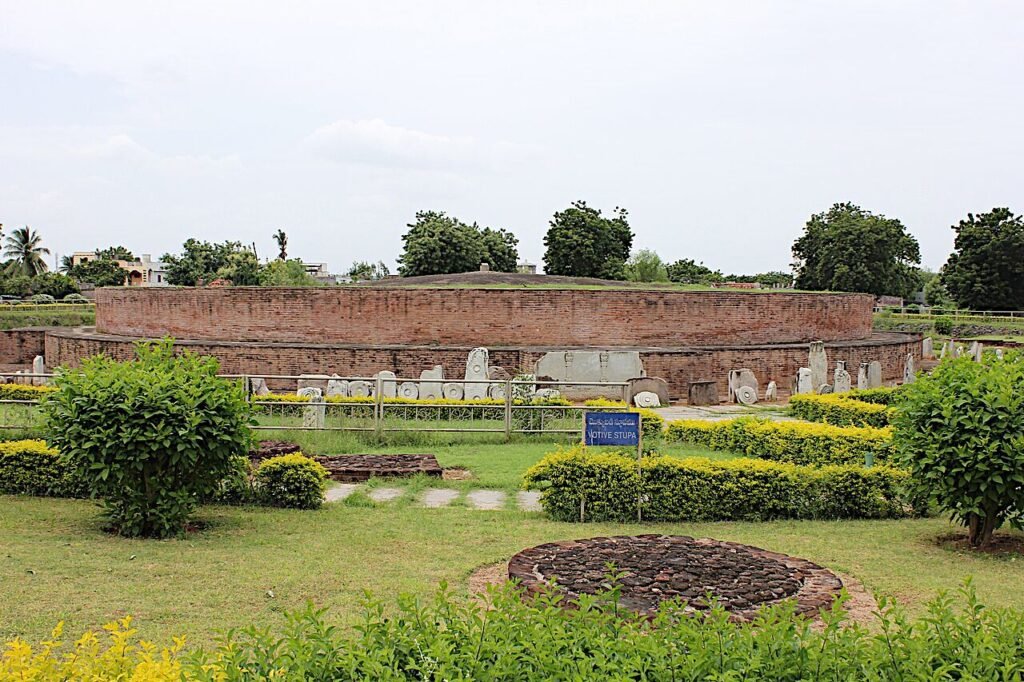
Figure 2: The Great Stupa of Amarāvatī, a major Buddhist monument of ancient South India (2nd century BCE–3rd century CE) and an important center of pilgrimage and Buddhist artistic production. Source: Wikimedia Commons
Within the context of Vajrayāna, this symbolic interpretation becomes even more pronounced. Many Tantric texts describe the stūpa as a material manifestation of the Buddha’s body, in which the architectural elements of the structure correspond to different aspects of the enlightened body. When practitioners venerate or circumambulate a stūpa, they are not simply performing a ritual act of devotion; they are also engaging with the symbolic structure of the enlightened cosmos.
Yet the role of the stūpa in Mahāyāna Buddhism is not limited to symbolic meaning alone. Numerous Mahāyāna scriptures emphasize that constructing, offering to, or worshipping a stūpa generates immeasurable merit. From this perspective, the stūpa is not only a representation of the enlightened universe but also a powerful means for accumulating spiritual merit.
A striking example of this view appears in the Uṣṇīṣa Vijaya Dhāraṇī Sūtra.
In this scripture, building a stūpa or enshrining a dhāraṇī within it is presented as a powerful means of eliminating negative karma and prolonging life. The text emphasizes that even seeing or worshipping a stūpa containing such dhāraṇī can generate immense merit. Teachings of this kind illustrate that in Mahāyāna thought, the stūpa is not merely a historical monument but a center of spiritual power where merit is accumulated and transformed.
Within this framework, the great stūpas of the Buddhist world became major pilgrimage centers. Monks and lay devotees from different regions undertook long journeys to venerate these sacred monuments, believing that approaching such spiritual centers could bring profound religious benefits. Pilgrimage to stūpas therefore functioned not only as a ritual practice but also as a means of participating in the broader network of merit within the Buddhist world.
In sources related to the journeys of Buddhagupta, the role of stūpas as sacred centers of the Tantric world is particularly evident. Certain stūpas are described as the centers of different mandalas in which cosmic Buddhas occupy the central position within the symbolic structure. This suggests that in the worldview of Vajrayāna practitioners, stūpas could be understood as cosmic centers of the mandala, where elements of the enlightened universe are manifested within geographical space.
One of the important sites mentioned in this tradition is:
Dhānyakaṭaka
Dhānyakaṭaka, associated with the region of Amarāvatī in southern India, was a major Buddhist center for many centuries. In later Tantric traditions, this site became linked with important esoteric transmissions. Some Vajrayāna sources even regard Dhānyakaṭaka as one of the centers of Tantric mandalas where esoteric teachings were transmitted.
The association of major stūpas with Tantric mandalas indicates that in the later Vajrayāna world of India, Buddhist sacred sites were not understood merely in historical or devotional terms. Instead, they became coordinates within a sacred cosmic map in which the structure of the mandala was expressed through the geographical landscape itself.
From this perspective, pilgrimage journeys between different stūpas can be interpreted as movements between the centers of the Tantric universe. When a practitioner travels from one sacred site to another, they are not simply crossing different regions of land; they are also moving through different symbolic layers of the cosmic mandala.
This interpretation helps illuminate the meaning of the journeys recorded in the traditions surrounding Buddhagupta. His travels not only reflect the pilgrimage and commercial networks of the medieval Buddhist world but may also be understood as a journey through the sacred centers of the Vajrayāna cosmos. Each stūpa encountered along this route is not merely a location on a map but a cosmic center where the structures of the Tantric mandala become manifest within geographical space.
Examining the role of the stūpa in Buddhist tradition therefore not only deepens our understanding of religious architecture and pilgrimage practice but also opens a broader perspective on how Vajrayāna practitioners experienced the world. In this view, the geographical landscape of the Buddhist world is not a scattered collection of sites but a network of sacred centers through which the structure of the enlightened universe is reflected in the stūpas and holy places of the Tantric tradition.
IV. The Mandala of the Five Wisdom Buddhas
One of the most distinctive features of Vajrayāna cosmology is the mandala system of the Five Wisdom Buddhas, in which the enlightened universe is represented as a symbolic and geometric structure organized around a sacred center.
Five Buddha Families
According to Vajrayāna tradition, these five Buddhas are not historical figures in the ordinary sense but manifestations of different aspects of enlightened wisdom. Their mandala structure is often depicted as a square or circular diagram in which each Buddha occupies a specific direction within cosmic space.
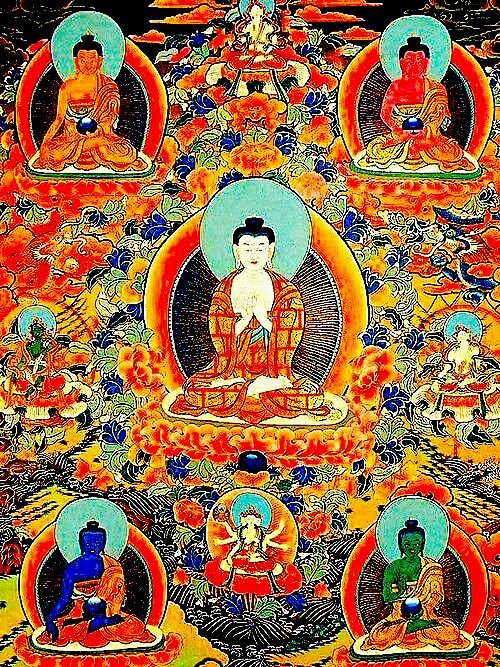
Figure 3: The Five Wisdom Buddhas of the Vajrayāna tradition—Vairocana, Akṣobhya, Ratnasambhava, Amitābha, and Amoghasiddhi—often arranged in the structure of a mandala representing the cosmic order of the enlightened universe. Source: Wikimedia Commons
At the center of the mandala is:
Vairocana
Vairocana is commonly regarded as the embodiment of the Dharmakāya, the Dharma-body of the Buddha. In many Tantric traditions, Vairocana represents the supreme wisdom from which the other dimensions of enlightenment unfold toward the four directions of the universe.
In the eastern direction of the mandala is:
Akṣobhya
Akṣobhya represents mirror-like wisdom, a form of insight that reflects all phenomena without distortion or attachment. This symbolism reflects an important Vajrayāna principle: the afflictions of the mind can be transformed into wisdom when they are perceived in their true nature.
In the western direction is:
Amitābha
Amitābha symbolizes discriminating wisdom, the capacity to perceive distinctions among phenomena without falling into attachment. In many Mahāyāna traditions Amitābha is closely associated with the ideal of salvation and the Pure Land, yet within the Tantric mandala structure his role is primarily cosmological and symbolic.
The remaining two directions of the mandala are occupied by:
Ratnasambhava
and
Amoghasiddhi
Ratnasambhava represents the wisdom of equality, in which all phenomena are perceived as sharing the same fundamental nature. Amoghasiddhi, by contrast, symbolizes the wisdom of action, the capacity to accomplish enlightened activity within the world of phenomena.
When these five Buddhas are arranged within the mandala structure, they form a symbolic map of the enlightened universe. In this map, each direction of space corresponds to a particular type of wisdom, a specific color, a symbolic attribute, and a distinct Buddha family. For this reason, the mandala is not merely a religious diagram but also a cosmological model reflecting the Vajrayāna understanding of the structure of reality.
What is particularly significant is that in the later Vajrayāna traditions of India, this mandala structure did not remain confined to textual descriptions or ritual visualization. It was also reflected in the geographical landscape of the Buddhist world. Sacred sites, great stūpas, and major centers of learning were sometimes interpreted as points within a larger mandala extending across geographical space.
Descriptions preserved in sources related to Buddhagupta suggest that certain major stūpas were associated with different mandalas of the Five Wisdom Buddhas. For example, some centers of worship were described as places where the mandala of Vairocana occupied the central position, while other sites were linked with Amitābha or Akṣobhya. Such associations suggest that Vajrayāna practitioners may have experienced the Buddhist world as a network of mandalas, in which each sacred site functioned as a nodal point within the symbolic structure of the cosmos.
In this context, pilgrimage between sacred sites was not merely a religious journey. It could also be understood as a passage through different layers of the cosmic mandala. When a practitioner moved from one stūpa to another, they were not only changing their location in geographical space but also moving within a broader symbolic structure of the Tantric universe.
From this perspective, the journeys recorded in sources related to Buddhagupta reflect more than the commercial or pilgrimage routes of the medieval world. They also suggest that Vajrayāna practitioners may have experienced the world itself as a mandalic landscape, in which sacred centers were arranged according to the profound symbolic principles of Tantric cosmology.
Thus, the mandala of the Five Wisdom Buddhas is not merely a ritual diagram depicted in Tantric texts. It may also be understood as a way of perceiving the world, in which the geographical space of the Buddhist world becomes an expression of the cosmic structure of enlightenment.
V. Sacred Landscapes and the Network of Vajrayāna Holy Sites
If the mandala provides a symbolic model of the enlightened universe, the sacred sites of the Buddhist world may be understood as the points where this symbolic structure manifests within geographical space. In the Vajrayāna tradition, sacred mountains, monumental stūpas, and major centers of learning are often viewed as coordinates within a sacred landscape in which the elements of the Tantric universe are reflected through the physical world.
This perspective can be described as a form of sacred geography, in which specific locations possess not only historical or archaeological significance but are also associated with profound symbolic meanings. When Vajrayāna practitioners travel between different sacred sites, they are not merely undertaking religious pilgrimages; they are also experiencing a sacred map of the world.
In many Tantric traditions, certain locations are regarded as centers of spiritual power where esoteric teachings were revealed or preserved. Such places are frequently connected with legends of great siddhas, yoginīs, or sacred events in Buddhist history. Consequently, sacred sites function not only as destinations for pilgrimage but also as points where religious memory, spiritual practice, and cosmological symbolism converge.
One of the important centers within this sacred landscape is:
Dhānyakaṭaka
Dhānyakaṭaka, associated with the region of Amarāvatī in southern India, was a major Buddhist center from ancient times. In later Vajrayāna traditions, this site became linked with important esoteric transmissions and was sometimes regarded as a center of Tantric mandalas. Some traditions even suggest that significant Vajrayāna teachings were transmitted there within the context of Tantric ritual practices.
This indicates that major Buddhist centers were not understood merely as places where the Dharma was taught, but also as points within the symbolic structure of the Vajrayāna cosmos. From this perspective, a sacred site is not simply a historical location but a coordinate within the sacred map of the Tantric universe.
Beyond the inland centers of India, many Tantric texts and pilgrimage traditions also refer to locations situated across a broader geographical horizon. Islands of the Indian Ocean, coastal regions of Southeast Asia, and even more distant areas could become nodes within this network of sacred sites.
In the context of the medieval Buddhist world, maritime trade routes played a crucial role in connecting these regions. Merchants, monks, and religious practitioners traveled between the major ports of India, Sri Lanka, Southeast Asia, and East Africa, forming an extensive network through which religious ideas, texts, and ritual practices could circulate.
These trade routes were not purely economic; they also contributed to the emergence of a cultural and religious space linking multiple regions of the Indian Ocean world. Within this sphere of interaction, coastal Buddhist centers and important islands may have functioned as points of transmission for various religious traditions, including Tantric lineages.
A notable example of such connections can be found along the coasts of East Africa, where merchants and travelers from India arrived through Indian Ocean trade networks. Within these networks, places such as:
Zanzibar
became significant centers of cultural exchange. Although direct evidence for Buddhist activity in these regions remains limited, the trade routes connecting East Africa with India and Southeast Asia suggest that religious ideas may have traveled alongside commercial networks.
Another location often mentioned in discussions of medieval maritime networks is:
Madagascar
Situated along important Indian Ocean trade routes, Madagascar was a meeting point for merchants from India, Arabia, and East Africa for many centuries. Within the context of late Vajrayāna Buddhism, these maritime routes may have facilitated the movement of monks and Tantric texts between different regions of the Buddhist world.
From the perspective of sacred geography, these trade routes may be interpreted not only as economic pathways but also as connections between sacred centers. As monks and practitioners traveled from one religious center to another, they simultaneously participated in a sacred network in which different places were linked through symbolic and religious meanings.
In this context, the journeys of Buddhagupta become particularly significant. The records of his travels suggest that Vajrayāna practitioners may have moved across vast regions, from the Buddhist centers of India to distant parts of the Indian Ocean world. Such journeys reflect not only the expansion of pilgrimage and trade networks but also suggest that the Buddhist world may have been experienced as a sacred landscape linking diverse geographical regions.
When these journeys are interpreted within the framework of Tantric cosmology, the locations mentioned in historical sources appear not merely as points on a map. Instead, they may be understood as elements within a geographical mandala, in which the sacred centers of the Buddhist world are connected through networks of pilgrimage and trade.
Thus, the sacred geography of Vajrayāna extends beyond the well-known holy sites of India such as Bodhgayā or Dhānyakaṭaka to include the coastal regions and islands of the Indian Ocean. From this perspective, the medieval Buddhist world was not a collection of isolated religious centers but a network of sacred landscapes spanning multiple regions.
Within this network, Vajrayāna practitioners may have experienced the world itself as an immense mandala, where sacred sites, stūpas, and monastic centers functioned as points within the cosmic structure of the Tantric universe.
VI. Buddhagupta and the Tantric Geography of the Indian Ocean
One of the important sources that helps illuminate the network of sacred sites in the late Vajrayāna world is the collection of accounts related to the journeys of the Indian Buddhist practitioner Buddhagupta. These materials were analyzed by the Italian scholar Giuseppe Tucci in his studies of Tantric traditions and the Buddhist history of the Himalayan region. Through his analysis, the travels of Buddhagupta appear not merely as an isolated religious journey, but as traces of sacred networks extending across multiple regions of the medieval Buddhist world.
According to sources preserved within Tibetan traditions, Buddhagupta is portrayed as a wandering practitioner who undertook extensive journeys across diverse geographical regions. These routes included not only the Buddhist centers of the Indian subcontinent but also extended to the Himalayan regions, Central Asia, and even the coastal areas of the Indian Ocean world. Such journeys reflect an important reality of the medieval Buddhist world: religious, commercial, and cultural networks often overlapped, creating vast spheres of interaction that transcended the boundaries of individual geographical regions.
Within this context, the journeys of Buddhagupta may be viewed as a representative example of the intersection between religious pilgrimage routes and the trade networks of the Indian Ocean world. Monks, merchants, and religious practitioners frequently traveled along the same maritime and overland routes, carrying with them not only goods but also religious ideas, scriptures, and spiritual traditions. These networks contributed to the formation of a wide cultural sphere through which Buddhist traditions could spread from the Indian subcontinent to many other parts of Asia and beyond.
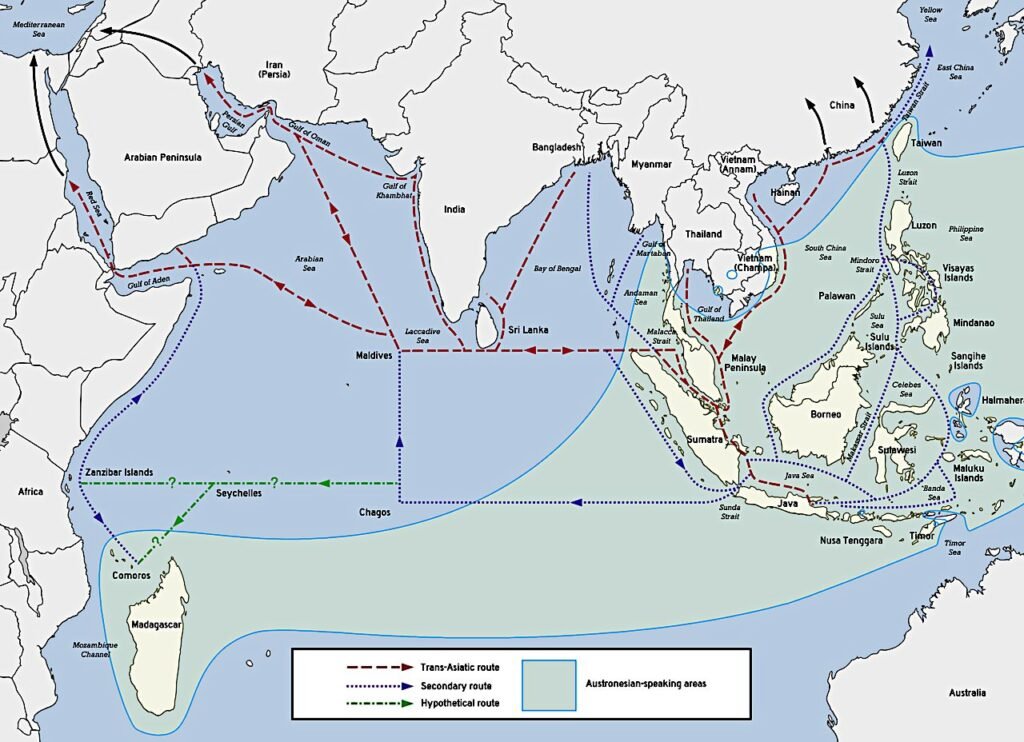
Figure 4: Maritime trade networks across the Indian Ocean linking South Asia, Southeast Asia, and East Africa. Such sea routes facilitated the movement of merchants, monks, and religious ideas, providing the broader historical context for the circulation of Buddhist traditions across the Indian Ocean world. Source: Adapted from Study.com.
From the perspective of religious history, what is particularly striking is that such journeys were not merely practical or economic in nature. In many cases they were also understood as journeys through the sacred sites of a vast spiritual landscape. As practitioners moved from one Buddhist center to another, they simultaneously participated in a symbolic network in which different places were connected through religious and cosmological meanings.
Within the context of Vajrayāna, these networks of sacred sites were often interpreted through the symbolic structure of the mandala. As discussed in earlier sections, the mandala is not merely a diagram used in meditation or ritual; it can also be understood as a cosmological model reflecting the order of the enlightened universe. When this symbolic structure is projected onto geographical landscapes, sacred sites and religious centers can be interpreted as points within a vast mandala extending across the Buddhist world.
From this perspective, the journeys of Buddhagupta may be interpreted not only as travels across different regions but also as movement through the centers of a geographical mandala. The great stūpas, Tantric monasteries, and pilgrimage sites he may have visited functioned not merely as religious centers but also as nodal points within the symbolic structure of the Vajrayāna cosmos.
Particularly when considering the role of maritime trade routes in the medieval world, it becomes apparent that journeys such as those of Buddhagupta may have connected the inland Buddhist centers of India with the coastal regions and islands of the Indian Ocean. Major port cities, where merchants from various regions gathered, could also have served as hubs through which religious ideas and Tantric traditions circulated. Within this sphere of exchange, Vajrayāna practitioners may have traveled across networks of sacred sites extending from the Indian subcontinent to Southeast Asia and even farther regions.
Seen from this perspective, the journeys of Buddhagupta suggest that the medieval Buddhist world may have been experienced as a sacred landscape linking multiple regions of the Indian Ocean world. Maritime and overland routes did not merely connect economic and cultural centers; they also created pathways of pilgrimage through which practitioners moved between the sacred centers of the Buddhist tradition.
Thus, rather than viewing Buddhagupta’s travels as a sequence of isolated locations on a map, they may be understood as traces of a vast sacred network. Within this network, sacred sites, stūpas, and centers of learning in the Buddhist world did not exist in isolation but were interconnected through routes of pilgrimage, trade, and the transmission of religious teachings.
It is within this broader context that the late Vajrayāna world may be understood as a vast geographical mandala in which sacred centers were connected through the journeys of Tantric monks and practitioners. Journeys such as those of Buddhagupta therefore reflect not only the historical networks of the medieval world but also reveal a distinctive way of perceiving religious space—one in which the physical world itself is experienced as a sacred landscape reflecting the cosmic structure of enlightenment.
VII. The World as Mandala: Tantric Cartography of Sacred Space
The analyses presented in the preceding sections suggest that the sacred sites of the Vajrayāna Buddhist world may be understood not merely as isolated religious locations, but as elements within a broader symbolic structure. When placed within the framework of Tantric cosmology, pilgrimage centers, stūpas, and sacred landscapes appear as nodal points within a sacred terrain organized according to the logic of the mandala.
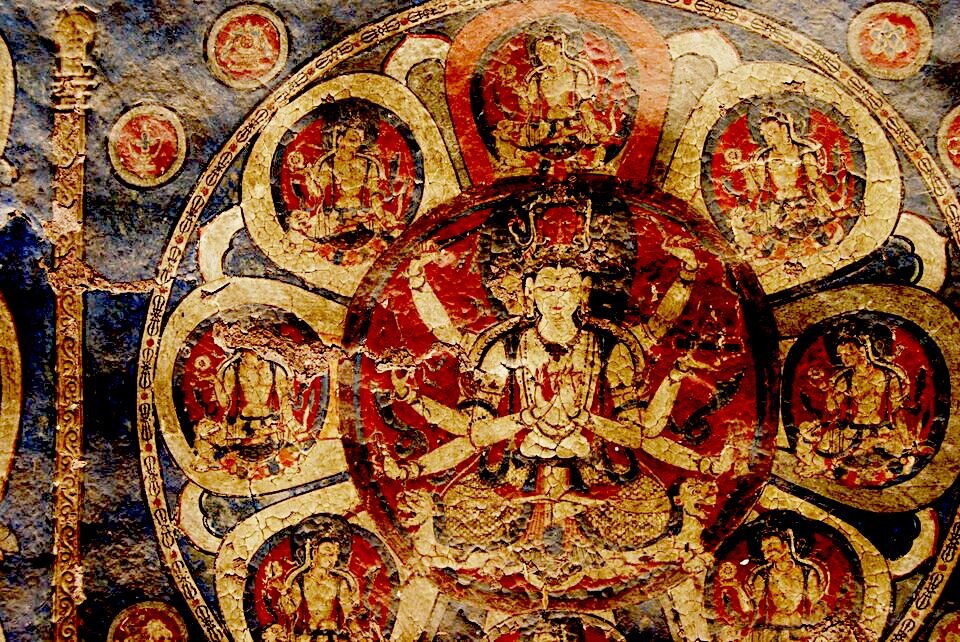
Figure 5: Tantric mandala painting from Sumda Chun Monastery in Ladakh. Such visual representations illustrate the symbolic structure of the Vajrayāna cosmos, where Buddhas, Bodhisattvas, and sacred directions are arranged within a mandala representing the enlightened universe. Source: Wikimedia Commons
In the Vajrayāna tradition, the mandala is commonly understood as a meditative diagram representing the structure of the enlightened universe. However, as many scholars have pointed out, the meaning of the mandala is not limited to ritual space or meditative visualization. The symbolic structure of the mandala can also be projected onto the physical world itself, where sacred locations may be interpreted as points corresponding to the directions and centers of the Tantric cosmos.
From this perspective, the geographical landscape of the Buddhist world may be read as a form of Tantric cartography—a sacred map in which religious centers are arranged according to a symbolic order. Major holy sites such as Bodhgayā, Dhānyakaṭaka, and other Tantric centers function not only as pilgrimage destinations but also as locations where the structure of the cosmic mandala is manifested within geographical space.
When Vajrayāna practitioners travel between these sacred sites, they are not merely undertaking religious pilgrimages. They are also moving across different points of a vast sacred map. Pilgrimage routes, maritime trade networks, and monastic connections may therefore be understood as the pathways linking the centers of this geographical mandala.
Within this context, the medieval Buddhist world may have been experienced as a mandalic landscape, in which sacred sites, stūpas, and centers of learning functioned as points within the cosmic structure of the Tantric tradition. The journeys of Vajrayāna monks and practitioners—such as those attributed to Buddhagupta—thus reflect not only movement across geographical space but also passage through symbolic layers of the Tantric cosmos.
This idea suggests that the network of sacred sites in the Buddhist world was not merely the result of historical processes such as trade or religious expansion. It also reflected a particular way of perceiving the world, in which geographical landscapes were integrated into the broader symbolic structure of Vajrayāna cosmology.
Thus, when we reconsider the sacred sites, stūpas, and pilgrimage routes of the medieval Buddhist world, they may be understood not only as traces of religious history but also as elements within a vast geographical mandala. Within this sacred map, the spiritual centers of the Buddhist world were connected through a symbolic landscape reflecting the cosmic structure of enlightenment.
VIII. Conclusion: The Sacred Geography of the Tantric World
The analyses presented in the preceding sections suggest that Buddhist sacred sites cannot be understood merely as historical or archaeological locations scattered across the map of the medieval world. When placed within the framework of Vajrayāna thought, these sites appear instead as elements of a broader symbolic structure, in which the geographical landscape of the Buddhist world reflects a Tantric cosmic order.
One of the key concepts for understanding this perspective is the mandala. In the Vajrayāna tradition, the mandala is not only a ritual diagram used in meditation but also a cosmological model that expresses the structure of the enlightened universe. When the elements of the mandala are projected onto geographical landscapes, stūpas, sacred mountains, and pilgrimage centers can be understood as points within a sacred map of the cosmos.
Within this context, the role of the stūpa becomes especially significant. Beyond serving as reliquary monuments containing the relics of the Buddha or revered saints, stūpas are also interpreted as symbols of the Buddha’s body and as representations of the cosmic axis. The acts of constructing, venerating, or circumambulating a stūpa therefore carry meanings that extend beyond devotion; they are also regarded as means of accumulating merit and establishing a connection with the sacred structure of the enlightened universe.
The mandala systems of Vajrayāna—particularly the mandala of the Five Wisdom Buddhas—provide a symbolic model for the organization of the Tantric cosmos. Within this framework, each direction of space is associated with a particular Buddha and a distinct form of wisdom, forming a symbolic map of the enlightened world.
When this symbolic structure is considered alongside the sacred sites of the Buddhist world, it becomes possible to recognize that many holy locations were understood as centers of different mandalas. Major stūpas, Tantric monasteries, and pilgrimage centers functioned not only as places where Buddhist teachings were transmitted, but also as coordinates of a sacred universe within the worldview of Vajrayāna practitioners.
From this perspective, the journeys of Tantric monks and practitioners were not merely religious travels across geographical space. As they moved between sacred sites, they simultaneously passed through different symbolic layers of the cosmic mandala. The pilgrimage routes and trade networks of the medieval world can therefore be understood as pathways connecting the centers of an extensive sacred landscape.
Accounts of the travels of Buddhagupta, preserved in Tibetan sources and analyzed by the Italian scholar Giuseppe Tucci, suggest that Vajrayāna practitioners may have moved through a network of sacred sites extending from the Buddhist centers of India to more distant regions of the Indian Ocean world. These journeys reflect not only the pilgrimage and commercial routes of the medieval world but also indicate that Tantric monks may have experienced the world as a geographical mandala, in which sacred centers were interconnected through pilgrimage routes and trade networks.
Viewed from the perspective of sacred geography, the medieval Buddhist world appears as a sacred landscape in which the elements of the Tantric cosmos are expressed through holy sites, stūpas, and monastic centers. As Vajrayāna practitioners traveled between these locations, they were not merely undertaking religious pilgrimages; they were also participating in a symbolic network in which geographical space and cosmic structure converged.
Thus, the study of journeys such as those attributed to Buddhagupta does more than illuminate the networks of trade and pilgrimage in the medieval Buddhist world. It also opens a deeper perspective on how Vajrayāna practitioners understood and experienced the world. In this vision, the world was not a collection of isolated places but a living mandala, in which the geographical landscape of the Buddhist world reflected the cosmic structure of enlightenment.
Related Studies:
- Maritime Buddhism: Vajrayāna Networks Across the Indian Ocean
- Tantric Buddhism and the Himalayan World: Cultural Exchanges and Religious Transformation
Bibliography
Bentor, Yael. Consecration of Images and Stūpas in Indo-Tibetan Tantric Buddhism. Leiden: Brill, 1996.
Buswell, Robert E., Jr., and Donald S. Lopez Jr., eds. The Princeton Dictionary of Buddhism. Princeton: Princeton University Press, 2014.
Davidson, Ronald M. Indian Esoteric Buddhism: A Social History of the Tantric Movement. New York: Columbia University Press, 2002.
Gethin, Rupert. The Foundations of Buddhism. Oxford: Oxford University Press, 1998.
Huntington, John C., and Dina Bangdel. The Circle of Bliss: Buddhist Meditational Art. Columbus: Serindia Publications, 2003.
Snodgrass, Adrian. The Symbolism of the Stupa. Ithaca: Cornell University Press, 1985.
Tucci, Giuseppe. “The Journey of Buddhagupta.” Indian Historical Quarterly 9 (1933): 690–702.
Wayman, Alex. The Buddhist Tantras: Light on Indo-Tibetan Esotericism. Delhi: Motilal Banarsidass, 1995.
Williams, Paul. Mahāyāna Buddhism: The Doctrinal Foundations. 2nd ed. London: Routledge, 2009.