
Le Hoang Da
Buddhist Scholar
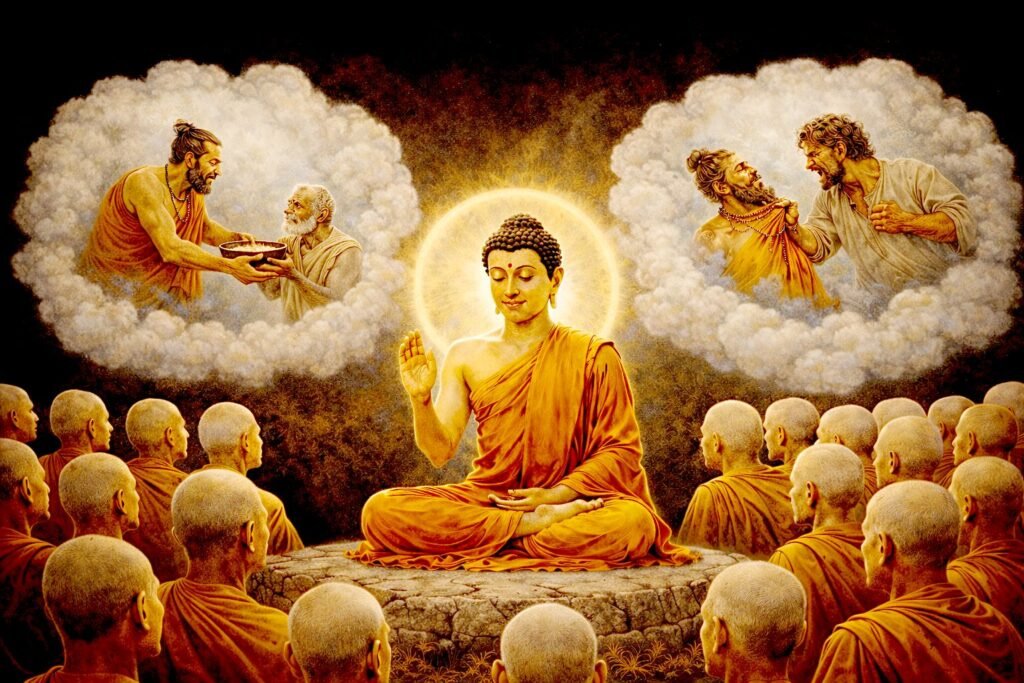
Figure 1: A man gives with compassion—yet is struck down moments later.
If karma were linear, this would not happen. But what if causation does not unfold the way we expect?
I. When Reality Refuses Our Moral Expectations
There is a quiet yet persistent unease that arises in the mind of anyone who has reflected deeply: the world does not operate in the way our moral intuition expects it to. In one way or another, we are nurtured into a belief in a basic moral equilibrium—that good actions should lead to good outcomes, and that unwholesome actions must eventually result in suffering. This belief is not only religious in nature but also deeply psychological: it sustains a sense of fairness, structures our expectations, and reassures us that existence is not a meaningless chaos.
Yet lived experience continually disrupts this comforting balance. We encounter individuals who act with cruelty, deceit, or indifference, yet seem to prosper—socially, materially, even emotionally. At the same time, we witness those who live with integrity, generosity, and restraint facing illness, misfortune, or obscurity. These cases are not rare anomalies; they are common enough to provoke doubt, and persistent enough to resist any simple explanation.
Faced with this reality, various responses emerge. Some abandon the very idea of moral causation altogether, concluding that the world is governed by randomness or blind forces. Others maintain their faith in justice, but displace its realization into an unseen future—a next life or a transcendent realm. Still others adopt a more skeptical stance, treating morality as merely a social construct with no intrinsic connection to the nature of reality.
But there is another possibility—one that demands more and unsettles more: what if the problem is not that moral causation fails to operate, but that we misunderstand how it operates? What if our expectation of a direct, immediate, and symmetrical relationship between action and outcome is itself a simplification—a projection of our need for clarity onto a system that is inherently complex?
It is precisely at this point of tension that a key text, the Mahākammavibhaṅga Sutta (The Great Discourse on the Analysis of Action), becomes relevant. Belonging to the Majjhima Nikāya, it is among the most sophisticated analyses of karma in the entire Nikāya corpus. Rather than preserving moral order through reassurance, the discourse intervenes directly in how we understand causation, unsettling the very cognitive framework through which we interpret moral experience.
The discourse does not deny the operation of karma; on the contrary, it affirms it. But in affirming it, it simultaneously dismantles the assumption that karma operates in a linear, transparent, and easily traceable manner.
In this sense, the text is not merely a teaching about moral causation; it is a critique of what may be called linear moral thinking—a deeply ingrained tendency to interpret complex processes through simple cause-and-effect narratives. This tendency manifests in familiar judgments: that those who suffer must have done something wrong, that those who succeed must have acted rightly, or that present circumstances can be read as a direct “moral residue” of past actions. Such interpretations provide a sense of cognitive closure, allowing us to believe that the world can be understood in a way that aligns with our expectations.
But the cost of such closure is considerable. It reduces the complexity of life to a kind of “moral arithmetic” that is both inaccurate and ethically hazardous. It encourages hasty judgments, sustains implicit forms of moral attribution, and obscures the intricate network of conditions shaping each moment of existence.
The Mahākammavibhaṅga Sutta challenges this entire mode of thinking. It does not replace one simple formula with another. Instead, it opens a space in which causation must be understood as a multi-layered process, extended through time and dependent on the interaction of countless conditions. To approach this discourse, therefore, is not merely to learn about karma, but to undergo a shift in perspective—from a world imagined as a series of moral transactions to a world understood as a dynamic field of interdependent processes.
The question, then, is no longer whether actions produce consequences, but rather: how do they operate, under what conditions, and across what temporal horizons? And perhaps more importantly: what happens to our moral life when we relinquish the demand for immediate moral transparency?
It is precisely at this threshold—between the desire for simplicity and the demands of deeper understanding—that this inquiry begins.
II. Four Misconceptions About Karma: When Linear Thinking Is Imposed on a Nonlinear Reality
When confronted with the asymmetries of life—where the unwholesome may prosper and the virtuous may suffer—people rarely abandon the idea of moral causation altogether. Instead, they tend to adjust it to fit their expectations. It is within this effort that certain interpretations of karma gradually take shape and become so familiar as to appear self-evident.
The Mahākammavibhaṅga Sutta does not merely explain causation; it actively dismantles these misconceptions. What is striking is that these views do not appear as crude errors. On the contrary, they often carry an air of plausibility, even moral persuasiveness. Precisely for this reason, they are easily accepted—and for the same reason, they obscure the complexity of causation itself.
The first view—“those who do evil are destined for hell”—is among the most widespread. At an intuitive level, it provides a sense of order: every wrongdoing is met with a proportionate consequence. Yet this very clarity is a sign of simplification. The discourse points out that a person may engage in unwholesome actions and still be reborn in a favorable realm. This does not deny causation; rather, it denies a one-dimensional understanding of it. The consequence of an action does not exist in isolation; it is always embedded within a totality of other karmic forces operating simultaneously. It is the interaction among multiple streams of karma—not any single act—that shapes the outcome.
Conversely, the second view—“those who do good are destined for heaven”—is simply the “positive” version of the same cognitive error. It reinforces an image of morality as a system of reward, in which every good deed is compensated with a corresponding result. But this perspective not only simplifies causation; it also turns morality into a form of transaction. The discourse explicitly rejects this: a person may live virtuously and yet still encounter adverse outcomes. This appears paradoxical only if one assumes that each action independently produces a proportionate result. Once that assumption is removed, what appears as “injustice” is revealed not as a flaw in reality, but as a limitation of our understanding.
The next two views go further, not merely addressing outcomes but imposing a causal interpretation onto persons themselves. The third view—“this person is bad because they committed evil in the past”—reads a person’s present condition as direct evidence of a prior moral cause. At first glance, this seems consistent with the doctrine of karma. In reality, however, it is a misuse of causation to legitimize judgment. From a present phenomenon, one infers a moral cause in the past without any possibility of verification. This is a dangerous cognitive leap: it not only simplifies a complex system but also opens the door to moral attribution, whereby those who suffer are seen as deserving their suffering. The discourse rejects this reasoning by emphasizing that one cannot infer the entirety of a person’s past karma from their present condition.
The fourth view—“this person is good because they did good in the past”—repeats the same logic in reverse. Here, success, happiness, or social standing is taken as evidence of past virtuous actions. Once again, the interpretation appears reasonable, as it preserves the belief in a morally ordered world. Yet it contains the same fundamental error: reducing a complex phenomenon to a simple conclusion. It ignores countless other conditions, the interaction of multiple karmic processes, and above all, the dimension of time. In doing so, it not only impoverishes understanding but also risks legitimizing social inequalities under a veneer of moral justification.
When placed side by side, these four views are no longer isolated mistakes. They reveal themselves as different expressions of a single cognitive structure: a persistent effort to reduce a complex reality into intelligible straight lines. Within this structure, the world is imagined as a transparent system in which each action can be directly linked to a specific outcome, and each phenomenon can be traced back to a determinate moral cause.
Once this structure is dismantled, a crucial insight emerges: the problem is not that causation fails to operate, but that we have imposed upon it a model too simple to capture its nature. The question, therefore, is no longer whether wholesome or unwholesome actions lead to corresponding results. It must be reformulated at a deeper level: what is the actual structure of causation, if it does not conform to the linear logic we habitually assume?
It is precisely at this turning point that another mode of understanding begins to open—one in which karma is no longer seen as a simple chain of cause and effect, but as a nonlinear system of interacting conditions.
III. Karma as a Nonlinear System in Time: When Causation Exceeds Linear Logic
Once the four misconceptions about karma are dismantled, what remains is not a void but a challenge: if causation does not operate according to the linear logic we are accustomed to, then how does it actually operate? The Mahākammavibhaṅga Sutta does not offer a simple alternative formula. Instead, it compels us to abandon the very desire for such a formula. What the discourse opens up is not an easily graspable model of causation, but a way of seeing in which causation appears as a complex network of interacting conditions—a system in which no single straight line can account for the entirety of an outcome.
In conventional understanding, causation is imagined as a linear sequence: an action leads to a result through a direct and traceable connection. This model is appealing because it provides clarity and a sense of control. Yet when applied to the domain of moral life and human experience, it quickly reveals its limitations. The discourse suggests a different view: each result is not the product of a single cause, but the convergence of multiple conditions—wholesome and unwholesome, proximate and distant, matured and yet-to-mature. A life is not the result of a single karma, but the intersection of countless karmic streams. There is no “straight line” connecting action to outcome; rather, there is a network in which all elements interact and influence one another.
Within this network, a crucial feature emerges: the layering of karma. Multiple karmic forces can coexist and bear fruit within a single life. A wholesome action does not erase an unwholesome one, just as an unwholesome action does not entirely negate a wholesome one. They persist as distinct currents, varying in strength, and ripening at different times. The appropriate image is not a straight line, but a river fed by many tributaries. What we observe as an outcome is merely a temporary state of that flow—a point of intersection where multiple causal streams are simultaneously at work.
Yet it is precisely here that a deeper dimension of nonlinearity becomes visible: time. In ordinary intuition, cause and effect are expected to occur in close temporal proximity, as if time were a synchronized linear sequence. Within the structure of karma, however, this relationship is stretched. An action may bear fruit immediately, in the near future, or under conditions so distant that they remain beyond direct observation. There is no uniform temporal rhythm governing all karma; each has its own “rate of maturation,” dependent on the convergence of relevant conditions.
From this structure arises a phenomenon that may be called a phase lag between action and result. An action occurs at one moment, but its consequence may manifest at another—sometimes much later, sometimes obscured by other conditions ripening at the same time. It is precisely this phase lag that creates the illusion that some actions have no consequences, or that some results arise without causes. Yet this is not a failure of causation, but a limitation of perspective: we perceive only fragmented slices of an extended process, and from these fragments attempt to reconstruct a complete causal narrative—an endeavor that is almost bound to fail.
From here, another misunderstanding is also dispelled: karmic result is not a discrete event, but a process. A karma does not simply “ripen” at a single moment; it may manifest as a tendency, a psychological disposition, an enduring circumstance, or a sequence of interconnected experiences. The result is not an endpoint, but a dynamic unfolding in which multiple karmic forces are simultaneously expressed, overlapping and interacting.
Within this entire nonlinear structure, the discourse maintains a central focus: intention (cetanā). Not all actions carry the same karmic weight; it is intention—the internal motive behind an act—that shapes the strength and direction of a karma. Yet even here, nonlinearity persists. Intention does not arise in isolation; it is conditioned by perception, emotion, circumstance, and the entirety of one’s experiential history. Thus, cetanā is not an independent cause, but a central node within the network—crucial, yet inseparable from the structure of dependent arising.
When causation is understood as a nonlinear system in time, an inevitable cognitive consequence follows: the world can no longer be “read” in the simple way we are accustomed to. We cannot look at a person and infer their past, cannot look at a situation and deduce a single moral cause, and cannot predict with certainty the outcome of any isolated action. This does not render the world meaningless. On the contrary, it renders it deeper, more complex, and demands a more humble epistemic stance. To understand karma correctly is not to gain the power to judge, but to become more cautious in judging.
When causation is viewed in the depth of its structure and temporality, what we call “injustice” often reveals itself as the expression of an unfinished process. We see a part and take it for the whole; we see a moment and take it for a conclusion. Yet within the reality of karma, no point is an absolute endpoint. Each result is merely a phase within a longer unfolding—one whose greater portion remains beyond our immediate perception.
For this reason, the issue is no longer whether causation operates, but whether we are viewing it through too narrow a slice of time. And once this insight is accepted, a further question emerges: if outcomes can no longer serve as an immediate and reliable measure, what truly determines the direction of an action?
The answer no longer lies in the outcome, but in the point of origin of the action itself—intention (cetanā).
IV. Intention (cetanā) and the Problem of Agency: The Center of Ethics in a Nonlinear World
Once causation is understood as a nonlinear system operating across time, an inevitable consequence follows: outcomes can no longer serve as a reliable measure of the moral value of an action. Action and result may be separated by time, overlapped by multiple streams of karma, and obscured by conditions beyond direct observation. In such a world, ethical inquiry can no longer be grounded in the question “what will happen,” but must shift to another point—closer to where action itself arises.
It is precisely here that the Mahākammavibhaṅga Sutta places its emphasis on a familiar yet often insufficiently understood factor: intention (cetanā). However, to grasp its full significance, intention cannot be treated merely as a simple “motive.” It must be situated within a broader problem: the problem of agency—the capacity of a person to initiate, direct, and take responsibility for their actions within a world shaped by multiple conditions.
In many ethical systems, outward behavior is taken as the primary criterion of evaluation. An action is judged good or bad based on its consequences or on the rules it follows or violates. In the Buddhist perspective, however, the focus shifts from behavior to intention. Two actions may be identical in form yet entirely different in karmic significance if their underlying intentions differ; conversely, two actions that differ in form may share the same moral value if they are guided by the same intention. This shift is not merely a change of criterion, but a change of level: ethics no longer resides at the surface of behavior, but in the internal structure of the process through which action arises.
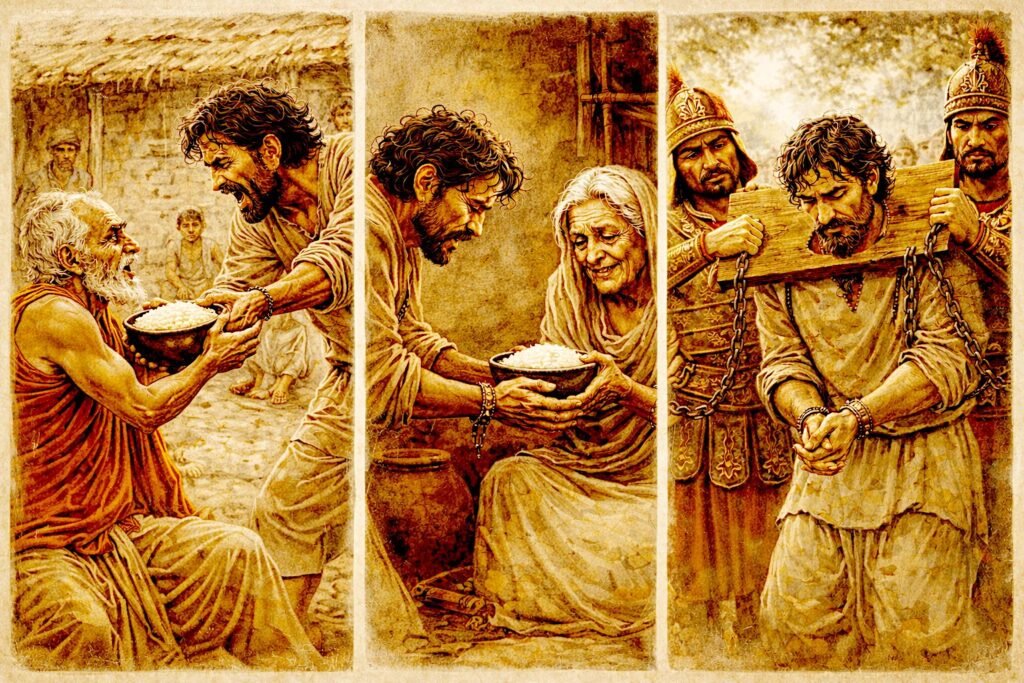
Figure 2: A man seizes a bowl of food from another—an act of theft driven by urgency. Yet he brings it home to feed his aging mother, an act rooted in filial compassion. Soon after, he is arrested and punished.
This sequence resists any simple moral conclusion: within a single action, unwholesome conduct, wholesome intention, and painful consequence coexist, revealing the nonlinear and layered nature of karma.
Within a nonlinear system, where outcomes are no longer clear indicators, intention becomes the point most directly accessible within the causal process. It is where an action begins to take shape—before it manifests externally, before it enters into interaction with other conditions. Yet the role of cetanā does not end at this point of origin. It is not only the starting point, but also the orienting force of the entire karmic stream in which the action participates. A wholesome intention may lead to complex outcomes, even unfavorable ones in the short term; an unwholesome intention may not immediately manifest as suffering. Yet over the long course of the process, it is intention that shapes the direction of karma—not as a single isolated cause, but as a directional force within a complex system.
At this point, however, a philosophical tension emerges. If every action is shaped by countless conditions—perception, emotion, environment, personal history—can intention truly be considered “free”? And if it is not entirely free, how can moral responsibility still be meaningfully understood?
The Mahākammavibhaṅga Sutta does not resolve this tension by asserting an absolute free will. Rather, it suggests that intention itself is part of the network of conditions. Cetanā does not arise in a vacuum; it is influenced by what we perceive, what we feel, and what we have experienced. Yet this does not render intention meaningless. On the contrary, it redefines the nature of agency: not as an absolute point outside all conditions, but as a point within them that can be recognized, intervened upon, and transformed.
Here, ethics ceases to be a system of judgment based on outcomes and becomes an inner process. The value of an action does not require external confirmation through its results; it is already shaped at the point of intention. At the same time, practice is no longer about controlling outcomes, but about transforming the source from which actions arise—the very structure of cetanā. In this way, ethics moves from a domain of reaction to a domain of formation.
When placed in a modern context, this perspective opens a profound dialogue with cognitive science and neuroscience. Many studies suggest that human behavior is not the product of a simple free will, but of multiple layers of conditions: neural structures, emotional responses, social environments, and past experiences. At first glance, this seems to undermine moral responsibility. Yet when considered alongside the concept of cetanā, another possibility emerges: responsibility does not lie in controlling all conditions—an impossibility—but in the capacity to recognize and transform the process through which intention is formed.
In this view, agency is neither absolute freedom nor total determinism. It is a form of conditioned freedom: the capacity to intervene in one’s own stream at the very point where action is taking shape. For this reason, ethics is no longer about labeling behavior, but about understanding and restructuring the inner process that gives rise to behavior.
When outcomes can no longer serve as reliable measures, and when behavior is no longer the starting point of evaluation, the center of gravity must shift to the source of action. Intention (cetanā) is no longer a secondary factor, but becomes the core of the entire ethical structure—not as an independent entity, but as a point of convergence where conditions can be recognized and transformed.
And it is precisely here that a critical question begins to emerge: if ethics truly resides in the structure of intention within such a nonlinear system, why do human beings—even in the modern world—continue to judge according to simple linear patterns? Why, despite possessing abundant knowledge about the complexity of behavior, do we repeatedly return to models of direct, rapid, and definitive attribution?
This question no longer belongs to the domain of scripture. It belongs to the cognitive structure of contemporary human beings—and it is this very question that leads to the next stage of the inquiry.
V. When Modern Humans Still Judge in Straight Lines: A Critique of Ethics, Responsibility, and the Illusion of Transparency
If the Mahākammavibhaṅga Sutta dismantled illusions about causation in an ancient context, an unavoidable question arises: have these illusions truly disappeared in the modern world, or have they merely reappeared in new forms? Observing contemporary life, the answer seems to lean decisively toward the latter. What the discourse critiques—linear moral thinking, the tendency toward rapid attribution, and the belief in a direct link between action and moral judgment—not only persists, but is intensified in an environment where information travels faster than reflection.
One of the clearest manifestations of this tendency is the culture of instant judgment. A statement stripped of context, an action captured in a few seconds, a moment detached from a person’s inner history and lived circumstances—and almost immediately, a moral verdict is formed. Within this structure, there is no room for intention, for the layering of conditions, or for the temporal lag between action and meaning. Everything is compressed into a simple sequence: behavior, judgment, conclusion. In other words, the linear thinking critiqued by the discourse has not disappeared; it has become faster, more forceful, and more socially rewarded.
Underlying this phenomenon is a deeper illusion: the illusion of moral transparency. Modern individuals often behave as if the actions of others can be directly “read,” as if sufficient data were available to infer causes, motives, and moral value from surface appearances alone. Yet the preceding analysis of nonlinear causation, temporal layering, and cetanā as a node within a network of conditions reveals the opposite: behavior is never a transparent text. It is the surface of a process far deeper than what any observer can access.
The problem becomes more serious when this logic is not confined to individual judgment but is institutionalized within social structures. People are evaluated based on isolated actions, short-term outcomes, and measurable indicators, as if behavior could be separated from its context and understood as a discrete unit. To a certain extent, every society requires mechanisms of evaluation. But when those mechanisms ignore the conditional nature of action and the nonlinear structure of human life, they do more than simplify reality—they begin to distort it.
It is at this point that the problem of agency becomes decisive. The central difficulty of modern ethics is not a lack of information, but the absence of a sufficiently nuanced model capable of holding two truths at once: that individuals must be held responsible for their actions, and that those actions are always formed within a network of conditions beyond anyone’s full control. If we emphasize responsibility alone, we fall into attribution and punishment. If we emphasize conditions alone, we dissolve the very notion of ethics. Read through the lens of cetanā, the Mahākammavibhaṅga Sutta points toward a more demanding but more accurate path: responsibility lies not in absolute control, but in the capacity to recognize, orient, and transform intention within the conditions that give rise to action.
What is striking is that our age is not lacking in knowledge about human complexity. Psychology, sociology, and neuroscience increasingly demonstrate that behavior does not arise from a single cause. And yet, the more knowledge we accumulate, the less tolerant we seem to become in everyday moral judgment. This paradox reveals an uncomfortable truth: understanding conditions does not automatically transform perception. When the underlying cognitive structure remains linear, even the most sophisticated knowledge is forced back into simplified conclusions.
In this sense, the Mahākammavibhaṅga Sutta is not merely an ancient text explaining karma. It is a warning that remains fully contemporary. It compels us to confront a difficult reality: the problem of human beings lies not only in knowing too little, but in concluding too quickly. And for this reason, the greatest ethical challenge of our time may not be to construct more refined systems of judgment, but to learn how to pause long enough to refrain from imposing straight moral lines onto a reality that has never operated in straight lines.
If the previous sections have shown that causation is nonlinear, temporally layered, and oriented by intention, then this section leads to a clear practical consequence: to understand karma correctly does not make us better judges. It makes us more cautious in judging. And perhaps, in an age where everyone seeks to conclude before understanding, this very caution is the first sign of moral maturity.
VI. When “Presence” and “Absence” No Longer Mean What They Seem: A Conclusion from the Paradox of Causation
In the final passage of the Mahākammavibhaṅga Sutta, the Buddha does not offer a conclusion in the conventional sense. No principle is summarized, no moral formula affirmed. Instead, he leaves a statement that appears paradoxical:
“There is karma that appears nonexistent yet is not nonexistent;
there is karma that appears nonexistent yet is existent;
there is karma that appears existent and is existent;
there is karma that appears existent yet is not existent.”
At first glance, this statement may be mistaken for a classification. But when situated within the broader movement of the discourse, it is not a system of arrangement but a disruption. It strikes at the foundational assumption underlying linear moral thinking: that one can look at a phenomenon and directly determine its nature.
Within the structure the discourse reveals, the correspondence between essence, appearance, and result no longer remains stable. An action that “exists”—that is, one carrying a certain moral quality—may fail to manifest that quality in its immediate outcome; conversely, an action that appears “absent” may present itself as “present” when conditions ripen in unexpected ways. What appears is no longer a direct reflection of what has been formed.
It is here that binary moral logic begins to collapse. Oppositions such as good and evil, right and wrong, reward and punishment can no longer be directly imposed upon lived experience. This is not a rejection of morality, but a deconstruction of the tools too crude to grasp it. Ethics does not disappear; it becomes more subtle, and therefore more resistant to simplification.
If we stop at this level, we are still reading the statement merely as a teaching about karma. At a deeper level, however, it is also a warning about cognition. It reveals that what we see is insufficient for conclusion, that what we take to be clear may be only the surface of a deeper process, and that it is precisely our confidence in our ability to “read” the world that must be called into question. This statement does not merely disrupt our understanding of causation; it disrupts the belief that causation can be directly understood.
Once the entire structure of linearity and binary opposition is dismantled, the question is no longer “what is right” or “who is wrong,” but rather: where do we stand in a world that is no longer morally transparent? The answer suggested by the discourse does not lie in a new doctrine, but in a transformation of attitude—from judgment to observation, from conclusion to process-understanding, from the need for control to the capacity to accept complexity. To understand karma correctly does not make us more refined judges; it makes us more restrained in judging.
Looking back across the entire trajectory of the discourse—from the dismantling of four misconceptions, to the articulation of nonlinear causation, to the introduction of temporal depth and the centrality of intention—this concluding passage emerges as a point of convergence. It adds no new component, but compels us to recognize the limits of all attempts at simplification. Causation is not a transparent system of moral accounting in which each act is paired with a proportional result; it is a field of unfolding in which conditions interact, overlap, and manifest in ways that cannot be captured by simple linear models.

Figure 3: No single stream defines the river.
What reaches the sea is not the trace of one cause, but the convergence of many.
So too with karma: what appears as an outcome is only a moment within a vast and interwoven field of conditions.
If there is one thing the discourse compels us to relinquish, it is the desire for a morally transparent world—a world in which everything can be seen, understood, and concluded immediately. And if there is one thing it offers in return, it is not certainty, but depth: a way of seeing in which causation continues to operate without always revealing itself, intention continues to shape without always appearing, and understanding does not lead to rapid conclusions but to restraint.
In such a world, the question is no longer who is right or wrong, who deserves reward or punishment. The question becomes: have we seen enough to conclude at all? And perhaps it is precisely in the refusal to conclude too quickly that another form of intelligence begins to emerge—an intelligence grounded not in certainty, but in the capacity to remain with the complexity of reality.
Related Studies:
⭐ If causation does not unfold in straight lines, then what becomes of human freedom? This question is explored further in:
Bibliography
Bhikkhu Bodhi. The Buddha’s Teaching on Social and Communal Harmony. Somerville: Wisdom Publications, 2016.
Rupert Gethin. The Foundations of Buddhism. Oxford: Oxford University Press, 1998.
Peter Harvey. An Introduction to Buddhist Ethics: Foundations, Values and Issues. Cambridge: Cambridge University Press, 2000.
Majjhima Nikāya. The Middle Length Discourses of the Buddha. Translated by Bhikkhu Ñāṇamoli and Bhikkhu Bodhi. Boston: Wisdom Publications, 1995.
Mark Siderits. Buddhism as Philosophy: An Introduction. Indianapolis: Hackett Publishing, 2007.