
Le Hoang Da
Buddhist Scholar
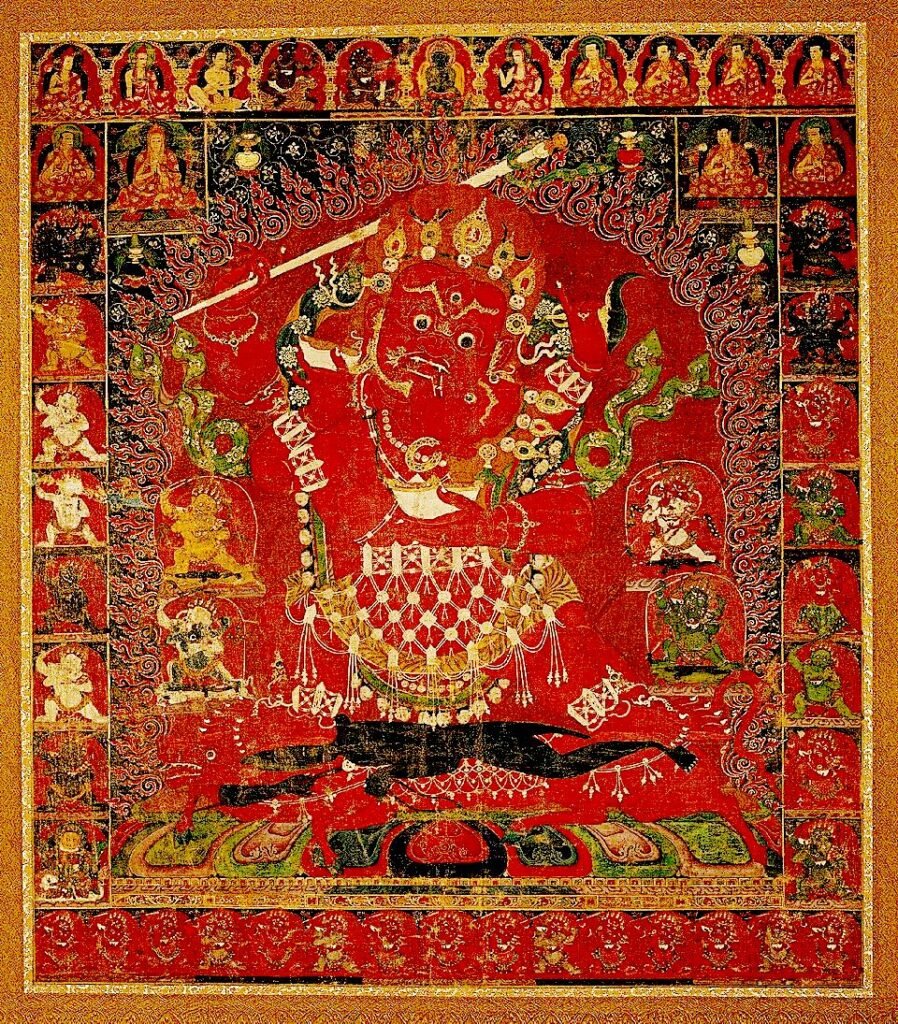
Figure 1: Rakta Yamāri, a wrathful manifestation associated with Mañjuśrī in Tantric Buddhism. Bronze sculpture, 16th century, Himalayan region. Museum of Fine Arts, Boston. Source: Wikimedia Commons
I. Wrathful Deities and the Transformation of Tantric Buddhism
In the historical development of Buddhism, the most familiar images of sacred figures are often associated with serenity, compassion, and wisdom. From the Buddha statues of Gandhāra to the Bodhisattva images of Mahāyāna art, Buddhist aesthetics for many centuries emphasized dignity, purity, and transcendence. However, from around the eighth century onward—particularly within the context of Tantric Buddhism (Vajrayāna)—an entirely different type of symbolism began to appear in Buddhist art and ritual: wrathful deities.
These figures are typically depicted with fierce expressions, protruding fangs, hair rising like flames, and bodies adorned with skulls and serpents. They are often shown trampling corpses or figures representing ignorance. For those encountering Buddhism for the first time, such imagery may appear to contradict the ideal of compassion that is commonly regarded as central to the Buddha’s teaching. Yet within the symbolic system of Vajrayāna, wrathful deities are not expressions of violence or anger in the ordinary sense. Rather, they represent the dynamic power of awakened wisdom confronting and transforming the negative forces of the world.
One of the most prominent examples of this symbolic type is Yamāntaka, a well-known deity in the Tibetan Buddhist tradition. In Tantric systems, Yamāntaka is usually regarded as a wrathful manifestation of the Bodhisattva Mañjuśrī, the embodiment of wisdom. According to Tibetan traditions, Yamāntaka appeared in order to subdue Yama, the lord of death, thereby symbolizing the triumph of awakened wisdom over death and ignorance. Because of this role, Yamāntaka became one of the most important yidams in Tibetan Vajrayāna, particularly within the Gelug lineage.
However, when examining textual and artistic sources from medieval Indian Buddhism, it becomes clear that the figure of Yamāntaka did not emerge suddenly. Before the iconographic system of Yamāntaka became clearly established in the Tibetan tradition, Indian tantric texts already referred to a closely related deity: Yamāri, “the enemy of Yama.” In many tantric sources, Yamāri is described as a wrathful form of Mañjuśrī and possesses several symbolic features that later became characteristic of Yamāntaka. Nevertheless, in modern scholarship Yamāri has usually been mentioned only in passing and has rarely been treated as an independent subject of study.
A remarkable sculpture discovered in the Bengal region, now preserved in the Varendra Research Society Museum, provides important material evidence for examining this issue. First published in a brief scholarly note by Niradbandhu Sanyal in 1929, the sculpture depicts a wrathful deity with three heads and six arms, displaying several features that correspond closely to the descriptions of Kṛṣṇa Yamāri found in tantric texts. The existence of this artifact suggests that the cult of Yamāri was already present within the Vajrayāna environment of the Pāla dynasty in eastern India, prior to the full development of the Yamāntaka iconographic systems in the Tibetan world.
This article examines the figure of Yamāri within the context of Pāla-period Tantric Buddhism by comparing tantric textual sources with surviving artistic evidence. Through the case study of the Yamāri sculpture from Bengal, the article proposes that the study of relatively neglected figures such as Yamāri can illuminate the formation of wrathful iconographic traditions in Vajrayāna and reveal the historical transition from Indian tantric forms to the ritual and symbolic systems that later flourished in Tibetan Buddhism.
II. Tantric Buddhism in the Pāla World
From approximately the eighth to the twelfth century, eastern India—particularly the regions of Bengal and Bihar—became one of the most important centers of Buddhism in the Indian world. During this period, the Pāla dynasty (c. 750–1174) emerged as a major political power and at the same time one of the most significant patrons of Buddhism. Under the support of the Pāla rulers, numerous monasteries and major centers of learning were established and flourished, among which the most renowned were Nālandā, Vikramaśīla, Odantapuri, and Somapura Mahāvihāra. These institutions were not only centers of monastic education but also environments in which new intellectual and religious developments within Indian Buddhism took shape.
Within this historical setting, Mahāyāna Buddhism continued to develop, yet it also underwent profound transformation. From around the seventh century onward, a growing body of new texts and ritual traditions began to appear, collectively referred to as tantras. These traditions emphasized ritual and symbolic methods of practice, including the use of mantras, maṇḍalas, mudrās, and various forms of deity visualization. Through the integration of these elements, a new form of Buddhism gradually emerged, commonly known as Vajrayāna, or the “Diamond Vehicle.”
The major Buddhist centers of the Pāla period played an important role in the development of these tantric traditions. Tantric texts—many of which survive in collections such as the Sādhanamālā—indicate that monasteries in eastern India were not only places for philosophical study but also environments where complex tantric rituals were practiced. In these settings, practitioners did not merely study doctrinal teachings but also engaged in methods of deity visualization, in which divine figures were understood as symbolic manifestations of awakened wisdom.
One of the most striking features of Vajrayāna is the increasingly prominent appearance of wrathful deities. These figures differ markedly from the more familiar images of Buddhas and Bodhisattvas in earlier Mahāyāna art. Instead of serene and tranquil expressions, wrathful deities are typically depicted with fierce faces, flaming hair, bodies adorned with skulls and serpents, and often standing upon figures symbolizing death or ignorance. Within the symbolic language of Tantric Buddhism, such features do not represent violence in an ordinary sense; rather, they signify the powerful energy of wisdom confronting and transforming negative forces.
Many wrathful deities in Vajrayāna are understood as emanations of figures already well known in Mahāyāna Buddhism. For example, the Bodhisattva Mañjuśrī—one of the central embodiments of wisdom in the Mahāyāna tradition—also appears in wrathful forms within Tantric Buddhism. These manifestations are described as expressions of wisdom in a dynamic and forceful mode, capable of subduing ignorance and destructive forces. Among the wrathful forms associated with Mañjuśrī, the most widely known is Yamāntaka, a deity especially prominent in Tibetan Buddhist traditions.
However, when examining the available sources from Pāla-period Indian Buddhism, it becomes clear that the wrathful manifestations of Mañjuśrī were not limited to Yamāntaka alone. Tantric texts and ritual compilations also attest to the existence of a closely related figure: Yamāri, “the enemy of Yama.” In many descriptions, Yamāri shares iconographic features similar to those later associated with Yamāntaka, while at the same time preserving distinct characteristics of his own. The study of Yamāri representations in both art and textual sources from the Pāla period can therefore provide valuable insight into the early formation and development of wrathful deity traditions within Tantric Buddhism.
It is within this historical and religious context that the Yamāri sculpture discovered in the Bengal region must be considered. Rather than being viewed merely as an isolated work of art, the statue may be understood as material evidence of the Vajrayāna environment that flourished in eastern India during the Pāla period. By analyzing the iconography of this sculpture and comparing it with descriptions found in tantric texts, it becomes possible to clarify the role of Yamāri within the symbolic system of Tantric Buddhism and to explore his relationship to the Yamāntaka traditions that later developed in Tibetan Buddhism.
III. Yamāri in Tantric Texts
If artistic artifacts demonstrate the presence of Yamāri in the Buddhist world of the Pāla period, tantric textual sources provide a deeper understanding of the deity’s place within the ritual and symbolic system of Vajrayāna. One of the most important collections for the study of Tantric Buddhist deities is the Sādhanamālā, a compilation of ritual manuals and meditation descriptions that was compiled around the eleventh to twelfth centuries. In these texts, each deity is typically described through a dhyāna, a detailed visualization passage intended to guide practitioners in mentally constructing the form of the deity during meditation.
Within the texts of the Sādhanamālā, Yamāri appears as one of the wrathful manifestations of wisdom and is often regarded as closely associated with the Bodhisattva Mañjuśrī. The name Yamāri literally means “the enemy of Yama,” the god of death in Indian mythology. The symbolic meaning of this title reflects a familiar theme in Buddhist iconography: awakened wisdom possesses the power to overcome death and ignorance. In the Tantric context, this idea is expressed through the image of a wrathful deity endowed with supernatural power, capable of subduing the negative forces of the world.
Tantric texts indicate that Yamāri is not a single, fixed form but appears in several iconographic variants. Two of the most commonly distinguished forms in the texts are Rakta Yamāri (the Red Yamāri) and Kṛṣṇa Yamāri (the Black Yamāri). This distinction reflects a common feature of Tantric symbolism, in which the color and form of a deity often correspond to particular ritual functions and symbolic meanings.
In the case of Rakta Yamāri, textual descriptions typically present the deity with one head and two arms, holding ritual implements such as the kapāla (skull cup) and the kartri (ritual knife). This form is usually depicted in a dynamic posture and sometimes appears together with a consort, reflecting a characteristic feature found in many Tantric deities. By contrast, Kṛṣṇa Yamāri is described with more complex iconographic features, including multiple heads and arms, as well as weapons such as swords, maces, or the vajra. These descriptions suggest that the image of Yamāri developed within a rich symbolic environment in which elements from Buddhist traditions and broader Indian tantric currents were combined.
One notable form of Kṛṣṇa Yamāri described in the texts is the figure with three heads and six arms. In the corresponding dhyāna passages, the deity is portrayed with a fierce expression, protruding fangs, and hair rising like flames. His body is adorned with a garland of skulls and ornaments made of serpents, while a small image of Akṣobhya—one of the Five Dhyāni Buddhas—often appears on his crown. The presence of Akṣobhya in the iconography of Yamāri is not incidental but reflects the deity’s integration into the mandala system of Tantric Buddhism, in which each deity is typically associated with a particular Dhyāni Buddha.
Moreover, tantric texts indicate that Yamāri was not merely an object of veneration but also played an important role in Vajrayāna ritual practice. In many sādhanā texts, practitioners are instructed to visualize themselves in the form of the deity, a method commonly referred to as deity yoga. Through this process of visualization, practitioners do not simply contemplate a divine image but identify themselves with the symbol of awakened wisdom that the deity embodies.
These textual descriptions provide an important framework for the analysis of artistic artifacts. When scholars examine statues or reliefs belonging to the Tantric tradition, they often compare the iconographic features of the object with the dhyāna passages found in tantric texts. Through this method of comparison, many divine figures in Indian Buddhist art have been identified and classified. In the case of the Yamāri sculpture discovered in Bengal, comparison with the descriptions preserved in the Sādhanamālā suggests that the three-headed, six-armed figure corresponds closely to the form of Kṛṣṇa Yamāri recorded in tantric literature.
However, as many studies of Tantric art have noted, the relationship between textual descriptions and artistic representations is not always exact. Artists and religious communities sometimes modified or adapted the iconography of deities to suit specific ritual contexts or local traditions. For this reason, the analysis of a particular artifact requires not only textual comparison but also consideration of the broader historical and artistic context. It is precisely within this interaction between text, ritual, and art that the figure of Yamāri must be understood and evaluated.
IV. The Three-Headed Yamāri Statue from Dacca
One of the most significant pieces of material evidence for the presence of the Yamāri tradition in the Buddhist world of the Pāla period is a sculpture discovered in the region of Pāścimpāra in the district of Dacca (present-day Dhaka, Bangladesh). The artifact is currently preserved in the Varendra Research Society Museum in Rajshahi and was first published in a brief scholarly note by Niradbandhu Sanyal in 1929. Although the original article spans only a few pages, the statue it introduced holds considerable importance for the study of Vajrayāna iconography.
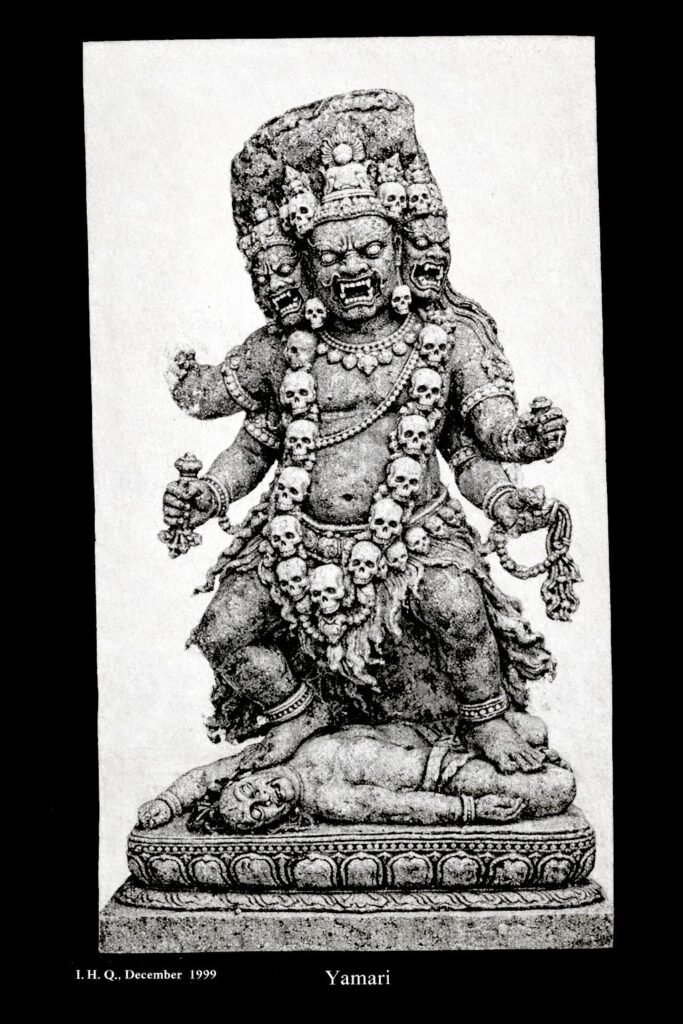
Figure 2: Digital reconstruction of the three-headed Yamāri statue from the district of Dacca (present-day Dhaka, Bangladesh), based on the photograph published by Niradbandhu Sanyal in Indian Historical Quarterly (1929).
According to the museum catalogue, the sculpture was initially described rather simply as a “four-armed figure,” and the identity of the deity was not clearly determined. However, upon examining the iconographic features of the object more carefully, Sanyal observed that the statue displayed several characteristics corresponding to the descriptions of Yamāri found in Tantric texts. Through comparison with textual sources such as the Sādhanamālā, he therefore proposed identifying the sculpture as a form of Yamāri or possibly Yamāntaka.
The statue exhibits the characteristic appearance of a wrathful deity in Vajrayāna art. The figure possesses a compact body with a prominent belly, a feature often described in tantric literature by the term mahodara. The face bears a fierce expression, with furrowed brows and protruding fangs, while the hair rises upward like flames. These features are not intended to represent ordinary violence but rather symbolize the powerful force of awakened wisdom confronting ignorance.
One of the most striking features of the sculpture is its three heads and six arms, an iconographic structure that appears in descriptions of Kṛṣṇa Yamāri in the Sādhanamālā. The additional heads are positioned on either side of the central face, forming a visual arrangement commonly found in Tantric art, where multiple heads often signify a transcendent capacity that surpasses ordinary perception. The six arms of the figure originally held various ritual implements, although some of these details have been damaged over time. Nevertheless, elements such as the khadga (sword), the kapāla (skull cup), and threatening mudrā gestures can still be recognized—symbols that frequently appear in the iconography of wrathful deities.
The costume and ornaments of the statue also clearly reflect the stylistic language of Tantric art. The body of the deity is adorned with a garland of skulls that extends down to the knees, while serpents are used as necklaces and decorative bands around the body. Such elements commonly appear in wrathful figures of Vajrayāna and carry symbolic meanings related to the subjugation of death and ignorance. Particularly noteworthy is the presence of a small image of Akṣobhya—one of the Five Dhyāni Buddhas—on the crown of the figure. The inclusion of Akṣobhya in the iconography of Yamāri corresponds with descriptions found in Tantric texts and indicates that the deity is situated within the mandala system of Tantric Buddhism.
The posture of the statue is likewise rich in symbolic meaning. The figure stands in the pratyālīḍha-pāda stance, a warrior-like posture frequently found in Indian art and especially common in wrathful Vajrayāna iconography. In this position, the legs are spread apart with one knee slightly bent, creating a sense of dynamism and strength. Beneath the feet of the deity lies a corpse in a supine position, an iconographic detail of particular interest. In Tantric symbolism, the act of trampling a corpse is often interpreted as representing the triumph over ignorance and death.
At the same time, this detail also reveals an intriguing point when comparing textual descriptions with artistic representations. The descriptions of Yamāri in the Sādhanamālā do not always mention the deity standing upon a corpse. The presence of this feature in the Dacca sculpture therefore suggests that artists and religious communities may have adapted the iconography of the deity according to local ritual or symbolic traditions. Such differences make artistic artifacts valuable sources of evidence, as they reflect the ways in which religious symbols were interpreted and practiced within specific historical contexts.
When considered within the broader framework of Pāla art, the Yamāri statue from Dacca demonstrates the characteristic fusion of eastern Indian sculptural style with the symbolic language of Vajrayāna. Pāla art is renowned for its refined lines and the richness of its divine imagery, particularly in works associated with Tantric Buddhism. In this artistic environment, wrathful deities such as Yamāri were not merely mythological figures but vivid expressions of a religious tradition that was actively developing.
Thus, the Yamāri statue from Dacca not only provides a rare example of the iconography of this deity in Indian Buddhist art but also opens a window onto the development of wrathful traditions within Tantric Buddhism. When compared with descriptions preserved in Tantric texts, the artifact enables us to better understand how religious symbols were expressed and transformed within the artistic culture of the Pāla world.
V. Wrathful Forms as Pedagogical Means in Tantric Buddhism
While many images of Buddhas and Bodhisattvas in Buddhist art are typically portrayed with serene and peaceful expressions, the Vajrayāna tradition developed a different symbolic form: wrathful deities. These figures commonly appear with fierce faces, protruding fangs, hair rising like flames, and bodies adorned with skulls and serpents, often standing in dynamic or combative postures. For those encountering Buddhism from the outside, such images can appear striking and even seem to contradict the ideal of compassion usually associated with the Buddha’s teaching. Yet within the symbolic framework of Vajrayāna, wrathful forms are not expressions of anger in the ordinary sense but function as a form of upāya, or skillful means, intended to transform the negative forces of the world.
In Tantric Buddhism, many wrathful deities are understood as dynamic manifestations of Buddhas and Bodhisattvas. Rather than expressing the tranquil stillness of awakened wisdom, wrathful forms embody the powerful energy of wisdom confronting ignorance and obstacles. In this symbolic sense, the ferocity of these deities is not meant to intimidate or frighten practitioners but to represent the ability of wisdom to break through the bonds of delusion and attachment.
A prominent example of this principle is Vajrabhairava, also known as Yamāntaka, a wrathful deity regarded as a manifestation of the Bodhisattva Mañjuśrī. In Tibetan traditions, Yamāntaka is frequently depicted with multiple heads and arms, with the central head taking the form of a buffalo. This iconographic feature symbolizes the power to subdue Yama, the lord of death. The image expresses a fundamental idea in Tantric Buddhism: wisdom is not only a state of calm understanding but also a powerful force capable of overcoming the forces of ignorance and death.
In addition to Yamāntaka, numerous other wrathful figures appear within the symbolic universe of Vajrayāna. Among them is Mahākāla, an important protector deity in many Tibetan Buddhist traditions, often regarded as a wrathful manifestation of Avalokiteśvara or other Buddhas. Mahākāla is typically portrayed with a dark body, wide glaring eyes, and a garland of skulls, symbolizing the protection of the Dharma against destructive forces.
Another example is Vajrapāṇi, the Bodhisattva frequently depicted as a powerful protector wielding the vajra. In many Tantric traditions, Vajrapāṇi appears in wrathful form with a vigorous posture and holding the thunderbolt, representing the power to shatter ignorance. Other figures such as Heruka or Hevajra display even more complex wrathful forms, with multiple heads and arms, standing in dynamic postures surrounded by the flames of wisdom.
These wrathful forms are often collectively referred to as Dharmapālas, or protectors of the Dharma—figures whose role is to safeguard the Buddhist teaching and assist practitioners on the path. In many Tantric rituals, the visualization of wrathful deities is regarded as a method through which practitioners confront their own powerful emotions, such as fear, anger, or desire, and transform them into the energy of wisdom.
Within this symbolic framework, the figure of Yamāri may be understood as one of the early expressions of the wrathful deity tradition in Vajrayāna. The title “enemy of Yama” suggests that this deity embodies the power capable of subduing death and ignorance. When viewed alongside other wrathful figures of Vajrayāna, Yamāri no longer appears as an unusual or isolated figure but as part of a broader symbolic system in which wrathful forms function as powerful pedagogical instruments.
From this perspective, the ferocity of wrathful deities in Tantric Buddhism does not represent a rejection of the Buddhist ideal of compassion but rather another mode of expressing it. If the serene images of Buddhas and Bodhisattvas symbolize the tranquility of awakening, the wrathful forms represent the dynamic force of wisdom confronting the negative forces of the world. It is precisely through the integration of these two dimensions that the symbolic universe of Vajrayāna becomes rich and multifaceted.
VI. From Yamāri to Yamāntaka: The Transformation of a Wrathful Icon
When examining textual and artistic sources of Tantric Buddhism, it becomes evident that the relationship between Yamāri and Yamāntaka does not represent two entirely separate figures but rather reflects a process of symbolic development within the Vajrayāna tradition. In many Indian tantric texts, the two names are sometimes used almost interchangeably, and both are associated with a common symbolic theme: the victory of wisdom over death, represented through the subjugation of Yama, the lord of death.
From a semantic perspective, the similarity between the two names already suggests a close relationship between them. The name Yamāri means “the enemy of Yama,” while Yamāntaka can be understood as “the one who brings Yama to an end.” Both expressions convey the same symbolic idea: awakened wisdom possesses the power to transcend the authority of death. However, in the course of the development of Tantric traditions, this symbolic motif gradually expanded and transformed, eventually giving rise to the more elaborate iconography associated with Yamāntaka.
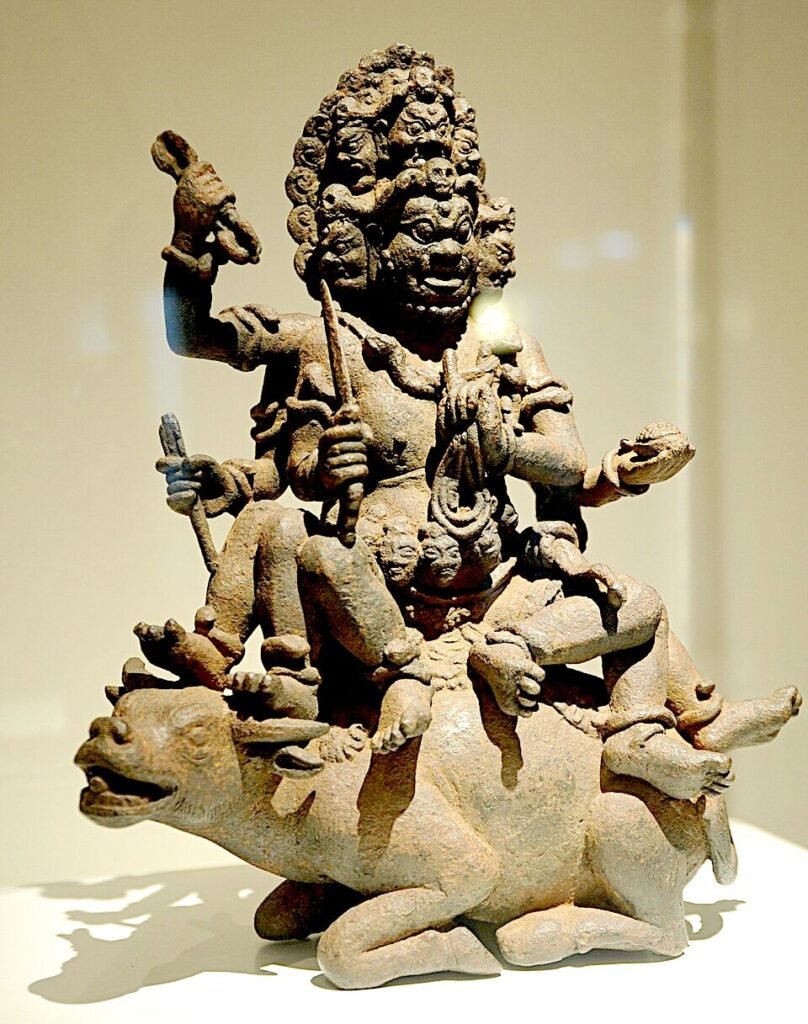
Figure 3: Yamāntaka (Vajrabhairava), the wrathful manifestation of Mañjuśrī, depicted with multiple heads and arms and riding a water buffalo. Tibetan Vajrayāna tradition. Source: Wikimedia Commons
One of the most notable differences between the two figures lies in their iconographic form. In Indian textual descriptions and artistic representations, Yamāri generally appears in relatively simpler forms, such as the three-headed and six-armed figure recorded in several sādhanā texts. By contrast, the representations of Yamāntaka that developed in later Tantric traditions—especially within Tibetan Buddhism—display far more complex iconographic structures. Well-known images of Yamāntaka in Tibetan art often feature numerous heads and arms, a buffalo head as the central face, and a dynamic posture surrounded by flames of wisdom while trampling figures symbolizing ignorance.
This difference reflects a broader process of symbolic evolution within the history of Vajrayāna. In the Buddhist environment of Pāla-period India, wrathful figures such as Yamāri emerged as part of a developing Tantric symbolic world. However, when these Tantric traditions were transmitted to the Himalayan regions and Tibet from around the eleventh century onward, many divine figures underwent processes of reinterpretation and expansion. During this transformation, figures such as Yamāntaka developed into complex mandala systems accompanied by elaborate rituals and symbolic structures.
An important factor in this transformation is the role of Mañjuśrī within Tantric Buddhism. In many tantric systems, Yamāntaka is regarded as a wrathful manifestation of Mañjuśrī, the Bodhisattva of wisdom. This interpretation emphasizes that awakened wisdom possesses not only a tranquil dimension but also a dynamic and forceful aspect capable of subduing the powers of ignorance and death. As these traditions evolved within Tibetan monastic settings, Yamāntaka came to occupy a central role in Tantric practices, particularly within traditions associated with Vajrabhairava.
Within this broader context, Yamāri may be understood as an earlier stage of this symbolic motif within Indian Tantric Buddhism. Descriptions of Yamāri in tantric texts and artistic representations from the Pāla period indicate a figure that already possessed many of the basic features of later wrathful deities. Nevertheless, the iconography of Yamāri remained comparatively simpler than the highly developed symbolic systems of Yamāntaka in Tibetan traditions.
The Yamāri statue from Dacca therefore carries particular significance for the study of the symbolic history of Vajrayāna. The artifact demonstrates that the basic motifs associated with the Yamāntaka tradition were already present within the Buddhist environment of India before they were fully elaborated in Himalayan Tantric traditions. When placed within the broader context of Vajrayāna art and literature, the statue can thus be interpreted as evidence of a transitional stage in the formation of wrathful figures connected with the wisdom of Mañjuśrī.
From the perspective of symbolic history, the transformation from Yamāri to Yamāntaka illustrates how divine figures within Tantric Buddhism could evolve and adapt as they were transmitted across different cultural environments. In this process, earlier images were often expanded, reinterpreted, and incorporated into new ritual systems. It is precisely this dynamic development that contributed to the rich symbolic universe of Vajrayāna, in which wrathful forms came to embody powerful expressions of awakened wisdom.
VII. Yamāri and the Symbolic History of Vajrayāna
The analyses presented in the preceding sections demonstrate that the figure of Yamāri occupies a noteworthy position within the symbolic universe of Indian Tantric Buddhism, even though the deity is far less widely known today than other famous wrathful figures such as Yamāntaka. Through an examination of tantric textual sources in conjunction with surviving artistic evidence, it becomes clear that Yamāri should not be understood as an isolated figure but rather as part of a broader symbolic tradition associated with wrathful manifestations of awakened wisdom.
First, Tantric texts such as the sādhanā materials preserved in the Sādhanamālā show that Yamāri was described as a wrathful deity with clearly defined iconographic characteristics, including multiple heads, multiple arms, and a range of symbolic ritual implements. These descriptions indicate that the image of Yamāri had already been integrated into the ritual system of Vajrayāna and may have played a role in the deity visualization practices of Tantric practitioners.
Second, the Yamāri statue from the region of Dacca provides rare material evidence for the existence of this cult within the Buddhist environment of eastern India during the Pāla period. When placed within the context of Vajrayāna art, the artifact demonstrates that wrathful figures had already become an important component of the religious symbolic world of the time. The statue not only reflects descriptions found in tantric texts but also illustrates how religious symbols were expressed through the sculptural traditions of the Pāla era.
Third, situating Yamāri within the broader context of wrathful figures in Vajrayāna helps clarify the symbolic meaning of this deity. In Tantric traditions, wrathful deities are often interpreted as dynamic manifestations of Buddhas and Bodhisattvas, expressing the power of wisdom confronting ignorance and negative forces. From this perspective, Yamāri may be understood as an expression of this broader symbolic principle within the Vajrayāna tradition.
Finally, the comparison between Yamāri and Yamāntaka reveals a process of symbolic development within the history of Tantric Buddhism. While Yamāri appears in Indian sources in relatively early iconographic forms, the representations of Yamāntaka that later emerged in Tibetan traditions developed into far more elaborate symbolic systems. This transformation reflects the dynamic nature of Vajrayāna as divine figures were transmitted across different cultural environments and reinterpreted within new religious contexts.
The study of Yamāri therefore not only sheds light on a relatively little-known figure in Buddhist art but also contributes to a broader understanding of the development of wrathful imagery in Vajrayāna. The statue from Dacca and the descriptions preserved in tantric texts suggest that the fundamental symbolic motifs associated with Yamāntaka already existed within the Buddhist environment of India before being fully elaborated in Tibetan Tantric traditions. In this sense, Yamāri may be regarded as an important link in the symbolic history of Vajrayāna, connecting the Tantric world of Pāla-period India with the later developments of Tantric Buddhism in the Himalayan regions.
Bibliography
Bhattacharyya, Benoytosh. The Indian Buddhist Iconography: Mainly Based on the Sādhanamālā and Other Cognate Tantric Texts of Rituals. 2nd ed. Calcutta: Firma K. L. Mukhopadhyay, 1958.
Bhattacharyya, Benoytosh, ed. Sādhanamālā. 2 vols. Baroda: Oriental Institute, 1925–1928.
Huntington, Susan L. The Art of Ancient India: Buddhist, Hindu, Jain. New York: Weatherhill, 1985.
Linrothe, Rob. Ruthless Compassion: Wrathful Deities in Early Indo-Tibetan Esoteric Buddhist Art. Boston: Shambhala, 1999.
Pal, Pratapaditya. Art of Tibet: A Catalogue of the Los Angeles County Museum of Art Collection. Berkeley: University of California Press, 1983.
Pal, Pratapaditya. Indian Sculpture: Circa 500 B.C.–A.D. 700. Berkeley: University of California Press, 1974.
Sanyal, Niradbandhu. “A Three-Headed Statue of Yamāri from the District of Dacca.” Indian Historical Quarterly 5 (1929): 641–645.
Snellgrove, David L. Indo-Tibetan Buddhism: Indian Buddhists and Their Tibetan Successors. 2 vols. Boston: Shambhala, 1987.
Williams, Paul. Mahayana Buddhism: The Doctrinal Foundations. 2nd ed. London: Routledge, 2009.