Sacred Texts & Interpretation

This section is devoted to close readings of Buddhist scriptures and other sacred texts across early Nikāya traditions and later Mahāyāna sources, alongside commentarial literature and historical narratives.

Rather than approaching these texts as static records, the essays engage them as dynamic fields of meaning—where language, doctrine, and contemplative insight reveal the unfolding structure of experience from within.

Through careful interpretation and philosophical reflection, each reading seeks not only to clarify textual meaning, but to illuminate how understanding itself arises in relation to the text.

early buddhist methodology kalama apannaka suttas

Early Buddhist Methodology through the Kālāma and Apannaka Suttas

Rather than asking people to accept teachings on authority, the Kālāma Sutta and the Apannaka Sutta reveal a deeper methodological approach within early Buddhism. Together they outline a practical framework for navigating doctrinal uncertainty—combining critical evaluation of beliefs with ethical prudence in action, and thereby laying the foundation for the formation of right view.

Early Buddhist Methodology through the Kālāma and Apannaka Suttas Read More »

kukkuravatika sutta go board destiny interruption zen

When Habit Becomes Destiny: Re-reading the Kukkuravatika Sutta

The Kukkuravatika Sutta is often remembered for its strange account of ascetics imitating dogs and cows. Yet beneath this unusual narrative lies a profound analysis of how repeated habits gradually solidify into identity and destiny. At the same time, the discourse reveals a radical possibility: when repetition ceases, the structure that sustains destiny can dissolve.

When Habit Becomes Destiny: Re-reading the Kukkuravatika Sutta Read More »

first precept refraining from killing ten wholesome actions

The Ten Wholesome Actions in Early and Mahāyāna Buddhism: A Structural and Doctrinal Comparison

This study compares the Sāleyyaka Sutta (MN 41) and the Ten Wholesome Actions Sūtra to examine how a shared 3–4–3 ethical structure is preserved yet differently positioned within distinct soteriological horizons. While early Buddhism emphasizes linear karmic causality culminating in arahantship, the Mahāyāna text expands the same ethical foundation toward the ideal of Buddhahood. The divergence lies not in the ethical catalogue itself, but in its interpretive and doctrinal horizon.

The Ten Wholesome Actions in Early and Mahāyāna Buddhism: A Structural and Doctrinal Comparison Read More »

vammika sutta buddha meditation ant hill dawn

Sudden Awakening and Structural Maturation: Rethinking the Vammika Sutta

Is sudden awakening truly unconditioned, or does it culminate a structural process unfolding beneath experience? Rereading the Vammika Sutta (MN 23), this study distinguishes phenomenological rupture from structural maturation. The repeated act of “digging” dismantles conditions sustaining defilement rather than revealing a hidden essence. When the final condition ceases, the method itself falls silent. Suddenness, therefore, is not the denial of structure but the collapse of a dependently arisen configuration—an insight that reframes the sudden–gradual debate within the logic of dependent origination and emptiness.

Sudden Awakening and Structural Maturation: Rethinking the Vammika Sutta Read More »

residual karma water droplet buddhist causality

Residual Retribution and the Completion of Karma in The Sūtra on the Arising of Karmic Actions (佛說興起行經, T0197)

This article explores the concept of residual retribution (yúyāng, 餘殃) in The Sūtra on the Arising of Karmic Actions (T0197) and argues that the text does not endorse fatalism. Although the Buddha continues to experience bodily pain and adversity after awakening, such events are not rebirth-producing karma but the final completion of past causal conditions.

By distinguishing between generative karma and residual retribution, the study shows that awakening does not abolish causality but ends its reproduction. What ceases is the creation of new karmic chains; what remains is the closure of previously activated conditions. Liberation, therefore, is not freedom from conditions but freedom within their completion.

Residual Retribution and the Completion of Karma in The Sūtra on the Arising of Karmic Actions (佛說興起行經, T0197) Read More »

siddhartha great renunciation anoma river hero image

Redefining Heroism in the Buddhacarita

This study argues that the Buddhacarita does not abandon the classical Indian model of epic heroism but transforms it from within. By relocating the battlefield from the external world to the interior domain of consciousness, Aśvaghoṣa redefines conquest as self-mastery and sovereignty as freedom from conditioning. Heroism is not negated; it is refined into awakening. Through this symbolic revaluation, the poem participates in a broader cultural shift in ancient India concerning the meaning of greatness and power.

Redefining Heroism in the Buddhacarita Read More »

faith in buddha longhu banner t01n0018 hero

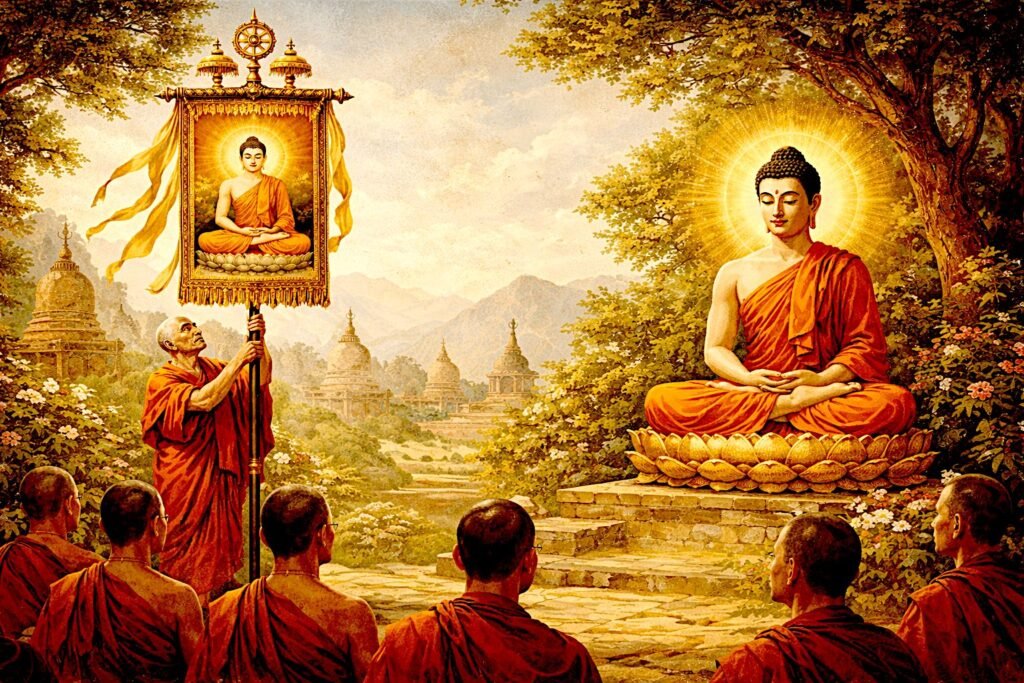
Faith in the Buddha and the Transformation of Cognition: A Reading of the Sūtra on the Merit of Faith in the Buddha (T01n0018)

Faith in the Sūtra on the Merit of Faith in the Buddha (T01n0018) does not emerge as devotional sentiment, but as an inward movement of cognition. Through the dialogue between Śāriputra and the Buddha, the text shows that faith arises when personal understanding recognizes its own limits and opens itself to perfected liberating wisdom. At the same time, the Tathāgata’s refusal of public glorification protects faith from sliding into mythic exaltation. This article rereads the sūtra as a subtle inquiry into the structure of faith: not a suspension of thought, but a reconfiguration of thought around the normative horizon of the Dharma and the cessation of suffering.

Faith in the Buddha and the Transformation of Cognition: A Reading of the Sūtra on the Merit of Faith in the Buddha (T01n0018) Read More »

pure land trinity

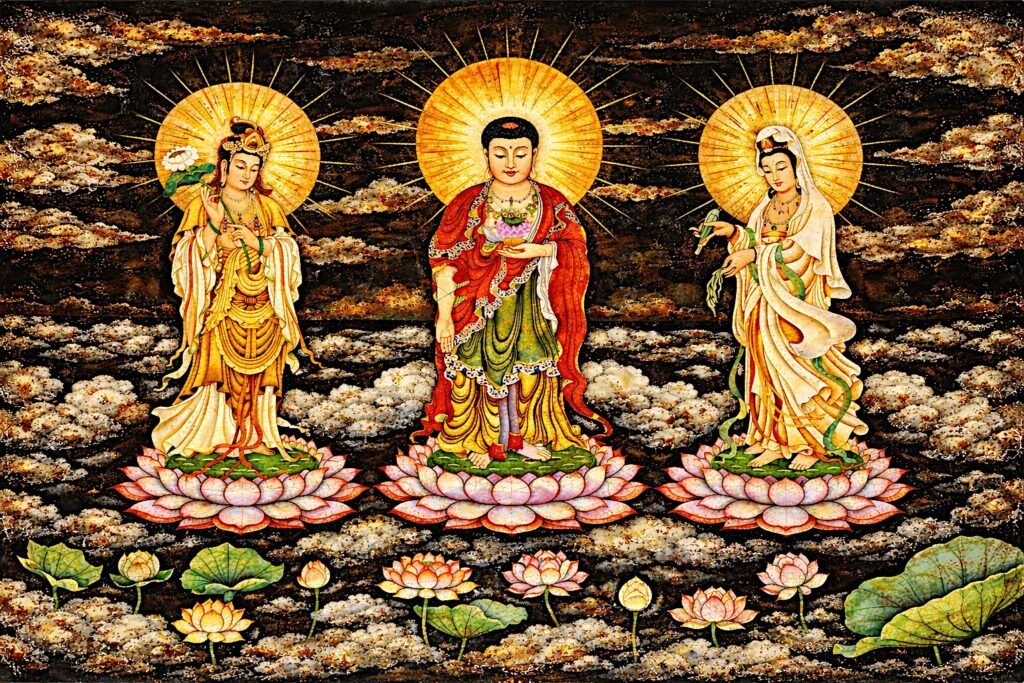
Recollection of the Buddha: From the Theravāda Tradition to Pure Land Buddhism

This article traces the development of recollection of the Buddha from Theravāda Buddhānussati and the eleven contemplations of T.791 to its systematization in Pure Land Buddhism. It argues that these forms represent not doctrinal rupture, but structural expansion. Whether through epithets, ethical contemplation, or visualization of a pure realm, recollection functions as a cognitive axis that gathers and transforms consciousness around the model of awakening.

Recollection of the Buddha: From the Theravāda Tradition to Pure Land Buddhism Read More »

seed and vow amitabha thousand buddhas

Seed and Vow: Hearing the Sacred Name in Pure Land and the Thousand Buddhas Sutra

In Mahāyāna thought, to hear the Name of a Buddha is not merely to register a sound. It can function either as a seed that imprints karmic continuity across immeasurable kalpas or as an invocation that opens a salvific relation with a fulfilled vow. By comparing these two metaphysical logics—seed and vow—this study argues that sacred sound possesses ontological density. Hearing is not passive reception but participation in dependent origination. A finite moment of listening may thus initiate an infinite horizon of awakening.

Seed and Vow: Hearing the Sacred Name in Pure Land and the Thousand Buddhas Sutra Read More »

bodhidharma lankavatara sutra transmission

From the Laṅkāvatāra Sūtra to Mind-Seal Transmission: The Epistemological Structure of Early Chan Buddhism

This paper offers a structural reading of the relationship between the Laṅkāvatāra Sūtra and early Chan Buddhism. Rather than treating Chan as a rejection of scripture, it argues that the sūtra’s deconstruction of subject–object duality, its critique of linguistic reification, and its account of parāvṛtti already prepare the ground for Chan’s emphasis on direct realization. The Chan “mind-seal” thus appears not as esoteric transmission, but as the confirmation of a transformed mode of cognition. Text and direct experience emerge as two moments within a single epistemic movement.

From the Laṅkāvatāra Sūtra to Mind-Seal Transmission: The Epistemological Structure of Early Chan Buddhism Read More »