

Sacred Texts & Interpretation

This section is devoted to close readings of Buddhist scriptures and other sacred texts across early Nikāya traditions and later Mahāyāna sources, alongside commentarial literature and historical narratives.

Rather than approaching these texts as static records, the essays engage them as dynamic fields of meaning—where language, doctrine, and contemplative insight reveal the unfolding structure of experience from within.

Through careful interpretation and philosophical reflection, each reading seeks not only to clarify textual meaning, but to illuminate how understanding itself arises in relation to the text.

samadhiraja merit without self

From Structured Merit to Non-Conceptual Giving: Reconfiguring Soteriology in the Samādhirāja Sūtra

In the Samādhirāja Sūtra, merit and emptiness are not opposing doctrines but coexisting dimensions of a single act. Chapter 27 affirms the clear causal efficacy of generosity: actions produce tangible benefits and shape the path of awakening. Yet Chapter 32 declares that all dharmas are without inherent existence, dissolving the triadic structure of giver, gift, and recipient. Rather than negating merit, this insight transforms it. Generosity does not cease; it is purified of appropriation. What disappears is not action, but the claim of ownership over action. The sūtra thus presents an early Mahāyāna reconfiguration of soteriology: liberation is neither infinite accumulation nor withdrawal from causality, but the functioning of action without a center of possession.

From Structured Merit to Non-Conceptual Giving: Reconfiguring Soteriology in the Samādhirāja Sūtra Read More »

formlessness one vehicle bodhi tree

From Formlessness to the One Vehicle: Unity and Plurality in the Mahāyāna Sutra of Innumerable Meanings

The Mahāyāna Sutra of Innumerable Meanings unfolds a vision in which diversity arises from emptiness without collapsing into fragmentation. From the insight that “innumerable meanings arise from one dharma,” the sutra traces a movement from emptiness to multiplicity and toward the One Vehicle. Unity here does not erase difference; it reveals a shared ground beneath it. Read in this light, the text becomes more than doctrine: it offers a way of thinking — flexible yet grounded, open yet ethically oriented toward the transformation of suffering.

From Formlessness to the One Vehicle: Unity and Plurality in the Mahāyāna Sutra of Innumerable Meanings Read More »

house builder dhammapada

The “House-Builder” in the Dhammapada: A Process-Oriented Reinterpretation of Ignorance and Craving

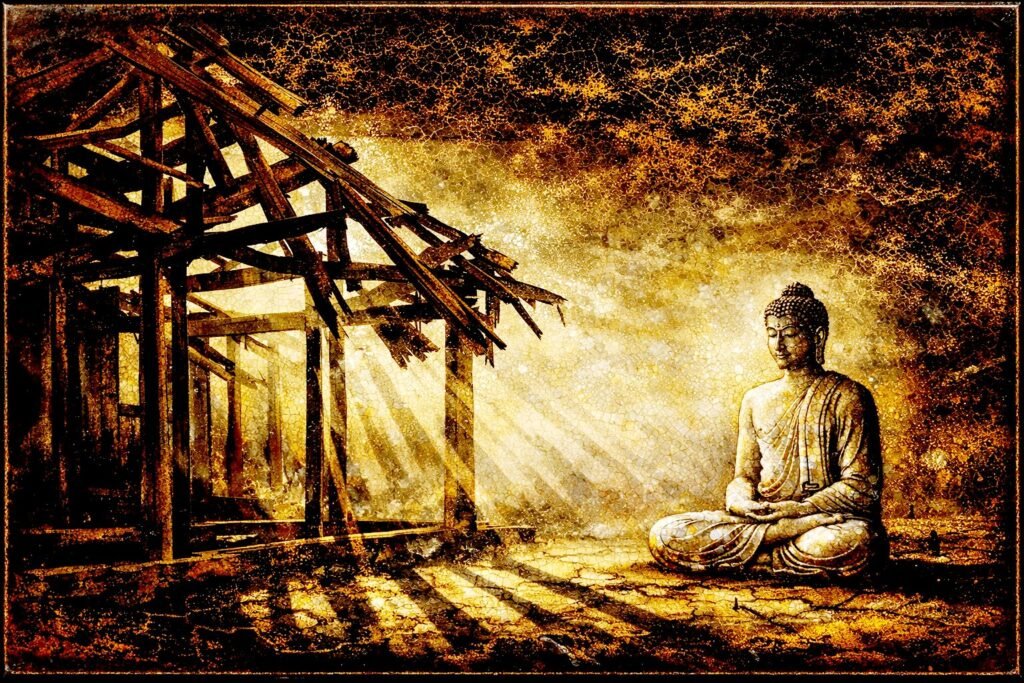
The “house-builder” in the Dhammapada is traditionally identified with ignorance and craving, the psychological causes of rebirth. Yet a closer reading of the Pāli verses raises a question: can such states truly “build” anything? Returning to the language and internal logic of the metaphor, this essay argues that what constructs existence is not a hidden entity but an ongoing karmic process. Liberation, accordingly, is not the defeat of an inner enemy, but the clear seeing of an impersonal mechanism whose cessation leaves nothing to rebuild.

The “House-Builder” in the Dhammapada: A Process-Oriented Reinterpretation of Ignorance and Craving Read More »